Relocating to Germany as an EU/EEA Citizen: Registration and Work Rights (No Visa Needed)
Thinking that holding an EU passport makes moving to Germany a breeze is a trap many newcomers fall into, leading to missed tax deadlines and illegal unregistered stays. I arrived from Spain assuming my ID card was all I needed, only to face a wall of mandatory registrations. This guide explains how to legally establish your residency and work rights without a visa.
Disclosure: This post may contain affiliate links. We may earn a commission at no extra cost to you if you make a purchase through these links. Read full disclosure.
The Reality of Freedom of Movement for EU Citizens
What Freedom of Movement Actually Means
The European Union’s Freedom of Movement directive is a profound privilege. If you are a citizen of an EU or EEA member state, or Switzerland, you have the fundamental right to enter, live, work, and study in Germany without ever applying for a visa or a residence permit. You are not subjected to the strict salary thresholds of the Blue Card or the bureaucratic hurdles of finding a sponsored employer before crossing the border. You simply book a flight or drive across the border with your national ID card or passport.
However, “no visa” does not mean “no rules.” Many EU citizens mistakenly believe that freedom of movement is a free pass to ignore local laws and administrative requirements. While you can bypass the immigration authorities (the Ausländerbehörde) for your own arrival, you are still fully subject to the strict civil and tax regulations of the German state. Moving to Germany from France or Italy is legally more akin to moving between states in the US, but with the added complexity of entirely different healthcare, taxation, and administrative systems.
You are expected to integrate into the German system just like any other resident. This means paying taxes, contributing to the social security system, and adhering to mandatory local registration laws. If you fail to do so, your presence in Germany, while not inherently illegal under immigration law, will result in massive fines from the tax office and public broadcasting authorities. If you want to understand how your status compares to non-EU expats, read our Moving to Germany: Comprehensive Visa & Immigration Guide.
The Three Month Rule and Your Legal Status
For the first three months of your stay in Germany, you are essentially treated as a tourist. During this period, you do not need to justify your presence to anyone. You can travel, visit friends, look for an apartment, or attend job interviews using only your valid EU passport or national ID card. There are absolutely no conditions attached to your stay during this initial 90-day window.
The legal landscape shifts dramatically after three months. Under the EU Freedom of Movement Act, to maintain your legal right of residence beyond 90 days, you must fulfill at least one specific condition. You must be employed, self-employed, enrolled as a student, or actively looking for work with a reasonable prospect of finding it. Alternatively, if you are not working or studying (for example, if you are a retiree or a financially independent individual), you must prove you have sufficient financial resources to support yourself and comprehensive health insurance coverage.
While Germany rarely deports EU citizens, failing to meet these criteria means you technically lose your right to freedom of movement in the country. If the local authorities discover you are destitute and lacking health insurance after a year of living in Berlin, they can legally ask you to leave, as you would be considered an undue burden on the German social assistance system.
Dispelling the No Bureaucracy Myth
The biggest culture shock for EU expats is the realization that avoiding the visa office does not mean avoiding German bureaucracy. Germany runs on paper, physical stamps, and mailed letters. Simply arriving in the country does not automatically put you in the system, nor does it allow you to start a job or sign a long-term lease without fulfilling foundational administrative steps.
Many EU citizens arrive assuming they can just find a job, sign a contract, and figure out the rest later. This is a myth. German employers cannot correctly tax your pay without a German Tax Identification Number (Steuer-ID), which you cannot get without an official registered address, which you cannot get without a specific document from a landlord. It is a rigid, interconnected loop of paperwork that catches many Europeans off guard.
Understanding the chronological order of these administrative hurdles is vital. You cannot tackle them simultaneously; you must conquer them sequentially. Being an EU citizen removes the anxiety of getting a visa denied, but it does not exempt you from the weeks of waiting for appointments and mailing physical forms that define the German expat experience.
Navigating the Mandatory Address Registration
Booking the Elusive Bürgeramt Appointment
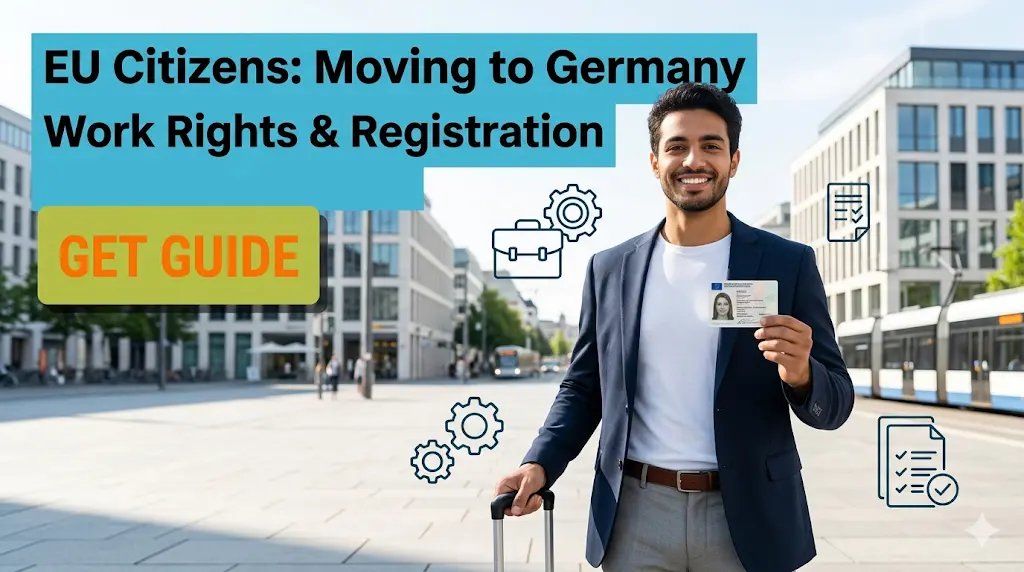
The absolute foundation of your life in Germany is the Anmeldung, or address registration. Every single person who moves into a residence in Germany—whether they are a German citizen, an EU citizen, or a third-country national—is legally required to register their address at the local citizens’ office (Bürgeramt) within 14 days of moving in.
Because you do not need a visa, the Anmeldung is the very first official record of your existence in Germany. Booking this appointment in major cities like Berlin, Munich, or Frankfurt is notoriously difficult. The online booking portals are often fully booked for months. You will likely have to wake up at 6:00 AM to refresh the local city portal in hopes of catching a canceled appointment slot for that same day. For a detailed walkthrough of this process, consult our Registering Your Address (Anmeldung): Step-by-Step Guide.
Do not skip this step just because the appointments are hard to find. Without your Anmeldung certificate (Meldebescheinigung), you cannot open a standard German bank account, sign up for a traditional internet contract, get your tax ID, or even register a library card. It is the golden ticket to unlocking daily life.
The Wohnungsgeberbestätigung Explained
You cannot simply walk into the Bürgeramt and claim you live somewhere. The German government requires physical proof in the form of a Wohnungsgeberbestätigung (landlord’s confirmation). This is a specific, signed form from the owner or primary tenant of your apartment stating that you actually moved in on a specific date.
This requirement is what makes finding initial accommodation so difficult for expats. If you are staying in an Airbnb, a hotel, or sleeping on a friend’s couch informally, you generally cannot get this document. Many people attempt to buy “fake” registrations or pay friends to sign the document without actually living there. This is a severe administrative offense that carries heavy fines.
When searching for a temporary furnished apartment or a flatshare (WG), your first question to the landlord must always be, “Is Anmeldung possible?” If they say no, it means they are likely sub-letting illegally or hiding rental income from the tax office. Do not rent these places, as it will completely block your ability to establish your legal and financial life in Germany.
What to Expect During Your Address Registration
When the day of your appointment finally arrives, the process itself is usually quite fast, taking only about ten minutes. You must bring your valid EU passport or national ID card, the completed registration form, and the signed Wohnungsgeberbestätigung from your landlord.
Be prepared for the fact that the clerk at the Bürgeramt may not speak English. While some are accommodating, many stick strictly to German due to legal liability rules regarding official documents. It is highly recommended to bring a German-speaking friend if your language skills are not up to par.
Once processed, the clerk will print out your Meldebescheinigung and hand it to you. Keep this physical piece of paper incredibly safe. It is your ultimate proof of residency. You will be asked to present it constantly over the next few months as you set up your life. To understand how this document interacts with other systems, review our guide on Anmeldung (Address Registration) vs Visa: Why Both Are Needed in Germany.
Health Insurance Requirements for EU Nationals
The Limitations of the European Health Insurance Card
As an EU citizen, you likely possess a European Health Insurance Card (EHIC). Many expats assume they can just rely on this card indefinitely while living in Germany. This is a dangerous misunderstanding of how the EU healthcare coordination system works.
The EHIC is strictly designed for temporary stays—like holidays, short business trips, or temporary study exchanges. It covers emergency medical care and necessary treatments to allow you to continue your trip. It is not a substitute for full health insurance in the country where you actually reside. If you try to use your EHIC for routine check-ups, dental cleanings, or chronic care management while living in Germany long-term, the German doctors will either reject it or bill your home country, which will eventually figure out you have moved and cancel your coverage.
Once you register your address in Germany (Anmeldung) or sign a German employment contract, you are legally considered a resident. At this exact moment, you fall under the German legal mandate requiring comprehensive local health insurance. Continuing to use your foreign EHIC while officially residing and working in Germany is a violation of this mandate. To fully grasp these limitations, read about the European Health Insurance Card (EHIC): Using It in Germany and Abroad.
Transitioning to the German Healthcare System
Transitioning from your home country’s healthcare to the German system must be done quickly to avoid back-payments, as German insurance companies will often charge you retroactively to the date you officially registered your address. The easiest path is entering the public statutory health insurance system (Gesetzliche Krankenversicherung or GKV), which covers around 90% of the population.
Setting this up can be tricky if you do not speak German. This is where utilizing a service like Expatrio is incredibly helpful for EU citizens. Even though you do not need their visa services, you can use Expatrio to digitally set up your public health insurance (usually with TK) before you even arrive in the country. Expatrio streamlines the application process entirely in English.
Furthermore, Expatrio allows you to bundle this health insurance setup with opening a German bank account. Since you will inevitably need a German IBAN to pay your rent and receive your salary, handling both your health insurance and banking through Expatrio in one fell swoop saves you weeks of navigating clunky, German-only banking and insurance websites.
Choosing Between Public and Private Coverage
If you are a high-earning employee or a freelancer, you have the right to opt out of the public system and choose private health insurance (Private Krankenversicherung or PKV). This is a massive, lifelong financial decision that should not be taken lightly.
| Feature | Public Health Insurance (GKV) | Private Health Insurance (PKV) |
| Cost Basis | Income-based (approx. 14.6% of gross salary) | Risk-based (age, health history, coverage level) |
| Family Coverage | Non-working spouse & kids covered for free | Everyone needs their own paid policy |
| Billing | Card swipe; doctor bills insurance directly | You pay upfront, then claim reimbursement |
| Doctor Access | Access to all public doctors | Shorter wait times; access to private-only specialists |
Navigating this choice is complex, which is why turning to specialized brokers like Feather Insurance is highly recommended. Feather Insurance caters specifically to expats and offers unbiased advice in English regarding whether you should choose public or private. When I transitioned to freelance work, I used Feather Insurance to evaluate my options, and their team helped me realize that staying in the public system was safer for my specific family situation. Using Feather Insurance ensures you do not accidentally sign a private contract that traps you with exorbitant premiums in your old age. For a deeper financial breakdown, see Health Insurance in Germany: Choosing Public vs Private (Financial Perspective).
Working and Paying Taxes in Germany
Securing Your Tax Identification Number
As an EU citizen, your right to work is absolute, but your ability to get paid depends entirely on the tax office (Finanzamt). To be placed on a German payroll, you need an 11-digit Tax Identification Number (Steuer-Identifikationsnummer or Steuer-ID).
The good news is that generating this number is an automatic process. When you complete your Anmeldung at the Bürgeramt, their system automatically notifies the Federal Central Tax Office. The tax office will then generate your unique Steuer-ID and mail it to your newly registered German address via physical post. This usually takes two to four weeks.
If your employer demands your tax ID before the letter arrives, do not panic. Explain that you have just registered your address and are waiting for the post. In the interim, they will likely place you in Tax Class 6 (the highest taxation bracket) for your first paycheck. Once you hand them your Steuer-ID, your tax class will be corrected, and the overpaid taxes will be refunded in your next paycheck. For a comprehensive overview of this system, read Understanding Taxes in Germany: An Expat’s Guide to the German Tax System.
Employment Contracts and Social Security Contributions
When you sign a German employment contract, you are entering a highly regulated, worker-friendly environment. German contracts strictly define your working hours, vacation days (a legal minimum of 20 days for a 5-day work week, though 28-30 is standard), and a mandatory probationary period (Probezeit) which usually lasts six months.
Your gross salary will look significantly different from your net salary. Germany has a robust social security system, and contributions are split almost evenly between you and your employer. Every month, roughly 20% of your gross salary will be automatically deducted to cover health insurance, pension insurance, unemployment insurance, and long-term care insurance.
Understanding your payslip is crucial to ensuring you are being taxed correctly based on your marital status and religion (Germany levies a church tax on registered members of specific faiths). Do not let the heavy deductions shock you; these contributions fund the safety nets that make living in Germany secure. You can decode these deductions by reading Understanding Your German Payslip: Gross vs Net Salary Explained.
Setting Up Your Freelance Business as an EU Citizen
If you intend to work as a freelancer (Freiberufler) or start a business (Gewerbe), being an EU citizen makes the process exponentially easier. You do not have to submit a business plan to the immigration office or prove your business will positively impact the German economy, which is required for non-EU nationals.
However, you still must register your business with the local authorities. If you are a freelancer in a catalog profession (like an artist, writer, doctor, or consultant), you register directly with the tax office by filling out the Fragebogen zur steuerlichen Erfassung (Tax Registration Questionnaire). If you are opening a commercial trade or a shop, you must first register with the trade office (Gewerbeamt).
Filling out the tax registration questionnaire is notoriously complex, as it asks for detailed estimates of your future income and profit to determine your advance tax payments. It is highly advisable to consult an English-speaking tax advisor (Steuerberater) to help you navigate this step to avoid massive tax bills at the end of the year. For more specific steps, check out Freelancing in Germany: How to Register as a Freelancer (Freiberufler).
Bringing Non-EU Family Members to Germany
The EU Freedom of Movement Directive for Dependents
One of the most powerful but overlooked benefits of holding an EU passport is how it protects your non-EU family members. If you are a Spanish citizen married to a Mexican citizen, and you both move to Germany, your spouse does not fall under standard German immigration laws for family reunification. They fall under the EU Freedom of Movement directive.
This is a massive advantage. Under German law, a non-EU citizen marrying a German citizen often has to prove basic German language skills (A1 level) just to get a visa. Under EU law, your non-EU spouse does not need to speak a single word of German to join you. Furthermore, they are immediately granted unrestricted access to the German labor market the moment their paperwork is processed.
This rule applies to spouses, registered civil partners, and dependent children under the age of 21. If you are moving to Germany with family, understanding this legal distinction will save you thousands of euros and months of stress. You can explore the differences in our guide on Family Reunification in Germany: Ultimate Guide for Bringing Your Loved Ones.
Translating and Legalizing Marriage and Birth Certificates
While the rules are favorable, the bureaucracy is still rigid. To prove your relationship to the German authorities, you must provide official civil documents, such as your marriage certificate or your children’s birth certificates. If these documents were issued outside of Germany (and especially if they are not standard multilingual EU documents), they must be translated into German.
You cannot simply translate these documents yourself, nor can you use an uncertified translation agency. The German Ausländerbehörde will only accept certified translations completed by sworn translators legally recognized in Germany. This is an area where utilizing Lingoking is absolutely essential. Lingoking connects you directly with sworn translators who attach the necessary official seals to your documents.
Do not risk delays by trying to find cheap alternatives. I once had a crucial civil document rejected because the translator lacked the proper German court certification, delaying a family member’s registration by two months. Once I switched to Lingoking, the certified translations were accepted immediately without question. Furthermore, if your documents are from outside the EU, ensure they have the proper Apostille legalization before you send them to Lingoking for translation. For a full breakdown, read Legalizing and Translating Documents for German Visa Applications.
Applying for the Residence Card for Family Members
If your non-EU spouse holds a passport that requires a Schengen visa to enter Germany (e.g., India, Philippines), they must apply for an entry visa at the German embassy in their home country, specifically stating they are joining an EU citizen. This visa is usually processed faster and free of charge. If they do not need a Schengen visa (e.g., USA, Brazil), they can travel with you directly.
Once you arrive in Germany, you both must complete the Anmeldung together. After your address is registered, your non-EU family member must book an appointment at the Ausländerbehörde to apply for their physical residence card, known as the Aufenthaltskarte (Residence Card for family members of EU citizens).
At this appointment, you will need to present your passports, your translated marriage/birth certificates (via Lingoking), your Anmeldung certificate, and proof that you (the EU citizen) are exercising your freedom of movement (e.g., your employment contract, or proof of funds and Feather Insurance health coverage if you are not working). Once issued, this card is valid for five years and grants them the legal right to live and work alongside you in Germany.
References
Primary sources (official)
- Federal Ministry of the Interior and Community (BMI) – EU Freedom of Movement: https://www.bmi.bund.de/EN/topics/migration/law-on-foreigners/freedom-of-movement/freedom-of-movement-node.html
- Federal Office for Migration and Refugees (BAMF) – Immigrants from the EU: https://www.bamf.de/EN/Themen/MigrationAufenthalt/ZuwandererEuropa/zuwanderereuropa-node.html
Other helpful sources
- Your Europe (Official EU Portal) – Residence rights for workers: https://europa.eu/youreurope/citizens/residence/residence-rights/workers/index_en.htm
- Make it in Germany (Official Portal) – EU Citizens: https://www.make-it-in-germany.com/en/visa-residence/eu-citizens
Disclaimer
The information provided in this guide is for general informational purposes only and is based on the real-world experiences of expats navigating the German administrative system. Laws regarding EU freedom of movement, address registration, taxation, and health insurance are complex and subject to change. This article does not constitute legal, financial, or tax advice. Always consult the official websites of the Bürgeramt, the Finanzamt, or a certified legal or tax professional in Germany to ensure you are fully compliant with all current laws regarding your specific situation.