Health Insurance in Germany: Choosing Public vs Private (Financial Perspective)
Navigating the German healthcare system requires understanding the critical financial distinctions between public and private health insurance. This comprehensive guide breaks down the costs, long-term implications, and strategic considerations to help expats make the best financial decision for their circumstances.
Disclosure: This post may contain affiliate links. We may earn a commission at no extra cost to you if you make a purchase through these links. Read full disclosure.
Understanding the German Healthcare System’s Financial Framework
The Statutory Health Insurance (GKV) Model
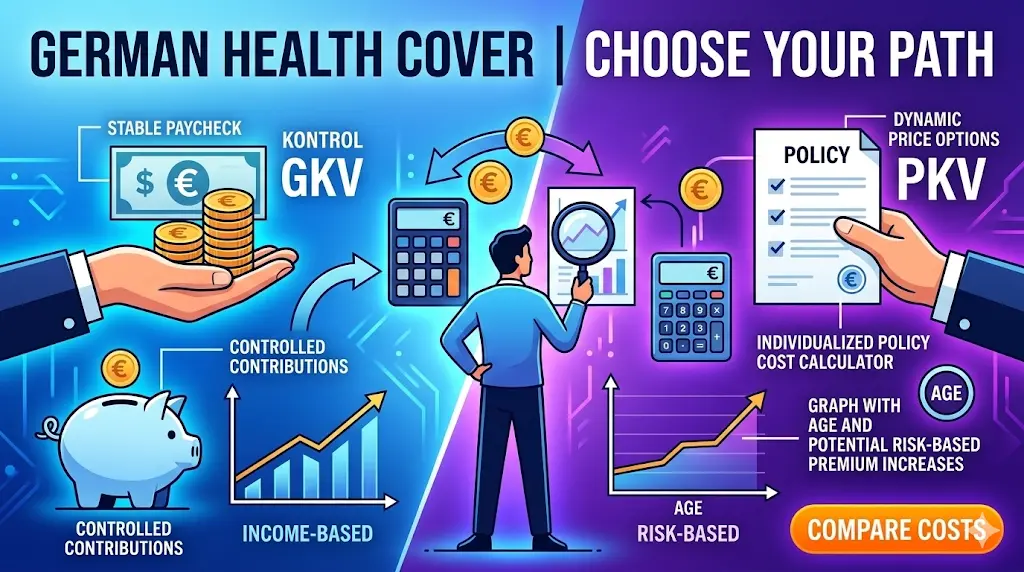
The bedrock of the German healthcare system is the Gesetzliche Krankenversicherung (GKV), commonly known as statutory or public health insurance. This system operates on the principle of solidarity, meaning that the financial framework is based entirely on the insured individual’s income, rather than their age, health status, or individual risk factors. Currently, approximately ninety percent of the German population is insured under this public scheme, creating a massive, highly regulated risk pool that stabilizes costs across the board. The fundamental philosophy here is that stronger, wealthier members of society financially support those who are more vulnerable, ensuring equitable access to high-quality medical care for everyone.
In practice, this means that the costs are shared proportionally based on what you earn. The system redistributes wealth within the healthcare sector so that a high-earning corporate executive and a minimum-wage worker receive the exact same standard of basic medical care, regardless of the vast difference in their monthly financial contributions. To keep the system fair and prevent infinite taxation on high earners, the government implements a contribution assessment ceiling (Beitragsbemessungsgrenze). Once your income surpasses this specific threshold, your public health insurance contributions are capped, and any additional income you earn is not subject to further health insurance deductions.
Consider a practical example of how this affects expats. If an expat moves to Germany and earns a modest starting salary, their monthly deduction will be relatively low. If another expat arrives with a lucrative senior management contract, their deduction will be significantly higher, up to the legal cap. Despite this financial disparity, if both expats require an emergency appendectomy, they will be placed in similar hospital wards, treated by similar doctors, and receive identical postoperative care. Understanding this solidarity principle is the first step in Healthcare in Germany: A Comprehensive Guide for Expats. The financial predictability of this model is a massive draw for those who prioritize stability. For further details on exact coverages, expats often refer to resources detailing Public Health Insurance (gesetzliche Krankenkasse): What It Covers and Costs.
The Private Health Insurance (PKV) Model
In stark contrast to the public system, the Private Krankenversicherung (PKV), or private health insurance, operates on the equivalence principle. In this model, premiums are calculated based on your individual risk profile rather than your income. When applying for private health insurance, the insurance provider will look at your age upon entry, your current health status, any pre-existing medical conditions, and the specific level of coverage you wish to purchase. Because the premium is tailored to your unique demographic and physical state, the financial dynamics are entirely different from the public solidarity model.
The private system in Germany functions much like standard health insurance in purely privatized global markets, such as the United States, but with strict local regulations overseen by authorities like BaFin. You are essentially paying for a customized menu of benefits. If you want a guaranteed single room during hospital stays, treatment exclusively by the chief physician (Chefarztbehandlung), or premium dental implant coverage, you add these modules to your policy, and your premium increases accordingly. Because the system is risk-based, applicants must undergo a rigorous health questionnaire and sometimes a medical examination before being accepted. Any undisclosed conditions can lead to retroactive cancellation of the policy.
The financial barrier to entry and the allure of early savings make the private system a complex topic for newcomers. Not everyone is legally permitted to simply opt for private insurance; you must meet specific criteria. However, for those who do qualify—such as a young, healthy, twenty-something expat with no pre-existing conditions—the initial monthly premiums in the private system can be significantly lower than what they would be forced to pay into the public system based on a high salary. This creates an immediate, highly attractive short-term financial incentive.
Mandatory Coverage and Financial Thresholds (JAEG)
One of the most critical legal and financial realities expats must grasp is that health insurance is strictly mandatory for all residents in Germany. You cannot simply opt out of the system entirely to save money, nor can you rely solely on standard travel insurance if you are a registered resident. If you arrive in Germany as a regular salaried employee, you are automatically and compulsorily enrolled in the public health insurance system by default, unless your income exceeds a very specific, government-mandated financial threshold.
This threshold is known as the Versicherungspflichtgrenze, or the annual earnings limit (Jahresarbeitsentgeltgrenze – JAEG). For 2026, this gross annual salary requirement is 77,400 EUR. If your regular gross annual income from employment is below this figure, you have no choice: you must remain in the public health insurance system. If your income exceeds this limit, you are officially classified as a voluntary member of the public system, and you are granted the legal freedom to opt out of the public scheme and sign a contract with a private health insurance provider.
The moment an expat crosses this financial threshold—either by securing a high-paying job upon arrival or receiving a promotion later on—they face a monumental financial decision. Opting out of the public system requires formal administrative steps and immediately changes how their monthly cash flow is managed. It is also crucial to note that freelancers, self-employed individuals, and civil servants are generally exempt from the compulsory public insurance requirement regardless of their income level.
Cost Structures: How Much Will You Actually Pay?
Income-Based Contributions in the Public System
To make an informed financial decision, you must understand exactly how the public system calculates its fees. The cost of statutory health insurance is a fixed percentage of your gross income. The government sets a standard base contribution rate, which is currently fixed at 14.6 percent of your gross salary. On top of this base rate, each individual public health insurance provider (such as TK, AOK, or Barmer) is allowed to charge a supplemental contribution rate (Zusatzbeitrag) to cover their specific administrative and operational costs. This supplemental rate typically averages between 1.2 percent and 1.7 percent. Therefore, the total health insurance contribution is roughly 15.8 to 16.3 percent of your gross monthly income.
However, the German government does not tax your income infinitely for health insurance. As mentioned earlier, there is an income ceiling known as the Beitragsbemessungsgrenze. For 2026, this ceiling is 5,812.50 EUR per month (or 69,750 EUR annually). If you earn 5,000 EUR a month, your percentage is calculated on the full 5,000 EUR. If you earn 10,000 EUR a month, your percentage is only calculated on the capped 5,812.50 EUR. This cap provides absolute certainty regarding the maximum possible amount you will ever pay into the public system as a single individual, allowing high earners to accurately predict their long-term budgetary requirements.
In addition to the health insurance contribution, expats must also factor in the mandatory long-term nursing care insurance (Pflegeversicherung). This adds another 3.4 percent to 4 percent to the total deduction, calculated against the same income ceiling. There is also a legally mandated surcharge for individuals over the age of 23 who do not have children, reflecting the demographic reality that childless individuals will rely more heavily on state-funded care in their old age. Managing these various deductions from your gross pay can initially be confusing for newcomers, which is why utilizing transparent banking applications like Wise or modern digital banking platforms like N26 can be incredibly helpful for expats looking to monitor their net income and track their exact monthly social security deductions effortlessly.
Risk-Based Premiums in the Private System
Determining your monthly cost in the private health insurance system requires an entirely different calculation, as it abandons income completely in favor of risk assessment. The single largest determining factor for your premium is your age at the time you sign the contract. A 25-year-old expat who enters the private system will secure a significantly lower baseline premium than a 45-year-old expat applying for the exact same level of coverage. Furthermore, any pre-existing medical conditions discovered during the mandatory health assessment will lead to risk surcharges (Risikozuschlag), which permanently increase your monthly payment, or they may result in specific conditions being entirely excluded from your coverage.
The highly customizable nature of private insurance also means that your financial output is directly tied to the luxury of the care you demand. If you want comprehensive coverage that pays for extensive alternative medicine, immediate access to top-tier specialists without a referral, and full reimbursement for high-end dental prosthetics, your premium will reflect those premium services. Conversely, you can manipulate your monthly costs by agreeing to a higher annual deductible (Selbstbeteiligung). By agreeing to pay the first 500 EUR or 1,000 EUR of your medical bills out of pocket each year, the insurance company assumes less risk and will subsequently offer you a notably lower monthly premium.
Unlike the public system, where costs fluctuate only when your salary changes or when the government adjusts the national percentage rates, private premiums are subject to medical inflation and the aging of the demographic pool within your specific insurance tariff. Over time, the cost of medical technology and treatments rises, and as the people in your insurance cohort grow older, they claim more benefits. Consequently, private insurance companies routinely raise their premiums to cover these escalating costs. This reality means that the attractive low premium you secured at age 30 will undeniably increase as you progress through your career and into retirement, a factor that must be rigorously modeled in your long-term financial plan.
Employer Contributions and Subsidies
A crucial element of the German employment landscape that drastically alters the individual financial burden of health insurance is the mandated employer contribution. In Germany, the cost of social security is considered a shared responsibility between the company and the worker. If you are enrolled in the public health insurance system, your employer is legally obligated to pay exactly half of your total contribution. This includes half of the base 14.6 percent rate, half of the supplemental rate, and half of the basic long-term care insurance. When you look at your German payslip, the massive 16 percent deduction is effectively halved, meaning the direct hit to your net pay is much more manageable than it appears on paper.
This employer subsidy is not exclusive to the public system; it also extends to employees who choose private health insurance, though the calculation mechanics differ slightly. If you opt for private insurance, your employer will still subsidize your monthly premium by paying 50 percent of the cost. However, there is a strict legal cap to protect employers from subsidizing lavish, luxury private health plans. The employer will only pay up to the maximum monetary amount they would have been required to pay had you remained in the public system at the maximum income ceiling.
To illustrate this mathematically: suppose the maximum employer contribution for public health insurance is roughly 400 EUR per month. If you purchase a private health insurance policy that costs 600 EUR per month, your employer will pay half (300 EUR), and you will pay the remaining 300 EUR out of your net income. However, if you purchase an ultra-premium private policy that costs 1,200 EUR per month, the employer will not pay 600 EUR. They will only pay the legally mandated maximum of 400 EUR, leaving you responsible for the remaining 800 EUR out of pocket. Understanding this dynamic is a vital part of How to Get Health Insurance in Germany: Step-by-Step for Newcomers, as it ensures expats do not accidentally over-leverage themselves on luxury healthcare plans without realizing the limits of their corporate subsidy.
Long-Term Financial Implications and Risks
Family Insurance: The Cost-Saving Benefit of the Public System
When analyzing lifetime financial value, the absolute biggest advantage of the German public health insurance system is the provision of Familienversicherung, or Family Insurance. Under the public scheme, if you are a paying member, your non-working spouse and your dependent children are covered under your policy at absolutely no additional monthly cost. Whether you have one child or five children, your monthly deduction from your salary remains exactly the same. The public system absorbs the risk and cost of your dependents entirely, making it an incredibly powerful financial safety net for families.
The contrast with the private system regarding family planning could not be more severe. In private health insurance, the concept of free family coverage does not exist. Every single human being requires their own individual risk assessment, their own dedicated policy, and their own monthly premium. If an expat has private insurance and their spouse stops working to raise children, the expat must now pay a full private premium for the spouse. When a child is born, a new private policy must be purchased for the infant. An expat family of four in the private system is paying four separate monthly premiums, which can quickly escalate into thousands of euros per month.
This creates a notorious financial shock for expats who arrive in Germany as single, high-earning professionals. They often opt for private insurance because it is cheaper for a single, healthy adult. However, a few years later, they marry, decide to start a family, and suddenly realize their monthly healthcare costs are poised to triple or quadruple overnight. Because switching back to the public system is heavily restricted, these individuals can find themselves financially strained by the very system they thought was saving them money. Therefore, transparent and honest long-term forecasting about your family plans is absolutely essential before signing a private insurance contract.
Premium Developments as You Age in the Private System
The financial architecture of private health insurance is heavily dependent on the concept of aging reserves, or Altersrückstellungen. Because older individuals inherently require more frequent and more complex medical care, the actual cost of insuring a 75-year-old is vastly higher than insuring a 30-year-old. To prevent premiums from becoming entirely unaffordable in old age, private insurers legally must collect more money from you than your actual risk profile demands while you are young. This extra capital is invested by the insurance company to build a financial reserve, which is then used to subsidize and stabilize your premiums as you enter your senior years.
Despite these mandatory aging reserves, historical data and continuous market analysis demonstrate that these reserves are frequently insufficient to entirely halt premium increases in old age. Medical inflation, the introduction of expensive new pharmaceuticals, and longer life expectancies constantly put upward pressure on costs. It is not uncommon for a private premium that started at a highly affordable 300 EUR per month at age 30 to steadily climb to 800 EUR, 900 EUR, or even over 1,000 EUR per month by the time the individual reaches the age of 65.
To mitigate this severe financial risk, sophisticated financial planning is required. Wealth advisors routinely suggest that individuals who choose private insurance should not simply spend the money they save in their younger years. Instead, they should systematically invest those monthly savings—perhaps utilizing robust international brokerage platforms like Interactive Brokers—to build a dedicated, compound-interest-bearing healthcare fund. By intentionally growing this parallel portfolio, retirees can draw down on those investments to afford the exorbitant private premiums during their retirement years when their active income has ceased. Failing to execute this dual-pronged financial strategy can result in severe financial distress in old age.
The Financial Challenges of Switching Back to Public Coverage
A common, yet dangerously flawed, strategy among expats is the intention to use cheap private insurance while they are young and healthy, and then simply switch back to the all-inclusive public system when they get older, start a family, or face rising premiums. The German government is acutely aware of this tactic and has implemented incredibly strict laws to prevent this exact behavior. The system is designed to prevent opportunistic individuals from avoiding their solidarity contributions during their peak earning years, only to burden the public system when they become expensive to care for.
The rules governing the return to the public system are stringent and unforgiving. To legally force your way back into the public system, your gross income must permanently drop below the mandatory insurance threshold (JAEG), typically achieved by reducing your working hours to part-time or taking a significantly lower-paying job. However, this escape hatch is firmly slammed shut the moment you celebrate your 55th birthday. If you are 55 years of age or older, it is virtually impossible to return to the public health insurance system under almost any circumstances. Even if you lose your job, declare bankruptcy, or your income drops to zero, the law generally dictates that you must remain in the private system.
This creates a terrifying financial trap for those who are unprepared. Expats who intend to make Germany their forever home must thoroughly understand this age-55 barrier before opting out of the public system in their 30s or 40s. Getting permanently locked into the private system with exponentially rising premiums, while transitioning to a fixed pension income, is a well-documented cause of financial hardship for elderly residents in Germany.
Hidden Costs and Out-of-Pocket Expenses
Co-payments and Deductibles in Both Systems
While the public system is heralded for its comprehensive coverage, it is not entirely free at the point of service. There are small, statutory out-of-pocket costs known as co-payments (Zuzahlungen) designed to prevent the overutilization of medical resources. For example, when you take a prescription to the pharmacy, you are generally required to pay 10 percent of the drug’s cost, strictly capped at a minimum of 5 EUR and a maximum of 10 EUR per medication. Similarly, if you require inpatient hospital treatment, you are billed a statutory fee of 10 EUR per day, but this is capped at a maximum of 28 days per calendar year. While these costs exist, they are highly regulated and financially manageable for almost everyone.
In the private system, your out-of-pocket exposure is dictated entirely by the specific contract you negotiate. The most significant variable is the deductible (Selbstbeteiligung). To lower their exorbitant monthly premiums, many privately insured expats agree to an annual deductible of 500 EUR, 1,000 EUR, or sometimes even higher. This means that for all standard outpatient doctor visits, minor lab work, and routine prescriptions, the insurance company will pay absolutely nothing until the patient has spent the entirety of their deductible out of their own bank account within that calendar year.
Calculating the true annual cost of private insurance requires adding the annual premium to the chosen deductible. A seemingly cheap private premium of 300 EUR a month with a 1,000 EUR deductible effectively costs you 4,600 EUR a year if you actually need moderate medical care. This structure requires expats to maintain a higher degree of liquid emergency savings. When traveling or managing these emergency funds remotely, ensuring secure access to your home financial institutions is paramount, making tools like a secure NordVPN connection vital for safely checking balances and transferring funds from hotel Wi-Fi networks without risking your financial data.
Billing Processes and Cash Flow Considerations
The administrative and cash flow differences between the two systems are night and day, drastically affecting how you manage your monthly household budget. In the public system, the billing process is completely invisible to the patient. When you visit a clinic or a hospital, you simply hand the receptionist your electronic health insurance card (Gesundheitskarte). The medical facility digitally records your visit and bills the statutory health insurance provider directly in the background. You walk out of the doctor’s office without ever seeing an invoice, pulling out your wallet, or worrying about how the consultation will be funded.
The private system operates on a reimbursement model, which places the immediate financial burden squarely on the patient. When a privately insured expat visits a doctor, the doctor provides the treatment and subsequently mails a detailed, itemized invoice directly to the patient’s home address. The patient is legally obligated to pay this invoice from their own personal bank account within a specified timeframe, usually 14 to 30 days. Only after paying the doctor (or simultaneously, depending on cash flow) does the patient submit the invoice to their private insurance company for reimbursement.
This creates a massive cash flow consideration. While a standard consultation for a mild flu might only generate a 50 EUR invoice, more complex diagnostics, MRI scans, or minor outpatient surgeries can immediately generate invoices totaling thousands of euros. You must have the available liquidity in your checking account to float these significant medical costs for the two to four weeks it typically takes the private insurance bureaucracy to process your claim and deposit the reimbursement back into your account. If you live paycheck to paycheck, the private system’s billing mechanics can cause severe, immediate financial stress.
Tax Deductibility of Health Insurance Premiums
An important, yet often overlooked, financial benefit in Germany is that health insurance premiums are generally tax-deductible. They are classified as special expenses (Sonderausgaben) on your annual German income tax return, which lowers your taxable income and can result in a significant tax refund at the end of the year. However, the German tax authority (Finanzamt) treats public and private premiums differently, which impacts the net financial efficiency of your choice.
In the public system, the entire amount of your basic health and nursing care contribution is almost universally recognized for tax purposes. Because the public system only provides what the government defines as basic, medically necessary care, the tax office allows you to deduct the full scope of those mandatory contributions. This straightforward deduction provides a clean, predictable benefit when you file your annual taxes, reducing your overall tax burden proportionately to your income-based contributions.
The calculation becomes much more complex in the private system. The tax office will only allow you to deduct the portion of your private premium that corresponds directly to the basic level of care provided by the public system (known as the Basisabsicherung). If your expensive private policy includes luxury modules—such as guaranteed treatment by the chief physician, single-room hospital accommodation, or daily sickness allowance (Krankentagegeld)—the percentage of the premium covering those specific luxury add-ons cannot be deducted from your taxes. Your private insurance provider will send you an annual statement explicitly detailing which portion of your premium is tax-deductible.
Making the Right Financial Decision for Your Expat Journey
Assessing Your Length of Stay and Career Trajectory
The most critical factor in deciding between public and private insurance is your anticipated timeline in Germany. If you are a highly-paid expat arriving on a fixed, short-term contract of two to three years, the private system can be incredibly lucrative. You bypass the high income-based public deductions, secure immediate access to premium medical facilities, and leave the country long before the aging reserves or long-term premium increases become a relevant problem. For the short-term, high-earning transient expat, private insurance is often the mathematically superior choice.
However, if you view Germany as your long-term home—if you plan to buy real estate, integrate into the culture, and eventually retire here—the public system offers unparalleled financial predictability and stability. The fact that your premiums will automatically drop if you ever face unemployment, decide to take a lower-paying job that you are more passionate about, or simply transition into a fixed-income retirement, provides massive psychological and financial relief. Furthermore, as discussed earlier, the free family coverage makes the public system financially unbeatable for long-term residents raising children.
Your career trajectory also dictates your risk. If you are currently a corporate employee but dream of transitioning into freelance consulting or starting your own business in Berlin or Munich, your income may become highly volatile. The public system accommodates this volatility by adjusting your premiums based on your latest tax returns. The private system does not care if your startup is failing or if you lost your biggest freelance client; your fixed monthly premium remains due in full.
Weighing Pre-existing Conditions and Healthcare Needs
Your physical health is inextricably linked to your financial health when choosing an insurance system in Germany. If you suffer from chronic illnesses, have a history of severe medical conditions, or require ongoing, expensive treatments, the private system may immediately disqualify you. Even if they accept you, the risk surcharges applied to your premium could make the monthly cost astronomically high, rendering it financially unviable. The public system is bound by law to accept you regardless of your medical history, without charging you a single cent more than a perfectly healthy person earning the same salary. This non-discriminatory financial protection is life-saving for many.
Conversely, if you have very specific, niche healthcare demands that the public system deems non-essential, private insurance can save you money in out-of-pocket costs. For instance, the public system offers very rudimentary dental coverage, meaning high-end ceramic crowns or complex implants will cost you thousands of euros out of pocket. If you know you require extensive dental work, a private plan with robust dental coverage might be financially beneficial. Similarly, if you rely heavily on alternative therapies like advanced osteopathy or specific forms of private psychotherapy that the statutory system limits, a tailored private plan can shift those massive out-of-pocket costs to the insurer.
To navigate this, expats must engage in rigorous scenario analysis. Create a detailed spreadsheet outlining your expected annual medical costs, including your known prescriptions, therapy needs, and potential dental work. Compare the guaranteed, zero-cost coverage of the public system against the tailored coverage of a private plan, meticulously factoring in the private plan’s deductible, the monthly premium differences, and the expected out-of-pocket cash flow. Only through hard mathematical comparison can you determine the true financial efficiency of each option.
Comparing Overall Lifetime Value vs Short-Term Savings
The most dangerous financial trap for expats in Germany is the illusion of the cheap private premium. It is incredibly common for young, high-earning professionals to look solely at their immediate monthly cash flow. If a public plan costs them 800 EUR a month, and a private broker offers them a plan for 500 EUR a month, they see an immediate 300 EUR profit and sign the contract without hesitation. This short-term thinking ignores the complex, compounding mechanics of the German healthcare system over a lifespan.
Actuarial models and historical data consistently demonstrate that the total lifetime cost of private insurance almost always surpasses the public system for the average person. The breakeven point—where the initially expensive public system becomes cheaper than the escalating private system—usually occurs when the individual hits their late 50s or early 60s, precisely when their income is plateauing or decreasing. Furthermore, this breakeven point accelerates dramatically the moment the individual gets married to a non-working spouse or has multiple children, immediately obliterating any short-term savings they accumulated while single.
Summary Comparison: Financial Aspects of Public vs Private Insurance
| Financial Aspect | Public Health Insurance (GKV) | Private Health Insurance (PKV) |
| Premium Calculation | Strictly income-based (approx. 15.8% – 16.3% of gross). | Strictly risk-based (age at entry, health status, coverage level). |
| Maximum Monthly Cost | Capped by the income ceiling (Beitragsbemessungsgrenze). | Uncapped; relies on tariff choice and future medical inflation. |
| Family Coverage | Free for non-working spouses and dependent children. | No free coverage; separate paid policies required for every family member. |
| Billing & Cash Flow | Direct billing between doctor and insurer; no upfront payments. | Patient pays invoices upfront from personal bank account, then seeks reimbursement. |
| Out-of-Pocket Costs | Minimal statutory co-payments (e.g., 5-10 EUR for prescriptions). | Depends on chosen contract deductible (e.g., 500 – 1,000+ EUR annually). |
| Old Age Cost Stability | Premiums drop if retirement income is lower than working income. | Premiums typically rise regardless of income drops, relying on aging reserves. |
Conclusion
Ultimately, your health insurance choice in Germany should be viewed as one of the largest financial commitments you will ever make, rivaling the purchase of a home or the funding of a retirement portfolio. It requires the same analytical rigor, long-term forecasting, and defensive planning.
By prioritizing comprehensive lifetime value over fleeting monthly savings, expats can secure their financial future and enjoy the world-class medical care that Germany has to offer without fear of bankruptcy in their old age.
References
Primary sources (official)
- Federal Ministry of Health (BMG) – Information on the Statutory Healthcare System: https://www.bundesgesundheitsministerium.de/
- Federal Financial Supervisory Authority (BaFin) – Guidelines on Private Health Insurance: https://www.bafin.de/EN/Verbraucher/Versicherung/Produkte/Kranken/krankenversicherung_node_en.html
Other helpful sources
- Techniker Krankenkasse (TK) – Detailed Overview of Public Health Insurance for Expats: https://www.tk.de/en
- InterNations – Comprehensive Guide to Health Insurance and the Healthcare System in Germany: https://www.internations.org/germany-expats/guide/healthcare
Disclaimer
The information provided in this article is for educational and informational purposes only and does not constitute financial, legal, or professional medical insurance advice. The German healthcare system and tax regulations are subject to frequent legislative changes. Individuals should always consult with a certified independent insurance broker or financial advisor in Germany to evaluate their specific personal circumstances before entering into any binding health insurance contracts.