The Role of the Foreigner’s Office (Ausländerbehörde): What to Expect
Checking the mail every day for a letter that dictates if you can legally stay in the country is a uniquely agonizing expat experience. I once spent four months checking my mailbox at dawn, terrified my visa would expire before they replied. This guide demystifies the infamous Foreigners’ Office, showing you exactly how to prepare, what to expect, and how to survive.
Disclosure: This post may contain affiliate links. We may earn a commission at no extra cost to you if you make a purchase through these links. Read full disclosure.
Understanding the Auslanderbehorde and Its Purpose
The Gatekeeper of Your German Life
For any non-EU citizen stepping foot onto German soil with the intention to stay long-term, the Ausländerbehörde is the absolute center of gravity for your legal existence. Simply translated as the Foreigners’ Authority or Immigration Office, this decentralized government body is responsible for enforcing the German Residence Act. Whether you are arriving on an EU Blue Card, enrolling in a master’s program, or marrying a German citizen, your paperwork must eventually pass across the desk of a case worker inside this building.
The scope of their power cannot be overstated. They are the only entity that can issue, extend, or revoke your residence permit. They dictate whether your specific visa allows you to work full-time, part-time, or not at all. If you want to change employers while on a tied work visa, you must ask their permission. If you drop out of university, they are the ones who decide if you get a grace period to find a job or if you must leave the country immediately. For a deeper dive into the specific vocabulary used in these offices, review our guide on German Immigration Terms Explained: A Glossary for Newcomers.
Because Germany operates under a federal system, there is no single, national immigration office that you mail your passport to. Instead, the Ausländerbehörde is organized at the municipal or district level. If you live in Munich, you deal with the Munich office; if you move to a small village in Bavaria, your file is physically transferred to the local district office. This extreme localization means that rules, wait times, and even the leniency of case workers can vary wildly from one city to the next, creating a landscape that is incredibly difficult for foreigners to navigate.
Auslanderbehorde vs Burgeramt Differences Explained
One of the most frequent points of confusion for newcomers is distinguishing between the two major bureaucratic offices they must visit during their first month: the Ausländerbehörde and the Bürgeramt. Walking into the wrong building after waiting weeks for an appointment is a heartbreaking, yet common, mistake.
The Bürgeramt (Citizens’ Office) is responsible for general civil administration for everyone living in the city, including German citizens. This is where you go to complete your Anmeldung, the mandatory address registration required within 14 days of moving into an apartment. They do not care about your visa status; they only care about recording where you physically sleep. You cannot get a tax ID or open a bank account without them. To understand this dynamic fully, read Anmeldung (Address Registration) vs Visa: Why Both Are Needed in Germany.
Conversely, the Ausländerbehörde strictly handles immigration status for non-German citizens. They do not register your address, and the Bürgeramt cannot extend your visa. You must generally visit the Bürgeramt first to get your registration certificate, as the Ausländerbehörde will demand to see it as proof that you actually live in their jurisdiction before they will process your residence permit application.
| Feature | Bürgeramt (Citizens’ Office) | Ausländerbehörde (Foreigners’ Office) |
| Primary Function | Address registration, civic duties | Visas, residence permits, citizenship |
| Who Must Go | Everyone (Germans and Expats) | Only Non-German citizens |
| Key Document Issued | Meldebescheinigung (Registration) | Aufenthaltstitel (Residence Permit) |
| Appointment Difficulty | Hard (Usually 2-4 weeks wait) | Extreme (Usually 3-6 months wait) |
| Order of Operations | Must be done FIRST | Must be done SECOND |
The Reality of Understaffing and Bureaucracy
It is absolutely vital to approach the Ausländerbehörde with a clear understanding of their current operational reality. Across Germany, these offices are chronically understaffed and technologically outdated. Many departments still operate entirely on paper, physically moving massive cardboard files from one desk to another.
In recent years, the system has been pushed beyond its breaking point by a combination of factors. The influx of refugees from various global conflicts, combined with massive new government initiatives to attract skilled international workers, has resulted in application volumes that the existing infrastructure simply cannot handle. Case workers are drowning in paperwork, often managing hundreds of complex, life-altering files simultaneously.
When you do not hear back from them for three months, it is rarely personal, and it does not mean your application has been rejected. It simply means your paper file is sitting in a massive stack waiting to be opened. Understanding this systemic bottleneck helps alleviate the crushing anxiety that expats feel when their emails go unanswered. Your frustration is entirely valid, but getting angry at the staff will only harm your case. Patience and meticulous preparation are your only real weapons.

Preparing for Your First Appointment
Strategies for Booking the Appointment
Securing a time slot to even enter the building is often the most stressful part of the entire immigration process. In major metropolitan hubs like Berlin, Frankfurt, or Stuttgart, the digital calendar for the Ausländerbehörde is perpetually greyed out. Officially, you are supposed to book an appointment online months in advance. Unofficially, you are entering a digital lottery.
The most common strategy is the early morning refresh. Many offices release canceled appointments or new blocks of time back into the system between 6:00 AM and 8:00 AM local time. Expats routinely wake up at dawn, set up dual monitors, and refresh the portal repeatedly. If you see an open slot, you must book it immediately—hesitating for even ten seconds to check your calendar will result in the slot being taken by someone else.
If your visa is expiring in a matter of days and the calendar is completely empty, you must pivot to emergency tactics. Many offices allow you to submit your application via an official online contact form or via registered physical mail. Sending your complete application by registered post before your current visa expires officially logs you into their system, legally protecting your status while you wait for them to summon you for an in-person biometrics appointment.
Organizing Your Paperwork and Certified Translations
The German bureaucracy does not tolerate disorganized files, missing signatures, or “I can email it to you later” excuses. When you finally get your appointment, you must bring a flawless dossier. This usually includes your passport, current visa, biometric photos, the completed application form, and specific proofs depending on your visa category. For an exhaustive list of what to pack in your folder, consult our Documents Required for German Visa Applications: Complete Guide.
A critical hurdle here is the language of your documents. The Ausländerbehörde operates strictly in German. If you are applying for a family reunification visa and your marriage certificate is in English, Spanish, or Hindi, the case worker will likely reject it on the spot. You must provide certified translations of all vital foreign civil documents.
You cannot translate these yourself, and you cannot use a random bilingual friend. You must use a sworn translator recognized by the German courts. This is where a service like Lingoking becomes indispensable. You can upload your foreign birth certificates or university diplomas to Lingoking, and they will securely mail you the certified, legally binding German translations bearing the official sworn stamp. Do not risk your appointment by bringing uncertified paperwork; using Lingoking ensures your documents meet the absolute strictest bureaucratic standards. For more on this, see Legalizing and Translating Documents for German Visa Applications.
Securing Financial and Health Insurance Proof
The primary directive of any immigration officer is to ensure that you will not become a financial burden on the German state. To satisfy this requirement, your paperwork must definitively prove that you have both the liquid funds to survive and the health coverage to handle medical emergencies.
For students and job seekers, this almost always means establishing a blocked account. A blocked account locks a mandatory sum of money and only pays you a fixed monthly allowance. Setting this up through traditional banks can be a slow, paper-heavy nightmare. Using digital providers like Expatrio is the modern standard. Expatrio allows you to open the account entirely online and provides the exact, officially formatted confirmation PDF that the Ausländerbehörde demands to see. Showing up with a printed Expatrio confirmation instantly satisfies the financial proof requirement without any pushback. For further details, read Proof of Financial Means for Visas: Blocked Accounts and Sponsorship Letters.
Equally important is your health insurance. Travel insurance is completely unacceptable for a residence permit. You must have comprehensive coverage that meets strict German statutory limits. Handing over a generic travel policy is the fastest way to get your application denied. Policies provided by Feather Insurance are designed specifically for expats and are pre-vetted to meet all Ausländerbehörde standards. Whether you need statutory public insurance or expat-focused private coverage, showing the case worker a clear, German-language certificate from Feather Insurance proves you are fully compliant with national healthcare laws. For a breakdown of acceptable policies, see Medical Insurance for German Visa Applications: What You Need.
What Happens on the Day of Your Visit
Arrival Etiquette and Waiting Room Survival
When the day of your appointment arrives, you should aim to be at the building 15 to 30 minutes early. Do not arrive two hours early; security guards strictly monitor the doors and will often force you to wait outside in the rain or snow until your specific time slot approaches. Security is tight, similar to an airport, and you may be asked to pass through metal detectors.
Once inside, the environment is intensely institutional. You will likely find yourself in a large, echoing waiting room filled with hundreds of other anxious applicants. You will either be given a physical number ticket from a machine, or your appointment confirmation will have a specific waiting number on it. There are large digital screens on the walls; your only job is to stare at those screens until your number flashes alongside a specific room number.
Bring a physical book. Do not rely on your phone for entertainment, as cellular service inside these massive concrete buildings is notoriously poor, and you want to conserve your battery in case you need to quickly access a digital document. The atmosphere is tense, and delays are common. An appointment scheduled for 10:00 AM might not actually happen until 11:30 AM. Stay seated, stay quiet, and keep your eyes glued to the monitors.
Navigating the Interview and the Language Barrier
When your number flashes, you will proceed to the designated room. You are not walking into a cozy office; you are usually approaching a glass window or a small, stark desk where the case worker (Sachbearbeiter) sits. Their demeanor will be strictly professional, highly efficient, and generally unsmiling. Do not interpret this as hostility; it is simply the German bureaucratic communication style.
The most critical thing to understand is that the official language of the Ausländerbehörde is German. Case workers are legally not obligated to speak English, and many are explicitly instructed not to, in order to avoid legal liabilities stemming from misinterpretations. If your German is below a conversational B1 level, you are taking a massive risk by going alone.
It is highly recommended, and entirely legal, to bring a German-speaking friend, colleague, or hired interpreter with you. They can sit next to you and translate the officer’s requests. If you go alone and cannot understand what the officer is asking for, they may terminate the appointment and tell you to rebook. Hand your perfectly organized folder to the officer and wait for their instructions. Do not volunteer extra information unless directly asked.
Fingerprints Biometrics and Processing Fees
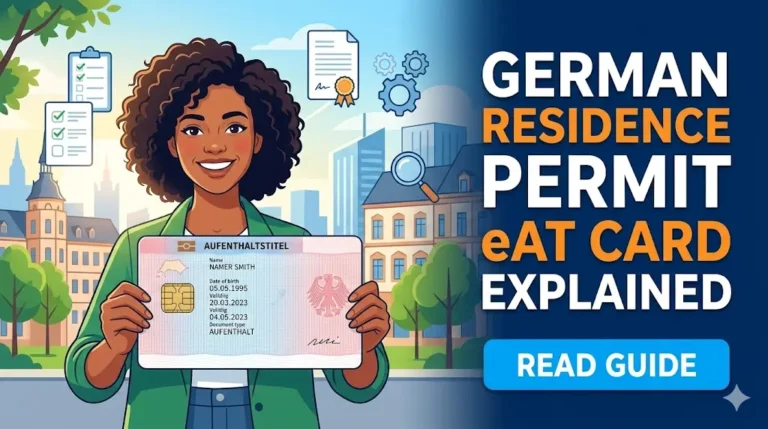
If your paperwork is in order and the interview proceeds smoothly, the mechanical part of the process begins. For almost all long-term residence permits, Germany issues an electronic residence title (eAT), which is a plastic card embedded with a microchip.
The case worker will ask you to place your fingers on a digital scanner to capture your fingerprints. They will also collect your biometric passport photo, scanning it into their system. They will ask you to verify your height and eye color, which will be printed on the final card. To understand exactly what data this card holds and how it protects you, read Biometric Residence Permit (eAT): Understanding Your German Residence Card.
Finally, you must pay the processing fee. For a standard residence permit or EU Blue Card, this usually ranges from €100 to €115. Most offices have shifted away from accepting cash directly at the desk. Instead, the officer will hand you a plastic payment card. You take this card to an automated payment machine in the hallway, insert it, pay the fee using your German EC card (Girocard), and bring the printed receipt back to the officer. Note that many of these machines do not accept Visa or Mastercard credit cards, so having a local German bank card or exact cash is critical.
Coping with Delays and Emergency Situations
The Infamous Fiction Certificate Explained
A very common nightmare scenario occurs when your current visa or 90-day visa-free period is expiring, but the Ausländerbehörde has not yet approved your new residence permit or issued your plastic card. If you manage to submit your application before your current status expires, you will likely be issued a Fiktionsbescheinigung (Fiction Certificate).
This is a temporary, green folded paper document that acts as a legal bridge. It certifies that the decision regarding your residence permit is pending, but your legal stay in Germany is protected in the interim. It proves to the police, your employer, and your landlord that you are not residing in the country illegally.
However, you must read the fine print very carefully. If the certificate is issued under Section 81 Paragraph 4, it means your previous visa conditions remain active—you can usually continue working and traveling in and out of Germany. If it is issued under Section 81 Paragraph 3, it simply suspends your deportation; it does not grant you the right to work, and if you leave Germany, you will not be allowed back in. For a comprehensive breakdown of these crucial legal differences, read What is a Fiktionsbescheinigung? Temporary Residence Explained.
Handling Requests for Missing Documents
Even with the most meticulous preparation, case workers frequently request additional documentation. Perhaps your employer forgot to stamp a specific page of your job description, or the tax office hasn’t updated your latest assessment. If this happens, the officer will not reject your visa immediately. Instead, they will issue a formal letter detailing exactly what is missing and provide a strict deadline.
Do not panic, but do act immediately. Any delay in providing these documents halts the entire processing of your visa. Follow their submission instructions to the letter. Some offices allow you to upload missing documents via a secure online portal, while others require you to drop them physically into the mail slot at the Ausländerbehörde or send them via fax.
If they ask for updated bank statements to prove ongoing financial stability because the process took too long, you can easily generate a fresh confirmation document from Expatrio showing your blocked account is still active. If you cannot obtain the requested document before the deadline (for example, if you are waiting on a foreign university to mail a transcript), you must write a formal letter in German requesting a deadline extension, explaining exactly why the delay is out of your control.
Escalating Urgent Cases and Legal Recourse
Sometimes, your application simply disappears into the bureaucratic void. Weeks turn into months, and your employer threatens to withdraw your job offer because you cannot produce a valid work permit. Phoning the Ausländerbehörde is largely useless, as the hotlines are either perpetually busy or staffed by general operators who cannot access your specific file.
If your situation becomes critically urgent, you have a few escalation paths. The first is having a German entity advocate for you. Case workers are historically much more responsive to polite but firm inquiries from German HR departments, university international offices, or local politicians than they are to individual expats. Having your employer’s legal team contact the office often miraculously unblocks a stalled file. To understand typical processing times and when to panic, refer to Renewing Your German Visa or Residence Permit: Timeline and Process.
If all communication fails and you are facing severe hardship, the ultimate legal recourse is the Untätigkeitsklage (action for failure to act). Under German administrative law, if an authority fails to process your application without a valid reason for more than three months, you can hire an immigration lawyer to file a lawsuit forcing them to make a decision. While this sounds extreme, simply having a lawyer draft a formal warning letter threatening an Untätigkeitsklage is often enough to compel the Ausländerbehörde to process your file within the week. However, this is a costly final option that should only be used when your livelihood is genuinely threatened. If your situation results in an expired visa without a Fiktionsbescheinigung, you must immediately read Overstaying in Germany: Consequences and How to Rectify the Situation.
References
Primary sources (official)
- Federal Office for Migration and Refugees (BAMF) – Foreigners Authority: https://www.bamf.de/EN/Themen/MigrationAufenthalt/ZuwandererDrittstaaten/Migrathek/Auslaenderbehoerden/auslaenderbehoerden-node.html
- Make it in Germany – Foreigners’ Authority: https://www.make-it-in-germany.com/en/visa-residence/living-in-germany/foreigners-authority
- Berlin State Office for Immigration (LEA): https://www.berlin.de/einwanderung/en/
Other helpful sources
- IOM Germany – Information on Visas and Migration: https://germany.iom.int/
- European Commission – Immigration Portal: https://immigration-portal.ec.europa.eu/germany-employed-worker_en
Disclaimer
The information provided in this guide is for general informational purposes only and is based on the real-world experiences of expats navigating the German immigration system. Immigration laws, administrative procedures, and required documentation are highly complex and subject to frequent changes by local and federal German authorities. This article does not constitute legal or immigration advice. Always consult the official website of your local Ausländerbehörde or a certified German immigration lawyer for the most current, legally binding requirements regarding your specific situation.