German Visa Photos and Biometrics: Meeting the Requirements
Getting a visa application rejected at the embassy window simply because a photograph was two millimeters off-center is a devastating reality. I once had my entire EU Blue Card application paused for a month because my chin was tilted slightly too high in my passport photos. This guide breaks down the exact German biometric and photo requirements so you can pass your embassy appointment without administrative delays.
Disclosure: This post may contain affiliate links. We may earn a commission at no extra cost to you if you make a purchase through these links. Read full disclosure.
The German Bureaucratic Approach to Biometrics
When you interact with the German immigration system, you are stepping into a machine that values precision above all else. German civil servants are not trained to apply subjective leniency to your application materials; they are trained to process data through highly calibrated verification systems. Understanding why they are so rigid about your face and fingerprints is the first step to surviving the ordeal.
Why Germany is Unforgiving with Photo Specs
In many countries, a passport photo is simply a visual reference for the border agent. In Germany, your photograph is a dataset. When you hand your printed photos to the consular officer or the municipal clerk, those photos are immediately scanned into a centralized federal database. The software running this database uses facial recognition algorithms to measure the distance between your pupils, the symmetry of your jawline, and the positioning of your nose.
If your photo has shadows, incorrect lighting, or the wrong dimensions, the software physically rejects the scan. The clerk sitting across from you does not have an “override” button to accept a flawed photo out of pity. If the computer says the contrast is too low to map your facial geometry, your application grinds to a halt. You will be handed your paperwork back and told to find a photographer, effectively losing your hard-fought appointment slot.
This technological rigidity is why you cannot treat the photo requirement as an afterthought. It is just as critical as your employment contract or your university admission letter. For a comprehensive look at the other flawless paperwork you must provide alongside your photos, you should review Documents Required for German Visa Applications: Complete Guide.
The Role of the Federal Printing Office Bundesdruckerei
Once your biometric data is successfully captured at the local immigration office or embassy, it does not stay local. The data is securely transmitted to the Bundesdruckerei, the Federal Printing Office located in Berlin. This high-security government facility is solely responsible for manufacturing every single German passport, ID card, and residence permit.
The Bundesdruckerei uses extremely sophisticated laser engraving and polycarbonate printing techniques to embed your biometric data into physical plastic cards. Because this manufacturing process is highly centralized, the quality control is absolute. If a local clerk accidentally accepts a borderline photo, the technicians at the Bundesdruckerei will catch it during the pre-printing verification phase.
If this happens, the printing office will reject the order and notify your local foreigners authority. You will then receive a terrifying letter in the mail weeks later, ordering you to return to the immigration office to submit a new photo, pushing your final visa delivery date back by a month or more. Knowing that your data must pass multiple levels of federal scrutiny emphasizes the need to get it perfect the first time.
E Passports and the Electronic Residence Title eAT
The end product of this biometric collection is the Electronic Residence Title, known locally as the elektronischer Aufenthaltstitel or eAT. When your temporary entry visa expires and you transition to long-term residency, you will be issued this credit-card-sized plastic document.
The eAT is not just a piece of plastic with your face printed on it. It contains a hidden, contactless Radio Frequency Identification (RFID) chip. This chip securely stores a high-resolution digital copy of your biometric photograph, two of your fingerprints, and your auxiliary visa conditions. Border control agents across the Schengen Area can scan this chip to instantly verify your identity against the physical card.
The German government takes the security of this chip incredibly seriously, which is why the input data must be mathematically flawless. If you want to understand how this physical card dictates your long-term legal standing and European mobility, you must thoroughly read Visas and Residence Permits in Germany: Everything You Need to Know.
Exact Dimensions and Technical Photo Requirements
You cannot simply use leftover passport photos from your home country, especially if you come from a nation like the United States where standard passport photos are two inches by two inches (51x51mm). German immigration law mandates a completely different, highly specific dimensional template.
The Golden Rule and Facial Proportions
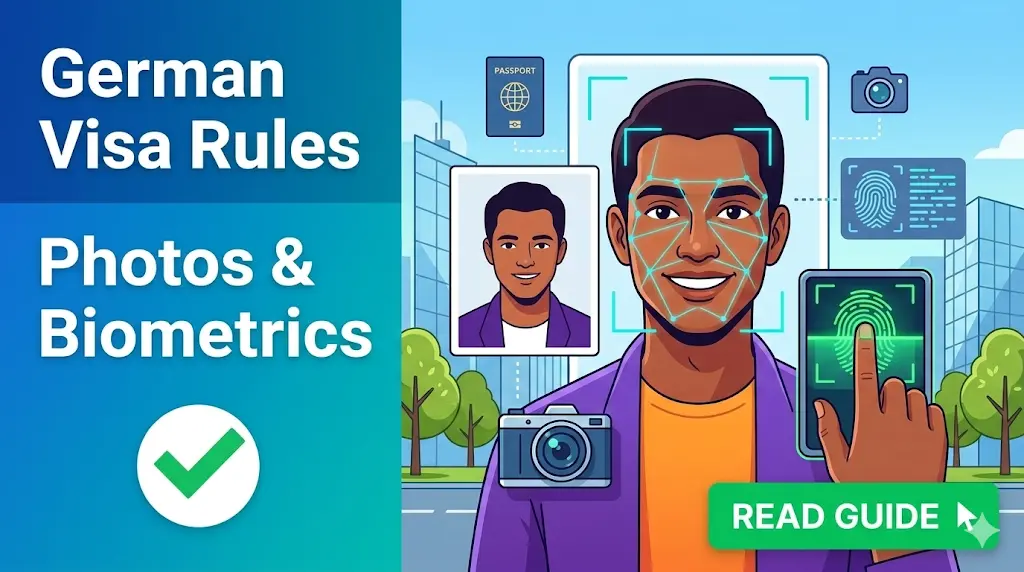
The absolute golden rule for German biometric photos is the dimension: exactly 35 millimeters wide by 45 millimeters high without a border. However, simply cutting a photo to this size is not enough; your face must occupy a highly specific percentage of that rectangular space.
The German Federal Ministry of the Interior strictly mandates that your face—measured from the tip of your chin to the crown of your head (the top of your skull, ignoring hair volume)—must measure between 32mm and 36mm. This means your face should take up roughly 70 to 80 percent of the entire vertical space of the photograph. If your head measures 29mm, your face is too small. If it measures 38mm, your face is too large and your chin is likely too close to the bottom edge.
Furthermore, your face must be perfectly centered. The imaginary vertical line running down the center of your nose must align exactly with the center of the photograph. Your eyes must be horizontally aligned and clearly visible in the upper third of the image. The government actually provides a transparent overlay mask to photographers to ensure these exact measurements are met before the image is printed.
Background Lighting and Contrast Standards
Your photograph must be taken against a plain, light-colored background that provides a clear, sharp contrast to your hair and face. The standard requirement is a medium-light grey. White backgrounds are sometimes accepted, but if you have very pale skin or white hair, a pure white background will cause your features to blend into the negative space, resulting in software rejection.
Lighting is where many DIY attempts fail catastrophically. The lighting must be perfectly uniform across your entire face. If a flash is placed slightly to the left, it will cast a shadow on the right side of your nose or along your jawline. Shadows of any kind—whether on your face or cast onto the background behind your head—render the photo instantly non-biometric.
The contrast and focus must be sharp enough to capture the natural color of your skin and eyes without red-eye effects or pixelation. The photos must be printed on high-quality photographic paper with a print resolution of at least 600 dots per inch (dpi). A standard home inkjet printer will invariably leave micro-banding lines across the image, which the federal scanners will reject.
Expression Head Position and Glasses Guidelines
The days of smiling for your visa photo are long gone. German biometric standards demand a completely neutral facial expression. You must look directly into the camera lens with your eyes wide open and your mouth firmly closed. A “Mona Lisa” half-smile will distort the natural resting geometry of your facial muscles and lead to rejection.
Your head must be perfectly straight. It cannot be tilted up, down, or rotated even slightly to the side. The camera must capture both edges of your face symmetrically. Hair cannot fall across your eyes or obscure your eyebrows. If you wear religious headwear, it is permitted, but the face must remain entirely visible from the lower tip of the chin to the top of the forehead without any shadows cast by the fabric.
If you wear glasses, the rules are intensely strict. Your eyes must be clearly visible through the lenses. Thick frames that obscure any part of your iris are forbidden. The most common point of failure for glasses wearers is flash glare reflecting off the lenses, obscuring the pupil. Tinted lenses or sunglasses are absolutely strictly prohibited.
The Fingerprint and Digital Signature Process
While you bring your physical photographs with you to your appointment, the rest of your biometric data is captured live by the German authorities. This process is mandatory for anyone applying for a National Visa (Type D) or a long-term residence permit inside the country.
What Happens at the Embassy or Auslaenderbehoerde
When you attend your visa interview at the German embassy in your home country, or when you apply for your residence card at the local foreigners authority (Ausländerbehörde), you will go through a live biometric capture process at the clerk’s desk.
After reviewing your documents, the clerk will point to a small, glowing green electronic scanner bolted to their desk. You will be asked to place your left index finger flat on the glass, followed by your right index finger. The scanner captures a high-resolution topological map of your fingerprint ridges. You must press down firmly and hold still until the software registers a successful scan.
Following the fingerprints, you will be handed an electronic stylus and asked to sign your name on a digital signature pad. This exact digital signature will be laser-engraved onto your final plastic residence card. You must sign your name exactly as it appears in your national passport. If your passport signature includes your middle name, but you only sign your first and last name on the pad, the clerk will clear the screen and force you to do it again. Knowing how to handle these intense, intimidating interactions is crucial, which is why studying Navigating the Ausländerbehörde: Tips for Dealing with German Immigration Offices is highly recommended.
Technical Issues with Fingerprint Scanners
While the fingerprinting process sounds simple, it frequently causes stressful delays for expats. The optical scanners used by German authorities are highly sensitive to moisture and skin texture.
If your hands are excessively sweaty from the anxiety of the visa interview, the scanner will read a blurred image. The clerk will hand you a paper towel and ask you to dry your hands. Conversely, if your skin is extremely dry, cracked, or calloused—common for people who work with their hands or climb frequently—the scanner may fail to register the depth of your ridges. In these cases, the clerk might ask you to rub your fingers on your forehead to pick up natural skin oils before trying again.
If an index finger is permanently damaged, bandaged, or missing, the authorities will systematically move to the middle finger, then the ring finger, until they capture two viable prints. If you have temporary cuts on your fingertips, it is actually advisable to wait until they heal before attending a residence permit appointment, as a rejected scan means you must book a new appointment weeks later.
Data Privacy and Storage in the German System
Germany is governed by some of the strictest data protection laws in the world, heavily dictated by the European General Data Protection Regulation (GDPR). Many expats are rightfully curious about what happens to their fingerprints once they leave the embassy.
Your biometric data is not thrown into an unregulated, open-access database. The fingerprints captured during your visa application are securely stored on the RFID chip of your eAT card and on a highly secured federal registry. They are used exclusively for identity verification—to prove that the person holding the card is the person who applied for it.
German law dictates strict retention limits. Your biometric data is only stored in local systems for as long as it takes to process the application and manufacture the card. Once your residence permit is handed to you and confirmed, the temporary local files holding your fingerprints are generally purged to prevent unauthorized surveillance.
DIY vs Professional Photography
In an era of high-definition smartphone cameras, it is incredibly tempting to take your own visa photos against your living room wall to save twenty euros. This is arguably the most common and easily preventable mistake expats make when preparing their visa dossiers.
The Risks of Using Apps and Photo Booths
There are dozens of smartphone apps claiming to generate “biometric-ready” passport photos. While the software might crop the image to 35x45mm, it cannot control the physical environment. Smartphone lenses often create slight wide-angle distortions (the “fisheye” effect), making your nose appear larger and altering the exact geometric distances between your facial features. Furthermore, home printers simply cannot achieve the 600 dpi resolution required without micro-banding.
Photo booths (Fotoautomaten) located in German train stations and shopping malls are a slightly better alternative, as they use calibrated lighting and specific photographic paper. Most modern booths in Germany have a “Biometrisches Passbild” setting that guides your face into a digital overlay. However, if the stool is the wrong height, or if a flash bulb is failing, the machine will print a non-compliant photo and refuse to offer a refund.
Hiring a Professional and What to Ask For
The absolute safest route is visiting a professional photographic studio. In Germany, almost every photography shop clearly advertises biometric photo services in their window.
When you walk in, you must specifically ask for “Biometrische Passbilder für ein Visum” (Biometric passport photos for a visa). The photographer knows exactly what this means. They will position you under softbox lighting that eliminates all background and facial shadows. They will instruct you to pull your hair back and close your mouth. Most importantly, professional photographers use specific desktop software to run a preliminary check on the image against federal guidelines before they even hit print.
While it costs roughly 15 to 25 euros, investing in professional photos buys you absolute peace of mind. You are removing one of the most common reasons for instant bureaucratic rejection.
| Method | Cost | Lighting/Contrast Quality | Dimensional Accuracy | Risk of Visa Rejection |
| Smartphone App & Home Printer | Free | Very Poor (Shadows, distortions) | Moderate (Relies on user skill) | Extremely High |
| Train Station Photo Booth | ~€8 – €10 | Acceptable (Can be harshly lit) | Good (Has digital overlays) | Moderate |
| Professional Photographer | ~€15 – €25 | Excellent (Softboxes, zero shadows) | Perfect (Verified by studio software) | Very Low |
Preparing Babies and Children for Biometric Photos
If you are relocating with your family, getting a biometric photo of a squirming toddler is a universally dreaded experience. The German authorities acknowledge that it is physically impossible to force a six-month-old infant to hold a perfectly neutral, centered expression.
Because of this, the biometric requirements are slightly relaxed for infants and children under the age of ten. For babies, the head does not need to perfectly fill the 70-80% height requirement; a smaller facial area is permitted to account for unpredictable movement. The child does not need to look directly into the camera with a perfectly neutral expression, though their eyes must be open and clearly visible.
However, the background rules remain absolute. You cannot hold your baby against your chest if your shirt is visible in the frame. The easiest way to photograph an infant is to lay them on their back on a light grey or white blanket and shoot from directly above, ensuring no toys, pacifiers, or adult hands are visible in the frame.
Integrating Biometrics with Your Complete Visa File
Your flawless biometric photos do not exist in a vacuum. They must be submitted alongside a massive, heavily scrutinized portfolio of legal documents, financial proofs, and certified translations.
Matching Your Photos to Other Application Documents
When you hand your photos to the consular officer, they will immediately compare the face in the image to the person standing in front of them, and then cross-reference both against the name and details on your physical passport.
If your documents show different variations of your name—perhaps your birth certificate has a middle name that your passport lacks, or your marriage certificate shows a maiden name—the officer will pause the application. If you have foreign documents that require authentication, they must be translated perfectly to match your current legal identity. Utilizing a certified sworn translation platform like Lingoking ensures that your foreign vital records are translated into the exact legal German terminology, leaving no room for a caseworker to doubt your identity.
Similarly, your biometric photos will be clipped to your health insurance certificates and financial proofs. If you are applying for a premium corporate visa, you must bring proof of your blocked funds or insurance alongside the photos. Utilizing a digital financial provider like Expatrio ensures you have the exact, government-approved blocked account confirmation ready to hand over. Likewise, using a specialized broker like Feather Insurance guarantees that your mandatory health insurance certificate perfectly aligns with the dates and details on your application form.
Dealing with Rejections and Retakes
Despite your best efforts, a strict caseworker might still reject your photo. Perhaps the contrast isn’t sharp enough for their specific desktop scanner, or the lighting caught a faint shadow behind your ear.
If this happens during an embassy appointment in your home country, the officer will usually hand the photo back and tell you to go to an approved photographer near the embassy and return the same day. Do not argue with them. Take the photo back, find the nearest professional studio, and pay for a retake.
If it happens inside Germany while applying for your final eAT card, the local municipal buildings often have self-service biometric photo booths specifically installed in the waiting rooms for this exact scenario. You can quickly feed coins into the machine, take a new photo, and bring it directly back to the clerk’s desk.
Navigating the biometric requirements of the German immigration system is a lesson in rigorous compliance. If you respect the millimeters, eliminate the shadows, and present a perfectly neutral face to the camera, you will glide past one of the most common administrative traps and secure your right to build a life in Germany.
References
Primary sources (official)
- Federal Ministry of the Interior and Community (BMI) – Photo sample board (Fotomustertafel): https://www.bmi.bund.de/SharedDocs/downloads/EN/publikationen/modul3/fotomustertafel.pdf%3F__blob%3DpublicationFile
- Federal Foreign Office (Auswärtiges Amt) – Visa Regulations and Biometrics: https://www.auswaertiges-amt.de/en/visa-service/buergerservice/faq
Other helpful sources
- Service-BW – Residence permit application guidelines: https://www.service-bw.de/en_US/web/guest/lebenslage/-/vz/Aufenthaltstitel%2Bbeantragen%2Boder%2Bverlaengern-5000494-lebenslage-0
Disclaimer
This guide is for informational purposes only and does not constitute formal legal or immigration advice. German biometric requirements, technical photo specifications, and municipal processing protocols change frequently and are strictly enforced by local authorities. Always consult the official websites of the German embassy in your home country or seek professional counsel from a certified German immigration lawyer before submitting formal visa applications or paying for document translations.