Living in Hamburg: A Guide to Germany’s Port City for Newcomers
Arriving in Hamburg with a light jacket and high hopes of quickly signing a lease is a rookie mistake that left me freezing and effectively homeless my first month. I completely underestimated the horizontal rain and the ruthless landlord interviews of this incredibly wealthy port city. This guide decodes Hamburg’s neighborhoods, maritime culture, and intense housing market to help you truly settle in.
Disclosure: This post may contain affiliate links. We may earn a commission at no extra cost to you if you make a purchase through these links. Read full disclosure.
Decoding Hamburg’s Brutal Housing Market
The Reality of Rents and Intense Competition
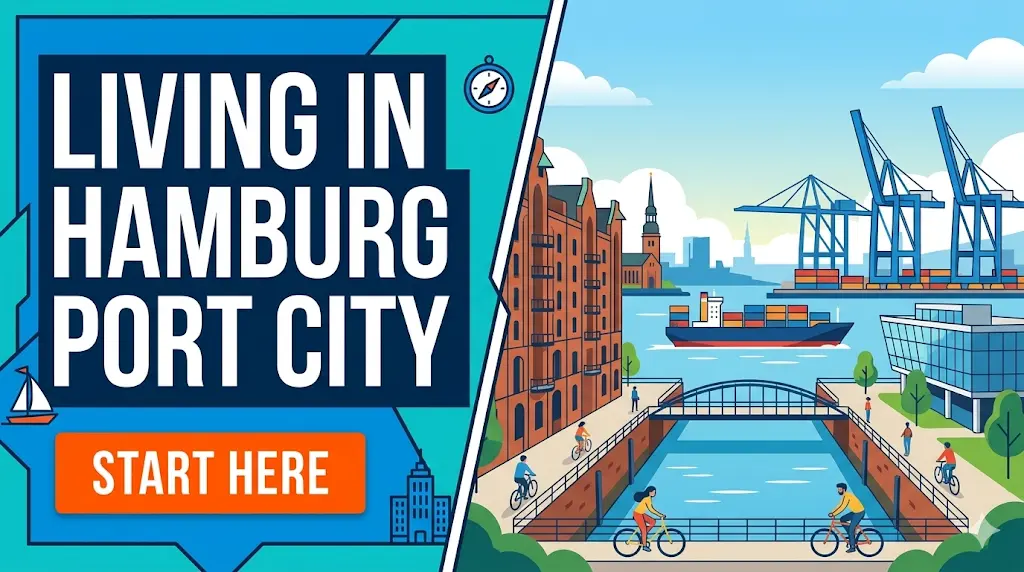
Hamburg is the undisputed economic powerhouse of northern Germany, boasting the second-largest port in Europe and a staggering concentration of generational wealth. Because of this massive economic engine, the city acts as a magnet for highly paid professionals, media executives, and international logistics experts. This dense concentration of capital creates a hyper-competitive, deeply frustrating housing market for newcomers. The competition for a standard flat, particularly anywhere near the Alster lakes or the city center, is so fierce that you will regularly see lines of seventy people stretching down the street for a single fifteen-minute viewing.
Landlords in Hamburg are notoriously conservative and risk-averse. They demand a flawless financial portfolio: a perfect SCHUFA (credit score), three months of local payslips, a permanent work contract, and a beautifully assembled application folder. For an expat who has just arrived and lacks a local financial history, competing against double-income German couples is profoundly demoralizing. Many landlords will not even respond to an inquiry written in English, adding a severe linguistic barrier to the already daunting financial hurdles.
You cannot approach this market casually. It is a full-time job that requires extreme vigilance and immediate response times when an alert pops up on an online portal. To survive this initial bloodbath and learn how to assemble a winning application dossier from scratch, studying the strategies in Finding an Apartment in Germany: Best Websites and Tips for Expats is an absolute necessity before you even begin browsing the local listings. You must treat every viewing as a formal job interview, arriving dressed professionally and armed with every conceivable piece of documentation.
Furnished vs Unfurnished Apartments in the North
A devastating shock for many expats moving to Hamburg is the strict German definition of an “unfurnished” apartment. If you manage to sign a standard, long-term lease in a neighborhood like Eimsbüttel or Altona, you are typically renting a bare, echoing shell. There are no light fixtures on the ceilings, no closets in the bedrooms, and, most shockingly, absolutely no kitchen. You are entirely responsible for purchasing, transporting, and installing the kitchen block—including the sink, oven, countertops, and cabinets—at your own massive expense.
For an international professional arriving on a two-year corporate rotation, investing five to ten thousand euros into a custom-built kitchen that you might have to rip out when you leave makes zero financial sense. Because of this absurd logistical hurdle, the savviest expats bypass the permanent market initially. Booking a mid-term, fully equipped flat through Wunderflats has become the standard survival tactic for international arrivals. This allows you to walk into a ready-made home with high-speed internet, pots in the cupboards, and a bed to sleep in, bypassing the immediate trauma of appliance shopping.
It buys you the essential time needed to pass your work probation and physically explore the different districts before committing to a massive financial undertaking. When you finally do transition to a permanent, unfurnished flat, ordering your heavy power tools, light fixtures, and basic appliances from Amazon Germany is the fastest way to make a bare Hamburg shell livable without hauling goods through the freezing rain on the U-Bahn. The financial nuances of this transition are thoroughly detailed in Furnished vs Unfurnished Apartments in Germany, which you must read before signing a multi-year lease.
Navigating the Anmeldung and Bureaucracy
The most infuriating administrative loop in Hamburg, and indeed all of Germany, is the Anmeldung (address registration) catch-22. To legally exist in the country, open a standard German bank account, secure a tax ID number, or even get a local mobile phone contract, you must present a certificate proving you are officially registered at a local address. However, to secure a long-term apartment to register at, traditional Hanseatic landlords will demand a local bank account and a German credit history. You are completely paralyzed before you even begin.
Many newcomers attempt to solve this by crashing on a colleague’s couch or finding an informal sublet on Facebook. This is a highly dangerous game. To legally register at the local citizen’s office (Kundenzentrum), you must present a Wohnungsgeberbestätigung—a confirmation form signed by the actual landlord. If an informal sublessor refuses to provide this document because they are hiding you from the property manager, the sublet is illegal, and you remain in bureaucratic limbo, completely unable to get paid correctly by your employer.
This administrative nightmare is another primary reason why managed housing platforms are so valuable. Utilizing Wunderflats guarantees that you are entering a legally compliant rental agreement where the landlord will provide the mandatory confirmation paperwork on your move-in day.
Finding Your Kiez (Neighborhoods Explained)
Eimsbüttel, Eppendorf, and Winterhude (Upscale and Green)
Eimsbüttel, Eppendorf, and Winterhude represent the classic, deeply affluent heart of Hamburg’s residential life. These neighborhoods are universally sought after by established professionals, doctors, lawyers, and wealthy expat families who desire a pristine, highly manicured quality of life. The architecture here is stunning, defined by massive, brilliantly white Jugendstil (Art Nouveau) facades, wide tree-lined avenues, and an intricate network of picturesque canals (Fleete) that connect directly to the Alster lakes.
Eppendorf and Winterhude, in particular, exude a quiet, old-money luxury. The streets are packed with high-end boutiques, organic bakeries, and gourmet wine shops. Living here means you can step out of your front door on a Saturday morning, grab an artisan pastry, and take a serene walk along the water without ever encountering the grit of the inner city. The atmosphere is incredibly safe, intensely family-focused, and undeniably beautiful.
However, because these neighborhoods are universally beloved, the vacancy rate is practically zero, and the rents are astronomically high. Finding a flat here requires immense patience, a massive budget, and often a stroke of luck through personal connections. If you prioritize a quiet, luxurious neighborhood feel over alternative nightlife, these northern districts are unparalleled. Weighing the sheer cost of living here against other major hubs is a crucial exercise found in Best Cities in Germany for Expats: Pros and Cons of Each.
Sternschanze and St. Pauli (Alternative and Loud)
If you are moving to Hamburg to experience the famous bohemian, counter-culture lifestyle and legendary nightlife, you will inevitably gravitate toward Sternschanze (the “Schanze”) or St. Pauli. St. Pauli is globally famous as the home of the Reeperbahn, the city’s massive red-light and entertainment district. While the main drag is heavily commercialized and packed with tourists, the side streets of St. Pauli retain a fierce, independent, working-class spirit, heavily tied to the famously left-wing FC St. Pauli football club.
Just to the north lies the Schanze, which acts as the hipster and culinary epicenter of the city. The streets around the Rote Flora—a famous squatted theater that serves as the heart of Hamburg’s alternative political scene—buzz with energy around the clock. The district is densely packed with third-wave coffee shops, Portuguese bakeries, natural wine bars, and independent record stores. It is loud, graffiti-covered, and incredibly vibrant. English is spoken here far more frequently than in the wealthy northern suburbs, making it the cultural heart of the modern, young expat community.
Living in these districts requires a certain tolerance for chaos. The streets are noisy, the weekends are packed with partygoers, and the sidewalks are constantly crowded. However, the sense of community, the culinary diversity, and the proximity to the city’s legendary nightlife make it the most exciting place to live. If you thrive on constant stimulation and want to build an international network rapidly, this is exactly where you belong.
HafenCity and Altona (Maritime and Modern)
For a completely different flavor of Hamburg, you must look toward the River Elbe. HafenCity is Europe’s largest inner-city urban development project, built entirely from scratch on former port land. It is characterized by hyper-modern, glass-and-steel architecture, cutting-edge sustainability, and the breathtaking Elbphilharmonie concert hall. It feels somewhat sterile and lacks the organic, historic grit of the older neighborhoods, but it offers unparalleled modern amenities like underground parking and high-efficiency heating. Because of its frictionless, modern setup, many corporate relocation packages place incoming executives in Wunderflats within HafenCity for a seamless transition.
Altona, located further west along the river, offers a beautiful middle ground. It is an incredibly diverse, massive district that historically operated as an independent Danish city. Altona seamlessly blends trendy, bustling commercial streets like Ottenser Hauptstraße with deeply tranquil, affluent residential zones near the water. It is heavily favored by creatives and young families who have been priced out of Eimsbüttel but still want excellent infrastructure and vibrant local life.
The greatest draw of Altona is its immediate proximity to the Elbe. Living here means you are just a short walk or cycle away from the “Elbstrand,” Hamburg’s famous sandy river beach. Watching massive container ships glide past while you sit on the sand with a local Astra beer is the quintessential Hamburg experience.
| Neighborhood | Primary Vibe | Average Rent Cost | Target Expat Demographic |
| Eppendorf / Winterhude | Classic luxury, canals, quiet | Astronomical | Executives, wealthy families, diplomats |
| Eimsbüttel | Upscale, green, family-friendly | Very High | Established professionals, young families |
| Sternschanze | Alternative, hip, culinary hub | High | Creatives, young expats, nightlife lovers |
| St. Pauli | Gritty, loud, politically active | Medium to High | Adventurous singles, students, artists |
| HafenCity | Hyper-modern, sterile, waterfront | Very High | Corporate expats seeking modern amenities |
| Altona | Diverse, maritime, balanced | High | Creatives, families, professionals |
The Maritime Weather and Lifestyle Adjustments
Surviving the “Schietwetter” (Bad Weather)
If you ask any German about Hamburg, the very first thing they will mention is the weather. The city is famous for its Schietwetter (literally: “shit weather”). Because Hamburg is located relatively close to the North Sea, the climate is heavily maritime. The winters are not defined by beautiful, crisp white snow, but rather by relentless, horizontal rain, thick gray fog, and a bone-chilling dampness that penetrates the thickest of wool coats. The sky can remain a solid, unbroken sheet of gray from November through March.
You must entirely abandon fashion for function if you want to survive a Hamburg winter. Do not bring flimsy umbrellas to this city; the sudden, violent gusts of wind whipping off the Elbe will destroy a standard umbrella within minutes. The local uniform consists of heavy-duty, bright yellow raincoats (Friesennerz), thick woolen sweaters, and proper, waterproof rubber boots. If you fail to dress appropriately, your daily commute will be a miserable, freezing ordeal.
Proactively ordering high-quality, windproof outdoor gear and waterproof backpacks from Amazon Germany before the autumn storms hit is the most critical lifestyle investment you can make. Fighting through the bleak, wet winter months requires immense physical and mental resilience.
Outdoor Life: The Alster, Elbe, and Parks
The great irony of Hamburg’s terrible weather is that its residents are obsessively dedicated to outdoor living. Because sunny, warm days are a precious, finite resource, the entire city undergoes a radical transformation the moment the sun breaks through the clouds in spring. Hamburg is one of the greenest cities in Europe, and the water is the absolute focal point of social life.
The Alster—a massive, dammed river that forms two spectacular lakes (Binnenalster and Außenalster) right in the center of the city—is the recreational heart of Hamburg. Jogging, cycling, or walking the 7.4-kilometer loop around the Außenalster is a daily ritual for tens of thousands of locals, regardless of the temperature. In the summer, the lake is packed with sailboats, stand-up paddleboards, and rented rowboats.
Similarly, the banks of the Elbe River serve as the city’s coastline. When the weather is good, everyone migrates to the Elbstrand in Övelgönne to barbecue, drink beer, and watch the massive, skyscraper-sized container ships navigate into the port. You must learn to seize the good weather immediately. If it is sunny on a Tuesday afternoon, you leave the office early and head to the water; you do not wait for the weekend, because by Saturday, it will likely be raining again.
Social Dynamics: Breaking the Northern Ice
The weather in northern Germany heavily influences the local personality. Hamburgers are famous for their Hanseatische Zurückhaltung (Hanseatic reserve). They are deeply stoic, intensely private, and famously tight-lipped. They do not engage in the boisterous, immediate friendliness found in the Rhineland (like Cologne), nor do they embrace the chaotic, over-sharing nature of Berlin.
To an expat, this Hanseatic reserve can initially feel incredibly cold, arrogant, and exclusionary. You will not make friends by chatting up a stranger in the supermarket line. Small talk is viewed as inefficient and slightly suspicious. The local greeting, “Moin,” can be used at any time of day or night, and using two words (“Moin Moin”) is often jokingly considered excessive chatter. You must respect their boundaries and realize that their distance is not a personal insult; it is simply cultural programming.
However, the reward for breaking through this northern ice is immense. Once you earn a Hamburger’s trust—usually through shared activities, joining a local sports club, or demonstrating consistent, quiet reliability—they are fiercely loyal friends for life. They mean exactly what they say, and they do not deal in fake pleasantries.
Career Opportunities and Cost of Living
Media, Logistics, and Corporate Hubs
While Frankfurt has finance and Munich has automotive engineering, Hamburg is the undisputed media, publishing, and logistics capital of Germany. The city is the historic headquarters for massive publishing empires like Der Spiegel and Die Zeit, alongside cutting-edge international advertising and creative agencies. Furthermore, the Port of Hamburg is the economic engine of the region, driving a massive logistics, maritime engineering, and global trade sector.
Because the wealth here is older and deeply established, the corporate culture leans much more heavily toward traditional professionalism than the startup hubs in the east. While creative agencies might embrace a casual dress code, the maritime, legal, and corporate headquarters still expect a high degree of formal business attire and strict adherence to hierarchical protocols.
If you are relocating for a senior role at massive local employers like Airbus, Beiersdorf (Nivea), or Otto Group, you will find a highly structured, highly lucrative career path. The salaries in Hamburg are very competitive, designed to match the high local cost of living and attract elite global talent to the harsh northern climate.
The Language Barrier in Northern Business
A critical distinction between Hamburg and Berlin is the absolute necessity of the German language in the professional sphere. While Berlin boasts hundreds of tech startups where the entire operational language is English, Hamburg’s corporate landscape is heavily anchored in the domestic German market. Outside of highly specific IT roles or massive multinational conglomerates, the default language of business in Hamburg is German.
If you want to climb the corporate ladder here in media, logistics, or marketing, you must prioritize language acquisition immediately. The “English bubble” in Hamburg is significantly smaller, and relying exclusively on English will severely limit your networking opportunities and your ability to integrate into the upper echelons of Hanseatic business society.
Furthermore, you need German to handle the day-to-day administrative realities of the city. Plumbers, civil servants at the local district offices (Bezirksämter), and traditional landlords will not negotiate complex, liability-heavy contracts in a foreign language.
Budgeting for the Hamburg Premium
Surviving in Hamburg requires a robust financial strategy. The city is unequivocally expensive. The wealth generated by the port and the media industries has driven the cost of real estate, dining out, and leisure activities to levels that rival Munich. Your monthly rent (Warmmiete) will be the single largest drain on your finances, easily consuming forty percent or more of a standard net salary for a centrally located apartment.
The lifestyle associated with the affluent neighborhoods is inherently costly. Weekend brunches in Winterhude, high-end gym memberships, and after-work cocktails in the HafenCity add up incredibly fast. If you try to maintain an elite lifestyle on a mid-level administrative salary, you will burn through your savings within months. You must conduct a ruthless audit of your finances before accepting a job offer in the Hanseatic city.
Learning to budget like a local means abandoning the convenience of eating out daily and embracing the German culture of cooking at home. Discount supermarkets like Aldi and Lidl provide high-quality staples at rock-bottom prices, while local weekly markets (Wochenmärkte) offer fresh regional produce. Understanding exactly how these regional costs compound, including the mandatory TV tax and utility reconciliations, is absolutely critical.
Navigating Public Transit and Daily Logistics
The HVV Network (U-Bahn, S-Bahn, and Ferries)
Owning a car in central Hamburg is an expensive, deeply frustrating liability. Parking is virtually non-existent, and traffic around the Alster and the port can be gridlocked. Fortunately, the Hamburger Verkehrsverbund (HVV) operates a world-class, integrated public transit network comprising the U-Bahn (subway), S-Bahn (commuter trains), and an extensive bus network.
The most unique and beloved feature of the HVV system, however, is the integration of the HADAG harbor ferries. Your standard public transit ticket allows you to board the massive yellow ferries that crisscross the River Elbe. Taking Ferry Line 62 from Landungsbrücken down to Finkenwerder is not just a daily commute for locals; it is one of the most spectacular, cheapest sightseeing tours in Europe, offering breathtaking views of the massive container port and the city skyline.
The ticketing system is zone-based, and buying the correct ticket can be confusing initially. Plainclothes ticket inspectors are ruthless, and if you are caught without a validated ticket, you will face an immediate €60 fine.
Cycling Infrastructure and Challenges
Hamburg is relatively flat, making it an excellent city for cycling, and a massive portion of the population commutes by bike year-round. The city is continuously expanding its network of dedicated, protected bike lanes (Velorouten) to encourage eco-friendly transport. Cycling around the Alster or through the massive Stadtpark is a daily joy when the weather permits.
However, cycling in Hamburg comes with extreme weather challenges. Biking through a horizontal rainstorm with near-freezing winds requires intense dedication and highly specialized gear. You cannot rely on a standard umbrella or a cheap poncho.
If you plan to commute by bike, you must invest heavily in waterproof panniers, high-visibility reflective gear, heavy-duty mudguards, and blindingly bright LED bike lights to combat the dark winter mornings. Proactively ordering these heavy-duty cycling essentials from Amazon Germany before the autumn hits ensures you arrive at the office dry and safe, rather than soaked and miserable.
Supermarkets and Daily Shopping Habits
The final lifestyle adjustment for expats in Hamburg is adapting to the strict retail hours. Unlike Berlin, where late-night Spätis (convenience stores) operate on every corner at all hours, Hamburg adheres much more strictly to traditional German retail laws. Supermarkets generally close promptly at 20:00 or 21:00, and literally everything is closed on Sundays (Sonntagsruhe), minus a few emergency kiosks in St. Pauli or the central train station.
You cannot rely on spontaneous, late-night grocery runs. If you forget to buy food on a Saturday evening, you will be eating plain pasta or paying exorbitant delivery fees on Sunday. You must adopt a highly structured, localized approach to shopping, planning your meals days in advance.
For heavy, non-perishable pantry staples, cleaning supplies, or specialized international ingredients that are impossible to find in standard northern German supermarkets, utilizing bulk delivery from Amazon Germany is a massive money and time saver. It frees you from having to lug heavy laundry detergent on the U-Bahn, allowing you to focus your local shopping on fresh bread from the neighborhood Bäckerei and produce from the weekend markets. Embracing this structured routine is the final step in transitioning from a confused tourist to a true Hamburger.
References
Primary sources (official)
- Hamburg.com (Official City Portal in English): https://www.hamburg.com/
- HVV (Hamburger Verkehrsverbund) Official English Site: https://www.hvv.de/en
Other helpful sources
- Make it in Germany (Official Federal Government Portal) – Hamburg: https://www.make-it-in-germany.com/en/living-in-germany/discover-germany/german-states/hamburg
Disclaimer
The housing market conditions, living costs, and cultural observations detailed in this guide are based on widespread expat experiences and the current realities of residing in Hamburg. Rent prices, HVV transit zones, and bureaucratic procedures are highly volatile and subject to constant change by local authorities. Always verify current visa requirements, municipal registration laws, and rental agreements directly through the official hamburg.com service portal before finalizing your relocation budget or signing legally binding lease contracts.