Work Culture in Germany: Etiquette, Hierarchy, and Office Norms
Sitting in a meeting while my manager brutally dismantled my hard work without a single compliment left me questioning my entire career. I once spent my lunch break fighting back tears before I understood that German feedback is purely functional, not personal. This guide decodes German work culture, from navigating rigid hierarchies to mastering direct communication and unwritten office etiquette.
Disclosure: This post may contain affiliate links. We may earn a commission at no extra cost to you if you make a purchase through these links. Read full disclosure.
The German Communication Style: Directness over Diplomacy
To survive in a German office, you must fundamentally reprogram how you give and receive information. The Anglo-American corporate world thrives on diplomacy, soft cushioning, and reading between the lines. In Germany, efficiency and clarity reign supreme, which often translates to brutal honesty.
Decoding Sachlichkeit: Fact-Based Feedback
The cornerstone of German professional communication is Sachlichkeit, which loosely translates to objectivity or matter-of-factness. When a German colleague reviews your project, they will isolate the facts from the emotions. If your presentation has a flaw, they will point directly at the flaw and say, “This section is incorrect and needs to be rewritten.” They will not wrap this critique in a “compliment sandwich” by praising your font choices first.
Expats frequently interpret this bluntness as a personal attack or a sign that their manager dislikes them. You must learn to decouple your ego from your work product. In the German mindset, providing clear, unvarnished feedback is a profound sign of professional respect. It means they value your time too much to waste it on pleasantries. If you are struggling to understand the nuances of this direct feedback, taking advanced business communication courses through Lingoda can help you decipher the phrasing and realize that it is entirely emotionally neutral.
Conversely, if you do an exceptional job, do not expect a standing ovation. The common German workplace motto is “Nicht geschimpft ist Lob genug”—meaning “not being scolded is praise enough.” Doing your job perfectly is simply what you are paid to do. Over-praising is viewed with deep suspicion, as it implies the standard expectation is failure.
Small Talk and the Strict Professional Boundary
In countries like the United States or the United Kingdom, meetings typically begin with five to ten minutes of casual chatter about the weekend, family, or sports. In Germany, small talk is a functional, highly abbreviated bridge. A meeting scheduled for 9:00 AM will see participants sitting down at 8:58 AM, and the actual business agenda will commence precisely at 9:01 AM.
When a German colleague asks, “Wie geht es Ihnen?” (How are you?), they are not using it as a casual greeting; they are asking a literal question. If you reply with an overly enthusiastic “Everything is awesome!” it can come across as superficial. A standard, polite, and brief “Danke, gut, und Ihnen?” (Thanks, good, and you?) is the maximum required interaction.
Germans draw a thick, impenetrable line between the professional and the private sphere. It is entirely normal to work next to someone for five years and know absolutely nothing about their spouse or children. Intrusive personal questions are considered highly inappropriate. To master these subtle social boundaries, passive listening to cultural breakdown tracks on GermanPod101 during your commute is an excellent way to absorb the natural rhythm of appropriate German office banter.
Navigating Formal and Informal Pronouns: Sie vs. Du
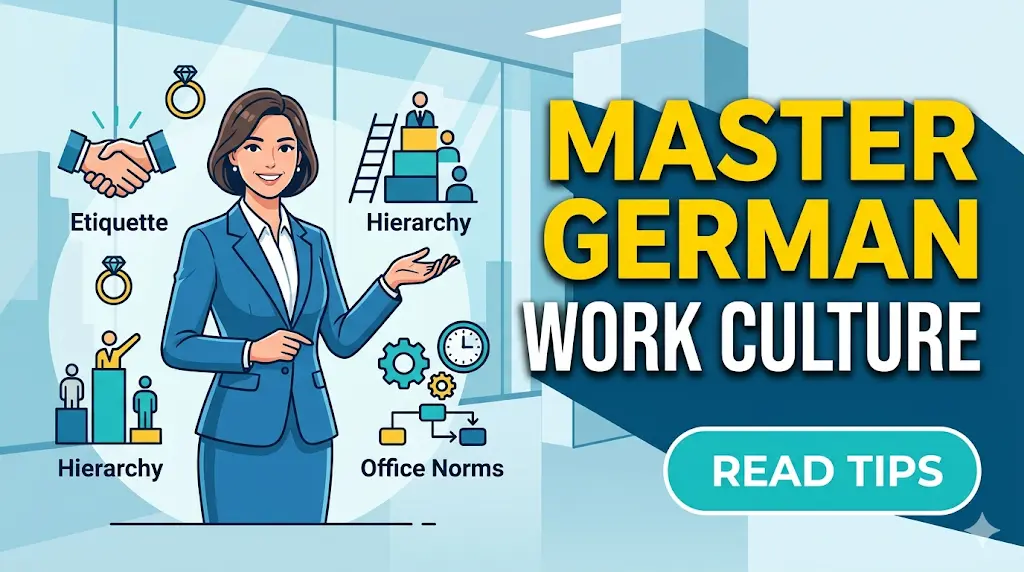
The German language forces a hierarchical choice upon you every time you address a colleague: the formal Sie or the informal Du. Getting this wrong is a massive breach of etiquette. As a default rule, you must always use Sie and address colleagues by their last name (e.g., Herr Müller or Frau Weber) when you first join a company.
The transition to the informal Du is a significant milestone and must follow strict hierarchical rules. The older, more senior person must be the one to offer the Du to the younger or junior person. If your boss introduces themselves with their first name, you still use Sie unless they explicitly say, “Wir können uns gerne duzen” (We can gladly use ‘Du’).
In modern startups in Berlin or Munich, the Du culture is often implemented across the board from day one, heavily influenced by English-speaking tech environments. However, if you are working for a traditional Mittelstand engineering firm, the Sie might remain in place for decades. Navigating these linguistic minefields requires practice. Enrolling in targeted conversation classes via Lingoda ensures you drill these formal and informal conjugations until they become reflex, preventing embarrassing slips in front of company directors.
Understanding German Office Hierarchy and Structure
While Germany operates as a highly democratic society, its traditional corporate structures are deeply hierarchical. Understanding who holds the power and how decisions are actually made will save you months of administrative frustration.
The Role of the Expert and Academic Titles
In German work culture, authority is heavily derived from specialized expertise and formal academic credentials, rather than sheer charisma or “hustle.” If someone is the designated technical expert on a specific software system, their word is generally final on that subject, even if a higher-ranking manager disagrees. Respect is earned through deep, verifiable competence.
This reverence for credentials extends to academic titles. If a colleague or client holds a doctorate, you must address them as “Herr Dr. Schmidt” or “Frau Dr. Weber.” The title is considered an official part of their name and professional identity. Omitting it is a sign of immense disrespect. You will notice this emphasis on credentials the moment you apply for a job; your educational background is scrutinized far more than in other countries, a process detailed in Writing a German-Style CV and Cover Letter: Tips for Success.
When drafting emails or preparing presentations, you must ensure your data is flawless. Claiming a project will increase revenue by “around 20%” without hard data to back it up will see you laughed out of the boardroom. Using the advanced business vocabulary lessons on GermanPod101 can equip you with the precise terminology needed to present your facts confidently and defend your methodology against rigorous German scrutiny.
Decision-Making Processes and Consensus
Because authority is tied to expertise, the decision-making process in Germany can feel agonizingly slow to expats used to agile, “move fast and break things” environments. Major decisions are rarely made by a single visionary leader acting on a gut feeling. Instead, the process is highly analytical, risk-averse, and consensus-driven.
Before a new software tool is adopted or a new marketing strategy launched, it will be analyzed by multiple departments, discussed in several lengthy meetings, and subjected to exhaustive risk assessments. The goal is to eliminate uncertainty before taking action.
While this thoroughness can cause project delays, the upside is that once a decision is finally made, execution is swift and flawless because every possible contingency has already been planned for. You must learn to be patient during the planning phase. Pushing for premature action will flag you as reckless and unreliable.
Punctuality and the Meeting Etiquette
In Germany, being “on time” is a rigid construct. If a meeting is scheduled for 10:00 AM, arriving at 10:02 AM means you are late, and you have inconvenienced every other person in the room. You are expected to be seated, with your laptop open and your notebook ready, at 9:58 AM.
Meetings themselves are highly structured. An agenda will usually be circulated beforehand, and the chairperson will stick to that agenda relentlessly. Tangents, brainstorming sessions, or off-topic discussions are swiftly shut down unless they were explicitly scheduled. The purpose of a German meeting is to review facts and finalize decisions, not to explore hypothetical ideas.
If you are leading a meeting, you must come prepared with hard data and a clear structural flow. If you try to “wing it” based on your natural presentation skills, you will lose the respect of your German colleagues within five minutes. If you want to understand how this strict punctuality applies before you even secure the job, read Job Interview Tips for Germany: What to Expect and How to Impress.
The Sacred Concept of Feierabend and Work-Life Balance
The most liberating aspect of German work culture is the absolute, legally enshrined respect for work-life balance. Germany boasts some of the highest productivity rates in the world, precisely because when the workday ends, work stops completely.
Separation of Private and Professional Spheres
The concept of Feierabend literally translates to “celebration evening,” but in practice, it simply means the end of the working day. When a German colleague says “Schönen Feierabend” as they leave the office at 5:00 PM, they are officially disconnecting from the corporate grid.
In Germany, answering work emails on a Sunday or taking client calls at 8:00 PM is not viewed as a badge of honor or a sign of dedication; it is viewed as a failure of time management. Many massive German corporations even have server-level policies that delay the delivery of internal emails sent during the weekend until Monday morning.
You must respect this boundary. Do not message your colleagues on Slack or WhatsApp regarding a project after hours. By strictly adhering to these limits, you protect your own mental health and integrate seamlessly into the local rhythm. The same strict rules apply to national holidays, where the entire country essentially shuts down, a phenomenon covered extensively in German Public Holidays: How They Affect Life and Work.
Sick Days and Vacation Entitlements
The Anglo-American culture of “powering through” a cold and coming to the office to prove your dedication is actively despised in Germany. If you are sick, you stay home. Coming to the office while coughing and sneezing is seen as deeply selfish because you are risking the health of the entire team.
German labor law is incredibly protective. If you are sick, you generally have up to three days to recover at home without a doctor’s note, though many companies require an Arbeitsunfähigkeitsbescheinigung (certificate of incapacity for work, or “Krankschreibung”) from day one. You receive full pay during your illness for up to six weeks.
Furthermore, vacation days (Urlaub) are generous and mandated by law. The legal minimum for a five-day workweek is 20 days, but almost all standard corporate contracts offer between 28 and 30 paid days off per year. You are expected—and heavily encouraged by HR—to take every single one of these days. Taking a consecutive three-week vacation in the summer is entirely normal and will not harm your career progression.
Socializing with Colleagues After Hours
Because Germans strictly separate their private and professional lives, forced corporate fun is kept to a minimum. You do not need to be best friends with your coworkers to be considered a great team player.
“After-work beers” do exist, but they are usually planned weeks in advance rather than being a spontaneous decision at 4:55 PM. Attendance is rarely mandatory, and leaving early is perfectly acceptable. Do not feel offended if you have worked somewhere for a year and have never seen the inside of your colleague’s apartment.
If you are struggling with the isolation that can arise from this strict separation, you must seek social fulfillment outside the office. Joining local sports clubs (Vereine) or hobby groups is the primary way Germans build their private social circles. For actionable strategies on building a community outside your cubicle, read Making Friends in Germany: Social Tips for Expats.
Dress Codes and Daily Office Norms
Beyond communication and hierarchy, daily survival in a German office requires mastering several subtle, unwritten cultural rules that govern everything from your shoes to your birthday celebrations.
Decoding the Smart Casual Paradox
The German corporate dress code leans heavily toward conservative “smart casual,” though the definition shifts wildly depending on your industry and city. If you work in banking, insurance, or law in Frankfurt, traditional dark suits and conservative dresses are still the mandatory uniform.
However, in the vast majority of engineering firms, marketing agencies, and the broader Mittelstand, the suit has largely died. The standard uniform for men is dark, unripped denim or chinos, high-quality leather shoes (sneakers are increasingly accepted if they are immaculately clean), and a crisp button-down shirt. For women, tailored trousers, elegant blouses, and blazers are standard.
The key to German office wear is quality and neatness over flashy designer labels. Being overly dressed (wearing a three-piece suit to a casual marketing meeting) can make you look as out of touch as wearing sweatpants. When in doubt during your first week, dress slightly more formal than you think is necessary, and slowly adjust your wardrobe to match your manager’s style.
| Workplace Scenario | US/UK Cultural Norm | German Cultural Norm |
| Constructive Feedback | Softened, positive framing first | Direct, blunt, purely factual |
| Office Birthdays | Colleagues buy a cake for you | You must bring a cake for the office |
| Punctuality | 5 minutes late is acceptable | Exactly on time or 5 minutes early |
| Weekend Emails | Sign of dedication and hustle | Sign of poor time management |
| Sick Leave | Work through minor illnesses | Stay home immediately to protect the team |
Kitchen Etiquette and the Birthday Cake Rule
The most famous trap for foreign workers in Germany is the birthday rule. In many cultures, if it is your birthday, your colleagues will surprise you with a cake, sing to you, and maybe buy you a coffee. In Germany, the exact opposite is true: It is your responsibility to provide the cake.
If it is your birthday, you are expected to bring enough cake, pretzels, or pastries to feed your immediate team. You place them in the communal office kitchen and send a brief, polite email inviting your colleagues to grab a slice. Failing to bring a cake on your birthday is considered a bizarre and slightly stingy social faux pas.
Communal kitchen etiquette is also strictly enforced. If you use a coffee mug, you put it in the dishwasher immediately. You do not leave passive-aggressive sticky notes; if someone leaves a mess, a German colleague will likely tell them directly to clean it up. To navigate these intricate social expectations without offending anyone, studying cultural breakdown modules on GermanPod101 will provide you with the exact polite phrases needed to invite colleagues to your birthday break.
Dealing with Bureaucracy Inside the Company
The German love for order and documentation does not stop at the doors of the local citizens’ office; it permeates internal corporate structures as well. Every internal process, from requesting a new computer mouse to claiming travel expenses, will require a specific form, a specific workflow, and a specific approval chain.
Do not try to bypass these systems by casually asking the IT guy for a favor. Respect the process. If you bypass the formal chain of command or ignore the proper paperwork, you create chaos in a system designed for predictability.
Overcoming the Language Barrier at Work
The final, and most significant, hurdle to fully integrating into the German work culture is the language. Relying on English is a temporary survival tactic, not a long-term career strategy.
The Reality of English-Speaking Roles
Many expats move to cities like Berlin or Munich having secured a job where the “official corporate language” is English. While you can certainly execute your daily tasks and write your code in English, you will quickly realize that the informal lifeblood of the company flows in German.
When a meeting officially ends, the subsequent corridor chat where the actual decisions are made will instantly revert to German. The lunch table conversations will be in German. If you cannot speak the language, you will be socially isolated and cut off from the vital informal networks that drive promotions and career advancement.
Strategies for Learning Business German
You cannot absorb business German simply by living in the country; you must actively study it. The vocabulary used in a financial reporting meeting is entirely different from the vocabulary used to order a beer at a pub.
Your most effective strategy is a dual approach. First, you need active, structured speaking practice. Utilizing Lingoda allows you to schedule live, intensive classes with native-speaking teachers around your working hours. Their business-specific curriculum forces you to practice the formal Sie conjugations and complex passive sentence structures required for professional emails and presentations.
Second, you need continuous passive immersion to train your ear to the speed of natural German office dialogue. By heavily utilizing the advanced audio and video libraries on GermanPod101, you can listen to simulated HR meetings, project management negotiations, and conflict resolution scenarios. By combining the structured speaking practice of Lingoda with the constant auditory input of GermanPod101, you bridge the gap between textbook grammar and actual, survival-level corporate fluency.
Mastering the German work culture requires thick skin, a deep respect for boundaries, and a willingness to embrace directness. Once you crack the code, you will find an incredibly stable, highly productive environment that respects your time and fiercely protects your right to a personal life.
References
Primary sources (official)
- Make it in Germany – Working Environment: The official portal of the German government detailing the exact cultural expectations, communication styles, and formal etiquette required for international professionals integrating into German companies.https://www.make-it-in-germany.com/en/working-in-germany/working-environment
- BMAS (Federal Ministry of Labour and Social Affairs): Official government outlines regarding the strict legal frameworks protecting working hours, vacation entitlements, and sick leave in Germany.https://www.bmas.de/EN/Labour/Labour-Law/labour-law-node.html
Other helpful sources
- Deutschland.de – Business Etiquette: Supported by the Federal Foreign Office, this guide provides practical, everyday examples of how to navigate hierarchy, punctuality, and the formal Sie vs. Du in the workplace.https://www.deutschland.de/en/topic/business/business-etiquette-in-germany-the-most-important-rules
Disclaimer
The information provided in this article is for general informational and educational purposes only and does not constitute professional career counseling, legal, or HR advice. German corporate culture, dress codes, and communication norms vary significantly between traditional industries (e.g., banking, manufacturing) and modern tech hubs, as well as between distinct federal regions. While utilizing language learning platforms can drastically improve your conversational readiness and formal business etiquette, your successful integration depends entirely on your specific workplace environment and your ability to adapt to local managerial expectations. Always verify specific company policies regarding sick leave, working hours, and internal communication protocols directly with your employer’s Human Resources department.