Best Banks in Germany for Expats: Low Fees and English Support
Finding the right bank in Germany is crucial for a smooth transition abroad. This comprehensive guide compares traditional branches with modern neobanks, highlighting the best accounts offering low fees, robust English-language support, and features specifically tailored to the unique financial needs of international expats.
Disclosure: This post may contain affiliate links. We may earn a commission at no extra cost to you if you make a purchase through these links. Read full disclosure.
The German Banking Landscape for Foreigners
Traditional Banks vs Digital Neobanks
When you first relocate to Germany, you are immediately confronted with a deeply entrenched, dual-tier banking system. On one side are the traditional Filialbanken (branch banks). These include the towering private giants like Deutsche Bank and Commerzbank, as well as the dense, regional networks of banks like the public Sparkasse and the cooperative Volksbank. Traditional banks offer a massive sense of historical security. They provide face-to-face consultations, extensive lending products for future mortgages, and dedicated business advisory services. However, they are also notorious for their rigid bureaucracy, mandatory physical paperwork, and monthly maintenance fees (Kontoführungsgebühren) that can quickly eat into your budget if you don’t meet their minimum monthly deposit requirements.
On the other side of the spectrum is the booming sector of digital-first “neobanks.” These financial technology companies have fundamentally disrupted the rigid German market by stripping away the physical branches and rebuilding the banking experience entirely around the smartphone. Neobanks prioritize agility, offering accounts that can be opened in mere minutes from your couch. They frequently offer zero-fee basic accounts, instant push notifications for every transaction, and intuitive budgeting tools. For expats, the lack of physical branches is usually an acceptable trade-off for the sheer convenience and cost-effectiveness these digital platforms provide during the chaotic first months of relocation.
Choosing between a traditional bank and a neobank often comes down to your long-term goals and your comfort level with the German language. If you intend to stay in Germany permanently, buy property, or start a complex business, establishing a relationship with a local traditional bank manager can be an invaluable asset. However, if you are a highly mobile professional, a student, or simply someone who despises bureaucratic red tape, a digital neobank is almost always the superior, frictionless starting point for managing your daily liquidity. To understand how your banking choice fits into your overall financial setup, consider reviewing our broader guide on Money Matters in Germany: Complete Financial Guide for Expats.
The Importance of the Girocard
One of the most jarring cultural financial shocks for newly arrived expats is Germany’s relationship with payment cards. While the rest of the world has broadly standardized on Visa and Mastercard debit networks, Germany fiercely protects its proprietary domestic payment system known as the Girocard (formerly and still colloquially referred to as the EC-Karte). Understanding the dominance of the Girocard is non-negotiable for anyone attempting to navigate daily commerce in the Bundesrepublik.
You will frequently encounter bakeries, independent cafes, pharmacies, and even some large grocery chains or government offices (Bürgerämter) that proudly display signs reading “Nur Girocard” (Girocard only) or “Keine Kreditkarten” (No credit cards). If you attempt to pay for your groceries with a sleek, international Visa debit card, the terminal will simply reject it. This is because the merchant processing fees for the domestic Girocard network are significantly lower than those charged by international conglomerates, and notoriously frugal German merchants refuse to absorb the higher costs.
Therefore, when evaluating any bank in Germany, you must explicitly check whether they issue a physical Girocard. Many modern neobanks, in a bid to streamline their global operations, have stopped issuing Girocards by default, offering only standard Mastercards. While the Mastercard is perfect for online shopping, booking flights, and international travel, relying on it exclusively within Germany will inevitably result in you having to abandon your cart at a local checkout counter. Always ensure your primary banking setup includes access to this vital piece of domestic plastic.
Overcoming the Language Barrier
The language barrier is arguably the highest hurdle when dealing with traditional German financial institutions. German banking terminology is exceptionally dense, filled with compound legal words like Dispositionskredit (overdraft facility) and Freistellungsauftrag (tax exemption order). When you walk into a traditional branch bank, especially outside of massive international hubs like Berlin or Frankfurt, you cannot assume the clerk will be willing or legally permitted to conduct a binding financial consultation in English. Strict compliance laws often make bank employees hesitant to explain complex financial products in a second language due to liability concerns.
This linguistic friction extends to online banking portals. Many traditional banks offer only rudimentary English translations of their websites, while their complex mobile apps and highly sensitive legal contracts remain entirely in German. If you receive a letter from your bank detailing a change in their fee structure or an update to their terms of service, it will arrive as a dense, physical letter in formal bureaucratic German. Relying constantly on translation apps to manage your money induces a permanent baseline of administrative anxiety.
This is precisely why banks that offer native, comprehensive English support have captured the expat market so aggressively. When a bank builds its entire mobile app, customer service chat, and legally binding terms and conditions in English, it shifts the power back to the consumer. You can confidently manage your account, dispute unauthorized charges, and understand exactly what you are paying for without needing a bilingual friend to hold your hand. Prioritizing this linguistic accessibility is just as crucial as securing a low monthly fee when establishing your new financial life abroad.

Top Digital Banks with Full English Support
N26 The Premier Expat Choice
When discussing banking for expats in Germany, N26 is unequivocally the most dominant name in the conversation. Founded in Berlin, this neobank was explicitly designed to cure the headaches associated with traditional German banking. N26 offers an interface that is completely native in English (along with several other languages), from the initial website sign-up to the sleek, highly intuitive mobile application. For a newcomer, this seamless linguistic experience is an immediate, massive relief.
The onboarding process with N26 is a masterclass in digital efficiency. You do not need to visit a branch or wait weeks for paperwork to clear. In many cases, you can open an N26 account using a quick VideoIdent process on your smartphone, verifying your identity with your passport in a matter of minutes. Crucially, they frequently allow you to open the account even before you have received your official German address registration (Anmeldung), simply by providing a valid shipping address to receive your debit card. This allows you to secure a German IBAN before you even step off the plane, which is vital for securing a rental contract or finalizing an employment agreement.
The basic N26 account is entirely free of monthly maintenance fees. It includes a virtual Mastercard for immediate online use, with the option to order a physical card for a small one-time delivery fee. The app features excellent budgeting tools, allowing you to categorize expenses and set up “Spaces” (sub-accounts) to easily separate your rent, groceries, and emergency fund. While they do offer premium paid tiers with travel insurance and higher free ATM withdrawal limits, the free basic tier is more than robust enough to serve as the primary daily account for the vast majority of expats.
Revolut and Wise for Global Mobility
For expats who live a highly transient lifestyle, or those who frequently travel across borders and manage finances in multiple currencies, locking all your funds into a single Euro-denominated account can be restrictive and expensive. This is where global financial platforms like Revolut and Wise become indispensable tools in your banking arsenal. While they are often used as secondary accounts alongside a primary German bank, their unique features solve specific international pain points perfectly.
Wise is fundamentally unmatched when it comes to international money transfers. If you are an expat sending a portion of your Euro salary back to the UK, the US, or India to pay off loans or support family, using a traditional German bank will subject you to terrible, hidden exchange rate markups and high SWIFT processing fees. Wise bypasses this entirely by offering the real, mid-market exchange rate and a completely transparent, low upfront fee. Furthermore, their multi-currency account allows you to hold, convert, and spend money in over 40 different currencies, providing you with local account details (like a US routing number or a UK sort code) alongside your European IBAN.
Revolut operates on a similar premise but leans heavier into the daily lifestyle and investing features. It offers a slick app with excellent analytics, cheap currency exchange during standard market hours, and the ability to easily buy fractional shares or commodities directly from the interface. Both Revolut and Wise provide debit cards that are universally accepted anywhere Visa or Mastercard is supported, making them excellent travel companions. However, because neither reliably issues a standard German Girocard, they are best utilized as powerful, multi-currency complements to your primary domestic German bank account.
Bunq and Vivid Money Alternatives
As the neobank sector matures, several compelling alternatives to the major players have emerged, offering unique value propositions for specific types of users. Bunq, a Dutch neobank that operates seamlessly across Germany with full German IBANs, brands itself as the “Bank of the Free.” It appeals heavily to environmentally conscious expats and digital nomads. Bunq offers incredibly advanced automation features, allowing you to route incoming salary directly into multiple sub-accounts based on percentages automatically. Their premium tiers even pledge to plant trees based on your transaction volume, tying daily spending to ecological impact.
Vivid Money is another Berlin-based financial platform that aggressively targets the expat and younger professional demographic. Vivid differentiates itself by aggressively gamifying the banking experience through robust cashback reward programs. Users can earn significant cashback on daily purchases at popular grocery chains, streaming services, and online retailers, which is automatically deposited into a “Stock Reward” pocket that grows alongside a chosen company’s stock value.
While both Bunq and Vivid offer excellent English support and highly modern app experiences, they tend to push users toward their paid premium tiers more aggressively than N26. Bunq’s fee structure can be notably higher than its competitors if you require multiple physical cards or frequent cash deposits. However, for users who actively utilize the automated budgeting tools of Bunq or maximize the cashback rewards of Vivid, these platforms can easily justify their monthly costs and provide a highly engaging daily banking experience.
Best Traditional Banks for Expat Residents
Commerzbank and Deutsche Bank
If you prefer the undeniable security, physical presence, and comprehensive financial product catalogs of traditional banking, the “Big Two” private banks in Germany are Commerzbank and Deutsche Bank. These institutions possess massive branch networks, meaning that no matter where you travel within the country, you are likely to find an affiliated ATM or a physical desk where you can discuss a complex mortgage application or a business loan.
Commerzbank is frequently highlighted as the more accessible of the two for standard retail customers. They occasionally run promotions offering a free basic Girokonto provided you meet a minimum monthly incoming transfer (usually around €700, which is easily covered by a standard salary). They also offer a surprisingly functional English version of their online banking portal, which is a massive rarity among traditional German banks. Deutsche Bank, while holding immense global prestige, tends to cater more aggressively toward high-net-worth individuals, corporate clients, and those requiring complex wealth management services, and their standard retail account fees are generally higher.
The primary drawback of both institutions is the administrative friction. Opening an account usually requires physical paperwork, a confirmed Anmeldung, and navigating a bureaucracy that moves much slower than the digital sector. Furthermore, while their central websites may offer English translations, the staff at your local neighborhood branch may not speak English. If you have a complex dispute or need to negotiate a loan, you may find yourself struggling against the language barrier. However, for expats setting down permanent roots and seeking long-term stability, establishing a history with a major traditional bank is a highly strategic move.
Sparkasse The Local Branch Network
The Sparkasse (savings bank) network is the absolute backbone of German retail banking. Characterized by their ubiquitous bright red logos, these banks are not a single corporate entity, but rather a vast network of hundreds of independent, regionally operated public banks (e.g., Berliner Sparkasse, Stadtsparkasse München). Because they are publicly owned and mandated to serve their local communities, you will find a Sparkasse branch and ATM in virtually every single town and village across the entire country, no matter how remote.
This localized structure is both their greatest strength and their most frustrating weakness. If you live in a rural area, the Sparkasse is often the only physical bank available, and they are deeply integrated into local civic life. They reliably issue the essential Girocard and provide excellent, highly conservative financial security. However, because each regional Sparkasse operates independently, your account is tethered to your specific city. If you open an account in Munich and later move to Berlin, you cannot simply use the Berliner Sparkasse branches for complex customer service; you essentially have to close your old account and open a brand new one in your new city.
For expats, the Sparkasse presents a steep cultural and linguistic learning curve. Their mobile apps, online banking portals, and customer service hotlines are almost exclusively operated in German. Their fee structures are generally higher than digital banks, often charging monthly maintenance fees regardless of your income. They are the quintessential traditional German banking experience—highly reliable, geographically dense, but exceptionally rigid and devoid of expat-focused conveniences.
DKB and ING The Hybrid Direct Banks
Sitting perfectly between the rigid traditional branches and the app-only neobanks are the “Direct Banks” (Direktbanken). Institutions like DKB (Deutsche Kreditbank) and ING are massively popular among tech-savvy Germans and long-term expats. They operate entirely online without any physical retail branches, which allows them to keep their overhead low and pass those savings onto the consumer, typically offering completely free accounts provided a minimum monthly salary is deposited.
DKB and ING offer the best of both worlds: they provide the robust, highly regulated security and comprehensive product ranges (including mortgages and extensive brokerage accounts) of a traditional bank, paired with the cost-efficiency of a digital model. They both offer excellent Visa debit or credit cards with highly competitive global exchange rates, allowing you to withdraw cash for free at almost any ATM worldwide—a massive perk for frequent travelers.
The massive catch for expats, however, is the approval process. Unlike neobanks, DKB and ING are incredibly strict with their credit checks. When you apply, they run a hard inquiry through the SCHUFA (the German credit bureau). As a newly arrived expat, your SCHUFA file is entirely blank, which these direct banks often interpret as “high risk.” Consequently, new expats face a very high rejection rate when applying for DKB or ING. These excellent accounts are usually only accessible after you have lived in Germany for at least six months to a year, established a clean credit history, and secured a steady employment contract.
| Bank Name | Bank Type | English Support | Standard Monthly Fee | Best For… |
| N26 | Digital Neobank | Full (App & Support) | €0.00 (Free Tier) | Immediate expat setup, easy daily budgeting. |
| Commerzbank | Traditional Branch | Partial (Online Portal) | €0.00 (with €700 deposit) | Branch access, eventual mortgages, cash deposits. |
| Wise | Digital / Multi-currency | Full | €0.00 (Pay per transfer) | Global nomads, cross-border salary, exchange rates. |
| DKB | Direct Bank | None (German Only) | €0.00 (with €700 deposit) | Established residents, free global ATM withdrawals. |
| Sparkasse | Traditional Regional | None (German Only) | Varies (Usually €4 – €10) | Ultimate local ATM access, rural living. |
Key Features to Look For When Choosing a Bank
Account Maintenance Fees and ATM Withdrawals
When evaluating a German bank account, understanding the precise fee structure is critical to avoid slow financial bleeding. Traditional banks commonly charge a Kontoführungsgebühr (account maintenance fee) that can range from €4 to €15 per month. Many banks will waive this fee if you meet a Mindestgeldeingang (minimum incoming transfer) each month, usually between €700 and €1,000. You must verify if this minimum requires a formal salary payment coded by an employer, or if simply transferring money from your own secondary account qualifies to trigger the fee waiver.
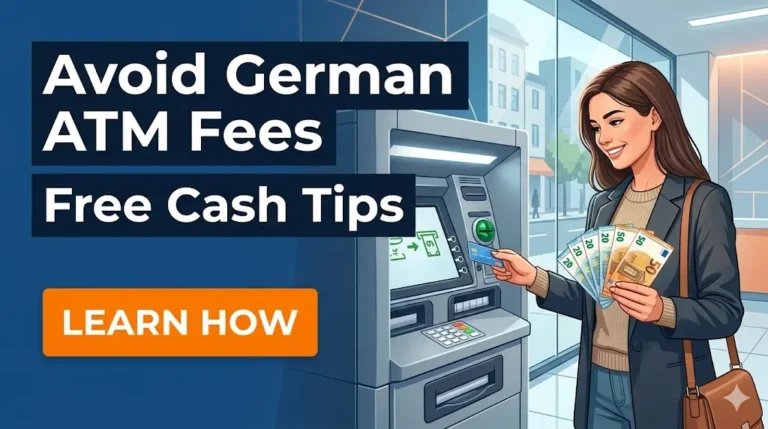
ATM withdrawal policies are another massive differentiator. In Germany, if you use an ATM that does not belong to your bank’s specific network, you will be hit with exorbitant withdrawal fees, often ranging from €4 to €6 per transaction. Traditional banks form alliances to combat this. For example, Deutsche Bank, Commerzbank, and Postbank form the “Cash Group,” allowing their customers to use each other’s ATMs for free. The Sparkasse and Volksbank operate their own massive, exclusive networks.
Neobanks handle cash differently. Because they do not own physical ATMs, platforms like N26 generally allow you a specific number of free withdrawals per month (usually 3 to 5) at any ATM that accepts Mastercard, regardless of the bank brand. Once you exceed that limit, they charge a flat fee (e.g., €2) per subsequent withdrawal. For expats who rely heavily on cash, evaluating your local neighborhood’s ATM density against these network alliances is a crucial step in choosing the right provider.
International Transfers and Exchange Rates
Expats rarely live their financial lives within a single currency zone. Whether you are paying off a student loan in the UK, sending support to family in India, or transferring savings from the US to fund an apartment deposit in Munich, the ability to move money across borders efficiently is paramount. If you rely on a traditional German bank to execute these international SWIFT transfers, you will be subjected to significant hidden costs. High-street banks routinely offer exchange rates that are 2% to 4% worse than the actual market rate, and they attach opaque, flat-fee processing charges on top.
This is where integrating specialized fintech platforms into your financial stack is highly recommended. Utilizing Wise fundamentally solves the cross-border transfer problem. Wise bypasses the expensive traditional SWIFT network, offering you the real, mid-market exchange rate and charging only a clear, minimal upfront fee. Linking your primary German Girokonto to a Wise account ensures that your global capital remains highly liquid without being eroded by punitive banking fees.
Furthermore, if your income streams are diversified—perhaps you freelance for an American company while living in Berlin—managing those incoming foreign funds directly through a traditional German bank can trigger manual compliance checks and delayed clearing times. Using multi-currency accounts to receive the funds locally in their native currency, and then converting them to Euros precisely when the market rates are favorable, provides a massive strategic advantage for the global professional.
Investment Opportunities and Trading
Once your daily liquidity is secured, building long-term wealth in Germany requires looking beyond a standard checking account. With inflation consistently eroding the purchasing power of cash, investing in the capital markets is essential. If you attempt to open a Depot (brokerage account) with a traditional German branch bank, you will likely be quoted high annual custody fees simply to hold your assets, along with steep commission fees of €10 to €20 every single time you buy or sell a stock.
For expats focused on building a globally diversified portfolio, independent international brokers are vastly superior to domestic retail banks. Utilizing a platform like Interactive Brokers allows you to access virtually every major global financial exchange with exceptionally low margin rates and trading commissions that cost mere fractions of a cent per share. Interactive Brokers is particularly advantageous for highly mobile expats; if you eventually leave Germany, an international brokerage account is infinitely easier to port to your new country compared to a rigidly localized German Depot.
When investing in Germany, you must also be acutely aware of the Abgeltungsteuer (capital gains tax). Germany levies a flat ~26.375% tax (including the solidarity surcharge) on all realized investment profits and dividends. While German-based brokers automatically withhold this tax for you, using an international broker requires you to manually report your gains on your annual tax return (Steuererklärung). To master these vital investment and taxation dynamics, exploring our detailed guides on Investing and Saving in Germany: Building Wealth as an Expat and Understanding Taxes in Germany: An Expat’s Guide to the German Tax System is highly advised.
How to Open a German Bank Account Successfully
Required Documents and the Anmeldung
The bureaucratic sequence of opening a bank account in Germany is often a classic “chicken and egg” scenario. Most traditional banks require you to present an Anmeldebestätigung—the official certificate proving you have registered your residential address with the local municipality (Bürgeramt). However, to secure a long-term apartment lease and actually get that address, landlords will almost always demand you provide a German bank account IBAN for the rent deposits.
To break this frustrating cycle, the required documents generally dictate which bank you must choose first. To open a traditional branch account, you will absolutely need your physical passport (ID cards are only accepted for EU citizens), your valid visa or residence permit, your Tax Identification Number (Steuer-ID), and the aforementioned Anmeldung certificate. You cannot walk into a Deutsche Bank branch with just a suitcase and a passport and expect to walk out with an active account.
This is the primary reason neobanks dominate the early expat experience. Digital platforms like N26 bypass the strict Anmeldung requirement during the initial onboarding phase. They require your passport for identity verification and simply ask for a valid shipping address anywhere in Germany where they can mail your physical debit card. This flexibility allows you to generate a functional German IBAN within your first few days in the country, breaking the bureaucratic deadlock and allowing you to confidently sign your rental and employment contracts.
The PostIdent and VideoIdent Verification Processes
Germany strictly enforces anti-money laundering (AML) and “Know Your Customer” (KYC) laws, meaning anonymous banking is entirely illegal. Every financial institution must definitively verify your identity before activating your account. Historically, if you opened an account with a direct online bank like DKB or ING, you had to use the PostIdent method. You would print out a verification form, take it to a physical Deutsche Post office along with your passport, and a postal worker would manually verify your documents, sign the form, and physically mail it to the bank.
Today, the industry standard has rapidly shifted to the VideoIdent process. This is a massive relief for expats. Utilizing your smartphone camera, you are connected to a certified verification agent via a secure video call. The agent will ask you to confirm your name, tilt your passport in front of the camera so they can verify the holographic security features, and read a confirmation code sent via SMS.
The entire VideoIdent process takes less than ten minutes and can be completed from your hotel room or temporary Airbnb. However, expats from certain countries should be aware that some specific non-EU passports lack the advanced holographic security features required by the VideoIdent software. If your specific passport is not supported by the digital system, you will unfortunately be forced to complete the manual PostIdent process at a local post office instead.
Protecting Your Financial Data Online
As you fully integrate into the digital banking ecosystem, managing your finances via smartphone apps and online portals becomes second nature. However, the convenience of digital banking introduces significant cybersecurity risks, especially for highly mobile expats. You will frequently find yourself checking your bank balance or paying utility bills while connected to unsecured public Wi-Fi networks in airports, coffee shops, or coworking spaces across Berlin or Frankfurt.
Accessing sensitive financial portals on unencrypted public networks exposes you to massive vulnerabilities, where malicious actors can intercept your login credentials through “man-in-the-middle” attacks. To secure your financial data, utilizing a premium Virtual Private Network (VPN) is absolutely vital. By running NordVPN on your laptop and smartphone, you encrypt all of your internet traffic with military-grade protocols, ensuring your banking passwords remain mathematically impossible to intercept, regardless of the network you are using.
Furthermore, NordVPN solves a highly frustrating administrative issue for expats. Many traditional banks in your home country utilize aggressive geoblocking software to prevent fraud. If you attempt to log into your American or British bank account from a German IP address, the system may instantly lock your account, assuming it has been compromised. By using the VPN to connect to a server back in your home country, you bypass these automated security hurdles, ensuring seamless, uninterrupted access to your global wealth portfolio while securely building your new financial life in Germany.
Conclusion
Securing the right bank account is the foundational step to a successful life in Germany. While the historical prestige and branch networks of traditional giants like Commerzbank or the local Sparkasse offer long-term stability and physical consultations, the sheer bureaucratic friction they present can be overwhelming for newcomers.
By leveraging the digital agility, English-language support, and zero-fee structures of modern neobanks like N26, expats can bypass the initial administrative roadblocks and secure a vital German IBAN immediately. Supplementing this local setup with powerful global tools like Wise for cross-border transfers and Interactive Brokers for long-term wealth building creates a robust, modern financial stack. Armed with a clear understanding of the Girocard system, the importance of ATM networks, and the digital security provided by tools like NordVPN, you can navigate the German financial ecosystem with total confidence and focus on thriving in your new home.
References
Primary sources (official)
- Federal Financial Supervisory Authority (BaFin): Official consumer guidelines on opening bank accounts and identity verification (VideoIdent/PostIdent). https://www.bafin.de/EN/Homepage/homepage_node.html
- Deutsche Bundesbank: Information on the German payment landscape, cash usage, and the Girocard system. https://www.bundesbank.de/en/tasks/payment-systems
Other helpful sources
- Make it in Germany: The official German government portal for qualified professionals, offering comprehensive guides on banking and setting up life abroad. https://www.make-it-in-germany.com/en/living-in-germany/money-insurance/bank-account
Disclaimer
The information provided in this article is for general informational and educational purposes only and does not constitute professional financial, tax, or legal advice. German banking regulations, fee structures, ATM network rules, and identity verification protocols are highly complex and subject to continuous changes. Always carefully read the official terms and conditions (AGB) provided by the specific financial institution before opening an account, signing a contract, or transferring funds. Consult with a certified financial advisor regarding your unique personal financial situation in Germany.