Understanding EC Cards (Girocard) vs Credit Cards in Germany
Standing at a grocery store checkout with a cart full of food, only to have your premium foreign credit card swatted away by a cashier demanding an “EC Karte,” is a deeply humiliating expat rite of passage. I once had to leave my groceries hostage while sprinting blocks to find a cash machine. This guide decodes the notoriously confusing German payment landscape so you never face checkout panic again.
Disclosure: This post may contain affiliate links. We may earn a commission at no extra cost to you if you make a purchase through these links. Read full disclosure.
The German Cash Culture and the Card Dilemma
Nur Bares ist Wahres
To truly understand how money moves in your new home, you must first wrap your head around a deeply ingrained cultural philosophy: “Nur Bares ist Wahres” (Only cash is true). If you are relocating from the United Kingdom, the United States, or the Nordic countries, you are likely accustomed to a virtually cashless society where buying a pack of gum with a tap of your smartphone is entirely normal. In Germany, relying solely on digital payments will lead to constant frustration and frequent logistical nightmares.
Despite the modernization forced by the recent global pandemic, a staggering percentage of the local economy still operates exclusively on paper currency. Small bakeries, neighborhood cafes, outdoor market stalls, and independent restaurants routinely refuse all forms of card payment. This preference for cash is not merely a technological lag; it is rooted in a fierce cultural desire for financial privacy and a historical skepticism of debt and institutional tracking. Germans prefer to physically see the money leaving their wallets, which provides an immediate, tangible sense of their daily budget constraints.
As an expat, you must rewire your daily habits to accommodate this reality. You should never leave your apartment without at least fifty euros in cash hidden in your wallet. Trying to argue with a stubborn bakery owner about the convenience of digital payments is a battle you will lose every single time. Accepting the cash culture is a fundamental step in your integration, acting as a core survival tactic discussed heavily in our Living in Germany Essential Guide to Daily Life.
The Shock of Card Rejection at the Checkout
When you do find a local business that proudly displays a card terminal at the cash register, your relief might be incredibly short-lived. Many newly arrived expats confidently present their foreign Visa or Mastercard, only to watch the machine immediately decline the transaction. The cashier will invariably point to a small, faded sticker on the terminal and say, “Nur EC-Karte” (Only EC Card).
This is the exact moment where the reality of the local banking system crashes into international expectations. The terminal is not broken, and your foreign bank account is not empty. The issue lies in the payment processing networks. Many small to medium-sized German businesses refuse to pay the higher merchant processing fees associated with international credit card networks like Visa, Mastercard, or American Express. Instead, their terminals are strictly configured to only accept transactions routed through the domestic, low-fee German banking network.
This rejection causes immense anxiety for foreign professionals who are still waiting for their local banking infrastructure to be set up. You might have thousands of euros in your home country account, but if you cannot access the local payment network, your purchasing power is effectively paralyzed. Navigating these restrictive payment gateways is a primary hurdle when mastering German Dining Etiquette Eating Out, Tipping, and Table Manners.
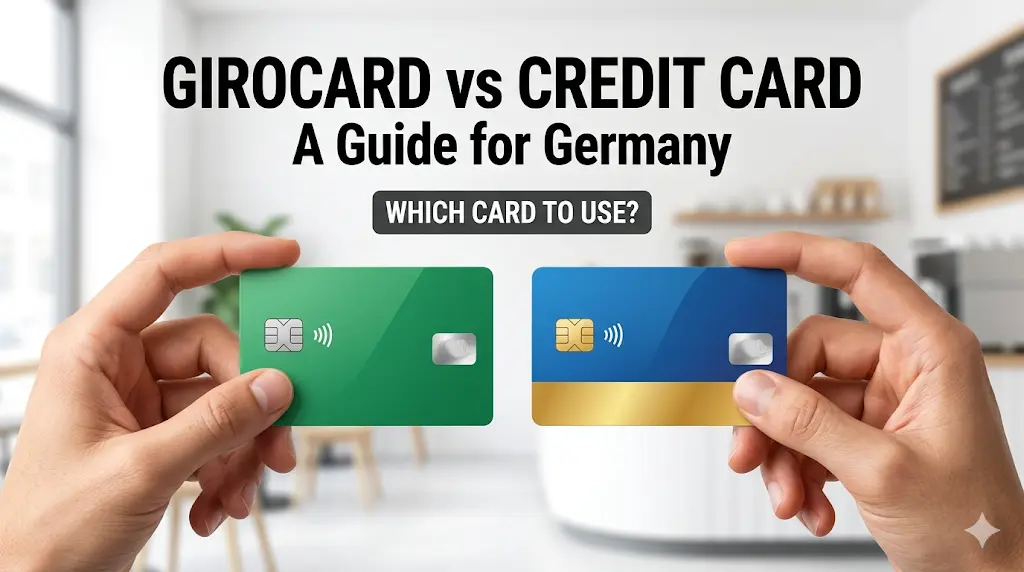
Decoding the EC Card Girocard
What Exactly is a Girocard
The term “EC Card” (EC-Karte) is actually an outdated relic of the past, originally standing for “Electronic Cash.” Although the German banking industry officially rebranded the system as the “Girocard” well over a decade ago, the entire population, including retail cashiers and bank tellers, stubbornly continues to call it the EC Card. When someone asks if you have an EC Card, they are asking if you have a Girocard.
A Girocard is a purely domestic debit card linked directly to your local German checking account, known as a Girokonto. It is issued automatically by almost every traditional brick-and-mortar bank in the country, such as the Sparkasse, Volksbank, Commerzbank, or Deutsche Bank. The Girocard system is a proprietary German payment network. It does not natively run on the Visa or Mastercard networks, which is precisely why it boasts near-universal acceptance across the country. Because the transaction fees for merchants are microscopically low, even the most stubborn neighborhood butcher will usually accept a Girocard.
When you insert or tap your Girocard at a terminal, the funds are pulled directly and immediately from your linked Girokonto. There is no line of credit involved. If you do not have sufficient funds in your account, or if you do not have an approved overdraft facility (Dispo), the transaction will be declined immediately. Setting up the account that provides this essential card is a critical milestone outlined in our comprehensive guide to Setting Up a German Bank Account.
How Girocards Work for Daily Life
Once you secure a Girocard, your daily friction in the local economy virtually disappears. It is the absolute master key to navigating retail in the country. You will use it to pay for your groceries at discount supermarkets like Aldi and Lidl, purchase tickets at local train station kiosks, and pay the notoriously high fees at the local citizens’ registration office (Bürgeramt), which frequently refuses any other form of payment.
Beyond retail purchases, the Girocard serves as your primary access pass to the massive network of automated teller machines (Geldautomaten) scattered across the country. However, you must be highly strategic about where you withdraw your cash. The German banking sector is heavily siloed. If you hold a Girocard from a Sparkasse bank, you can withdraw cash for free at any Sparkasse ATM in the country. But if you insert that exact same card into an ATM owned by the Volksbank or a private bank group, you will be hit with exorbitant withdrawal fees, sometimes reaching five to seven euros per transaction.
To combat these fees, you must understand your bank’s specific ATM alliance. The private banks form the Cash Group (Commerzbank, Deutsche Bank, Postbank), while the cooperative banks form the BankCard ServiceNetz. Understanding these alliances ensures you are not slowly draining your budget simply to access your own money, a crucial budgeting tactic we emphasize in our Cost of Living in Germany Budgeting Guide.
The Limitations of the Girocard
While the Girocard is practically flawless for buying bread in a local village, its functionality collapses the moment you attempt to interact with the modern, globalized digital economy. Because it is a proprietary, domestic network, a pure Girocard does not have a 16-digit card number, an expiration date, or a three-digit CVC security code printed on the back.
This means a traditional Girocard is completely, absolutely useless for online shopping. You cannot use it to book a flight, order a product from an international retailer, or sign up for a digital streaming service. Furthermore, if you travel outside the borders of Germany—even just crossing into neighboring France or the Netherlands—a pure Girocard will frequently be rejected at foreign payment terminals.
Historically, traditional German banks masked this massive flaw through “co-badging.” They would embed a secondary international network chip, usually Maestro or V-Pay, onto the physical Girocard to allow for foreign ATM withdrawals and limited international purchases. However, Mastercard has officially announced the phase-out of the Maestro system. This massive systemic shift is forcing German banks to rethink their payment cards, causing significant confusion for consumers who suddenly find their cards declining abroad. Understanding how your salary is deposited into this restrictive system is a key component of analyzing Understanding Your German Payslip and Net Income.
The Role of Credit Cards in Germany
Why True Credit Cards are Rare
To comprehend why actual credit cards are relatively rare in this economy, you must look at the German language itself. The German word for debt is “Schulden,” which famously shares its root with the word “Schuld,” meaning guilt. The culture exhibits a profound, deeply seated psychological aversion to accumulating revolving consumer debt. Living beyond one’s means to finance a lifestyle via credit is widely viewed as financially reckless and socially irresponsible.
Consequently, the concept of a true, revolving credit card—where you carry a balance from month to month and pay exorbitant interest rates—is highly uncommon. When a German bank issues you what they call a “Kreditkarte,” it is almost always a “Charge Card.” Under a charge card system, you are granted a credit limit for the month, allowing you to make purchases and book flights. However, at the very end of the billing cycle, the bank automatically and forcefully pulls the entire outstanding balance directly from your linked checking account in one massive lump sum.
You do not have the option to pay a “minimum balance” and roll the rest over to the next month. If your checking account does not have sufficient funds to cover the monthly pull, you will face severe financial penalties, and a negative mark will be immediately submitted to the national credit bureau. Grasping this rigid structure is essential for anyone trying to navigate Understanding the German Credit System without accidentally destroying their financial standing.
Debit and Prepaid Alternatives
Because traditional credit cards require rigorous credit checks and a proven history of local income, newly arrived expats are frequently rejected when they apply for one. To bridge this gap, many foreigners turn to Visa or Mastercard debit cards. Unlike a Girocard, a Visa or Mastercard debit card possesses the standard 16-digit number and CVC code, allowing for seamless online shopping and global acceptance.
The crucial distinction is that a debit card operates exactly like a Girocard financially: the money is deducted instantly from your available balance. There is no line of credit extended to you. Many modern and traditional banks now offer a “two-card wallet” solution. They will issue you a standard Girocard for domestic retail dominance, alongside a secondary Visa Debit card to handle your online subscriptions and international travel needs.
For those who want to completely isolate their spending, prepaid credit cards are another viable option. You transfer a set amount of cash onto the prepaid card, and you can only spend exactly what you loaded. While excellent for budgeting and avoiding the dreaded debt trap, prepaid cards frequently face rejection when you attempt to use them for specific high-security transactions.
When You Absolutely Need a Visa or Mastercard
Despite the domestic dominance of the Girocard, living exclusively without a Visa or Mastercard is virtually impossible for a globally mobile expat. You will encounter several critical scenarios where a Girocard will simply not be accepted, making a secondary card an absolute necessity.
The most prominent hurdle involves booking travel logistics. If you attempt to rent a car at an airport or book a room at a major international hotel chain, the merchant will demand a physical credit card to place a security hold or deposit. A Girocard cannot process “holds” or “authorizations.” If you only possess a Girocard, you will frequently be denied the rental car or forced to pay massive, non-refundable cash deposits upfront. Even debit cards are sometimes rejected by rigid car rental agencies that specifically demand a true credit card with an embossed name.
Additionally, as you begin to settle into your new life, you will want to execute international transactions, purchase software subscriptions, or book train tickets through third-party global aggregators. These platforms do not integrate with the localized German payment networks. If you plan to manage ongoing subscriptions or travel frequently across the European Union, securing a widely accepted Visa or Mastercard must be near the top of your administrative checklist.
Navigating Digital Banking and International Transfers
The Rise of Neobanks and Modern Payment Solutions
The deep frustration expats experience when dealing with the rigid, paper-heavy bureaucracy of traditional German banks has fueled a massive explosion of digital-first “Neobanks.” These mobile-centric institutions have completely disrupted the market by offering services explicitly tailored to the modern, borderless lifestyle, stripping away the archaic requirements that make traditional banking so painful.
Opening an account with a platform like N26 allows you to bypass the traditional Girocard trap entirely. N26 issues a standard Mastercard debit card as its primary payment vehicle. Because N26 provides a fully functional German IBAN, you can use the account to receive your local salary and pay your domestic utility bills, while simultaneously enjoying the seamless global acceptance of a Mastercard for all your online and international purchases.
The user interface of these modern apps provides real-time push notifications, allowing you to track your spending instantly—a stark contrast to traditional banks where transactions often take days to appear on a physical statement. This digital transparency is invaluable for expats trying to budget in a new currency. Furthermore, the ability to lock your card, change your PIN, and adjust withdrawal limits directly from your smartphone removes the need to ever visit a physical branch or speak to a teller in broken German.
Managing Multi Currency Finances
One of the most complex financial challenges expats face is managing wealth across multiple borders. When you first move to the country, you likely need to transfer significant savings from your home currency to pay for your apartment security deposit, your initial rent, and the upfront costs of furnishing your new life. If you execute a direct bank-to-bank international wire transfer, traditional financial institutions will bury you in hidden currency conversion margins and exorbitant flat fees.
To avoid surrendering your hard-earned savings to predatory banking rates, savvy expats rely on specialized international transfer services. Utilizing Wise allows you to move large sums of money across borders using the real, transparent mid-market exchange rate. You can hold balances in dozens of different currencies simultaneously, insulating yourself against sudden macroeconomic currency fluctuations.
Even more beneficial is the physical multi-currency debit card offered by Wise. While you are waiting weeks for your official German bank account to be approved and your plastic Girocard to arrive in the mail, you can use your multi-currency card to pay for your initial groceries, train tickets, and daily expenses. It acts as the perfect financial bridge during the chaotic first month of relocation, ensuring you always have access to your funds without paying international transaction penalties.
Connecting Your Cards to Your Investments
As you settle into your expat life and begin generating a stable surplus of income, letting your savings rot in a standard checking account is a massive financial error. German banks offer notoriously low, and sometimes even negative, interest rates on basic savings accounts. To build long-term wealth and combat inflation, you must redirect your surplus capital into the global financial markets.
However, domestic German brokerage accounts are often plagued by incredibly high order execution fees and restrictive access to international stock exchanges. They also automatically withhold a flat 25 percent capital gains tax the moment you execute a profitable trade. For highly mobile professionals who might eventually leave the country, tying your assets to a rigid domestic broker is strategically inefficient.
Instead, many veteran expats choose to route their savings outward. By linking your daily checking account to an international platform like Interactive Brokers, you gain unrestricted, low-cost access to global equities, bonds, and international index funds. Sending your monthly surplus from your local German account directly to Interactive Brokers allows you to build a globally diversified, multi-currency portfolio. If you ever relocate to another country, your investment portfolio moves seamlessly with you, avoiding the complex tax nightmares of unwinding domestic German assets. This level of strategic planning is the core focus of Managing Expat Finances and Investments.
Comparing Your Card Options
Girocard vs Visa and Mastercard Breakdown
To help you clearly navigate the payment landscape, the following table breaks down the core differences between the traditional domestic card and the global alternatives.
| Feature / Capability | EC Card (Girocard) | True Credit Card (Charge Card) | Debit Card (Visa/Mastercard) |
| Acceptance in Germany | High (post offices, most shops; many small bakeries are cash only) | Medium (Often rejected at small merchants) | Medium to High (Growing acceptance) |
| Online Shopping | Extremely Poor (Cannot be used on global sites) | Excellent | Excellent |
| International Travel | Poor (Often declined outside Germany) | Excellent | Excellent |
| Car Rentals & Hotels | Not Accepted for security deposits | Mandatory | Often accepted, but occasionally rejected |
| Line of Credit | None (Immediate deduction from checking) | Monthly limit (Paid in full at month’s end) | None (Immediate deduction from checking) |
| ATM Withdrawals | Free at specific domestic banking alliances | Often incurs high fees for cash advances | Often includes free global withdrawals |
Practical Strategies for the Expat Wallet
Relying on a single payment method in this country is a recipe for disaster. The most effective strategy for an expat is to build a diversified “wallet portfolio” that covers all potential commercial interactions. You must blend the traditional with the modern to ensure you are never caught empty-handed.
First, always carry physical cash. Keeping roughly fifty euros in small bills and coins in your pocket guarantees you can buy a coffee, pay for a quick taxi ride, or purchase fresh produce at the weekend farmers market without awkward apologies. Cash remains the ultimate fail-safe in the German economy.
Second, you must secure a localized card for domestic dominance. If you opt for a traditional bank, ensure you carry your Girocard for all daily retail interactions, trips to the discount supermarket, and bureaucratic appointments. Finally, you must hold a secondary global card—whether a true Charge Card or a modern debit card—to handle your flight bookings, international subscriptions, and emergency travel needs. If you are struggling to manage these multiple payment streams while filing your annual returns, reviewing How to File Taxes in Germany as an Expat will help you keep your financial documentation organized. By carrying a hybrid wallet of cash, a localized card, and a global card, you will seamlessly blend into the local economy without surrendering your international mobility.
References
Primary sources (official)
- Deutsche Bundesbank – Payment behaviour in Germany in 2021/2023: https://www.bundesbank.de/en/publications/reports/studies/payment-behaviour-in-germany-738024
- Girocard Official Portal – About Germany’s leading debit card: https://www.girocard.eu/english/
- BaFin (Federal Financial Supervisory Authority) – Debit cards and credit cards: https://www.bafin.de/EN/verbraucherinnen-verbraucher/themen-finanzprodukte/konten-zahlungen/zahlungen/zahlungskarten/zahlungskarten_en.html
Other helpful sources
- Expatica – A guide to banking in Germany: https://www.expatica.com/de/finance/banking/banking-in-germany-108034/
- N26 Magazine – The difference between an EC card and a debit card: https://n26.com/en-de/blog/ec-card-vs-debit-card
Disclaimer
The financial regulations, card network acceptances, and banking structures detailed in this article are based on standard industry practices and federal German banking guidelines at the time of publication. The transition away from Maestro co-badging and the evolving acceptance of Visa and Mastercard in local retail environments are ongoing macro-economic shifts and subject to rapid change by domestic institutions. Financial platforms, banking features, and investment regulations mentioned are for illustrative purposes and subject to the terms and conditions of the specific providers. This guide is intended for general informational purposes only and does not constitute legally binding financial, investment, or banking advice. Always consult with a certified financial advisor or directly with your banking institution to assess your specific account privileges and fee structures before committing to financial contracts.