Finances for International Students: Managing Money on a Student Budget
Watching your first blocked account payout disappear entirely into rent and health insurance deposits leaves you staring at a terrifyingly empty bank balance. I spent my first semester surviving on discount pasta because I grossly underestimated local hidden costs. This guide decodes the reality of the German student budget, from navigating strict visa withdrawal limits to stretching every single euro.
Disclosure: This post may contain affiliate links. We may earn a commission at no extra cost to you if you make a purchase through these links. Read full disclosure.
The Reality of the Blocked Account and Sperrkonto Rules
The defining financial feature of studying in Germany as a non-EU citizen is the blocked account. It is a brilliant administrative tool for the German government, but it is a massive source of daily anxiety for international students who suddenly have restricted access to their own life savings.
How the Monthly Payout System Works
To secure your student visa, you are legally required to prove you have sufficient financial resources to survive your first year without relying on public funds. You do this by depositing a state-mandated minimum amount into a specialized blocked account. As of 2026, this required baseline has increased to 11,904 euros for a full year of study.
The bureaucratic catch is that you cannot touch this lump sum. The account is legally “blocked” by the government. Instead, the provider is only allowed to release exactly one-twelfth of the total amount—currently 992 euros—to your regular checking account each month. This monthly drip is designed to ensure you do not spend all your money in the first semester, but it creates immense cash flow problems when you face massive upfront costs like your university semester contribution or an apartment security deposit.
If your rent is 600 euros, and your mandatory public health insurance is roughly 120 euros, your monthly 992-euro payout evaporates instantly. You are left with a tiny margin for food, textbooks, and transportation. Accurately mapping out these rigid constraints against the local economy is a crucial survival skill explored deeply in Cost of Living in Germany: Breakdown of Expenses Rent Food Transport.
Avoiding Withdrawal Traps and Fees
Getting your money into the blocked account from your home country is the first massive financial hurdle you will face. Traditional international wire transfers route through the SWIFT network, which means your home bank, and several intermediary banks, will aggressively shave off arbitrary fees from your principal amount.
If you wire exactly 11,904 euros, but intermediary banks deduct 50 euros in transit, the account provider will reject your visa confirmation certificate because the final balance is short of the legal minimum. You are then forced to send a second international wire just to cover the 50-euro shortfall, incurring another round of massive bank fees.
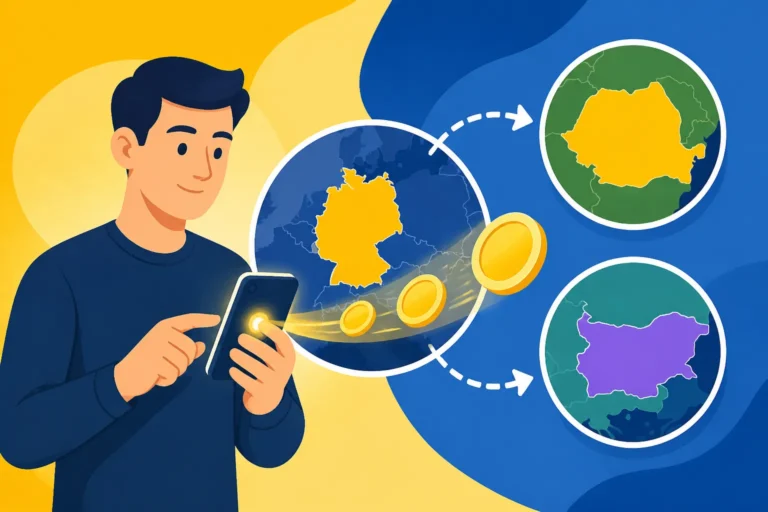
To bypass this expensive trap, veteran international students rely heavily on financial technology. By using Wise to fund your initial blocked account, you can convert your home-country currency into euros at the real mid-market exchange rate. You transfer your local currency to Wise, and they deposit the exact required euro amount directly into the German blocked account for a highly transparent, minimal fee. Understanding how to execute these large capital transfers without triggering international banking holds is thoroughly explained in Moving Money to Germany: Declaring Savings and Large Transfers.
Essential Banking Tools for Your Daily Life
A blocked account is essentially a locked vault; it cannot be used to pay for your groceries or set up a direct debit for your gym membership. To actually live in Germany, you need a standard checking account to catch the monthly payout from your locked vault.
Overcoming the Anmeldung Banking Catch
Here is the most frustrating paradox of arriving in Germany: traditional banks require an official city registration certificate to open a checking account. However, you cannot sign a lease to get that registration certificate unless you have a functional bank account with a European IBAN to pay the deposit.
Students often waste weeks trapped in this bureaucratic loop, unable to access their first month of funds. You can completely sidestep this nightmare by utilizing modern mobile banks. Opening an account with N26 allows you to bypass the traditional paperwork paradox. Because N26 verifies your identity digitally using just your passport, you can secure a fully licensed German IBAN within minutes of landing at the airport, long before you navigate the grueling steps detailed in German Bureaucracy 101: Understanding the Anmeldung, Schufa, and Tax ID.
Once your N26 account is active, you simply provide this new IBAN to your blocked account provider. Your 992 euros will automatically drop into this functional mobile account on the first of every month, giving you immediate access to your money via a digital debit card you can add to Apple or Google Pay. For a broader view of how these digital solutions compare to legacy banks, review Mobile Banking Apps in Germany: N26, Revolut, and More.
Splitting Bills and Managing Cash Flow
Living on a strict 992-euro monthly budget means you cannot afford a single unexpected overdraft fee. Most international students survive by living in a shared flat, which introduces the chaos of splitting utility bills, internet costs, and shared grocery runs.
If you are the primary leaseholder and responsible for paying the massive monthly energy bill, you need a foolproof way to collect money from your roommates. Modern banking apps are a lifesaver here. N26 features instant peer-to-peer transfers and the ability to create sub-accounts called “Spaces.” The moment your monthly blocked payout hits, you can immediately drag your rent and utility share into a locked Space, ensuring you do not accidentally spend it on a weekend out.
Living in a shared environment requires strict financial boundaries and communication. If your roommate uses a traditional savings bank, their transfer for the internet bill might take three business days to reach you. By integrating modern digital tools into your household, you remove the friction of shared expenses, a dynamic deeply analyzed in Housing for Students: Living in Dorms vs Off-Campus WG.
Navigating Part Time Income and Taxes
Because the blocked account payout is rarely enough to fund a comfortable lifestyle in a major city like Munich or Berlin, nearly every international student eventually looks for a part-time job. However, the German state heavily regulates your right to work.
The New 140 Day Working Rule for International Students
Your student visa explicitly limits how much you can participate in the local labor market. Historically, this was capped at 120 days, but under the updated Skilled Immigration Act, the allowance for non-EU students has been generously expanded.
As an international student, you are now legally permitted to work 140 full days or 280 half-days per calendar year. A “full day” is generally defined as any shift lasting more than four hours, while a “half-day” is any shift of four hours or less. This rule is violently strictly enforced by the immigration office. If you exceed this 140-day limit without explicit prior permission from the Federal Employment Agency, you risk immediate deportation and the cancellation of your visa.
The only major exception to this rule is working as an academic assistant at your university. These hours generally do not count toward your 140-day limit, making them highly coveted positions. Understanding the nuanced legal risks of employment and tracking your shifts meticulously is critical, a topic covered extensively in Working Part-Time as a Student: Rules for Working on a Student Visa.
Managing Tax Returns and the Mini Job Limit
The most popular form of employment for students in Germany is the “Mini-job.” This is a legally defined employment category designed for part-time workers, and the threshold routinely adjusts with inflation.
As of recent updates, the Mini-job earning limit is set at 556 euros per month. If you earn 556 euros or less, your income is entirely tax-free, and you do not have to pay into the heavy German social security and unemployment systems. You simply pocket the gross amount. Combining your 992-euro blocked account payout with a tax-free 556-euro Mini-job salary gives you a very comfortable student operating budget of over 1,500 euros a month.
However, if you take a standard part-time corporate role or a paid internship that pays more than the Mini-job limit, you will transition into a regular tax bracket. Your employer will automatically deduct income tax, health insurance, and pension contributions from your paycheck. The silver lining is that because your total annual income as a student will likely fall below the German tax-free base allowance, you can file a tax return at the end of the year and get almost all of those withheld income taxes refunded. Decoding the complex acronyms on your payslips and tax documents is a vital skill mapped out in Understanding German Bank Statements: Fees and Transactions Explained.
Budgeting Tactics to Stretch Your Euros
Surviving the German academic environment is just as much about playing defense with your money as it is about earning part-time income. You must radically adjust your consumer habits to match the local economy.
Mastering the German Supermarket Run
The single biggest drain on an unprepared student’s budget is food. If you rely on food delivery apps or eat at campus cafeterias for every meal, you will run out of money by the third week of the month. You must learn how to navigate the hyper-competitive German discount supermarket sector.
Germany invented the hard-discount grocery model. Stores like Aldi, Lidl, Netto, and Penny offer phenomenally high-quality basic ingredients at rock-bottom prices. You should avoid doing your primary weekly shopping at premium supermarkets like Rewe or Edeka unless you are looking for highly specific international ingredients.
| Expense Category | Premium Lifestyle | Student Survival Budget | Monthly Savings |
| Groceries | Premium supermarkets & delivery apps (350€) | Aldi / Lidl meal prep (180€) | 170€ |
| Transport | Uber & single tram tickets (80€) | Semesterticket / Deutschlandticket (included/subsidized) | 80€ |
| Banking Fees | Traditional bank maintenance & SWIFT fees (15€) | Digital mobile banking (0€) | 15€ |
| Coffee | Daily cafe purchases (90€) | Home brewing (15€) | 75€ |
Furthermore, Germany operates a strict bottle recycling system called Pfand. When you buy a plastic bottle or a can, you pay an extra 25 cents deposit. Do not throw these away. Returning them to the reverse vending machines at the supermarket is a mandatory part of stretching your grocery budget. A single trash bag of empty bottles can easily pay for a week’s worth of pasta and vegetables.
Investing Small Savings for the Future
If you successfully master your budget, combine your blocked account payout with a Mini-job, and cook at home, you will find yourself in a rare position: having surplus cash at the end of the month as a student.
The worst thing you can do is let this extra 50 or 100 euros sit idly in a checking account losing value to inflation. Building long-term wealth does not require a massive post-graduate corporate salary; it requires time in the market. Many savvy international students take their leftover monthly budget and immediately sweep it into a globally compliant brokerage account. By using Interactive Brokers, you can invest tiny fractional amounts into globally diversified ETFs with exceptionally low fees.
Because Interactive Brokers caters to a highly mobile international client base, your investments are not trapped in a rigid German banking product if you decide to leave the country after graduation. By deploying your surplus euros into Interactive Brokers today, you establish the compounding financial habits that will fund your future, proving that managing a student budget in Germany is not just about survival—it is about laying the foundation for your global financial independence.
References
Primary sources (official)
- Auswärtiges Amt (Federal Foreign Office) – Sperrkonto: The official government directive outlining the mandatory blocked account requirements, acceptable providers, and the current 11,904 EUR baseline for international students. https://www.auswaertiges-amt.de/de/sperrkonto-375488
- Minijob-Zentrale: The central German collection and registration agency providing the definitive legal rules on the 556 EUR monthly earning limit, social security exemptions, and student working hours. https://www.minijob-zentrale.de/
Other helpful sources
- DAAD (German Academic Exchange Service) – Side Jobs: A comprehensive guide detailing the 140 full days or 280 half-days employment regulation for non-EU international students, including exceptions for academic assistants. https://www.daad.de/en/studying-in-germany/work-career/side-jobs/
- Expatrio – Working Rights in Germany: A highly practical breakdown of international student labor rights, minimum wage compliance, and how to handle employment contracts safely while studying. https://www.expatrio.com/about-germany/working-rights-germany
Disclaimer
The information provided in this article is for general informational and educational purposes only and does not constitute professional financial, tax, or immigration advice. German visa regulations, specifically the mandatory blocked account (Sperrkonto) limits and the 140-day employment restriction under the Skilled Immigration Act, are strictly enforced by local immigration offices (Ausländerbehörde). Exceeding your permitted working hours can result in the immediate revocation of your student residence permit. The Mini-job earning limit is subject to dynamic adjustments by the German government based on the statutory minimum wage.