Should You Invest in German or International Stocks? Diversifying as an Expat
Moving to Germany and realizing your local bank pays zero interest while inflation slowly eats your savings is incredibly frustrating. I spent my first year completely paralyzed, leaving my money in a standard checking account because I was terrified of triggering a cross-border tax audit by buying the wrong stock. This guide demystifies the German capital gains system and explains how to safely diversify your portfolio internationally.
Disclosure: This post may contain affiliate links. We may earn a commission at no extra cost to you if you make a purchase through these links. Read full disclosure.
The “Home Bias” Trap: Looking Beyond the DAX
When you first settle into the German economy, it is incredibly tempting to invest in what you see around you. Every day, you see BMWs on the Autobahn, Siemens appliances in your kitchen, and SAP software in your office. Naturally, many expats assume that investing heavily in the DAX (the German stock market index) is the safest, most logical way to build wealth locally.
Why You Need International Diversification
Investing heavily in the country where you currently live is a psychological phenomenon known as “home bias.” For expats, this is a dangerous financial strategy. The DAX 40 only represents forty major German corporations. It is heavily weighted toward traditional, cyclical industries like legacy automotive manufacturing, chemicals, and industrials, while remaining notoriously light on modern technology and software.
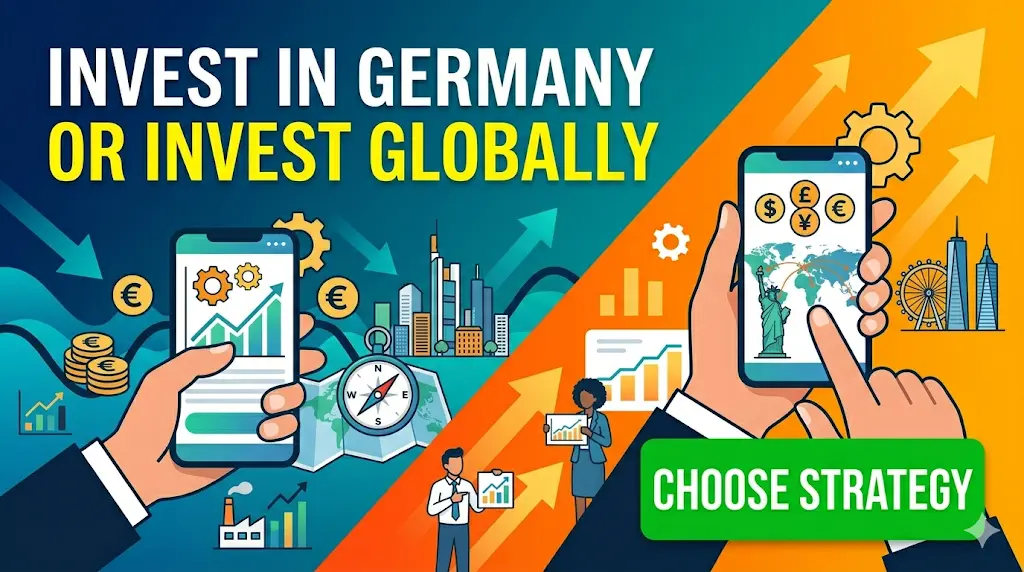
Furthermore, as an expat, your human capital (your salary) is already deeply tied to the German economy. If a severe recession hits Germany, your job might be at risk at the exact same time your DAX-heavy stock portfolio crashes. To truly protect yourself, you must decouple your investment wealth from your immediate geographic location by purchasing globally diversified funds, such as ETFs tracking the MSCI World or the FTSE All-World indices. Ensuring you do not tie all your financial fates to a single country is a core survival strategy explored in Taxing Worldwide Income: How Germany Taxes Foreign Income and Assets.
Decoding the German Capital Gains Tax (Abgeltungsteuer)
The most paralyzing fear for international professionals is misunderstanding the local tax system. Fortunately, compared to the labyrinth of income tax, the German system for taxing investments is surprisingly straightforward and mathematically predictable.
The 26.375% Flat Tax Rate
In Germany, profits generated from selling stocks, as well as dividends and interest, are subject to a flat capital gains tax known as the Abgeltungsteuer (final withholding tax).
The base tax rate is a flat 25%. On top of this, the government adds a 5.5% Solidarity Surcharge (Solidaritätszuschlag). When combined, your effective capital gains tax rate is 26.375%. If you are registered with a church in Germany, the applicable church tax (8% or 9% depending on your federal state) will be added to this amount, bringing the total slightly higher.
The beauty of the Abgeltungsteuer is that it operates entirely independently of your personal income tax bracket. Whether you earn 40,000 euros or 140,000 euros from your day job, your capital gains are taxed at that exact same flat rate.
The Tax-Free Allowance (Sparer-Pauschbetrag)
The German government actually gives you a small break before they start taxing your investments. Every resident is entitled to a tax-free allowance for capital income (Sparer-Pauschbetrag). As of recent tax years, this allowance is 1,000 EUR per person per year (or 2,000 EUR for a married couple filing jointly).
If your stocks pay you 800 EUR in dividends this year, you owe zero tax on that money. To ensure you aren’t taxed automatically, you must proactively set up an exemption order (Freistellungsauftrag) with your bank or broker. If you fail to do this, the broker will withhold the tax, and you will be forced to reclaim it by filing an annual tax return—a tedious process mapped out in Understanding Your Tax Assessment (Steuerbescheid): After You File in Germany.
The Vorabpauschale on Accumulating ETFs
For expats investing in accumulating ETFs (funds that automatically reinvest dividends rather than paying them out as cash), Germany introduced a pre-emptive tax called the Vorabpauschale.
Because the government does not want to wait twenty years for you to sell the ETF to collect their tax revenue, they assume a small, fictitious annual baseline return and tax it at the start of the year. This prevents endless tax deferral. However, the system is designed fairly: any tax you pay via the Vorabpauschale now is fully credited against your final tax bill when you eventually sell the ETF, ensuring you are never taxed twice on the same profit. To encourage people to invest in equities, Germany also offers a partial tax exemption (Teilfreistellung); if your ETF consists of at least 51% stocks, 30% of the profits are entirely tax-free.
Choosing the Right Broker: Domestic vs. International
Your choice of brokerage dictates how aggressively you can invest and how painful your eventual exit from Germany will be.
The Limitations of Domestic Neo-Brokers
Local German neo-brokers (like Trade Republic or Scalable Capital) are incredibly popular because they handle all the tax withholding automatically. When you earn a dividend, they instantly deduct the 26.375% and send it to the Finanzamt. You don’t have to lift a finger.
However, domestic brokers are designed for people who intend to live and die in Germany. If you are an expat on a temporary contract, opening a strictly German brokerage is a trap. If your international relationship or career forces you to relocate to another country, traditional German brokers will often legally force you to liquidate your entire portfolio because they cannot service non-residents. Liquidating your assets triggers a massive, immediate capital gains tax event, effectively destroying years of compound interest. Navigating the legal implications of these localized restrictions is just one facet of German Bureaucracy 101: Understanding the Anmeldung, Schufa, and Tax ID.
The Expat Solution: Globally Compliant Brokerages
Veteran expats actively avoid this forced-liquidation trap by utilizing internationally portable platforms. By housing your investments in Interactive Brokers, you physically separate your wealth from localized, restrictive German banking products.
Because Interactive Brokers operates globally, it simply travels with you. If you leave Germany, you do not have to sell a single share; you just log into Interactive Brokers, update your new tax residency, and your portfolio continues compounding without interruption. Furthermore, Interactive Brokers supports multi-currency accounts. This means you can buy US or UK stocks directly without paying exorbitant currency conversion spreads.
| Feature | Domestic German Broker | Interactive Brokers (International) |
| Tax Handling | Withheld automatically | You must declare via Anlage KAP |
| Expat Portability | Extremely poor (Forced liquidation) | Excellent (Moves across borders) |
| Currency Options | EUR only | Multi-currency supported |
| Target Audience | Permanent residents | Highly mobile expats |
However, using a foreign broker means the German tax is not withheld automatically. You are legally required to declare your capital gains and dividends manually on your annual German tax return using the Anlage KAP form. Thankfully, Interactive Brokers provides robust, localized European tax reporting documents that make this declaration straightforward for your tax advisor.
Orchestrating Your Daily Finances and Investment Capital
Managing a global stock portfolio while living in Germany requires a clean, deeply organized financial pipeline. You must strictly separate your operational household money from your investment capital.
Funding Your Investment Account
If you are a newly arrived expat trying to move bulk savings from your home country into your new brokerage account, using traditional legacy bank wires will obliterate your capital through hidden SWIFT fees and terrible exchange rates.
To bypass this, you must intercept the exchange process. Utilizing Wise allows you to convert your home currency into euros at the true mid-market exchange rate. You can initiate a transfer through Wise, converting your dollars or pounds cleanly and cheaply, and then deposit those funds directly into your brokerage. By avoiding the predatory margins of traditional banks, you ensure that every possible cent of your wealth is actually put to work in the market. Understanding the mechanics of these cross-border transfers and how to avoid triggering money-laundering flags is detailed in Moving Money to Germany: Declaring Savings and Large Transfers.
Separating Daily Spending from Wealth Building
Once your capital is deployed, you must protect your daily cash flow. Keeping your rent and grocery money in the same ecosystem as your global investments creates accounting chaos.
You need an agile, modern banking hub for your daily German life. Opening an account with N26 provides you with a localized German IBAN, ensuring your utility bills, gym memberships, and rent are perfectly integrated into the mandatory SEPA direct debit system. By using N26 to catch your monthly salary and manage your local expenses, you completely insulate your daily survival from the volatility of your investment portfolio.
Whenever you have surplus cash at the end of the month in your N26 account, you simply sweep it out and send it to your investment portfolio. This strict compartmentalization ensures your German obligations are always met while your long-term wealth grows undisturbed. Exploring how to optimize your daily banking setup to facilitate this flow is a core concept mapped out in Mobile Banking Apps in Germany: N26, Revolut, and More. If you still maintain financial obligations in your home country, balancing these three pillars—daily German banking, home-country debts, and global investments—requires the comprehensive strategies found in Cross-Border Banking: Managing Your Home Country Account While in Germany.
References
Primary sources (official)
- Bundesministerium der Finanzen (BMF): The Federal Ministry of Finance’s official guidelines on the taxation of capital income, detailing the 25% Abgeltungsteuer and the application of the solidarity surcharge. https://www.bundesfinanzministerium.de/Content/DE/Standardartikel/Themen/Steuern/Steuerarten/Kapitalertragsteuer/kapitalertragsteuer.html
- Bundeszentralamt für Steuern (BZSt): The Federal Central Tax Office’s legal framework explaining the Vorabpauschale calculation for accumulating investment funds under the Investment Tax Act (Investmentsteuergesetz). https://www.bzst.de/DE/Unternehmen/Kapitalertraege/Investmentsteuerreformgesetz/investmentsteuerreformgesetz_node.html
Other helpful sources
- Settle in Berlin – Capital Gains Tax Guide: A highly practical, plain-English breakdown for expats regarding how to declare foreign brokerage accounts on the Anlage KAP form and how partial exemptions (Teilfreistellung) function for equity ETFs. https://www.settle-in-berlin.com/income-tax-germany/capital-gains-tax-in-germany-guide/
- Prinz.Tax – ETF Tax Guide for US Expats in Germany: A specialized tax advisory guide explaining the complex intersection of the German Vorabpauschale and the strict reporting requirements for foreign investments. https://prinz.tax/blog/etf-tax-guide-for-u-s-expats-in-germany/
Disclaimer
The information provided in this article is for general informational and educational purposes only and does not constitute professional financial, tax, or legal advice. German tax laws regarding the capital gains withholding tax (Abgeltungsteuer), the pre-emptive tax on accumulating funds (Vorabpauschale), and the mandatory declaration of foreign brokerage accounts (Anlage KAP) are highly complex and strictly enforced by the Finanzamt. Residents of Germany are subject to unlimited tax liability on their worldwide investment income.