Refugee vs Expat: Understanding Asylum Options in Germany (for those seeking refuge)
Arriving in Germany to escape danger is a chaotic, frightening experience, vastly different from relocating for a corporate job. I once spent hours consoling a friend who nearly jeopardized her legal status because she misunderstood the rigid difference between seeking international protection and applying for a standard work permit. This guide clarifies Germany’s complex asylum options and immigrant classifications.
Disclosure: This post may contain affiliate links. We may earn a commission at no extra cost to you if you make a purchase through these links. Read full disclosure.
The Fundamental Divide Between Expats and Asylum Seekers
Defining the Expat Path and Economic Migration
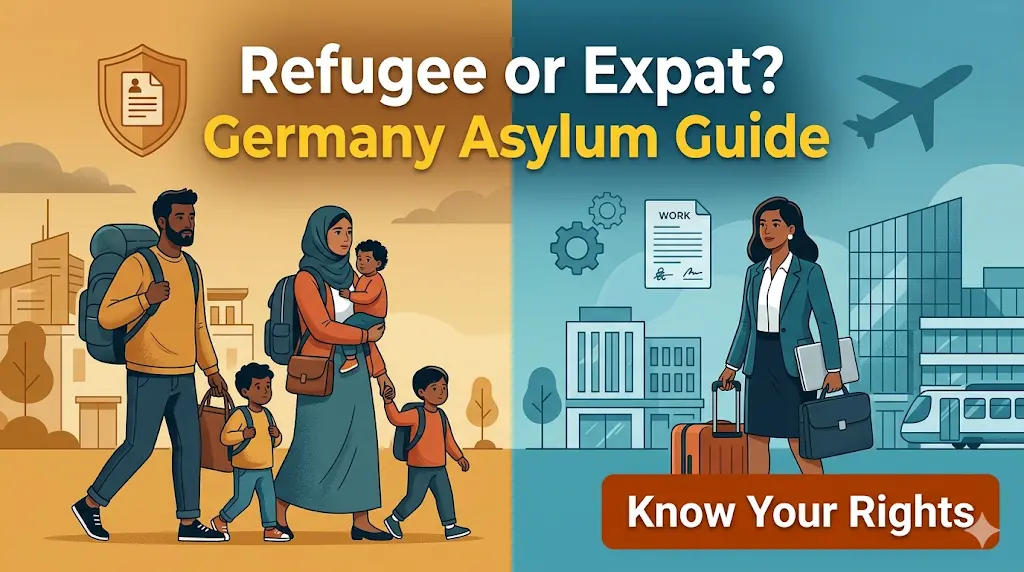
When we use the term “expat” in Germany, we are generally referring to economic migrants. These are individuals who relocate to the country by choice, usually for career advancement, higher education, or to start a business. Their journey is entirely governed by the standard framework of the Residence Act, and their path is highly structured. Expats meticulously plan their moves months in advance, secure employment contracts before crossing the border, and arrive with the capital needed to establish a comfortable life.
The German state views expats as a vital economic resource. Consequently, the visa requirements for this group are heavily focused on proving financial independence and professional qualifications. For example, international students rely on Expatrio to set up blocked accounts, depositing thousands of euros to guarantee they will not become a burden on the state’s welfare system. Expats also arrive with pre-arranged health coverage, stepping directly into the German workforce. If you fall into this category, understanding your specific pathways is detailed extensively in our Moving to Germany: Comprehensive Visa & Immigration Guide.
Defining Asylum and International Protection
Asylum seekers, on the other hand, are individuals who have been forced to flee their home countries due to war, terror, political persecution, or severe human rights violations. They do not migrate by choice; they move out of absolute necessity to preserve their lives. Their legal journey in Germany is governed primarily by the Asylum Act and the German Constitution, rather than standard immigration laws.
The expectations placed on asylum seekers are fundamentally different. The German government does not expect an asylum seeker to arrive with a corporate job offer or a perfectly funded bank account. They arrive seeking sanctuary, and their right to stay is based on proving their vulnerability, not their economic utility. However, this does not mean the borders are open without scrutiny.
Germany strictly adheres to the Dublin III Regulation. This European law dictates that an asylum application must be processed by the first secure European country the applicant enters. If your fingerprints were registered in Italy or Greece upon your arrival in Europe, Germany will likely determine that they are not responsible for your case and will initiate a transfer back to that country. Understanding how these overarching international laws interact with local German statutes is incredibly complex, a topic we explore further in Understanding Residence Act AufenthG Sections: Key Laws for Expats.
The Asylum Process in Germany Step by Step
Arrival and the Initial Registration Stage
The asylum process begins the absolute second you express your need for protection to a German official. This can happen at the border police, a local police station, or directly at an initial reception center. You cannot legally enter Germany as a tourist on a Schengen visa, suddenly decide to seek asylum, and expect to switch your status without facing intense scrutiny regarding your original entry intentions.
Once you request asylum, you will be formally registered. Your biometric data, including photographs and fingerprints, will be taken and checked against international databases. Following this, you will be issued a Proof of Arrival document. This vital piece of paper serves as your initial legal identification in Germany and entitles you to state benefits.
A massive shock for many new arrivals is the loss of geographical autonomy. Unlike expats who can choose to live in trendy neighborhoods in Berlin or Munich, asylum seekers are subject to a strict distribution quota system. You will be assigned to a specific reception facility in a designated federal state, and you are legally obligated to reside there. You cannot simply move to another city to live with friends or distant relatives. Violating this spatial restriction can severely damage your asylum claim. For a breakdown of the specific vocabulary used during this stressful phase, read German Immigration Terms Explained: A Glossary for Newcomers.
The BAMF Interview and Document Translation
The absolute core of your entire asylum journey is your personal interview at the Federal Office for Migration and Refugees. This is not a casual conversation; it is a rigorous, highly structured interrogation where you must detail the exact reasons why you fled your country and why you cannot return. The decision-makers at BAMF will look for contradictions in your story, demanding specific dates, locations, and names.
Providing hard evidence of your persecution or identity significantly strengthens your case. However, handing the BAMF officer a birth certificate, marriage license, or an arrest warrant from your home country written in Arabic, Farsi, or Spanish is useless. The German bureaucracy demands absolute legal certainty, which means these documents must be officially translated into German.
You cannot use a bilingual friend or an uncertified online tool for this. The authorities require translations completed by court-sworn professionals. This is where relying on Lingoking is an absolute necessity. By submitting your critical foreign documents to Lingoking, you ensure that the BAMF officer receives legally binding, certified translations bearing official court stamps. Presenting perfectly translated evidence via Lingoking leaves no room for the authorities to dismiss your documents due to a formatting technicality. For more advice on preparing your official paperwork, see Legalizing and Translating Documents for German Visa Applications.
Living Conditions and Initial Healthcare
The initial months of the asylum process are often characterized by agonizing waiting periods and austere living conditions. You will live in a collective accommodation center, sharing bathrooms and kitchens with dozens of other applicants from various countries. The state provides you with basic necessities, food, and a small amount of pocket money under the Asylum Seekers Benefits Act.
Healthcare during this pending phase is heavily restricted. Expats arriving for work can immediately secure comprehensive coverage through Feather Insurance, granting them access to top-tier specialists and preventive care. In stark contrast, asylum seekers are generally only entitled to medical treatment for acute illnesses, severe pain, and pregnancy. Routine check-ups or chronic care management are often denied unless deemed absolutely medically necessary. This disparity causes immense frustration and anxiety for vulnerable individuals. To fully grasp this two-tiered medical system, read Healthcare for Refugees vs Expats: Understanding the Differences.
Legal Outcomes and Bridging the Gap
Refugee Status versus Subsidiary Protection
After months, or sometimes years, of waiting, the BAMF will issue a decision via official postal mail. Navigating German mail is notoriously difficult, so ensuring your name is clearly marked on your assigned mailbox is critical. The decision is not a simple yes or no; Germany offers several tiered forms of international protection, each carrying vastly different legal rights.
| Form of Protection | Legal Basis | Duration of Initial Residence Permit | Family Reunification Allowed |
| Entitlement to Asylum | Article 16a Basic Law | 3 Years | Yes |
| Refugee Protection | Geneva Convention | 3 Years | Yes |
| Subsidiary Protection | EU Directives | 1 Year | Suspended or heavily restricted |
| National Ban on Deportation | Residence Act | 1 Year | Only in exceptional hardship cases |
Being granted Refugee Protection under the Geneva Convention is the strongest outcome, providing a three-year residence permit and the immediate right to bring your immediate family to Germany. Subsidiary Protection is granted when you do not meet the strict definition of a persecuted refugee, but returning home would still expose you to serious harm, such as an active civil war.
If your application is rejected entirely, you will receive a deportation notice. You have a very narrow window, usually just one to two weeks, to file a legal appeal through the administrative courts. Do not attempt to navigate an appeal without specialized legal counsel.
Transitioning from Asylum to the Standard Labor Market
The moment you receive official recognition as a refugee or a beneficiary of subsidiary protection, your life in Germany fundamentally changes. You are issued a standard residence permit and, crucially, you gain unrestricted access to the German labor market. You are no longer confined to the reception center and can begin searching for your own apartment, though you may still be geographically restricted to a specific federal state for a few years.
Transitioning into the workforce requires you to prove your qualifications. If you managed to bring your university degree or professional certifications from your home country, getting your foreign degree translated via Lingoking is the first step toward having your credentials officially recognized by German employers.
Furthermore, recognition means you finally exit the restrictive asylum healthcare system and enter the standard statutory public health insurance system. Navigating the transition to a regular public provider can be incredibly confusing when your German is still developing. This is where transitioning to statutory public health insurance with English-language support becomes vital. A service like Feather Insurance can guide you through the process of signing up for a standard public health fund, ensuring you finally receive the comprehensive medical care you have been denied. If you fall ill during this transition period, review What to Do When You’re Sick in Germany and Don’t Have a Doctor Yet.
Finally, recognized refugees who wish to pursue higher education can apply for state student funding, known as BAföG. While regular international students rely on Expatrio to prove their financial means through blocked accounts, recognized refugees are evaluated entirely differently and are eligible for financial support to integrate into the academic system. As you rebuild your life, your ultimate goal will likely be permanent residency and eventual citizenship. For an overview of how your new status interacts with long-term goals, read Switching Visa Types in Germany: Student to Work, Tourist to Freelance, etc. and prepare yourself for the long administrative road ahead by consulting Navigating the Ausländerbehörde: Tips for Dealing with German Immigration Offices.
References
Primary sources official
- Federal Office for Migration and Refugees BAMF – The implementation of the asylum procedure: https://www.bamf.de/EN/Behoerde/Aufgaben/Asylverfahren/asylverfahren-node.html
- Federal Office for Migration and Refugees BAMF – Forms of protection: https://www.bamf.de/EN/Themen/AsylFluechtlingsschutz/AblaufAsylverfahrens/Schutzformen/schutzformen-node.html
- Federal Ministry of Justice – Translations of German Laws: https://www.gesetze-im-internet.de/Teilliste_translations.html
Other helpful sources
- UNHCR Germany – Asylum seeking process: https://help.unhcr.org/germany/asylum-in-germany/asylum-seeking-process/
- UNHCR Germany – Rights and duties during the asylum procedure: https://help.unhcr.org/germany/rights-and-duties/rights-and-duties-during-the-asylum-procedure/
Disclaimer
The information provided in this guide is for general informational purposes only and reflects the realities of navigating the German immigration and asylum systems. The laws governing international protection, Dublin III transfers, and asylum procedures are highly complex and subject to strict deadlines and frequent legal updates. This article does not constitute legal, immigration, or asylum advice. If you are seeking asylum in Germany, it is absolutely critical that you consult with a certified asylum lawyer, the Federal Office for Migration and Refugees (BAMF), or an official non-governmental advisory center (such as Pro Asyl or the UNHCR) to receive legally binding guidance tailored to your specific, individual circumstances.