Work Visa for Germany Without Degree: Paths for Skilled Trades and Experienced Workers
Believing that moving to Germany is impossible without a traditional four-year university degree is a common and incredibly frustrating myth. I spent months assuming my technical diploma was useless until I discovered the alternative experienced worker pathways. This guide decodes the latest visa regulations for IT specialists, skilled tradespeople, and vocationally trained professionals to successfully relocate without an academic degree.
Disclosure: This post may contain affiliate links. We may earn a commission at no extra cost to you if you make a purchase through these links. Read full disclosure.
The IT Specialist Route No Degree Required
For decades, the German immigration system operated on a rigid, highly academic track. If you did not hold a recognized bachelor’s or master’s degree, crossing the border for work was a near-impossible bureaucratic nightmare. Recognizing a severe talent deficit, the government drastically overhauled the regulations, creating a massive loophole specifically for tech workers.
The Three Year Experience Rule
Under the updated Skilled Immigration Act, the German government completely removed the formal degree requirement for information technology professionals. You no longer need to submit a university diploma to secure a premium work visa. Instead, the state relies entirely on your proven professional track record.
To qualify for this pathway, you must prove that you possess at least three years of relevant IT experience gained within the last seven years. The scope of “IT” is quite broad, covering software developers, systems administrators, cybersecurity analysts, and network architects. The immigration office considers this practical experience to be the direct equivalent of an academic tertiary degree.
However, proving this experience requires far more than handing over a nicely formatted resume. The German consulate requires undeniable, concrete proof of your background. You must provide detailed reference letters from your previous employers explicitly stating your job duties, the technologies you used, and the exact dates of your employment. If these reference letters are not in English or German, the consulate will reject them. Using Lingoking to secure legally sworn, certified translations of your past employment records guarantees that the visa officer clearly understands your technical background. Because Lingoking utilizes officially recognized translators, it removes any bureaucratic doubt regarding the validity of your non-academic path.
Accessing the EU Blue Card for IT Professionals
The most groundbreaking change for IT workers without degrees is their newfound eligibility for the EU Blue Card. Previously, the Blue Card—Europe’s most coveted and powerful work permit—was strictly locked behind an academic degree requirement. Now, experienced IT specialists can bypass this entirely.
To secure a Blue Card as a non-academic IT professional in 2026, you must secure a binding job offer from a German employer that meets a specific salary threshold. Because IT is classified as a “shortage occupation” (Mangelberuf), the salary requirement is significantly lowered compared to standard corporate roles. Currently, the minimum gross annual salary required for an IT Blue Card is 45,934.20 euros.
Securing this specific permit drastically alters your expat trajectory. The Blue Card allows for accelerated permanent residency, letting you apply for settlement after just 21 months if you possess B1 German language skills. Furthermore, it allows your spouse to join you without needing to prove basic German proficiency beforehand. Navigating the exact mechanics of this premium permit is a massive advantage explored deeply in How to Apply for the EU Blue Card in Germany.
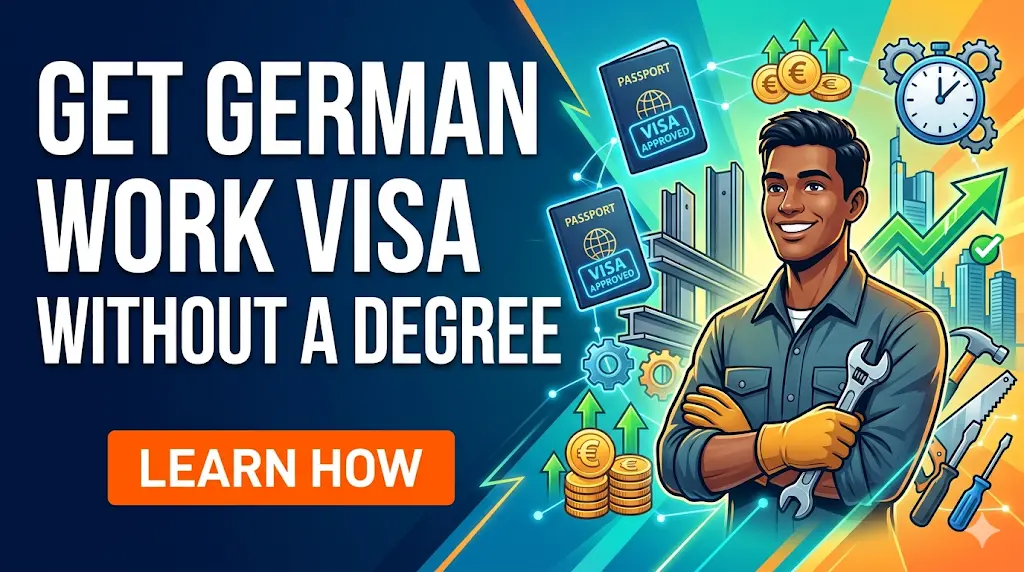
Visas for Skilled Trades and Vocational Training
While the IT sector enjoys heavily relaxed regulations, professionals in non-tech fields—such as electricians, nurses, specialized craftsmen, and educators—must navigate a slightly different framework. Germany deeply respects vocational training, but it requires that your foreign training mathematically aligns with its domestic standards.
Recognition of Foreign Qualifications Anerkennung
If you hold a non-academic vocational qualification, you must apply as a skilled worker (Fachkraft). The absolute baseline requirement is that your vocational training must have taken at least two years of full-time study to complete in your home country.
Before the German embassy will even look at your visa application, you must push your foreign credentials through a rigorous recognition process known as the Anerkennung. You submit your curriculum, transcripts, and practical training records to the Central Office for Foreign Education (ZAB) or the specific regional chamber of commerce (IHK) governing your trade. They will painstakingly compare the hours you studied and the skills you learned against the equivalent German apprenticeship (Ausbildung).
The authorities will only evaluate documents that they can actually read and legally verify. If you submit a vocational diploma from a local technical institute abroad, having it flawlessly translated is mandatory. Utilizing Lingoking ensures that highly specific technical terminologies from your coursework are accurately translated into the correct German bureaucratic equivalents, preventing a devastating rejection simply because the evaluating board misunderstood your curriculum. If they grant you “full equivalence,” you are officially classified as a skilled worker and can secure a standard employment visa.
The Professionally Experienced Worker Visa
Because the full formal recognition process can take many months and frequently results in “partial equivalence” (meaning you have to take makeup courses in Germany), the government introduced a powerful alternative: the Professionally Experienced Worker Visa (Section 19c).
This specific visa bypasses the agonizing formal recognition process entirely. To qualify, you need a vocational qualification that took at least two years and is recognized by the state in your home country. Additionally, you must have at least two years of relevant professional work experience within the last five years. Finally, your German employer must offer you a minimum gross annual salary of 45,630 euros.
If you meet these three criteria, the German state essentially trusts your employer’s judgment and grants you the visa without demanding the ZAB comparability statement. This is a massive administrative relief for international tradespeople and specialized business operators trying to relocate quickly. Understanding the subtle legal differences between these specific visa categories is a foundational step outlined in Understanding the Different Types of German Visas and Residence Permits.
The Chancenkarte Opportunity Card Without a Degree
What happens if you have the vocational skills but do not yet have a binding German job offer? Historically, job seeker visas were also gatekept behind university degrees. The introduction of the points-based Opportunity Card fundamentally democratized the job hunt.
Points System for Vocational Workers
The Chancenkarte allows you to move to Germany for up to one year specifically to search for employment. During this year, you are legally permitted to work part-time (up to 20 hours a week) to support yourself while you interview for full-time roles. This side income is crucial when battling the high Cost of Living in Germany: Breakdown of Expenses (Rent, Food, Transport).
If you do not have a university degree, you can still qualify by fulfilling the basic prerequisites: you must hold a two-year vocational qualification recognized in your country of origin, and you must prove you possess either A1 German or B2 English language skills. Once you hit that baseline, you must score at least 6 points on the official distribution system. You are awarded points for factors like your age, the number of years of professional experience you possess, and whether your profession is currently facing a critical shortage in Germany.
Securing the Financial Proof and Blocked Accounts
Because the Opportunity Card does not guarantee you a full-time income upon arrival, the German consulate operates on the strict assumption that you might remain unemployed for the entire year. Therefore, you must prove you have the liquid capital to survive without draining public welfare funds.
In 2026, you are required to prove you possess roughly 1,091 euros per month, totaling over 13,000 euros for the year. This money must be locked in a highly regulated, government-approved German blocked account (Sperrkonto). Attempting to open a specialized blocked account from your home country using legacy banks will trap you in a maze of international SWIFT fees, rejected applications, and terrible exchange rates.
Veteran expats entirely bypass the legacy banking system by using Expatrio. Setting up your legally mandated blocked account through Expatrio is a completely digital, streamlined process. You simply transfer your funds, and Expatrio instantly generates the official confirmation PDF that the German embassy demands. Handing the consular officer your Expatrio certificate definitively proves your financial solvency, neutralizing the most stressful part of the interview process. Securing this foundational financial proof is heavily detailed in Job Seeker Visa: Your Ticket to Finding Work in Germany.
Navigating Bureaucracy Contracts and Health Coverage
Securing the visa is only half the battle. When you arrive in Germany, you must seamlessly convert your entry sticker into a permanent plastic residence card while satisfying strict domestic mandates.
Preparing a Bulletproof Embassy Dossier
The German bureaucratic system operates on a culture of absolute paper compliance. If a single document is missing from your application folder, the caseworker will simply send you home and force you to re-enter a months-long waiting list. You must bring original copies and photocopies of every piece of evidence.
Your employer must fill out a specific document called the Declaration of Employment (Erklärung zum Beschäftigungsverhältnis). This form details your exact salary, working hours, and job description. For non-academic visas, the immigration office scrutinizes this form aggressively to ensure the role matches your vocational background or your three years of IT experience. If you need to submit supplementary foreign documents to prove your eligibility, relying on Lingoking to provide legally sworn translations ensures your dossier is absolutely bulletproof. Arriving prepared prevents the terrifying delays associated with German Bureaucracy 101: Understanding the Anmeldung, Schufa, and Tax ID.
Ensuring Compliant Health Insurance
The final, and often most complex, hurdle for securing your visa is health insurance. The German state absolutely refuses to issue long-term work visas or Opportunity Cards to individuals holding cheap, 30-day travel insurance policies. You must prove you have comprehensive incoming coverage that meets EU standards before you even cross the border.
Because you cannot officially enroll in the German public health insurance system until your employment contract actually begins and you have registered a local address, you need compliant bridging insurance for your visa appointment. Utilizing Feather Insurance solves this catch-22 flawlessly. Feather Insurance specializes in providing expats with incoming coverage that the German embassy universally accepts.
Furthermore, once you successfully arrive and start your new IT job or skilled trade, Feather Insurance will seamlessly transition you into the statutory public health insurance system (TK, Barmer, etc.), ensuring you are fully legally covered without navigating confusing German insurance portals. Deciphering the exact tier of coverage you are legally required to hold based on your new salary is a critical survival mechanism explored deeply in Public vs Private Health Insurance in Germany: Which is Right for You?.
| Visa Category | Degree Required? | Minimum Experience | 2026 Salary Threshold | Best Suited For |
| IT Specialist Blue Card | No | 3 years (in last 7) | €45,934.20 | Self-taught developers, sysadmins |
| Experienced Worker (§19c) | No (2-yr vocational req.) | 2 years (in last 5) | €45,630.00 | Specialized trades, business roles |
| Skilled Worker (Fachkraft) | No (Recognized vocational) | None | Standard local market rate | Nurses, recognized craftsmen |
| Chancenkarte (Job Seeker) | No (2-yr vocational req.) | None (but yields points) | N/A (Needs Blocked Account) | Unemployed tradespeople seeking work |
References
Primary sources (official)
- Make it in Germany – EU Blue Card: The official federal government portal detailing the updated 2026 salary thresholds and the specific exemption of the degree requirement for IT specialists. https://www.make-it-in-germany.com/en/visa-residence/types/eu-blue-card
- Chancenkarte.com – Opportunity Card: The federal information hub explaining the exact points distribution system, language requirements, and vocational prerequisites for the job seeker Opportunity Card. https://chancenkarte.com/en/
Other helpful sources
- Jobbatical – Blue Card IT Specialist Visa Germany 2026: An incredibly detailed HR guide breaking down exactly how employers navigate the lack of degree requirements and process IT specialist hires under the new immigration act. https://www.jobbatical.com/blog/germany-blue-card-it-specialist-employer-guide
- Sprachlingua – Germany’s Chancenkarte: A practical, step-by-step breakdown of how to legally prove your vocational training through ZAB and how the blocked account requirements function for non-academic applicants. https://sprachlingua.com/blog/opportunity-card/
Disclaimer
The information provided in this article is for general informational and educational purposes only and does not constitute professional legal, tax, or immigration advice. German residency laws under the Aufenthaltsgesetz (AufenthG), specifically regarding the waiver of academic degree requirements for IT professionals and the vocational training prerequisites for the Chancenkarte, are highly complex and strictly enforced by local immigration authorities (Ausländerbehörden). Salary thresholds, specifically the 45,934.20 euro minimum for shortage occupations, are subject to annual federal adjustments. Always consult a certified German immigration lawyer (Fachanwalt für Ausländerrecht) to evaluate your specific non-academic credentials.