Social Security Contributions in Germany: What Comes Off Your Salary
Few things prepare you for the "Netto-Schock" of your first German paycheck. I remember staring at my bank app, convinced there had been a clerical error because nearly 40% of my gross salary had evaporated before reaching my account. This guide meticulously breaks down every social security deduction so you know exactly where your hard-earned euros are going.
Disclosure: This post may contain affiliate links. We may earn a commission at no extra cost to you if you make a purchase through these links. Read full disclosure.
The Cultural Reality of the German Payslip
When you sign a job contract in Germany, the number you see is the "Brutto" or gross salary. It looks fantastic on paper. However, Germany operates on a principle of social solidarity (Solidaritätsprinzip), which means a significant portion of that number is diverted to fund the country’s robust social safety net. If you are coming from a country with lower taxes or private-sector-heavy systems, this transition can be a massive administrative and emotional hurdle.
I’ve sat in countless "Stammtisch" meetups where the main topic was how to survive on what’s left after the government takes its share. It’s not just about losing money; it’s about understanding that these contributions are actually pre-payments for your healthcare, your retirement, and your protection if you lose your job. To manage this effectively, many expats use tools like N26 to ensure their net pay lands in an account that makes digital banking easy, or Wise when they need to send money back home without losing even more to hidden fees.
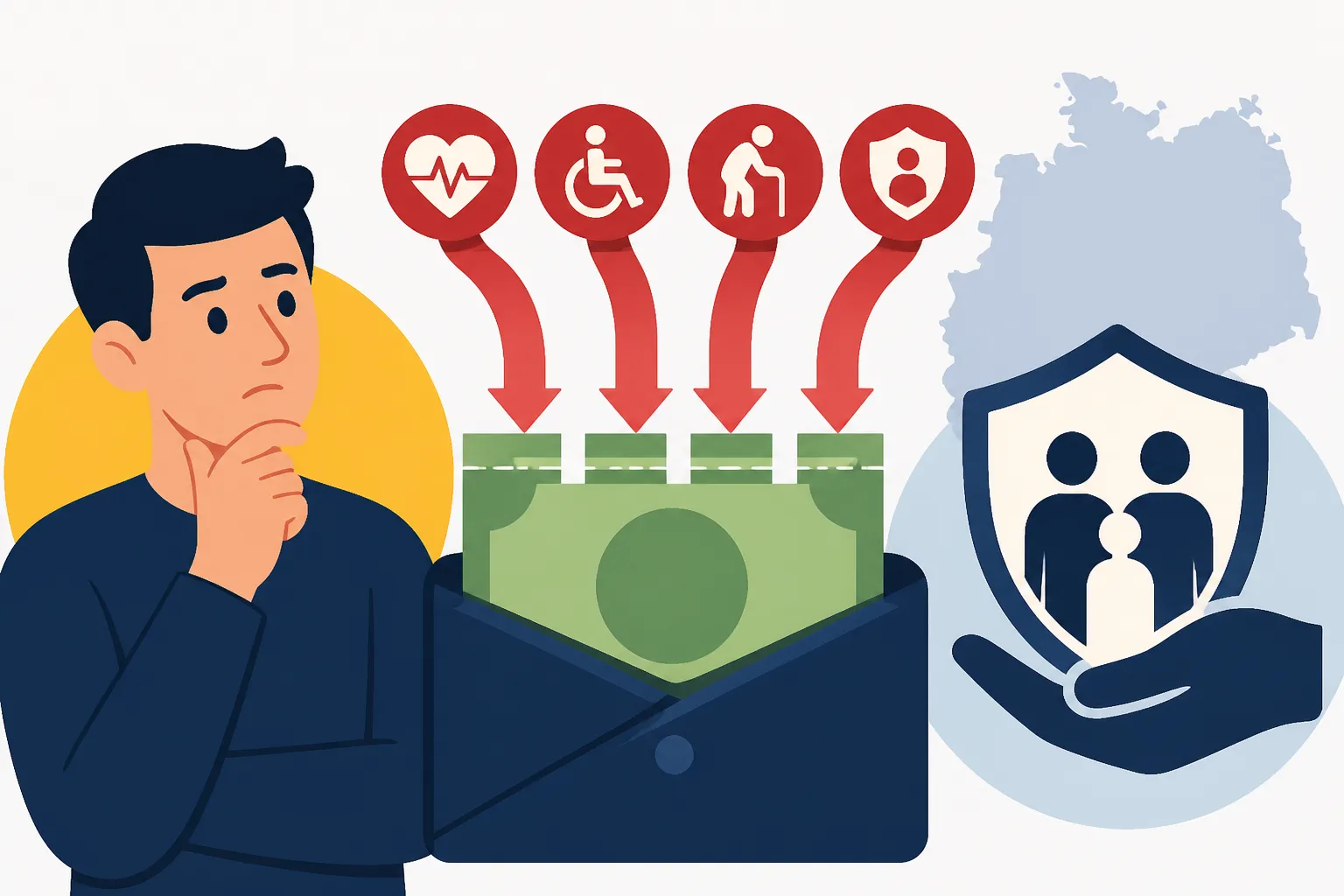
Understanding your Social Security Contributions: What Are You Paying For in Germany? is the first step toward financial literacy in your new home. It isn't just "lost" money; it is a mandatory investment in a system that ensures you won't be bankrupted by a hospital stay or left destitute in old age.
The Employer-Employee Split
One of the few saving graces of the German system is that you don’t bear the entire burden of these contributions alone. In most cases, social security is split roughly 50/50 between you and your employer. When you see a deduction of 9.3% for your pension, your employer is also paying 9.3% on top of your gross salary to the pension fund.
This is why hiring someone in Germany is so expensive for companies. If they offer you 60,000 EUR, they are actually budgeting closer to 72,000 EUR once their share of social security is factored in. Understanding this helps when you are in Salary Negotiation in Germany: Know Your Worth and Benefits, as you realize the "total cost" of your employment is much higher than your gross pay.
The Income Thresholds (Beitragsbemessungsgrenzen)
There is a ceiling to how much the government can take. These are called "Beitragsbemessungsgrenzen." Once your salary exceeds a certain point, your contributions to health and pension insurance level off. This is a crucial detail for high earners to understand. If you earn 100,000 EUR, you aren't paying social security on the full amount—only up to the legal cap.
For health insurance, this cap is significantly lower than for pension insurance. This means that as your career progresses and your salary rises, the percentage of your income going toward social security actually begins to decrease. Many expats find that using a service like Taxes for Expats helps them navigate these complex tax and contribution ceilings, especially if they have income in multiple countries.
Health and Nursing Care Insurance
Healthcare is the most visible part of the social security system. In Germany, health insurance is mandatory for everyone. Most expats will fall into the public system (Gesetzliche Krankenkasse), where the contribution rate is standardized. Currently, the general rate is 14.6% of your gross income, plus a "Zusatzbeitrag" (additional contribution) that varies slightly depending on which provider you choose.
I remember when I first arrived, I spent hours comparing providers like TK, AOK, and Barmer. While the core benefits are identical by law, the customer service and English-language support vary wildly. If you are still in the process of choosing, you might want to look into Choosing a Krankenkasse in Germany: TK, AOK, Barmer, and Others Compared.
Public Health Insurance Breakdown
The 14.6% base rate is split equally: you pay 7.3%, and your employer pays 7.3%. The additional contribution, usually around 1.2% to 1.7%, is also split. This money covers almost everything—from routine doctor visits to major surgeries. Unlike in many other countries, there are no massive deductibles. You show your card, and the insurance handles the bill.
However, if you earn above a certain threshold (the Versicherungspflichtgrenze), you have the option to opt-out of the public system and choose Private Health Insurance in Germany (PKV): Who It Suits. This is a major decision that shouldn't be taken lightly, as moving back to the public system later in life is notoriously difficult.
Nursing Care Insurance (Pflegeversicherung)
Often overlooked on the payslip is the "Pflegeversicherung." This was introduced in the 1990s to cover the costs of long-term care in old age or in the event of disability. The current rate is 3.4% for those with children and 4% for those without children. This is another area where the social solidarity principle is evident: those without children pay a higher "childless supplement" because they are seen as not contributing to the next generation of taxpayers who will fund the system.
You can read more about the specifics of this coverage in Long-term Care Insurance (Pflegeversicherung): What It Is and Who Needs It. It’s a small line item, but it provides a safety net that many countries simply don't offer, ensuring that if you need a nursing home or home care, the financial burden won't fall entirely on your family.
Pension and Unemployment Insurance
The "Rentenversicherung" (pension insurance) is the largest single deduction on your payslip. It currently sits at 18.6% of your gross income. Again, this is split 50/50, so you see a 9.3% deduction. This money doesn't go into a personal savings account with your name on it; it goes to pay the pensions of people who are currently retired. In return, the government promises that future generations will do the same for you.
For many expats, this feels like a black hole. "Will I even be in Germany when I'm 67?" is the question I get asked most. The good news is that Germany has social security agreements with many countries. If you move away, your contributions aren't necessarily lost. You might even be eligible for Claiming Pension Refunds: Getting Your Retirement Contributions Back When Leaving Germany if you move to a non-EU country and meet certain criteria.
The Statutory Pension System
The amount you receive in retirement is based on "pension points" earned through your contributions. The more you earn and the longer you work, the more points you get. However, with the aging population in Germany, there is a lot of debate about whether the state pension will be enough. This is why many expats also look into Pension Options in Germany: Riester, Rürup, and the State Pension to supplement their future income.
I personally found that once I understood the "points" system, the deduction felt less like a tax and more like a (very) long-term savings plan. If you are curious about how the math works, check out Pension System in Germany: What Expats Should Know About Retirement Contributions for a deeper dive.
Unemployment Insurance (Arbeitslosenversicherung)
Then there is the "Arbeitslosenversicherung." This costs 2.6% of your gross pay (1.3% for you). This is your insurance policy against job loss. If you have worked and contributed for at least 12 months within the last 30 months, you are generally entitled to "Arbeitslosengeld I," which is roughly 60% of your previous net salary (or 67% if you have children).
In the volatile world of international tech or startups, this is a massive comfort. I have friends who were caught in layoffs and were able to stay in their apartments and take their time finding the right next role because the German state was paying them a livable wage for up to a year. For more on this, look at Unemployment Insurance and Benefits: Financial Safety Net for Expats.
Summary Table of Contributions
To make sense of the math, here is a breakdown of what typically comes off your salary in 2024. Please note that rates can change annually based on government policy.
| Contribution Type | Total Rate (%) | Employee Share (%) | Employer Share (%) |
|---|---|---|---|
| Pension Insurance | 18.6% | 9.3% | 9.3% |
| Health Insurance | 14.6% + Zusatzbeitrag | 7.3% + 0.5 * Zusatzbeitrag | 7.3% + 0.5 * Zusatzbeitrag |
| Unemployment Insurance | 2.6% | 1.3% | 1.3% |
| Nursing Care (with kids) | 3.4% | 1.7% | 1.7% |
| Nursing Care (no kids) | 4.0% | 2.3% | 1.7% |
Managing the "Netto" Reality
Once all these deductions are gone, you are left with your net salary. But wait—there's more. We haven't even touched on income tax or the church tax. By the time everything is said and done, a single person earning 5,000 EUR gross might only see about 3,100 EUR in their N26 account.
This is why tax returns are so vital in Germany. Many of the expenses you incur as an expat—moving costs, professional equipment, even parts of your insurance—can be deducted to get some of that money back. I highly recommend using a tool like Wundertax to file your annual return. It’s designed for people who don't have a PhD in German tax law and can often result in a refund of over 1,000 EUR.
Dealing with the Financial Culture Shock
It takes about six months to stop converting your German salary back to your home currency and feeling "poorer." The reality is that while your take-home pay is lower, your "out-of-pocket" expenses for things like healthcare and education are almost zero. In many ways, the social security system is a form of forced budgeting for the most important things in life.
If you struggle with the bureaucracy of it all, remember that you are not alone. Almost every expat goes through the same confusion when they first look at their Understanding Your German Payslip: Gross vs Net Salary Explained. The key is to look at the "total compensation" including the security the system provides.
Using Technology to Ease the Burden
Modern fintech has made living with the German system much easier. When I first moved here, I had to go to a physical bank to explain why my "Netto" didn't match my contract. Today, apps like N26 provide clear breakdowns and notifications of when your salary arrives. If you are a freelancer, the burden is even higher because you have to pay both the employer and employee shares. In that case, Health Insurance for Freelancers and the Self-Employed: Navigating the System is essential reading to avoid massive debt to the health insurance providers.
Understanding Your Rights and Benefits
Because you are paying so much into the system, you have significant rights. For example, if you get sick, you don't just lose your pay. Your employer pays your full salary for the first six weeks, and after that, your health insurance kicks in with "Krankengeld." This is all funded by those deductions you see every month.
I once had a colleague who was out for three months due to a serious injury. Back home, she would have been bankrupt. In Germany, she focused on her recovery while the social security system handled her income. This is the "hidden" value of your Social Security Contributions in Germany: What Comes Off Your Salary.
Sick Leave and Social Security
When you are unwell, you need a "Krankschreibung" (sick note). This document is the trigger for the insurance benefits you’ve been paying for. Knowing Sick Leave in Germany: How to Get a Sick Note (Krankmeldung) and Your Rights is just as important as knowing your salary, because it’s the mechanism that protects your income.
Family Benefits
If you have children, the system also works in your favor. Contributions you make help fund "Elterngeld" (parental allowance), which allows parents to take time off to care for a newborn while still receiving a portion of their salary. You can learn more about how to navigate this in Having a Baby in Germany: Hospital vs Birth Center and Postnatal Care. Even if you feel the sting of the deductions now, the support provided during major life events is unparalleled.
Final Thoughts for the New Expat
Don't let the deductions discourage you. Germany is a high-tax, high-contribution country, but it is also a high-service country. The administrative hurdles of the "Finanzamt" and the "Krankenkasse" are real, and they are frustrating. But once you are settled and understand the logic behind the payslip, the peace of mind is worth the "Netto" shock.
Take the time to read through German Tax Classes (Steuerklassen) Explained as well, because your marital status and whether you have children can actually change how much tax is taken, even if the social security percentages stay the same. Being proactive about your finances is the best way to turn a "hurdle" into a stable foundation for your new life in Germany.
Disclaimer
This article provides a general overview of social security contributions in Germany for informational purposes only. Social security rates, income thresholds, and laws change frequently. This guide does not constitute professional financial, legal, or tax advice. Always consult with a qualified tax advisor (Steuerberater) or the relevant official authorities for advice tailored to your specific situation.