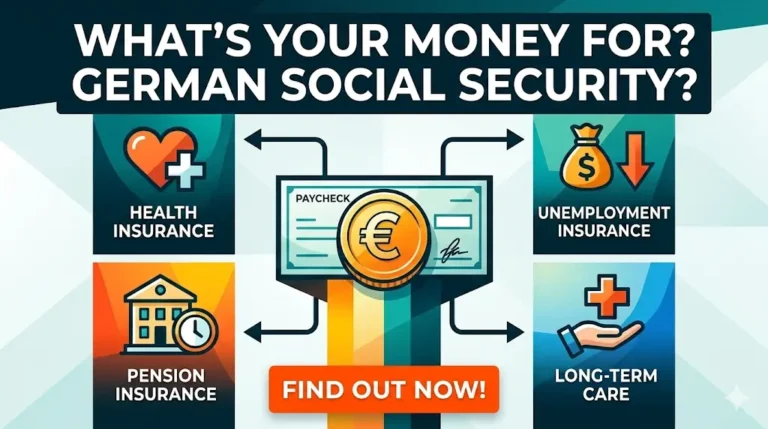
Pension System in Germany: What Expats Should Know About Retirement Contributions
Navigating the German pension system can feel overwhelming for newly arrived expats. This comprehensive guide breaks down mandatory contributions, explains how international agreements protect your benefits, and outlines strategies to secure your long-term financial future while living and working abroad.
Disclosure: This post may contain affiliate links. We may earn a commission at no extra cost to you if you make a purchase through these links. Read full disclosure.
The Three Pillars of the German Pension System
To fully grasp how your retirement will be funded if you choose to stay in Europe, you must first understand the structural foundation of the country’s social safety net. The German retirement system is famously built upon a “three-pillar” model. Each pillar serves a distinct purpose, offering varying levels of state support, mandatory participation, and personal flexibility. For expats, knowing how to balance these three pillars is the key to preventing a massive income drop in old age.
Statutory Public Pension Scheme
The first and most robust pillar is the statutory public pension scheme, known in German as the Gesetzliche Rentenversicherung (GRV). This system is managed by the Deutsche Rentenversicherung and serves as the primary source of retirement income for the vast majority of the country’s population. If you are formally employed in Germany, participation in this first pillar is not optional; it is a strict legal requirement. The moment you sign an employment contract, you are automatically enrolled.
The GRV operates on a “pay-as-you-go” mechanism, formally called the Umlageverfahren. This means that the money deducted from your monthly paycheck does not sit in a personalized investment account gathering interest for decades. Instead, your contributions are immediately paid out to fund the pensions of current retirees. In return for supporting today’s elderly, you earn a legally binding promise from the state—in the form of “pension points”—that the next generation of workers will fund your retirement when your time comes.
While this system provides immense stability and protects retirees from the volatility of the stock market, demographic shifts are putting it under severe strain. Germany has an aging population, meaning fewer active workers are supporting an increasing number of pensioners. Consequently, the statutory pension alone is no longer sufficient to maintain your pre-retirement standard of living, making a deep understanding of your Social Security Contributions and the subsequent two pillars absolutely essential.
Company Pension Plans
The second pillar of the retirement system is the company pension plan, or Betriebliche Altersversorgung (bAV). Unlike the mandatory public scheme, this pillar operates through your employer. While it is generally voluntary to participate, German labor law grants every employee the legal right to request a portion of their gross salary be redirected into a recognized company pension scheme—a process known as deferred compensation or Entgeltumwandlung.
When you choose to defer a portion of your salary into a bAV, that money is deducted before income taxes and social security contributions are calculated. This drastically lowers your immediate tax burden. Furthermore, to incentivize this second pillar, the German government legally mandates that employers must subsidize your contributions. If you sacrifice a portion of your salary, your employer must contribute an additional 15% on top of your deferral, provided they save on their share of social security contributions in the process.
For expats, the company pension requires careful consideration. While the tax benefits and employer match are highly attractive, these plans are notoriously inflexible. If you plan to leave Germany after a few years, transferring a localized company pension to a foreign equivalent is practically impossible. The money typically remains locked in the German fund until you reach retirement age. Therefore, expats must weigh the immediate tax advantages against the long-term lack of geographic portability.
Private Retirement Investments
The third and final pillar consists of private, individualized retirement provisions. Because the statutory pension will likely only cover about 45% to 48% of your final working salary—creating a massive financial shortfall known as the pension gap (Rentenlücke)—the German government heavily encourages citizens to invest privately to secure their future.
This pillar includes everything from state-subsidized insurance products (like the Riester and Rürup pensions) to entirely independent stock market investments, real estate, and private life insurance policies. For highly mobile international workers, this third pillar is arguably the most important. Relying solely on the German state or a localized corporate plan is a risky strategy if your career trajectory involves moving across multiple borders.
Expats must take the initiative to build a borderless investment portfolio. To ensure you have the monthly liquidity to fund these investments, optimizing your daily cash flow is vital. Utilizing a modern, low-fee digital bank like N26 helps you track your expenses efficiently, freeing up capital that can be deployed into the markets. By independently funding this third pillar, you guarantee that a significant portion of your retirement wealth remains entirely under your control, regardless of where in the world you eventually choose to retire.

How Statutory Pension Contributions Work
Every month, a significant portion of your gross salary disappears before the money ever reaches your checking account. Understanding the exact mathematics behind these deductions prevents “payslip shock” and helps you calculate the true value of the benefits you are acquiring.
Mandatory Contribution Rates and Caps
The cost of funding the statutory pension system is shared equally between the employee and the employer. For the current legislative period leading into 2026, the total contribution rate is set at 18.6% of your gross salary. This means 9.3% is deducted directly from your paycheck, and your employer pays a matching 9.3% out of their own pocket on your behalf.
However, the government does not tax your income infinitely. The contributions are capped by an assessment ceiling, known as the Beitragsbemessungsgrenze. Any income you earn above this specific threshold is completely exempt from statutory pension contributions. For 2026, this annual ceiling is set at €101,400 (or €8,450 per month). If you earn €120,000 a year, you only pay the 9.3% rate on the first €101,400; the remaining €18,600 is yours to keep, free from pension deductions.
| Contribution Component | Rate Applied | Who Pays | Annual Income Cap (2026) |
| Total Pension Rate | 18.6% | Shared 50/50 | €101,400 |
| Employee Share | 9.3% | Deducted from Gross Pay | €101,400 |
| Employer Share | 9.3% | Paid by Employer | €101,400 |
Understanding this cap is vital for high-earning expats when calculating their overall Cost of Living in Germany. Once your salary crosses the €101,400 threshold, your monthly net income experiences a noticeable bump, as a smaller percentage of your total compensation is siphoned into the social security system. If you are negotiating a senior executive salary, utilizing resources like Understanding the German Banking System can help you project your exact monthly liquidity.
Earning Pension Points Explained
The German pension system does not track your contributions in euros; instead, it uses a highly specific metric called Earnings Points (Entgeltpunkte). Your future monthly pension is directly determined by how many of these points you accumulate throughout your working life in Germany. The math behind acquiring a point is tied to the average national income.
If your gross salary exactly matches the average earnings of all contributors in Germany for a given year (which is roughly €45,000, though it fluctuates annually), you earn exactly 1.0 Pension Point for that year. If you earn exactly half the national average, you are awarded 0.5 points. If you are a high earner hitting the maximum assessment ceiling, you will earn just over 2.0 points for the year. You cannot earn more than roughly 2.0 points per year, regardless of how high your salary climbs, due to the contribution cap.
When you finally retire, the total number of points you have collected is multiplied by the Current Pension Value (Aktueller Rentenwert). As of recent valuations, one point is worth approximately €39.32 per month. So, if an expat works in Germany for 10 years, earning exactly the average salary each year, they will collect 10 points. At retirement, those 10 points would yield a localized German pension of roughly €393 per month (10 x €39.32), assuming the pension value does not increase due to inflation adjustments before they retire.
Retirement Age and Early Withdrawal Penalties
Acquiring points is only half the equation; you must also reach the legally designated age to cash them in. Historically, the standard retirement age (Regelaltersgrenze) in Germany was 65. However, due to increasing life expectancies and the aforementioned demographic pressures, the government is gradually raising the age limit to 67 for anyone born in 1964 or later.
You are not strictly forced to work until 67. The system allows for early retirement, usually starting at age 63, provided you have accumulated at least 35 years of recognized contribution periods. However, choosing to retire early comes with a severe financial penalty. For every single month you retire before reaching your official standard retirement age, your total pension payout is permanently reduced by 0.3%. If you retire two years early, you face a permanent 7.2% reduction in your monthly payouts for the rest of your life.
For expats, reaching the 35-year threshold for early retirement within the German system alone is often mathematically impossible if they migrated mid-career. Therefore, unless an international agreement applies, most expats must plan their global financial lives around the assumption that they will not be able to draw upon their German pension without penalties until they reach their late sixties.
Expat Eligibility and International Agreements
The greatest fear for any international worker is that they will pay thousands of euros into a foreign social security system, only to leave the country a few years later and lose everything. Fortunately, Germany maintains a vast, highly protective web of international treaties designed specifically to safeguard the retirement assets of mobile expats.
The Five Year Minimum Qualifying Period
The most critical rule every expat must memorize is the Minimum Qualifying Period, known as the Wartezeit. To be eligible to receive a statutory pension payout from the German government at retirement age, you must have contributed to the system for a minimum of 60 months (exactly 5 years).
If you work in Germany for 4 years and 11 months, and then permanently leave the country without an applicable international treaty to protect you, you will not receive a German pension when you turn 67. The contributions you made simply remain in the state coffers. Because of this strict 60-month cliff, expats must carefully monitor their employment timelines. If you are contemplating leaving the country around the four-and-a-half-year mark, it is often financially strategic to secure a few more months of employment to ensure you cross the five-year threshold and lock in a lifetime pension entitlement.
However, actually working in Germany is not the only way to accrue these 60 months. The German system is surprisingly forgiving, recognizing periods of raising a child in Germany (up to 3 years per child) and periods of receiving domestic unemployment benefits as valid contributions toward the 60-month Wartezeit.
Social Security Totalization Agreements
If you fail to reach the 60-month minimum through German employment alone, you are not necessarily out of luck. Germany is deeply integrated into the European Union and maintains bilateral Social Security Totalization Agreements (Sozialversicherungsabkommen) with over 20 non-EU countries, including the United States, Australia, Canada, Japan, India, and the United Kingdom.
These agreements are designed to prevent the loss of benefits for expats who split their careers across borders. Under a totalization agreement, you can combine the periods you worked in treaty countries to meet the 60-month minimum. For example, imagine a Canadian expat who works in Berlin for 3 years (36 months) and then returns to Toronto to work for another 10 years. Under German law alone, 36 months is not enough to get a pension. However, because of the Germany-Canada totalization agreement, the German government recognizes the Canadian working years.
By adding the Canadian years to the German years, the expat easily surpasses the 60-month requirement. When this expat reaches age 67, Germany will pay them a partial pension based strictly on the 3 years of actual financial contributions made in Berlin, while Canada will pay them a separate pension based on their Canadian contributions. This seamless portability protects your wealth and ensures every month you work globally counts toward your final retirement security.
Claiming a Pension Refund When Leaving Germany
If you are a citizen of a non-EU country that does not have a totalization agreement with Germany, or if you simply prefer cash in hand over a tiny monthly payout in 30 years, you may be eligible for a massive lump-sum Pension Refund (Beitragserstattung).
To claim this refund, you must meet three strict conditions: First, you must not be a citizen of the EU/EEA. Second, you must have contributed to the German system for fewer than 60 months in your entire lifetime. Third, you must permanently deregister your German address, move to a non-EU country, and wait exactly 24 calendar months. Once this waiting period expires, you can submit official paperwork to the Deutsche Rentenversicherung to request your money back.
Crucially, you are only refunded the employee half of the contributions (the 9.3% deducted from your salary). The matching 9.3% paid by your employer is forfeited to the German state. Even so, recovering 9.3% of your gross salary over four years can easily amount to tens of thousands of euros. Navigating the bureaucratic forms to secure this payout is complex, but highly lucrative. For a deeper dive into managing the simultaneous tax implications of your departure, review our guide on Tax Refunds When Leaving Germany.
Once the German government approves your massive refund, they will wire the euros to your foreign bank account. If you allow a traditional bank to handle this currency conversion, you will lose a staggering amount of money to hidden exchange rate markups. To protect your hard-earned retirement funds, you must use a specialized platform like Wise. By providing you with localized account details, Wise allows you to receive the euro refund and convert it to your home currency at the true mid-market exchange rate, saving you hundreds or even thousands of dollars in hidden banking fees.
Boosting Your German Retirement Income
Relying entirely on the German state pension is a mathematically flawed strategy for expats. Because the statutory system is strained, maintaining your standard of living in old age requires aggressive, proactive financial planning through the second and third pillars of the retirement framework.
Taking Advantage of the Riester and Rurup Pensions
To encourage citizens to invest privately, the German government created state-subsidized retirement products. The two most famous are the Riester-Rente and the Rürup-Rente (also known as the Basisrente).
The Riester-Rente is designed primarily for standard employees and families. If you contribute a small percentage of your income to a certified Riester product, the government deposits an annual cash bonus directly into your account, with additional, highly lucrative bonuses granted for every child you have. The Rürup-Rente, conversely, is designed for freelancers and high earners. It offers no direct cash bonuses but allows for massive tax deductions; you can write off tens of thousands of euros in Rürup contributions against your annual taxable income, drastically lowering your immediate tax bill.
While these products sound fantastic on paper, they are often terrible investments for highly mobile expats. Both products are heavily localized. They involve complex insurance contracts with high administrative fees, and they strictly prohibit you from cashing out the portfolio as a lump sum. They are designed to pay out a slow, monthly annuity until you die. Furthermore, if you leave Germany and move outside the European Economic Area, the government may legally demand that you repay all the tax subsidies and cash bonuses you received over the years. Unless you are absolutely certain you will retire in Germany, these rigid products should generally be avoided.
Integrating Global Brokerage Accounts
Instead of locking capital into inflexible German insurance contracts, modern expats should build their retirement wealth using globally portable investment platforms. The most effective way to close the German pension gap is by consistently investing a portion of your monthly net income into low-cost, broadly diversified global index funds or ETFs.
While you could open a standard domestic brokerage account (Depot) with a traditional German bank, this creates massive administrative headaches if you eventually relocate to Asia or the Americas. Traditional German banks will often forcefully close your account once you no longer have a registered German address.
The optimal solution is to bypass domestic limitations entirely by utilizing an institutional-grade, borderless platform. By routing your investments through a global brokerage like Interactive Brokers, you ensure your retirement portfolio remains intact regardless of your physical location. Interactive Brokers allows you to hold multiple currencies, invest in global markets, and simply update your tax residency within the platform if you leave Germany, preventing the need to liquidate assets and trigger massive capital gains taxes.
However, managing massive global wealth while living a highly mobile expat lifestyle introduces digital security risks. You will frequently find yourself checking your brokerage balances or initiating trades while connected to unsecure Wi-Fi networks in European airports or cafes. To protect your retirement assets from digital interception, running a premium Virtual Private Network is non-negotiable. Utilizing a trusted service like NordVPN creates an encrypted tunnel for your internet traffic, ensuring your financial login credentials remain completely invisible to malicious actors sharing your network. Setting up this secure infrastructure is a vital step immediately after Opening a Bank Account in Germany.
Tax Implications for Expat Pensioners
The final puzzle piece of retirement planning is understanding how the government will tax the wealth you have accumulated. Germany is currently undergoing a decades-long transition to a system of deferred taxation for retirement income.
In the past, statutory pensions were largely tax-free. However, legislation passed in 2005 dictates that an increasing percentage of your pension will be subject to income tax. By the year 2040, 100% of all statutory pension payouts will be fully taxable at your personal income tax rate. The trade-off is that the contributions you make today are increasingly tax-deductible.
Conclusion
The taxation becomes highly complex if you decide to retire outside of Germany while drawing a German pension. The right to tax your pension depends entirely on the specific wording of the Double Taxation Agreement (DTA) between Germany and your new country of residence. In some treaties, the country where you currently live gets exclusive rights to tax the pension.
In others, Germany retains the right to levy a withholding tax before the money ever crosses the border. Navigating this legal minefield is critical to preserving your wealth in old age; a thorough understanding of Double Taxation Treaties will dictate exactly where in the world you can afford to spend your golden years.
References
Primary sources official
- Deutsche Rentenversicherung (DRV): Official portal providing comprehensive English-language guides on pension refunds, international social security agreements, and access to Form V0901. https://www.deutsche-rentenversicherung.de/DRV/EN/Home/home_node.html
- Federal Ministry of Labour and Social Affairs (BMAS): Legislative overviews of the German statutory pension system, vesting periods, and bilateral treaties. https://www.bmas.de/EN/Home/home.html
Other helpful sources
- Make it in Germany: The official German government portal for qualified international professionals, detailing what happens to social security contributions upon leaving the country. https://www.make-it-in-germany.com/en/living-in-germany/money-insurance/social-security
Disclaimer
The information provided in this article is for educational and informational purposes only and does not constitute financial, investment, or legal tax advice. German pension laws, contribution ceilings, international totalization agreements, and refund eligibility criteria are highly complex and subject to frequent legislative changes. The specific financial outcomes of your retirement planning will depend entirely on your unique personal circumstances, career trajectory, and citizenship. Always conduct your own independent research and strongly consider consulting a certified Steuerberater (tax advisor) or a specialized expat financial planner before making binding decisions regarding your retirement contributions or initiating international asset transfers. We assume no liability for any financial losses or administrative complications resulting from actions taken based on the contents of this guide.