Church Tax in Germany (Kirchensteuer): Who Pays and How to Opt Out
One of the most jarring moments for any new expat in Germany is receiving that first official payslip and seeing a mysterious deduction labeled Kirchensteuer. I still remember the confusion I felt sitting in my small Berlin apartment, staring at my Lohnabrechnung and wondering why the government was redirecting my hard-earned euros to a religious institution I hadn't stepped foot in for years. This guide breaks down exactly how the German church tax works, who is liable, and the specific administrative steps required to legally opt out if you choose to.
Disclosure: This post may contain affiliate links. We may earn a commission at no extra cost to you if you make a purchase through these links. Read full disclosure.
What is the German Church Tax (Kirchensteuer)
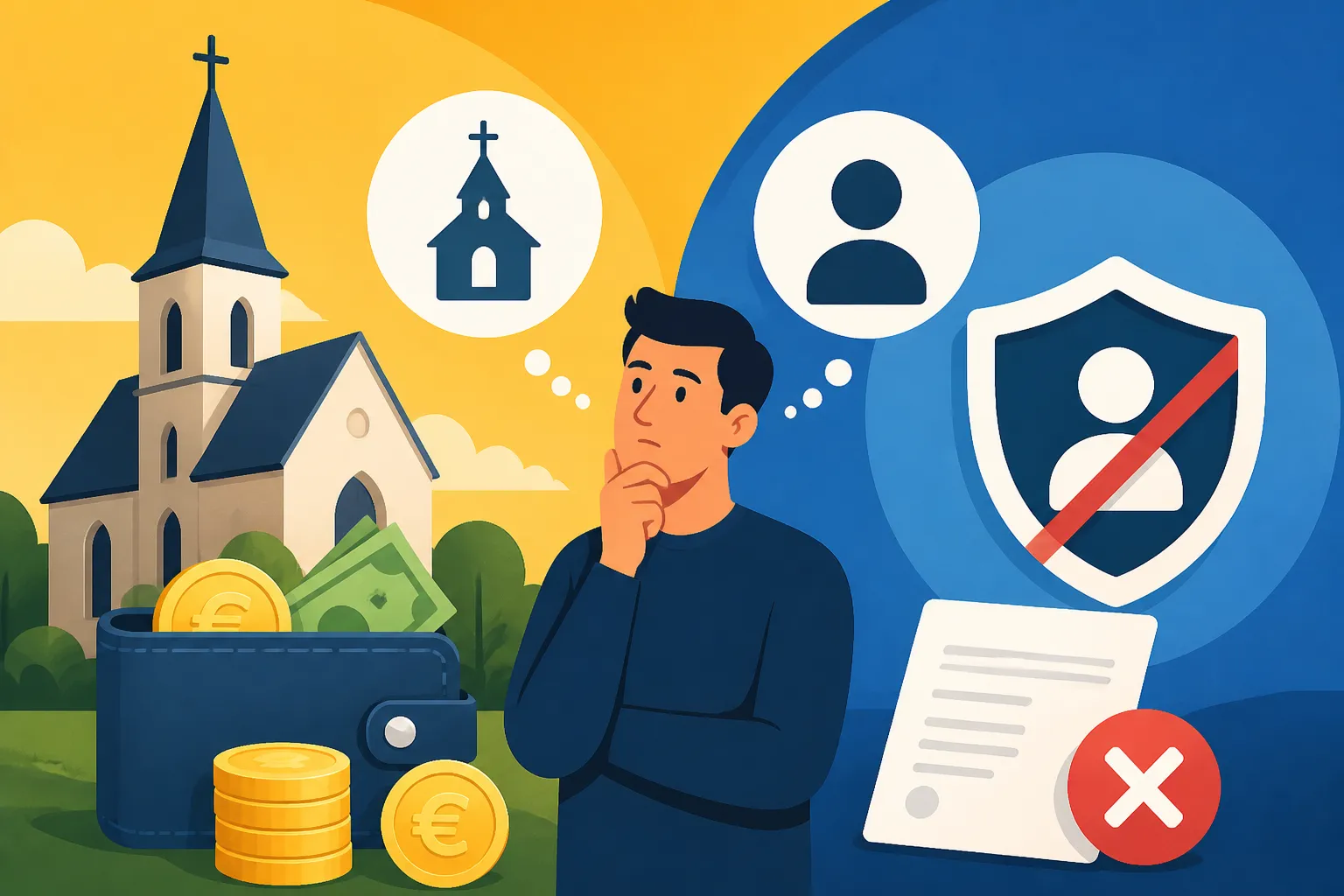
The German church tax is a centuries-old system where the state acts as a collection agent for recognized religious communities. Unlike many other countries where religious contributions are strictly voluntary and private, Germany integrates this into the national tax infrastructure. This means that if you are registered as a member of a participating church, the Finanzamt (Tax Office) automatically deducts a percentage of your income tax to fund that institution.
A Historical and Legal Perspective
The roots of the Kirchensteuer go back to the early 19th century. Following the Napoleonic Wars and the secularization of church lands, religious institutions lost their primary sources of income. To compensate, the state agreed to help the churches collect funds from their members to maintain buildings, pay clergy, and fund social services. This was eventually codified into the German Basic Law (Grundgesetz), specifically Article 140, which incorporates parts of the Weimar Constitution.
Today, the system is highly formalized. The state does not provide this service for free; it typically keeps around 3% to 4% of the collected tax as an administrative fee. For many Germans, paying this tax is seen as a civic duty that supports the vast network of church-run kindergartens, hospitals, and soup kitchens. However, for expats who may not share this cultural history, the deduction can feel like an unexpected financial burden. Understanding this history helps in Understanding Your German Payslip: Gross vs Net Salary Explained and why this specific line item exists alongside your social security contributions.
Which Religious Communities Collect Tax
Not every religion in Germany participates in the church tax system. The primary beneficiaries are the Catholic Church (Römisch-Katholische Kirche) and the Evangelical/Protestant Church (Evangelische Kirche). However, several other groups also utilize the state’s collection services, including certain Jewish communities (who call it Kultussteuer), the Old Catholic Church, and some free religious communities.
Noticeably absent from this list are most Orthodox Christian churches, many independent Protestant denominations, and Islamic communities. If you belong to one of these groups, you generally do not pay Kirchensteuer through your paycheck. Instead, these organizations rely on private donations or membership fees paid directly to the local mosque or parish. If you are unsure if your specific denomination is a tax-collecting entity, it is wise to check with your local Finanzamt: Dealing With German Tax Authorities for a definitive list.
Who Exactly Pays Church Tax
Liability for the church tax is tied directly to your legal status as a member of a recognized church. In Germany, this status is not just a matter of faith; it is a matter of administrative record. The moment you enter the country and complete your first registration, your religious affiliation becomes a data point in the government’s central database.
The Registration Process (Anmeldung) and Religious Status
The most common way expats accidentally "opt-in" to the church tax is during the registration of their address, known as the Anmeldung. On the registration form, there is a field for religion. Many newcomers, acting out of honesty or habit, write "Catholic" or "Protestant" because they were baptized in their home country, even if they haven't been practicing for years.
The clerk at the Bürgeramt then enters this code into the system. This information is shared with the tax office, which then instructs your employer to deduct the tax. If you are using a modern banking setup like N26, you will see your net pay reflected in your app, often significantly lower than you expected because of this registration choice. If you want to avoid this from the start, the only way to remain "tax-free" is to enter "keine" (none) or leave the field blank, provided you have never been a member of a German church.
Foreigners and the Religious Question
A frequent point of frustration for foreigners is the "baptism trap." The German Catholic and Protestant churches are part of global networks. This means that if you were baptized in Spain, Poland, Ireland, or the United States, the German church considers you a member. In recent years, church authorities have become more aggressive in cross-referencing records.
If you claim to have no religion during your Anmeldung, but the church later discovers your baptismal record from abroad, they can technically demand back-payments of the tax. This retrospective taxation can be a massive financial hit. I’ve seen fellow expats receive bills for thousands of euros after the church tracked down their records via communication with their home parishes. To manage these potential liabilities, it is often helpful to consult with Taxes for Expats or similar professional services who specialize in cross-border tax issues.
How Much Does It Cost: Calculating the Impact
The church tax is not a flat fee; it is a "surcharge" on your income tax. This means the more you earn, the more you pay. This progressive nature makes it particularly noticeable for high-earning professionals or those on an EU Blue Card.
Regional Differences: 8% vs 9%
The rate of church tax depends on which federal state (Bundesland) you live in. In Bavaria (Bayern) and Baden-Württemberg, the rate is 8% of your income tax. In all other German states, including Berlin, Hamburg, and North Rhine-Westphalia, the rate is 9%.
It is crucial to understand that this is not 9% of your total salary. It is 9% of the Einkommensteuer (Income Tax) you owe. For example, if you earn a salary where your monthly income tax is €1,000, your church tax would be an additional €90 (in Berlin). Over a year, this adds up to over €1,000. When you are Budgeting for Life in Germany: Tips to Save Money as an Expat, forgetting to account for this surcharge can throw off your entire financial plan.
The Relationship Between Income Tax and Church Tax
Because the church tax is calculated based on your income tax, anything that reduces your income tax liability also reduces your church tax. This includes tax-deductible expenses, child allowances (Kinderfreibetrag), and professional costs. When you file your annual return using tools like Wundertax, the software automatically calculates these adjustments.
Here is a simplified comparison of how church tax affects different salary levels (using a 9% rate and standard Tax Class I):
| Annual Gross Salary | Approx. Monthly Income Tax | Approx. Monthly Church Tax | Annual Total Church Tax |
|---|---|---|---|
| €30,000 | €260 | €23 | €276 |
| €50,000 | €680 | €61 | €732 |
| €80,000 | €1,450 | €130 | €1,560 |
| €100,000 | €2,100 | €189 | €2,268 |
As you can see, the costs are substantial. If you are sending money home or managing international finances via Wise, that extra €150 a month could be the difference between a standard transfer and a significant savings contribution.
The Benefits and Limitations of Paying Church Tax
While many choose to leave, there are reasons why some expats choose to stay. Beyond personal faith, membership in the church provides access to specific social and institutional structures in Germany that are not always available to non-members.
Access to Sacraments and Social Services
In Germany, if you have officially left the church (Kirchenaustritt), you are technically barred from receiving most sacraments. This includes being a godparent in a Catholic baptism, getting married in a church, or receiving a religious burial. For many families, this is a significant social hurdle.
Furthermore, many "state" schools and kindergartens in certain regions are actually run by religious organizations (Diakonie or Caritas). While they are legally required to accept non-members, in highly competitive areas like Munich or Stuttgart, church membership can sometimes be a "soft" factor in admissions. If you are Having a Baby in Germany: Hospital vs Birth Center and Postnatal Care, you may find that the most convenient local childcare is church-affiliated, leading some parents to stay in the system just to keep their options open.
Tax Deductibility of Church Tax Payments
One small silver lining is that the church tax itself is considered a "special expense" (Sonderausgabe) and is fully deductible on your German tax return. This means that paying the church tax actually lowers your taxable income, slightly reducing your overall income tax bill.
When Filing a Tax Return in Germany: A Guide for Employees and Expats, you must ensure that your church tax payments are correctly logged. This doesn't make the tax "free," but it does mean that the net cost is roughly 60% to 70% of the sticker price, depending on your tax bracket. For those who value the work the churches do in the community, this tax deduction makes the contribution more palatable.
How to Opt Out: The Kirchenaustritt Process
If you have decided that the financial cost outweighs the benefits, you must perform a formal act called Kirchenaustritt. Simply stopping your attendance or telling your priest you are leaving is not enough. You must notify the state.
Where to Go: Standesamt vs. Amtsgericht
The process varies by state. In most federal states, you go to the Standesamt (Registry Office) in your local town hall. However, in states like Berlin and Brandenburg, the process is handled by the Amtsgericht (District Court). You usually need to book an appointment in advance, which can be a challenge in major cities.
You will need to bring:
- A valid passport or ID card.
- Your registration certificate (Meldebescheinigung).
- If married, your marriage certificate (to ensure your spouse's status is also addressed).
- Roughly €30 to €60 in cash or EC card for the administrative fee.
If you find yourself needing to pay this fee and your main account is still abroad, using Wise to transfer funds to a local N26 account can save you on exchange rates compared to using a non-Euro card at the office.
The Paperwork and Costs Involved
During the appointment, you will sign a declaration stating that you are leaving the church. You do not need to provide a reason. The officer will then issue you a Kirchenaustrittsbescheinigung (Certificate of Church Exit). This piece of paper is incredibly important.
Do not lose this certificate. In Germany, the burden of proof is on you. If the church "loses" your record ten years from now and starts charging you tax again, the only way to stop them is to produce this original document. I keep mine in a fireproof folder alongside my birth certificate.
Crucial Post-Exit Steps
The exit usually becomes effective at the end of the month you filed the paperwork, and the tax deductions should stop the following month. However, the German bureaucracy is slow. You should proactively inform your employer's HR department by providing them with a copy of your exit certificate.
Check your next two payslips carefully. If "KiSt" (Kirchensteuer) is still being deducted, you need to contact your local Finanzamt: Dealing With German Tax Authorities to ensure they have updated your electronic tax features (ELStAM). If you have paid tax for months after your exit date, you can claim this back when you file your annual return through Wundertax.
Common Pitfalls and Frequently Asked Questions
Leaving the church in Germany is a legal act with permanent consequences, and there are several "traps" that expats frequently fall into.
What Happens if You Re-Enter a Church?
It is possible to re-enter a church (Kircheneintritt), but it involves a meeting with a priest or pastor and a formal application. Once you re-enter, the church will notify the tax office, and the deductions will resume immediately. You cannot "pause" your membership for a year to save money and then rejoin without the church being aware of your previous exit.
Dealing with Retrospective Tax Claims
If you have been living in Germany for several years and only now realize you’ve been paying church tax, or if the church has suddenly "found" you, the situation is complex. Generally, you cannot get a refund for tax already paid if you were legally a member at the time. The tax only stops moving forward from the date of your formal exit.
If the church is claiming you owe money from previous years because you "lied" on your registration form, you should seek professional advice. Experts at Taxes for Expats can help determine if the church's claim is valid under international treaties or if there is a way to mitigate the debt.
Summary Table: Comparison of Church Tax Across States
| Federal State | Church Tax Rate | Authority for Exit |
|---|---|---|
| Baden-Württemberg | 8% | Standesamt |
| Bavaria (Bayern) | 8% | Standesamt |
| Berlin | 9% | Amtsgericht |
| Hamburg | 9% | Standesamt |
| Hesse (Hessen) | 9% | Standesamt |
| Lower Saxony | 9% | Standesamt |
| North Rhine-Westphalia | 9% | Amtsgericht |
| Saxony (Sachsen) | 9% | Standesamt |
Disclaimer
This article provides a general overview of the German church tax system and is intended for informational purposes only. Tax laws in Germany are subject to change, and individual circumstances can vary significantly based on your nationality, income level, and specific religious denomination. This guide does not constitute legal or professional tax advice. For specific concerns regarding your tax liability or the legal implications of leaving a religious community, please consult with a certified German tax advisor (Steuerberater) or a legal professional. Ensure you are familiar with the German Tax Classes (Steuerklassen) Explained before making any major changes to your tax status.