How to Sort Waste Correctly in Germany
You are standing in a communal courtyard, clutching a soggy pizza box and staring at five different colored bins. A curtain twitches in the apartment across from you, and you feel the heavy weight of local judgment. I remember my first week in Berlin, paralyzed by a yogurt lid, terrified I would accidentally trigger a building-wide investigation. This guide solves the riddle of German waste management so you can recycle like a local and avoid the dreaded "neighbor talk."
Disclosure: This post may contain affiliate links. We may earn a commission at no extra cost to you if you make a purchase through these links. Read full disclosure.
The Cultural Significance of Mülltrennung in Germany
In Germany, sorting your trash, or Mülltrennung, is not just a suggestion; it is a civic duty and a cornerstone of the national identity. To a newcomer, it can feel like a complex puzzle designed to catch you out, but it is actually a highly efficient system that allows the country to maintain some of the highest recycling rates in the world. When you first complete your The Anmeldung: Registering Your Address in Germany and move into your new home, your landlord will likely point out the bin area with a solemnity usually reserved for religious sites.
The reason for this intensity is twofold: ecological and financial. Germany’s waste management system is subsidized by the companies that produce packaging, and when waste is mismanaged, the costs for the entire building go up. If a bin is "contaminated"—for example, if you put plastic in the paper bin—the waste disposal company may refuse to empty it or charge a significant "mis-sorting" fee. This fee is then passed on to all tenants through the Nebenkosten (service charges), which is why your neighbors are so protective of their bins. Understanding German Culture & Etiquette: A Guide to Social Life and Customs means realizing that being a "good neighbor" includes meticulously separating your plastics from your peels.
If you are staying in a temporary apartment through a provider like Wunderflats, you might think you are exempt from these rules, but the responsibility remains the same. Even in serviced apartments, the building’s central bins are monitored. Being a veteran expat, I can tell you that nothing sours a relationship with a Hausmeister (building manager) faster than a poorly sorted bin. It is worth taking the time to set up a system in your kitchen immediately. You can find excellent color-coded multi-bin systems on Amazon Germany that fit under a standard sink, making the process mindless once you get the hang of it.
Decoding the Colors: Your Comprehensive Bin Guide
The heart of the system is the color-coded bin network. While there are slight regional variations (some cities use bags instead of bins), the general rules are consistent across the country. Managing this is an essential part of Living in Germany: Essential Guide to Daily Life for New Expats.
The Blue Bin (Papier)
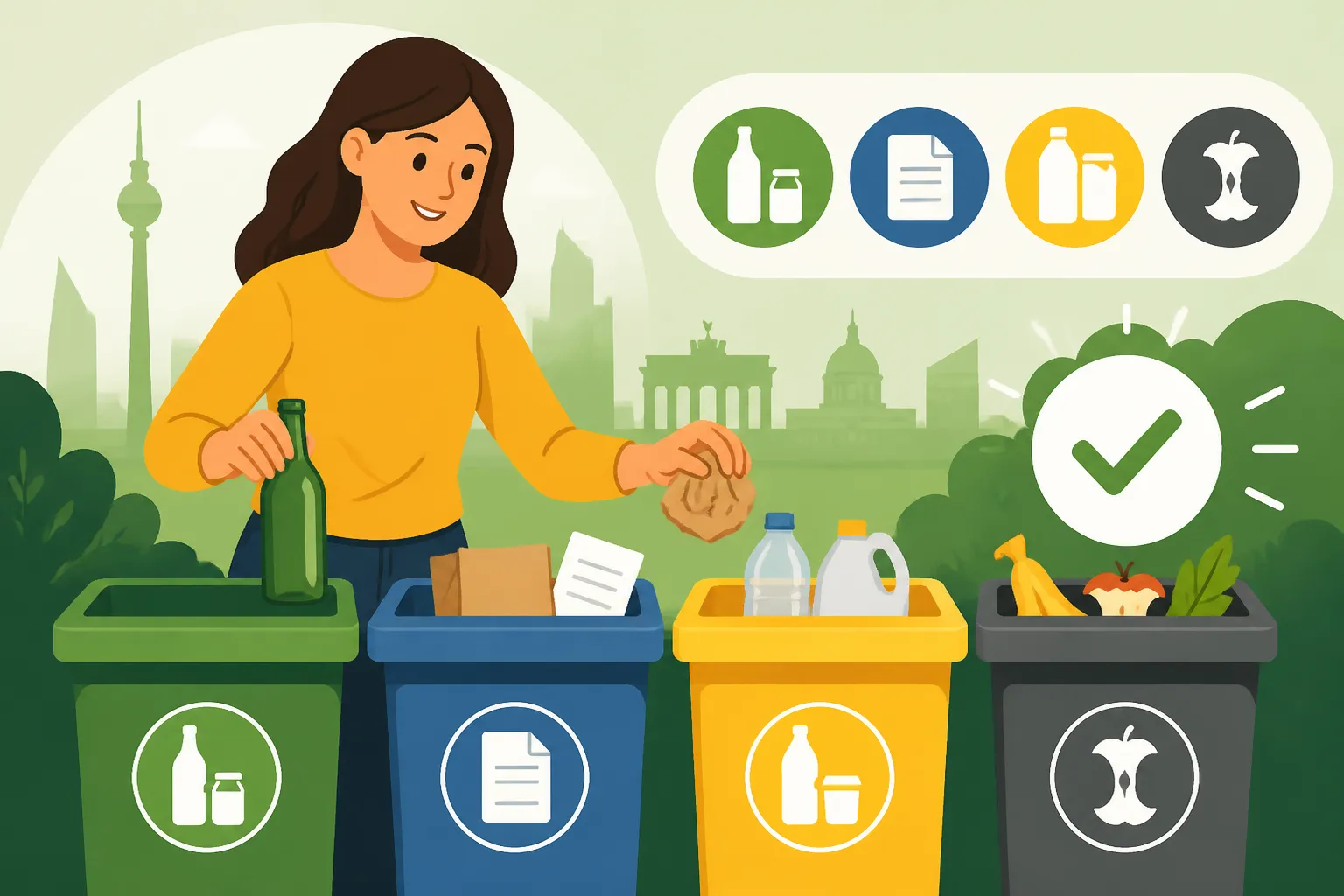
The blue bin is for paper and cardboard. This seems simple, but there are frequent traps for the unwary. You should include newspapers, magazines, brochures, old letters (shredded if they contain sensitive data), and cardboard boxes. The golden rule here is that the paper must be clean. That pizza box I mentioned? If it has grease stains or stuck-on cheese, it belongs in the black bin, not the blue one. Only the clean lid of the box can go in the blue bin.
Always flatten your boxes. Nothing irritates neighbors more than a blue bin that is "full" simply because someone threw in an intact Amazon Germany shipping box. Breaking down your cardboard is a small act of kindness that prevents the bin from overflowing before the next collection date. Avoid putting juice or milk cartons here; even though they feel like paper, they are composite materials and belong in the yellow bin.
The Yellow Bin or Yellow Bag (Wertstoffe/Gelber Sack)
The yellow bin—sometimes called the Wertstofftonne or provided as yellow plastic bags—is for "light packaging." This includes plastic containers (yogurt pots, shampoo bottles), metal cans (tuna tins, soda cans without a deposit), and composite materials like Tetrapaks.
A common mistake is nesting items. Do not put a plastic yogurt cup inside a tin can to save space; the sorting machines at the recycling plant cannot separate them, and they will likely end up in an incinerator instead of being recycled. Also, you do not need to rinse your containers until they are sparkling—that is a waste of water. Just ensure they are "spoon-clean." If you are unsure about a specific item, look for the "Green Dot" symbol, though most packaging is now included in this category by default.
The Brown or Green Bin (Biomüll)
The Biotonne is for organic waste. This includes fruit and vegetable scraps, coffee grounds (including the paper filter), tea bags, eggshells, and garden waste. In some regions, even small amounts of meat or cooked food are allowed, but you must check your local municipal website for specific rules.
The biggest controversy here is the use of "compostable" plastic bags. Even if the box says they are 100% biodegradable, many German composting facilities cannot process them fast enough, and they are treated as contaminants. It is much better to wrap your food scraps in a few sheets of old newspaper or use dedicated paper bio-bags. If you have just arrived and are still navigating Waste Sorting in Germany (Mülltrennung) and Pfand, sticking to paper liners for your bio-bin is the safest bet to avoid a stern note from the city.
The Black or Grey Bin (Restmüll)
The black bin is for "everything else"—the residual waste that cannot be recycled. This includes hygiene products (diapers, tampons), cigarette butts, cold ashes, old lightbulbs (non-LED), and broken ceramics or mirrors. If you are ever truly stumped by an item, the black bin is usually the safest "wrong" choice, as it won't contaminate the specialized recycling streams. However, because this is the most expensive waste to process, the goal is to keep this bin as empty as possible.
| Bin Color | Name | Common Items | Pro Tip |
|---|---|---|---|
| Blue | Papier | Newspapers, clean cardboard, flyers | Always flatten boxes to save space. |
| Yellow | Wertstoffe | Plastic pots, tins, Tetrapaks, foil | Do not stack items inside each other. |
| Brown | Biomüll | Veggie scraps, coffee grounds, eggshells | Use newspaper liners, not plastic bags. |
| Black | Restmüll | Diapers, cigarette butts, dirty tissues | This is the most expensive bin to empty. |
| Green/White/Brown | Altglas | Non-deposit glass bottles and jars | Sort by color; no blue or red glass in white. |
Beyond the Bins: Specialized Disposal Systems
The bins in your courtyard only cover about 70% of what you will need to throw away. Germany has specialized systems for glass, bottles with deposits, and hazardous materials. If you are out and about, you might need to look up the nearest disposal point; using an eSIM from a provider like Airalo ensures you have the data to find these locations on the go without hunting for public Wi-Fi.
The Altglas Containers
Glass bottles that do not have a deposit (like wine bottles, oil bottles, and jam jars) must be taken to large communal containers located on street corners. These are strictly sorted by color: Weissglas (white/clear), Braunglas (brown), and Grünglas (green). If you have a bottle that is blue or red, it always goes into the green container.
The most important rule here relates to Neighborhood Noise Rules: Understanding Ruhezeit (Quiet Hours) in Germany. Glass recycling is loud. Most containers have strict hours posted on them, usually 8:00 AM to 8:00 PM, and are strictly forbidden on Sundays and public holidays. Tossing a crate of empty Riesling bottles into a metal bin at 11:00 PM on a Saturday is a surefire way to have a neighbor scream at you from a window.
The Pfand System
Before you throw any bottle away, check for the Pfand (deposit) symbol. Germany has a brilliant system where you pay a small deposit (8 to 25 cents) on most drink containers, which you get back when you return the bottle to a machine at the supermarket. This applies to most beer bottles, plastic soda bottles, and even some yogurt jars.
Look for the symbol of a bottle and a can with an arrow. You can find detailed instructions in our guide on How to Return Bottles and Claim Pfand in Germany. If you are too tired to take them back, it is common practice to leave these bottles neatly next to a public trash can (never inside) so that people who collect them for the deposit can find them easily.
Hazardous Waste and Sperrmüll
Items like batteries, electronics, and old paint are never allowed in the household bins. Most supermarkets (like DM or Rossmann) have small boxes near the entrance specifically for old batteries. For old electronics, many stores are now legally required to take them back, or you can take them to a Recyclinghof (recycling center).
When you are moving or renovating, you will inevitably have "bulky waste" (Sperrmüll) like old mattresses or broken chairs. You cannot just leave these on the sidewalk. You must either book a collection with the city (usually once or twice a year for free or a small fee) or hire How to Find Reliable Tradespeople (Handwerker) in Germany to haul it away. Leaving furniture on the street without a permit is considered "illegal dumping" and can result in heavy fines. If you are finishing an Apartment Handover Protocol: Documenting Condition When Moving In/Out, ensure you have cleared all such items, or the landlord will deduct the removal cost from your deposit.
Practical Steps for a Stress-Free Trash Routine
To survive the German waste system, you need to be proactive. Start by visiting your local municipal website (search for "Abfallkalender" + your city name) and download the collection schedule. This will tell you exactly which days the different bins are emptied. In some cities, you are responsible for pulling the bins to the curb, while in others, the "full service" team enters the courtyard themselves.
Set up a "pre-sorting" station in your kitchen. I recommend three small bins (Bio, Yellow, and Paper) and a small bag for your Pfand bottles. Keeping the Pfand bottles separate is vital because if they get sticky or dirty, the automated machines at the supermarket might reject them. When I first moved here, I used to get frustrated by the amount of space these bins took up, but after a month, it became as natural as brushing my teeth.
Finally, don't be afraid to ask for help. If you see a neighbor at the bins, a polite "Entschuldigung, wohin kommt das?" (Excuse me, where does this go?) while pointing at a mysterious item is a great way to show you are trying to respect the local customs. Most Germans will be more than happy to explain the rules—they would much rather teach you now than deal with a contaminated bin later.
Disclaimer
This guide is intended for informational purposes and reflects common waste management practices in Germany. Specific regulations, bin colors, and collection schedules vary significantly between federal states and individual municipalities. Always consult your local "Stadtreinigung" or municipal waste authority for the most accurate and up-to-date rules for your specific address. Proper waste disposal is a legal requirement in Germany, and failure to comply can result in fines or civil penalties.