Sending Money From Germany to Romania and Bulgaria: Transfer Options
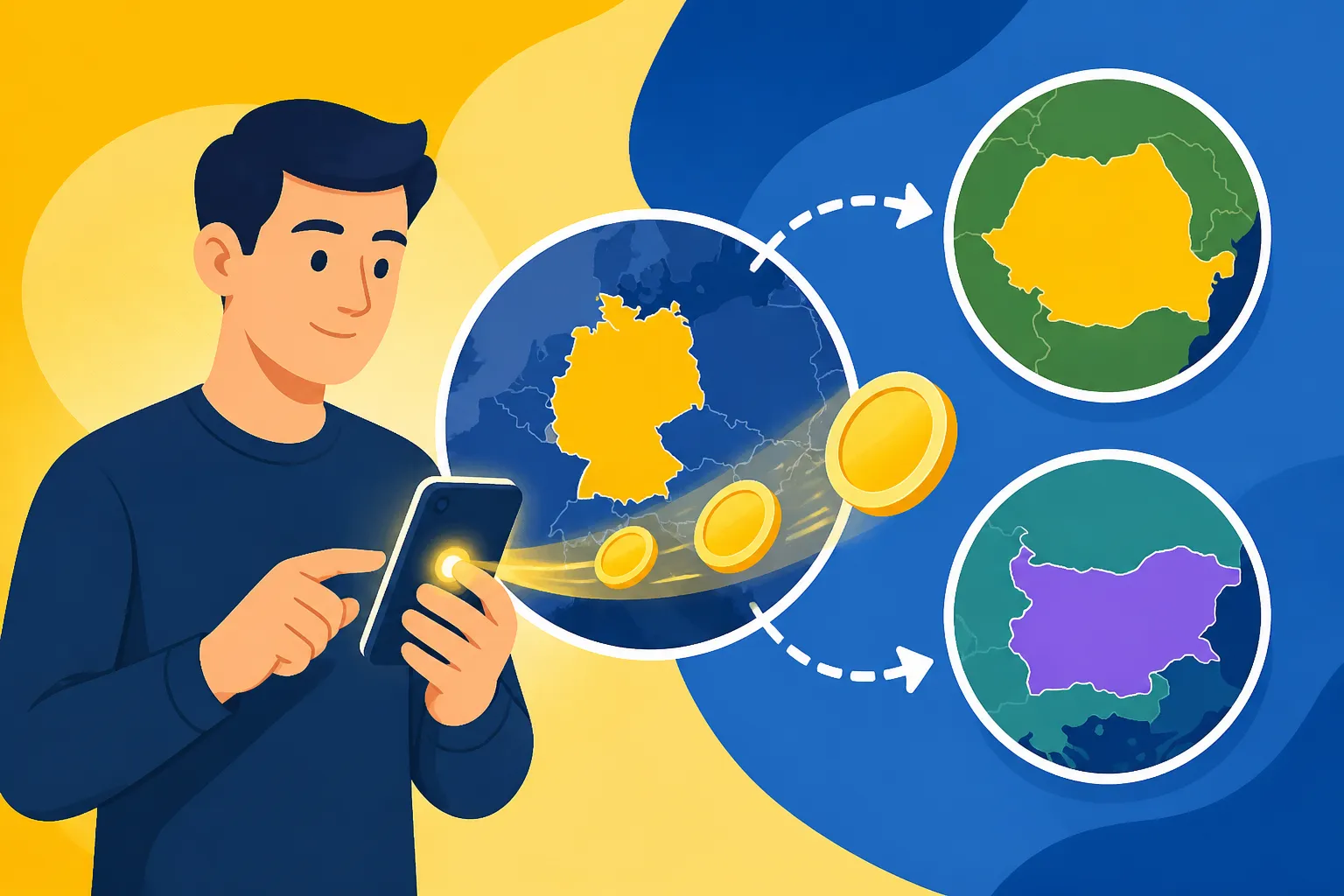
Your mother in Cluj needs help with a medical bill. Your cousin in Plovdiv is renovating the family flat. You open your German banking app, send what looks like a simple transfer, and a week later the amount that arrived is noticeably smaller than what you sent. This guide covers why that happens and which transfer options actually protect your money.
Disclosure: This post may contain affiliate links. We may earn a commission at no extra cost to you if you make a purchase through these links. Read full disclosure.
Why Sending Money to Romania and Bulgaria Costs More Than It Should
I learned this the hard way. In my first year in Germany I sent money to a friend in Bucharest through my regular bank account. I thought it would be like paying rent: type the IBAN, press send, done. The money arrived. But it arrived as less than I expected, and my friend’s bank had charged her a separate fee that neither of us had known about. Nobody had lied to us. The cost was just spread across three places, so it was easy to miss.
Romania and Bulgaria are both in the EU and both part of the SEPA payment area. That makes a lot of people assume transfers there are free and instant, the same as paying someone in Hamburg. Sometimes they are close. Often they are not, and the reason is nearly always currency.
The Currency Question Nobody Asks First
Ask your recipient this before you send anything: what currency is your account held in?
Romania still uses the leu, so most Romanians, especially older relatives, get their pension and pay their bills from a lei account. If you send euros from Germany into a lei account, the money still has to be converted. A German bank usually won’t do that for you on a standard SEPA transfer. It sends euros, and the Romanian bank converts them on arrival at whatever rate it chooses. That rate is rarely generous.
Bulgaria has adopted the euro, so for many recipients there the currency step disappears. A euro transfer from Germany into a euro account in Sofia or Varna is then a plain SEPA payment. Even so, ask before you assume. Your recipient may have an unusual account type, a savings product with its own rules, or a bank that handles incoming foreign payments differently from domestic ones. Two minutes on WhatsApp with your aunt can save a frustrating week.
The general rule is simple. If no currency conversion is involved, almost any SEPA-capable method works and the main question is cost and convenience. If a conversion into lei is involved, the method you choose decides how much money actually lands.
Where the Hidden Margin Hides
Almost no transfer service presents its exchange rate markup as a “fee.” The bank or provider takes the real mid-market exchange rate, the one you see on Google or a financial news site, and quietly offers you a worse one. The gap is their margin. A small difference on the rate shows up as a real difference in the lei your family receives.
There are three places this cost can sit:
- An upfront fee charged by the sending bank in Germany, often labelled as a foreign payment fee or an international transfer charge.
- An exchange rate margin, applied either by the sending provider or by the receiving bank in Romania when it converts your euros.
- A receiving fee taken by the recipient’s bank for processing an incoming payment from abroad.
Most people only look at the first one. The second is usually the largest, and the third catches families off guard because the recipient pays it, so you never see it from Germany. If you want the long version of how this works with a standard German account, see Wise vs Your Home Bank’s SEPA Payment: Where the Hidden Margin Sits.
A Worked Example of the Real Cost
Here is a realistic case. You want to send €500 to your father in Timișoara, and his account is in lei.
With a traditional bank international transfer, you might pay an upfront fee of €15 to €25. Then the money is converted at a rate 2-3% worse than the mid-market rate. On €500, that rate gap costs another €10 to €15.
Add them up and the total cost of that single transfer lands somewhere between €25 (a €15 fee plus €10 lost on the rate) and €40 (a €25 fee plus €15 lost on the rate). So your father receives the lei equivalent of roughly €460 to €475, and that is before any receiving fee his bank might charge on top.
Done once, it stings a bit. If you send €500 home every month, as many Romanian and Bulgarian workers in Germany do to support parents, it becomes a real annual loss. Using a provider that converts at the mid-market rate and shows its fee upfront would save that family most of that €25 to €40 every single month on this example, less the provider’s own fee.
Comparing Your Transfer Options From Germany
No option is perfect for everyone. A retired couple in Stuttgart sending birthday money twice a year has different needs from a care worker in Munich supporting three relatives in Craiova. Here are the main routes, with the trade-offs I’ve seen expats actually run into.
Traditional German Bank Transfers
Your Sparkasse, Volksbank, or big national bank can send money to Romania and Bulgaria. You already have the account, the app is familiar, and there is no new sign-up or identity check.
For euro-to-euro SEPA transfers into Bulgaria, this is often perfectly fine, because no conversion takes place. The weakness shows up when lei are involved. Your bank either sends euros and leaves the conversion to the Romanian bank, or offers its own conversion with a margin built in. In both cases you rarely see the final lei amount before you press send. That uncertainty is the core problem. You can’t compare what you can’t see.
Some German banks also treat certain payment types to Eastern Europe as foreign payments with separate charges, especially if you pick the wrong transfer type or a currency other than euro. The transfer form doesn’t always make this obvious, particularly if your banking German is still a work in progress.
Cash Pickup and Remittance Shops
Near the main stations in Frankfurt, Berlin, and Nuremberg you’ll find small shops offering money transfers with cash pickup. For some families this matters. An elderly grandmother in a village in Maramureș may not have a bank account, or may not trust one. Cash pickup at a local agent gets money into her hands.
The downside is cost and transparency. Cash-based services often combine a visible fee with a weak exchange rate, and the rate can vary depending on where you send from and how you pay. There’s also the practical side: you have to physically go somewhere during opening hours with cash or a card, and your recipient has to travel to a pickup point. For a broader look at how these compare on speed against digital options, see Wise vs Remitly and Western Union From Germany: Speed vs Cost.
Cash pickup earns its place for unbanked recipients and urgent emergencies. For regular support to someone with a bank account, it’s usually the more expensive route.
Wise and Other Digital Transfer Services
This is where my own habits changed for good. Wise is built around one idea: convert your money at the real mid-market exchange rate and charge a separate, clearly displayed fee. Before you confirm a transfer, you see exactly how many lei will arrive in your recipient’s account. No guessing, no surprise from the Romanian bank’s conversion desk.
For Romania, Wise can pay out directly into a local lei account. To the receiving bank, the incoming money looks like a domestic payment rather than a foreign one, which helps reduce the chance of an incoming foreign payment fee on the recipient’s side. Your father in Timișoara doesn’t need to sign up for anything or download an app. He just needs his normal bank account details.
For Bulgaria, where many recipients now hold euro accounts, the benefit is less about the exchange rate and more about clarity, tracking, and having a clean record of every transfer. If your recipient’s account is in a different currency, the same mid-market conversion logic applies.
The fee itself depends on the amount, the currency, and how you fund the transfer, so check the Wise pricing page or the in-app calculator for current figures before sending. The important part is that the calculator shows the full cost upfront, which lets you compare honestly against your bank’s offer for that exact amount on that exact day.
| Transfer Method | Exchange Rate Approach | Fee Visibility | Best Suited For | Main Drawback |
|---|---|---|---|---|
| German bank SEPA transfer in euros | No conversion if recipient account is in euros; receiving bank converts if account is in lei | Sending fee visible, conversion cost often hidden | Euro-to-euro transfers into Bulgaria | Lei recipients lose money to the receiving bank’s rate |
| German bank international transfer | Bank’s own rate with a built-in margin | Partial; final amount often unclear | People who refuse to use any other provider | In the worked example, €25 to €40 lost on €500 |
| Cash pickup shop | Provider’s own rate, varies by location | Fee shown, rate margin less obvious | Unbanked recipients and urgent cash needs | Higher overall cost, travel to agent required |
| Wise | Mid-market rate with a separate fee | Full cost and arrival amount shown before you pay | Regular transfers to lei accounts and anyone wanting a clear record | Requires identity verification at sign-up |
How to Send Money From Germany With Wise Step by Step
The first time is the only slow part. After that, a repeat transfer to your mother takes about as long as making a cup of coffee.
Setting Up Your Account From Germany
Wise will ask you to verify your identity, as any regulated financial service in Germany must. Have your passport or national ID ready. A Romanian or Bulgarian ID card is fine, as is a German residence permit alongside your passport if you’re from outside the EU. Address checks generally go more smoothly if your Anmeldung is done and your registered address matches what you enter. If you’ve only just arrived and haven’t registered yet, Your First Two Weeks in Germany: Paying for Things Before You Have a Local Account covers that awkward early phase.
Here’s the setup process:
- Download the Wise app or open the website and create an account with your email address.
- Choose a personal account and enter your details exactly as they appear on your ID document, including any diacritics if your system allows it.
- Upload photos of your identity document and complete the selfie or verification step when prompted.
- Wait for verification to complete. This is usually straightforward, but have your Meldebescheinigung handy in case extra proof of address is requested.
- Add your German bank account as a funding source, or decide to pay by card or bank transfer per transaction.
If you’re planning to move larger sums, for example helping a sibling with a property deposit in Brașov, look into verification tiers and caps before you need them. Wise Transfer Limits for Germany: Caps, Thresholds, and Verification Tiers explains how that works so you aren’t stuck mid-transfer.
Making Your First Transfer to Romania
Take Elena, a nurse in Düsseldorf whose mother lives in Iași. Her mother banks with Banca Transilvania and has a lei current account. This is how Elena’s first transfer went, and it’s the same process you’ll follow:
- Open the app and start a new transfer. Choose euros as the sending currency and Romanian leu as the receiving currency.
- Enter the amount you want to send in euros, or the amount you want to arrive in lei. Elena prefers to type the lei amount her mother needs for the month, so there’s no shortfall.
- Review the breakdown on screen: the fee, the exchange rate being used, and the exact lei amount that will arrive. Compare this against your German bank’s offer for the same amount if you want to see the difference yourself.
- Add the recipient’s details: full name exactly as the bank holds it, and their Romanian IBAN, which starts with RO. Double-check every character.
- State the reason for the transfer, such as family support. Be honest here, because it helps compliance checks run smoothly.
- Pay for the transfer from your German account by bank transfer, or with a card if that option suits you better.
- Track the transfer in the app and share the tracking update with your recipient so they know when to expect it.
Elena told me the part that won her over was seeing “your mother receives” followed by a precise figure. With her old bank, she always had to call home afterwards to ask how much had actually come through.
Setting Up Regular Support to Bulgaria
Now take Georgi, a warehouse supervisor in Leipzig who sends money to his parents in Ruse every month. His parents’ account is in euros, so no conversion is involved.
For Georgi, the appeal is organisation rather than exchange rates. He saves his parents as a recipient, repeats the transfer each month with a couple of taps, and keeps a clean history of every payment. That record has been useful more than once. When his sister asked how much the family had contributed to their father’s dental work, Georgi had every transfer, date, and amount in one place.
A good routine for regular family support looks like this:
- Save each family member as a recipient once, with verified account details.
- Pick a fixed day each month, ideally just after your German salary lands, so you never fund the transfer from an empty account.
- Repeat the previous transfer rather than re-entering details. This sharply reduces the risk of typos.
- Download or screenshot confirmations and keep them in a folder, which helps if questions ever come up about the purpose of the money.
For more on building a sensible monthly system, including how to keep records your tax advisor won’t sigh at, see Supporting Family Abroad From Germany: Monthly Transfer Setup and Records.
Avoiding the Mistakes That Cost Romanian and Bulgarian Families Money
Most of the painful stories I hear from friends aren’t about which provider they used. They’re about small errors and assumptions. Here’s what to watch for.
Getting Recipient Details Exactly Right
Romanian and Bulgarian names often contain letters like ș, ț, ă, or Cyrillic originals transliterated in different ways. A mismatch between the name you type and the name on the bank account can delay a transfer or get it returned. If your uncle’s account is under “Ștefănescu” and you type “Stefanescu,” it’s usually fine, but a completely different transliteration can trigger a manual review.
Ask your recipient to send you a screenshot of their account details from their banking app rather than reading the IBAN aloud over a crackly phone line. Romanian IBANs start with RO and Bulgarian IBANs start with BG. If what you’ve been given doesn’t start with the right letters, stop and check. If IBANs, BICs, and SEPA still feel like alphabet soup, Understanding the German Banking System: IBAN, SEPA, and More is worth ten minutes of your time.
One more point: confirm whether the account receives lei or euros before you choose the receiving currency. Sending lei to a euro account, or euros to a lei account, just reintroduces the conversion cost you were trying to avoid.
Protecting Yourself From Transfer Scams
Fraudsters know that people in Germany send money to family in Eastern Europe. The most common trick I’ve seen is a WhatsApp message from an unknown number: “Mama, I lost my phone, this is my new number, I need money urgently for a bill.” The message is often written in Romanian or Bulgarian to feel familiar.
Never send money to new account details based only on a text message, however convincing. Call the person on the number you already know. Agree on a family code word if your parents are elderly. Be equally suspicious of “landlords” in Romania asking for a deposit before you’ve seen a flat, or online sellers who only accept international transfers. Once a transfer has been paid out, getting it back is very difficult with any provider. For a wider look at the tactics circulating here, see Financial Scams to Watch Out for in Germany: How to Protect Your Money.
Handling Larger and One-Off Transfers
Large one-off transfers carry their own considerations: helping with a house purchase in Sibiu, paying a wedding venue in Sofia, or covering a hospital stay. The exchange rate margin matters more because it scales with the amount. A small percentage difference on a large sum becomes a meaningful figure, which is exactly where a mid-market rate approach like Wise’s pays off.
Larger amounts also tend to trigger more compliance questions, from your German bank and from any transfer provider. This is normal, not a sign you’ve done something wrong. Be ready to explain the source of the money, usually your salary or savings, and the purpose of the transfer. Keep documents such as a purchase contract or invoice to hand. On the receiving side, your family member’s bank in Romania or Bulgaria may ask them similar questions, so warn them in advance and explain where the money comes from.
If the money is a significant gift, it’s worth understanding the reporting and tax position on both sides before you send. Rules depend on the relationship between giver and recipient and on where each of you lives, so speak to a qualified advisor for anything substantial. For a comparison of everyday money apps that some Romanian and Bulgarian expats combine for different jobs, Wise vs Revolut in Germany: Which Account Actually Works for Residents breaks down which tool fits which task.
Choosing the Right Option for Your Situation
To pull it together, here’s how I’d decide if I were sending money from Germany today:
- If your recipient in Bulgaria has a euro account and you only send occasional small amounts, a standard SEPA transfer from your German bank may be enough, provided your bank doesn’t add a foreign payment charge.
- If your recipient in Romania has a lei account, avoid letting the Romanian bank convert incoming euros. Use a service that converts at the mid-market rate and shows the lei arriving, such as Wise.
- If your recipient has no bank account, cash pickup may be the only practical route. Compare the total cost, not just the headline fee.
- If you send money every month, the gap between a hidden-margin bank transfer and a transparent service adds up quickly. Run the numbers once using a real amount, as in the €500 example above, and the choice usually becomes obvious.
For the wider picture beyond these two countries, including how other expat communities handle remittances, see Sending Money Home: Best Options for Expats to Remit Funds.
Moving to Germany from Romania or Bulgaria often means carrying two lives at once: building a future here while still supporting people you love back home. Your hard-earned euros shouldn’t be quietly trimmed on the way. Try the Wise calculator with the amount you normally send, compare the arrival figure with your current bank’s offer, and let the difference make the decision for you.
Disclaimer
This article is for general informational purposes only and does not constitute professional advice. Laws, prices and regulations vary by location and change over time. Consult a qualified professional for guidance on your specific situation.