Luggage and Bike Rules on German Trains and Buses
Ah, the joys of German travel! You've got your destination picked, your tickets in hand, and then it hits you: "What exactly are the rules for my massive suitcase? And can I really bring my beloved Fahrrad on the train with me?" It’s a common expat dilemma, and believe me, you're not alone in feeling that little surge of panic. This guide will meticulously break down the often-confusing landscape of luggage and bike rules on Germany's trains and buses, helping you plan your journey with confidence using powerful booking platforms like Omio.
Disclosure: This post may contain affiliate links. We may earn a commission at no extra cost to you if you make a purchase through these links. Read full disclosure.
The Great Luggage & Bike Balancing Act: Why It's a Challenge in Germany
Germany's public transport system is undeniably efficient, usually punctual, and incredibly widespread. But beneath that veneer of seamless efficiency lies a labyrinth of rules, especially when it comes to what you can bring on board. For us expats, who often travel with more than just a carry-on or are keen to explore the fantastic cycling routes, understanding these nuances is crucial to avoid unexpected fees, frantic re-packing, or being turned away altogether.
Standard Luggage: The Unwritten Rules
Unlike air travel, where strict weight and size limits are enforced with an iron fist, German train and bus operators tend to be a little more… flexible, yet simultaneously opaque. This flexibility can be a double-edged sword. On one hand, you generally won't find yourself weighing your suitcase at the gate. On the other, the unspoken rule is often "if it fits and you can carry it, it's probably fine." This can lead to some awkward situations, especially on crowded regional trains or during peak hours. You're expected to manage your own luggage, stow it safely, and not inconvenience fellow passengers. This can be particularly frustrating when you're lugging a heavy bag up stairs in older stations or trying to squeeze into a packed S-Bahn during rush hour.
Bikes: Freedom on Wheels, Headaches on Rails
Germany is a wonderfully bike-friendly country, with an extensive network of cycling paths and a culture that truly embraces the Fahrrad. It’s no wonder so many of us want to take our bikes on our travels, whether for a cycling holiday along the Rhine or just to get around a new city. However, transporting your bike on public transport can feel like navigating a minefield. Each type of train, bus, and even regional transport association has its own specific set of regulations, availability, and often, additional costs. What’s allowed on an ICE might be forbidden on a local bus, and a reservation could be mandatory in one instance but not even an option in another. The dream of seamless bike travel can quickly devolve into a logistical nightmare if you don't do your homework.
Conquering German Trains: Deutsche Bahn (DB) and Your Gear
Deutsche Bahn (DB) is the backbone of German long-distance and regional travel. Its network is vast, connecting almost every corner of the country. But with different train types come different rules for your luggage and bike. Planning your journey with an all-in-one platform like Omio can be incredibly helpful here, as it often provides details or links to specific rules for your chosen route and carrier, saving you from digging through multiple websites.
Your Luggage: What Fits, What Pays Extra, and What You Carry
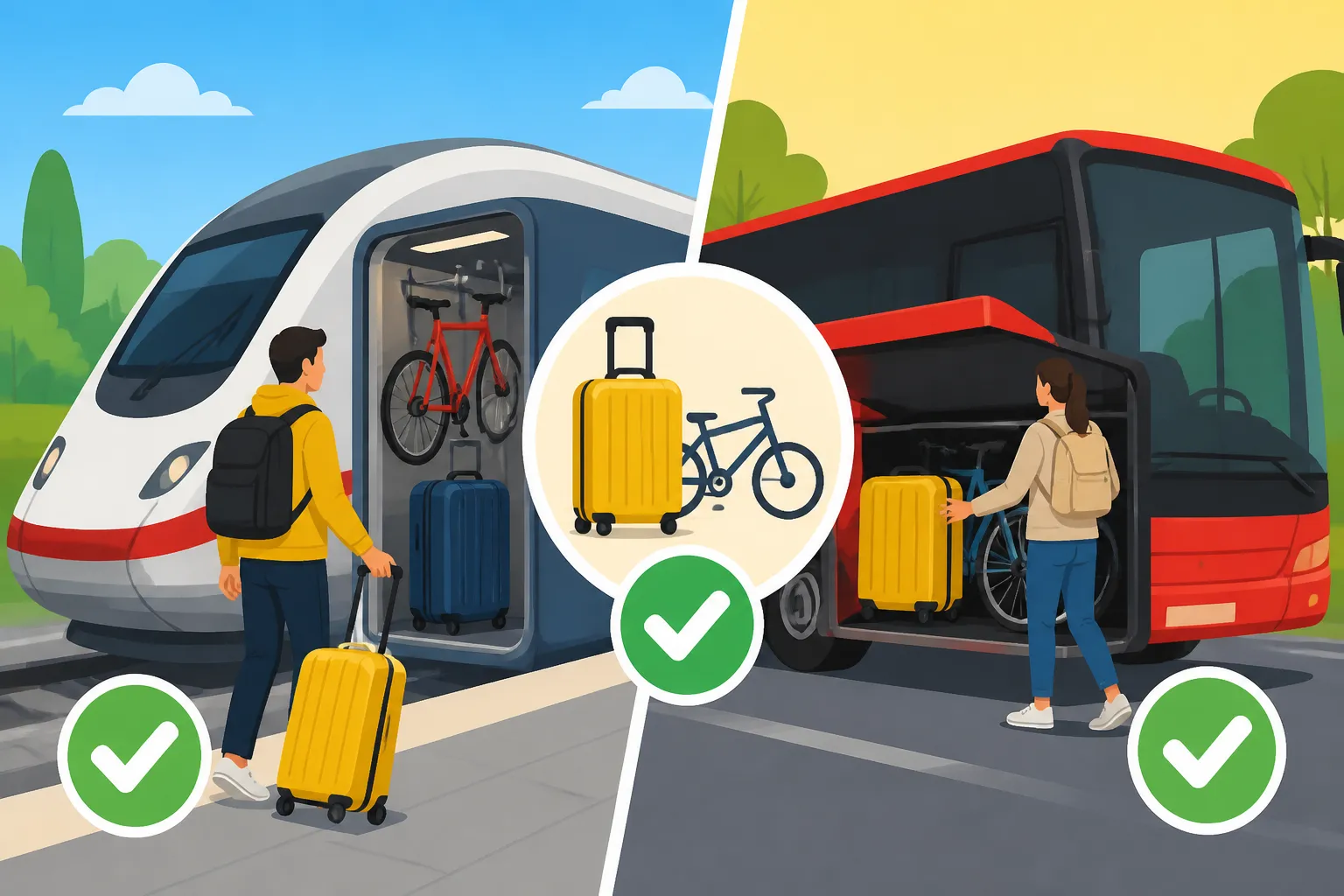
When you're hopping on a DB train, be it a speedy ICE, an Intercity (IC), Eurocity (EC), or a regional train (RE, RB), there's generally no explicit limit on the number of bags you can bring. The golden rule, as mentioned, is self-sufficiency: you must be able to carry and stow your luggage yourself.
- Standard Suitcases and Bags: For most journeys, two medium-sized suitcases (up to around 20-30 kg each, similar to airline checked baggage) plus a carry-on or backpack are perfectly acceptable. You'll find overhead racks for smaller items and spaces between seats or at the end of carriages for larger cases. On ICE trains, these designated luggage areas can fill up quickly, especially on popular routes or during holidays. Be prepared to keep your bag close if space is tight.
- Bulky Items: Thinking of bringing skis, a snowboard, or a large musical instrument? These are generally permitted as long as they don't block aisles or doors and can be stowed safely. Again, the onus is on you. If it's something truly oversized, consider sending it via DB's luggage service (Gepäckservice) ahead of time, which can be a lifesaver. Keep in mind that some international connections or specific ICE routes might have stricter interpretations of what constitutes "stowable" luggage. Always check your specific train type or use a booking tool like Omio to clarify details for your particular ticket.
Bikes on DB: Reservation, Restrictions, and Regional Differences
This is where it gets tricky. Bringing your bike on a DB train requires careful planning:
-
Long-Distance Trains (ICE, IC/EC): Not all long-distance trains have designated bike compartments. ICE trains, especially the newer models, generally do not have space for full-sized, non-dismantled bicycles. There are some exceptions, particularly on specific ICE routes, but these are rare and require mandatory reservations, which sell out fast. For IC/EC trains, bike spaces are more common but still limited and always require a separate bike ticket and reservation in advance. You simply cannot show up with your bike and expect to board without one. It's a €9 fee for the bike ticket plus the reservation fee. You can find out more about how to Buy Deutsche Bahn Tickets and Save Money and how this impacts bike transport.
-
Regional Trains (RE, RB, S-Bahn): This is where bikes are generally more welcome. On most regional trains, you can bring your bike, usually in designated multi-purpose areas (often marked with a bicycle symbol). A separate bike ticket (Fahrradkarte) is usually required, costing around €6 for a single journey or available as part of a day pass. The key here is availability: during peak hours, particularly weekday mornings and late afternoons, staff may deny boarding if the train is too crowded, as passenger priority always trumps bike transport. It’s important to understand the rules for Regional Trains and the Deutschland-Ticket Explained, as the Deutschland-Ticket often does not include bike transport and requires a separate bike monthly pass or day ticket.
Hypothetical Scenario: Imagine you're planning a weekend cycling trip to the Black Forest. You'd likely take an ICE for part of the journey. You could check on Omio to see if your ICE leg has bike spots, but chances are, it won't. Your best bet would be to take your bike to the nearest hub, find a regional train (RE or RB) going towards your destination, and purchase a bike ticket for that specific regional leg. You might even consider disassembling your bike and packing it in a bag if you're set on the ICE, treating it as "bulky luggage" if it fits within the dimensions (usually max 120x90cm) and doesn't impede other passengers.
-
Folding Bikes: If your bike folds down to a size comparable to standard luggage, you can usually take it on any train for free, provided it's folded and stowed properly. This is often the best solution for urban explorers.
For more detailed information, checking the official DB website or using a comprehensive booking platform like Omio is essential. Omio often allows you to filter for journeys that accommodate bikes or provides clear warnings if they don't, making your planning much smoother.
Beyond Bags and Bikes: Bulky Items and Special Transport
Sometimes you need to transport something truly out of the ordinary. Maybe you're moving a small chest of drawers, a large piece of art, or even a specialized sports item like a surfboard (if you're heading to the coast!).
- DB Gepäckservice: For things too big to comfortably bring on board, DB offers a luggage service. You can ship your items door-to-door or station-to-station. This service is fantastic for heavier or particularly awkward items, but it does come with a fee and requires booking in advance. It's especially useful for expats moving or sending items home, offering a peace of mind that can't be beaten.
- Prams and Wheelchairs: These are always transported free of charge and typically have dedicated spaces on trains. You’ll find accessible ramps and lifts at most major stations, making travel with these items much easier.
- E-Scooters: While popular for urban mobility, bringing personal e-scooters on trains is a newer grey area. Foldable ones generally fall under the "bulky luggage" category. Non-foldable e-scooters are treated like regular bicycles and fall under the same rules and restrictions, often requiring a bike ticket and potentially facing boarding restrictions on crowded trains.
Hitting the Road: Bus Travel with FlixBus and Alternatives
For long-distance travel, buses like FlixBus offer a more budget-friendly alternative to trains, often with more straightforward luggage rules, though bike transport can be a different beast entirely.
Baggage Basics on German Buses
Bus companies typically have much clearer, albeit sometimes stricter, rules than trains when it comes to luggage.
- FlixBus (and FlixTrain): The most popular long-distance bus operator, FlixBus, usually includes one piece of standard luggage (e.g., a suitcase up to 20kg, max dimensions 80x50x30cm) and one piece of hand luggage (e.g., a small backpack or bag fitting under your seat) in the ticket price.
- Extra Luggage: You can usually add up to two additional pieces of standard luggage for a fee (typically around €3-€5 per bag) during the booking process or sometimes directly with the driver (though booking online is cheaper and guarantees space).
- Bulky Luggage: Specific bulky items (like skis, musical instruments, large prams) can often be booked for an additional fee, but this varies by route and bus type. You must declare and book these in advance. For example, a pair of skis might be accepted in a ski bag, but a massive surfboard likely won't be.
- Other Bus Operators: While FlixBus dominates, smaller regional bus lines or international coach services might have slightly different allowances. Always check the specific operator's website. If you're using a booking platform like Omio, it's great because it aggregates options and often links directly to the baggage policies of the different carriers, so you don't have to hunt around. This is especially useful when considering Long-Distance Buses in Germany: FlixBus and Networks.
Bike Transport on Coaches: A Different Ballgame
Taking your bike on a long-distance bus is often more restrictive than on regional trains, but it is sometimes an option.
- FlixBus Bike Rack: Some FlixBus coaches are equipped with bike racks at the rear, usually accommodating 3-5 bikes. This service is only available on specific routes and must be booked in advance during the ticket purchase process. A special bike ticket (usually around €9-€15) is required. Spaces are extremely limited, so book early!
- Bike Bags: If the bus doesn't have a rack, or if you prefer, you can often transport a disassembled bike packed in a special bike transport bag as "special luggage" or an "oversized item." This usually incurs an additional fee and needs to be booked in advance, and the dimensions must adhere to their bulky luggage limits (usually max 240cm circumference).
- FlixTrain: FlixTrain, FlixBus's train service, operates similarly to DB regional trains in terms of bike transport, requiring a bike ticket and having capacity limits. Always verify availability and book in advance.
Traveler's Tip: Before you commit to a bus journey with your bike, use Omio to check if bike transport is even offered for your specific route and date. It's much better to know upfront than to arrive at the bus stop and be turned away.
Tips for a Smooth Bus Journey with Gear
- Book in Advance: This is paramount, especially for bikes or extra luggage. Capacity is limited.
- Arrive Early: Get to the bus stop with plenty of time to spare, particularly if you have special luggage. This allows the driver time to load everything without delaying the schedule.
- Label Everything: Put your name and contact details on all your bags and bike.
- Protect Your Bike: If using a bike rack, consider removing easily detachable parts (lights, bike computer) to prevent theft or damage. If packing in a bag, ensure adequate padding.
City Hopping: Luggage and Bikes on Local Public Transport
Once you arrive in a German city, you’ll be relying on the local transport network: U-Bahn (subway), S-Bahn (commuter rail), trams, and city buses. Each city’s public transport operator (e.g., Berlin's BVG, Munich's MVV) sets its own rules, but there are commonalities. For general guidance on Getting Around German Cities: U-Bahn, S-Bahn, Trams, and Buses, it's good to know the basics.
Rules for Luggage on City Transport
Generally, city transport is very accommodating for standard luggage.
- No Explicit Limits: As long as your luggage doesn't block aisles, doors, or seating, and you can manage it yourself, you're usually fine. There are no extra fees for suitcases or backpacks.
- Prams, Wheelchairs, Shopping Carts: These are always permitted and often have dedicated spaces, particularly in newer U-Bahn and tram models. They travel for free.
- Rush Hour Considerations: While generally permitted, common courtesy dictates that you avoid traveling with excessively large luggage during peak hours. You'll thank yourself for not trying to navigate a crowded U-Bahn with a giant suitcase when everyone else is heading to work.
Cycling in the City: When and Where Your Bike Can Join You
Bringing your bike on city public transport is a fantastic way to extend your cycling range or bypass unappealing urban stretches. However, it's regulated:
- General Rule: Bikes are usually allowed on U-Bahn, S-Bahn, and trams, but not on city buses (due to space constraints and safety).
- Dedicated Times: Many cities have restrictions during rush hours (e.g., 6-9 am and 3-6 pm on weekdays), when bikes are often completely forbidden or only allowed with significant limitations. Always look for signage or check the local transport authority's website (e.g., BVG in Berlin) for specific times.
- Bike Ticket Required: Almost universally, you'll need a separate bike ticket (Fahrradkarte) for your bike, similar to a reduced-fare single ticket. Folding bikes, when folded, usually travel free as hand luggage.
- Designated Areas: Look for compartments with bike symbols, usually near the doors or at the ends of carriages. You're expected to keep your bike in these areas and ensure it doesn't inconvenience other passengers.
- Crowd Control: Even outside restricted hours, if a train or tram is too crowded, staff (or fellow passengers!) may ask you to wait for the next service. Passenger safety and comfort always take precedence.
- Bike-Sharing: For casual city cycling, consider using a bike-sharing service. Many cities have excellent systems, eliminating the need to bring your own bike on public transport. Read more about Cycling in German Cities: Bikes and Bike-Sharing for options.
Local Insight: In Berlin, for instance, you can take your bike on the U-Bahn and S-Bahn outside peak hours with a valid bike ticket. However, on a sunny Saturday, the S-Bahn to Potsdam can be packed with cyclists, making it tough to find space. Planning with tools like Omio can help you see train frequencies, allowing you to pick less busy times if possible.
Seamless Journeys: Smart Planning with Your Digital Companion
Navigating these diverse rules can feel like a full-time job. This is precisely where a good travel planner and booking platform becomes your best friend.
Packing Smart for German Travel
Before you even think about booking, consider your packing strategy:
- The Capsule Wardrobe: Seriously, Germans are not overly concerned with fashion statements on trains. Pack versatile clothes you can mix and match.
- Soft Luggage: While hard-shell suitcases are fine, soft bags can sometimes be squeezed into tighter spots more easily.
- Packing Cubes: A lifesaver for organization and making bags seem smaller.
- Embrace Folding Bikes: If cycling is a big part of your plan, a foldable bike will save you immense hassle and money on transport.
- Consider Shipping: For truly bulky or heavy items, the DB Gepäckservice or other parcel services like DHL can be more convenient and sometimes even cheaper than struggling on public transport.
- Digitalize Documents: Keep copies of your tickets and reservations (especially for bikes!) on your phone.
Your Booking Assistant: How Omio Simplifies the Process
This is where the magic happens. A platform like Omio isn't just for buying tickets; it's a powerful tool for navigating the complexities of German travel.
- All-in-One Search: Omio allows you to compare and book tickets for trains (DB), buses (FlixBus), and even flights across Germany and Europe. This means you can see all your options for a route in one place, which is invaluable when planning with specific luggage or bike needs.
- Checking Bike Availability: Crucially, when you search for a route, Omio often indicates whether bike transport is an option for that specific carrier and service. This saves you the headache of manually checking each operator's website. You can often add a bike directly during the Omio booking process, ensuring you have the necessary ticket and reservation. This integration makes it so much easier to understand the full cost and feasibility of your journey right from the start.
- Clearer Rules: While Omio streamlines the booking, it also provides links or information about baggage allowances for the carriers it lists. This means you can quickly see the permissible luggage size for your FlixBus journey or confirm if an ICE train has bike compartments, all without leaving the platform.
- Streamlined Booking: Once you've figured out your luggage and bike strategy, booking through Omio is straightforward. You get all your tickets in one place, often accessible directly on your phone, reducing paper clutter and stress. This simplifies the act of Travel Logistics in Germany: Money, Safety, and Connectivity by consolidating your travel planning.
- Planning Multi-Modal Trips: If your journey involves a combination of long-distance train, a regional bus, and then a local S-Bahn, Omio can help you piece these together. For instance, you might find that a train journey part-way, followed by a local bus connection (where you might have to leave your bike at the station or use a folding bike), is the most efficient. Knowing these options upfront through Omio is a game-changer.
Example: You want to go from Hamburg to the beautiful lakes of Mecklenburg-Vorpommern for a cycling holiday. You search on Omio for your route. It might show you a direct regional train that allows bikes with a separate ticket, or it might suggest a combination of an IC train (no bike) to a connecting city, and then a regional bus that does have a bike rack, requiring a separate booking for the bike. Omio helps you see these scenarios and choose the one that fits your needs. This makes planning your adventure to, say, Germany's National Parks Worth Visiting or a Hiking in Germany: The Black Forest, Alps, and Beyond trip, much more manageable.
Using a platform like Omio is a significant stress-reducer for expats and tourists alike. It empowers you to plan and book your journeys, including your sometimes-tricky luggage and bike requirements, with confidence and clarity.
Disclaimer
The information provided in this guide is for general informational purposes only and is based on current regulations and common practices in Germany. Transport rules and regulations, especially concerning luggage and bikes, can change frequently and vary significantly between different transport providers (Deutsche Bahn, FlixBus, regional associations) and even specific train or bus types and routes. Always verify the most up-to-date information directly with your chosen carrier or on your booking platform like Omio before your journey. No liability is assumed for the accuracy, completeness, or timeliness of the information.