Losing and Reapplying for German Permanent Residency: What to Do
Realizing your “permanent” German residency has vanished because you stayed abroad for too long is a uniquely devastating expat nightmare. I once nearly lost my hard-earned status after returning home to care for a sick parent, entirely unaware of the invisible expiration clock. This guide explains how to prevent losing your permanent residency and the exact steps to reclaim it.
Disclosure: This post may contain affiliate links. We may earn a commission at no extra cost to you if you make a purchase through these links. Read full disclosure.
The Six-Month Expiration Trap How You Actually Lose Permanent Residency
The hardest lesson many expats learn is that German permanent residency is not actually permanent if you decide to leave the country. The immigration laws are designed to grant permanent status only to those whose center of life remains firmly rooted in the Federal Republic.
The Permanent Misconception and the Six Month Rule
The word “permanent” in the Niederlassungserlaubnis (Permanent Settlement Permit) is a bureaucratic misnomer. Under Section 51 of the German Residence Act (Aufenthaltsgesetz or AufenthG), your permanent residence permit automatically expires if you leave Germany for more than six continuous months.
This expiration happens by operation of law (kraft Gesetzes). The immigration office (Ausländerbehörde) does not send you a warning email, nor do they mail a cancellation letter to your last known address. Your plastic residency card simply becomes legally void the exact moment the 181st day of your absence hits. If you attempt to re-enter Germany on day 182, the border police at the Frankfurt or Munich airport will scan your card, see the prolonged absence, and have the legal authority to confiscate the card and deny you entry as a resident.
This invisible trap frequently catches expats who accept temporary international job rotations, take extended global sabbaticals, or return to their home countries to deal with prolonged family emergencies.
Exceptions The Fifteen Year Rule and EU Long Term Residence
As with all German laws, there are highly specific exceptions to the six-month rule. The most significant exception applies to long-term veterans: if you have lived in Germany legally for at least 15 continuous years and you can prove that your livelihood is entirely secure without relying on public funds, your permanent residency does not automatically expire after six months. Furthermore, spouses of German citizens can also maintain their permanent residency indefinitely while abroad, provided the marriage remains intact.
Another major exception relates to the type of permanent residency you hold. If you successfully applied for the Erlaubnis zum Daueraufenthalt-EU (EU Long-Term Residence Permit) instead of the standard national Niederlassungserlaubnis, you are granted significantly more geographical freedom. Holders of the EU permit can reside outside the European Union for up to 12 consecutive months, and can live in another EU member state for up to six years, before their German residency expires. To grasp the strategic value of this specific card, read EU Long-Term Residence Permit vs German Permanent Residency: Differences Explained.
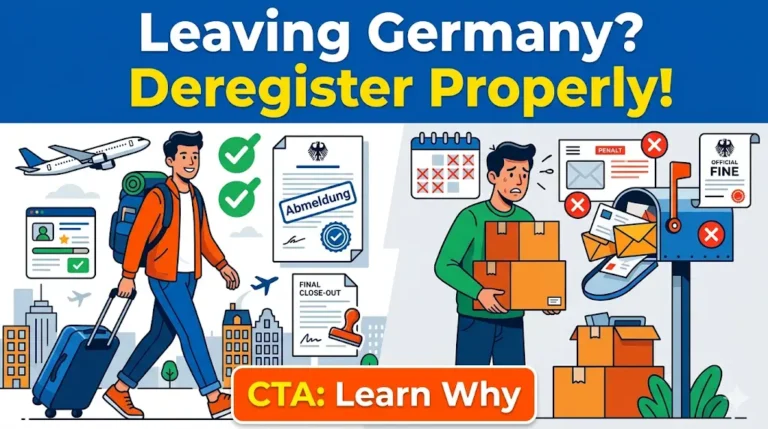
Expatriation by Deregistration
There is a second, much faster way to lose your permanent residency: the Abmeldung (deregistration). German law states that a residence permit expires immediately if a foreigner leaves the country for a reason that is “not of a temporary nature.”
If you cancel your apartment lease, sell your furniture, quit your German job, and officially deregister your address at the local citizens office, the Ausländerbehörde will legally assume your departure is permanent. In this scenario, your permanent residency expires the exact day you leave the country, regardless of the six-month allowance. You cannot move back to the US or India, deregister, and then casually fly back to Germany five months later expecting your permanent residency to still be valid. Proper handling of your address registration is the foundation of your legal existence in Germany.

Can You Prevent Losing Your Status Before You Leave?
If you know you are facing a life event that will keep you outside of Germany for more than six months, you do not have to surrender your status. You can legally protect your residency, but you must act before you board your outbound flight.
Applying for an Extension at the Auslaenderbehoerde
To legally bypass the six-month expiration rule, you must proactively apply for an official extension from your local Ausländerbehörde before you leave Germany. You must request a formal written certificate (Bescheinigung) stating that your prolonged absence will not lead to the expiration of your Niederlassungserlaubnis.
This is a highly discretionary process. The caseworker will heavily scrutinize your motives. You must definitively prove two things: first, that your absence is temporary by nature, and second, that you have a concrete, verifiable intention to return to Germany and resume your life here. If you tell the caseworker you are leaving to “see if you like living in Canada better,” they will deny your request and your residency will expire in six months.
Acceptable Reasons for Extended Absences
The authorities generally only grant these extensions for specific, state-approved reasons. Common acceptable scenarios include being temporarily dispatched abroad by your German employer (Entsendung), fulfilling mandatory military service in your home country, or pursuing a highly specific, temporary academic research project that requires your physical presence overseas.
Another acceptable reason is returning home to provide intensive care for a severely ill parent. However, you cannot simply claim your parent is sick. The Ausländerbehörde will demand overwhelming medical documentation from foreign hospitals proving the severity of the illness and the necessity of your care. Because these foreign medical documents will be in your native language, the caseworker will mandate that they be officially translated into German by a sworn translator. To bypass the stress of finding local translators during a family emergency, savvy expats use Lingoking before submitting their extension request. You can upload the foreign medical records to Lingoking, and they will return legally binding, officially stamped German translations that the caseworker will accept without hesitation.
Maintaining Ties Health Insurance and Financial Proof
Even if the authorities grant your extension, you must meticulously maintain your ties to Germany to prove your center of life remains here. You should not close your German bank accounts, and you must maintain a spotless financial record.
The most complex tie to maintain is your German health insurance. You cannot simply cancel your health insurance while you are abroad and expect to seamlessly resume it a year later. You should contact your provider to place your policy on an Anwartschaftsversicherung (entitlement or “pause” insurance). This requires paying a small monthly fee to keep your contract dormant, ensuring you can immediately reactivate your comprehensive coverage the moment you return, regardless of any new medical conditions you may have developed. Navigating this administrative pause is notoriously difficult with traditional German call centers. Utilizing an English-first broker like Feather Insurance allows you to manage this pause digitally, ensuring your policy remains legally compliant while you are overseas. We explore the intricacies of these insurance systems deeply in Public vs Private Health Insurance: Which One Should You Choose?.
Reapplying for Permanent Residency After Losing It
If you left Germany without securing an extension and your six-month window has closed, your Niederlassungserlaubnis is permanently gone. You cannot simply appeal to have it turned back on. You must formally reapply to enter the country.
The Right of Return for Former Residents
German immigration law recognizes that former long-term residents possess strong cultural and linguistic ties to the country. Under Section 37 of the Residence Act (AufenthG), there is a specific provision known as the “Right of Return” (Recht auf Wiederkehr).
This clause allows former residents to reclaim a residence permit under strict conditions. For adults, the baseline requirement typically demands that you lawfully resided in Germany for at least eight continuous years before you left, and that you attended a German school for at least six years. Because most working expat professionals did not attend childhood schooling in Germany, they often do not qualify for this specific statutory right of return, unless they are returning as pensioners whose retirement income can fully cover their German living expenses.
Re entering the System Initial Visas and Blocked Accounts
If you do not qualify for the Section 37 right of return, you must accept a harsh reality: in the eyes of the German state, you are a brand-new immigrant. You must start the immigration process completely from scratch.
You will need to apply for a new initial visa at the German embassy in your current country. This means securing a new EU Blue Card, a Skilled Worker Visa, or a Job Seeker Opportunity Card (Chancenkarte). If you are returning to Germany as a job seeker or to pursue further university studies, the embassy will ruthlessly demand proof of your financial independence. They will not care that you previously lived in Germany for four years; they will demand that you open a German blocked account (Sperrkonto) and deposit over 11,000 Euros to prove you can survive your first year back. Setting this up from abroad is incredibly efficient when you use a digital provider like Expatrio. By funneling your relocation funds into an Expatrio blocked account, you instantly generate the exact financial confirmation PDF the embassy demands for your new entry visa. To refresh your memory on how this vault functions, read Student Visa Blocked Account Sperrkonto: What It Is and How to Set It Up.
Fast Tracking Your Second Niederlassungserlaubnis
The silver lining of returning to Germany as a skilled worker is that your previous integration efforts are not entirely wasted. While you must start on a temporary visa, you do not necessarily have to wait another five years to regain your permanent residency.
If you return on a new EU Blue Card, you are immediately eligible for the Blue Card fast-track timelines. Because you already lived in Germany, you likely already possess the official B1 German language certificates required by the state. With a new Blue Card and your old B1 certificate in hand, you can apply to reclaim your Niederlassungserlaubnis in just 21 months of qualified employment. Furthermore, under certain discretionary clauses, the Ausländerbehörde may credit a portion of your previous German residency toward your new naturalization or permanent residency timelines, though this is heavily dependent on the individual caseworker’s assessment of your integration. To fully understand these accelerated timelines, bookmark Permanent Residence Permit Niederlassungserlaubnis: How to Qualify in Germany.
Navigating the Bureaucracy of Re-establishing Your Life
Returning to Germany after losing your permanent residency is not a simple homecoming. It is a massive bureaucratic relocation that requires immense preparation.
Securing Visa Compliant Health Insurance Instantly
When you apply for your new entry visa at the German embassy, you cannot simply promise that you will reactivate your old public health insurance once you land. The embassy demands immediate, visa-compliant incoming travel health insurance to issue the entry visa.
If your previous policy was completely canceled rather than paused, navigating the re-enrollment from abroad is highly complex. You can solve the immediate embassy requirement by purchasing a dedicated incoming policy through Feather Insurance. These policies are specifically designed to satisfy Schengen visa requirements. Once you successfully land in Germany and register your address, the English-speaking support team at Feather Insurance can help you transition smoothly back into the statutory public system or underwrite a new comprehensive private plan, entirely removing the friction of dealing with German insurance paperwork from overseas.
Translating Your Foreign Documents Again
During the years you spent outside of Germany, your life inevitably progressed. You may have gotten married, had children, or earned a new advanced degree from a foreign university.
When you apply to return, the German embassy will demand that all of these new life events be documented, legalized, and translated. A foreign marriage certificate is meaningless to the German authorities unless it is translated by a court-approved German sworn translator. Submitting untranslated or improperly certified documents will result in an immediate visa rejection. By utilizing Lingoking, you can upload scans of your new foreign marriage certificates and diplomas and have them translated by certified professionals. Submitting flawless, legally stamped translations generated through Lingoking guarantees your re-entry application moves swiftly through the embassy’s backlog.
Proving Financial Independence and Housing Space
The authorities will scrutinize your finances just as harshly during your re-application as they did the first time you moved here. They must be entirely convinced that you will not become a burden on the German social welfare system.
If you are returning to Germany without a signed employment contract, having a massive financial buffer in your Expatrio account is the most effective way to appease the immigration officers. Furthermore, you will face the grueling German housing market once again. You must prove to the local authorities that you have secured adequate living space for yourself and any dependents joining you. Securing a long-term lease from abroad is notoriously difficult, and you must budget aggressively for temporary furnished housing while you search for a permanent apartment.
Comparing Reapplication Pathways Which Route is Best?
If you want to reclaim your life in Germany, you must strategically choose your re-entry pathway based on your professional qualifications and your history.
The Former Resident Route vs The Skilled Worker Route
For the vast majority of expat professionals, attempting to use the Section 37 “Right of Return” is an administrative dead end because they do not meet the strict childhood schooling requirements. The standard skilled worker route is almost always the most pragmatic choice.
| Feature | Section 37 “Right of Return” | Skilled Worker Visa / Blue Card Route |
| Primary Eligibility | 8 years prior residence + 6 years German schooling | Recognized university degree + Job offer |
| Financial Proof | Must prove secured livelihood | Salary must meet statutory minimums |
| Application Speed | Often slow due to extensive background checks | Generally streamlined for highly qualified talent |
| Family Reunification | Subject to strict financial scrutiny | Highly facilitated, spouse can work immediately |
If you have a recognized university degree, aggressively applying for jobs from abroad and securing an employment contract before you return is the safest strategy.
EU Blue Card Re entry Pros and Cons
Returning via the EU Blue Card is the undisputed best option for expats who previously lost their permanent residency. The primary advantage is the sheer speed at which you can reclaim your permanent status (21 to 27 months) and the ease with which you can bring your spouse and children.
The only significant drawback is the psychological regression. Having previously tasted the absolute freedom of the Niederlassungserlaubnis, returning to Germany on a Blue Card means you are once again tethered to a specific employer. For the first 12 months, you cannot simply quit your job or change careers without explicitly requesting permission from the Ausländerbehörde. You must mentally prepare yourself to endure this temporary loss of autonomy.
Long Term Strategy Preparing for Citizenship
The ultimate cost of falling into the six-month expiration trap is the devastation it wreaks on your timeline for German citizenship.
Under the modernized 2024 citizenship laws, expats are eligible for naturalization after five years of continuous legal residency. When your permanent residency expires because you stayed abroad too long, you break that continuity. In the eyes of the naturalization office, your residency clock resets to zero. When you finally secure your new visa and return to Germany, you must wait another five years before you can apply for a German passport. Understanding this massive long-term penalty underscores exactly why you must protect your residency status before you ever board a flight out of the country.
References
Primary sources (official)
- Federal Ministry of Justice (Gesetze im Internet): The official English translation of the Residence Act (Aufenthaltsgesetz). Review Section 51 for the expiration of residence titles and Section 37 for the right of return.https://www.gesetze-im-internet.de/englisch_aufenthg/englisch_aufenthg.html
- Federal Office for Migration and Refugees (BAMF): Official directives clarifying the validity, expiration, and exceptions regarding the Settlement Permit (Niederlassungserlaubnis).https://www.bamf.de/EN/Themen/MigrationAufenthalt/ZuwandererDrittstaaten/Migrathek/Niederlassungserlaubnis/niederlassungserlaubnis-node.html
Other helpful sources
- Make it in Germany: The federal government’s official portal for skilled workers, outlining the administrative steps to maintain permanent residency during extended absences.https://www.make-it-in-germany.com/en/visa-residence/living-permanently/settlement-permit
Disclaimer
The information provided in this article is for general informational and educational purposes only and does not constitute professional legal, financial, or immigration advice. German citizenship laws, the specific eligibility criteria for the Niederlassungserlaubnis, health insurance enrollment rules managed by brokers, financial deposit requirements via platforms, and sworn translation regulations for services are highly complex and subject to continuous legislative updates. Always consult directly with the local Ausländerbehörde (Foreigners Office), the Standesamt (Civil Registry), or a certified immigration lawyer (Fachanwalt für Migrationsrecht) regarding your specific family situation and visa status in Germany.