Anmeldung (Address Registration) vs Visa: Why Both Are Needed in Germany
Arriving at a German bank only to be told your valid visa isn’t enough to open an account without an address registration is a crushing blow. I remember staring blankly at a teller who refused me despite my shiny new entry stamp. This guide untangles the chaotic relationship between your visa and Anmeldung, explaining why you absolutely need both to survive.
Disclosure: This post may contain affiliate links. We may earn a commission at no extra cost to you if you make a purchase through these links. Read full disclosure.
The Fundamental Difference Between a Visa and Anmeldung
Many expats step off the plane at Frankfurt Airport assuming the hard part is over. You survived the embassy interviews, you got the sticker in your passport, and now you are officially “in.” But the German administrative system operates on two entirely separate tracks, and your visa is only half the battle.
Visas Grant You the Right to Enter
A visa is an immigration document issued by the federal government—specifically the Foreign Office (Auswärtiges Amt) via its embassies abroad, or the local Foreigners Office (Ausländerbehörde) once you arrive. Its sole purpose is to grant you legal permission to cross the German border and remain on German soil for a designated reason, such as studying, working, or reuniting with family.
Your visa dictates your legal rights. It tells employers whether you are allowed to work, it tells universities whether you are allowed to study, and it tells border control how long you are allowed to stay. However, a visa is a floating concept. It proves why you are in Germany, but it does absolutely nothing to prove where you are physically living. The state knows you are somewhere within its borders, but without an address on file, you are essentially a ghost to the rest of the country’s infrastructure.
Anmeldung Roots You to a Physical Location
The Anmeldung (address registration) is a completely different beast. It is a municipal requirement governed by the Citizens’ Office (Bürgeramt). Under the Federal Registration Act (Bundesmeldegesetz), every single person living in Germany—whether they are a Syrian expat, an American student, or a German citizen born in Munich—is legally required to register their exact residential address with the local city hall within 14 days of moving in.
When you complete this process, the clerk hands you a Meldebescheinigung (registration certificate). This simple, unglamorous piece of paper is the most important document you will ever hold in Germany. It acts as your membership card to the local society. It proves that you are a verifiable, reachable resident of a specific municipality. The city needs this information to allocate tax revenues, plan local infrastructure, and know exactly where to mail your official government correspondence.
Why the State Keeps These Systems Separate
It is incredibly frustrating to hand over your passport to one government office, only to be forced to book an entirely separate appointment across town to hand the exact same passport to a different government office. You might wonder why the immigration office doesn’t just register your address when they print your visa.
The answer lies in Germany’s highly decentralized, federalist structure. Immigration is a federal matter handled by state-level authorities enforcing national borders and labor laws. Address registration, however, is strictly a local municipal matter. The Bürgeramt in your specific borough is responsible for tracking who is using their local trash collection, schools, and roads. These two massive bureaucratic machines do not speak to each other seamlessly. You are the bridge between them, and you must carry the paperwork from one to the other to synchronize your legal existence.
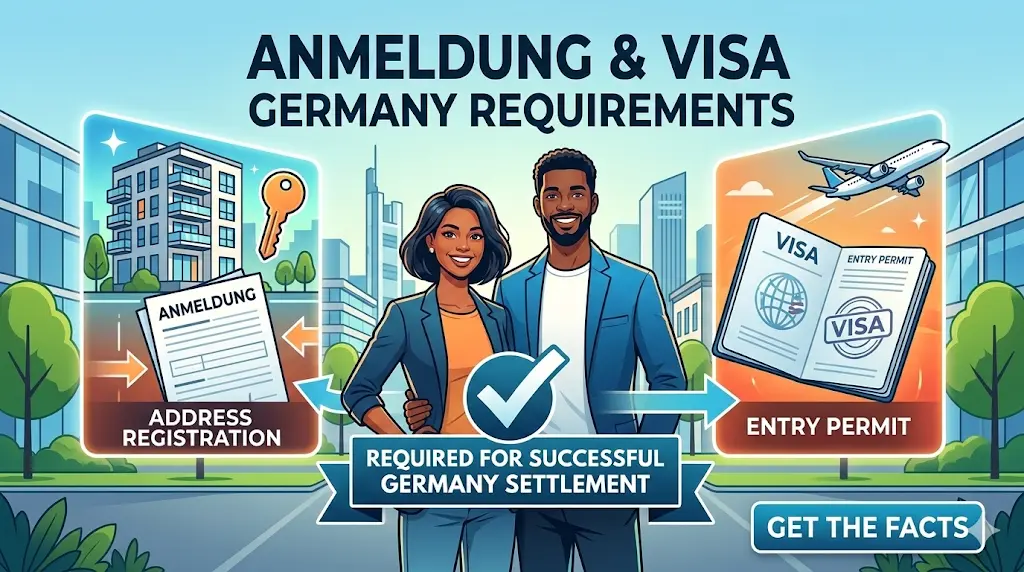
Why Your Visa Alone Is Essentially Useless
Having a visa without an Anmeldung is like having a driver’s license without a car. You have the legal right to participate, but you lack the physical vehicle to actually do anything. The Meldebescheinigung is the key that unlocks the German economy.
The Banking and Blocked Account Catch
The most immediate crisis expats face upon arrival is money. You land in Germany with a visa and a suitcase, and you need to open a local bank account to pay rent and buy groceries. When you walk into a traditional German bank, the first document the teller will ask for is not your visa, but your Meldebescheinigung. German banks are bound by strict anti-money laundering laws that require them to verify the permanent domestic address of every account holder.
This creates a terrifying catch-22 for international students and job seekers. To get your visa, you were likely required to lock over 11,000 Euros in a blocked account. If you used a provider like Expatrio to secure these funds, those monthly payouts are sitting in an inaccessible vault. To trigger the monthly releases from Expatrio, you must open an everyday German checking account, which you cannot do without an Anmeldung. The system freezes your cash until you prove where you live. For strategies on navigating this financial hurdle, review Student Visa Blocked Account Sperrkonto: What It Is and How to Set It Up.
Unlocking Health Insurance and Tax IDs
You cannot work in Germany without a Tax ID (Steueridentifikationsnummer), and you cannot get a Tax ID without an Anmeldung. The moment you register your address at the Bürgeramt, the local system pings the Federal Central Tax Office, which then automatically generates your unique 11-digit Tax ID and mails it to your newly registered mailbox. Without this number, your employer will be forced to place you in the highest possible tax bracket, slashing your take-home pay.
Furthermore, your mandatory health insurance is stalled without this registration. If you arrived with temporary “incoming” travel insurance, you must quickly transition to a permanent statutory or private plan. Health insurance providers require your official address to finalize your policy and mail your physical health card (Gesundheitskarte). Relying on expat-focused brokers like Feather Insurance can help you navigate this transition, as their support team understands the timing gap between your arrival and your registration. Using Feather Insurance ensures your medical coverage remains active while you fight for a Bürgeramt appointment. To weigh the overall pros and cons of these systems, read Public vs Private Health Insurance: Which One Should You Choose?.
Signing Contracts and Daily Life Necessities
Beyond the massive institutional hurdles, the lack of an Anmeldung infects your daily domestic life. Germany is a country that runs on localized, long-term contracts.
If you want to sign up for a post-paid cell phone plan with Vodafone or O2, they will demand your registration certificate to run a credit check. If you want to join a local gym, set up home internet through Telekom, or even register for a library card, the front desk will ask for your Meldebescheinigung. The entire consumer economy is gated behind this single piece of paper, proving that you are not a flight risk who will simply leave the country without paying your bills.
The Crucial Timeline from Border to Bürgeramt
The collision between your visa timeline and your registration timeline is where most expats experience extreme anxiety. You must manage a highly specific sequence of events to ensure neither document expires.
Arriving on the Entry Visa
When you successfully apply for a long-term visa at your home country’s embassy, they do not hand you a plastic residence permit. They affix a National D-Visa sticker inside your passport. This sticker is merely a temporary entry pass, usually valid for three to six months.
This temporary sticker is designed solely to get you past border control and give you enough time to settle your affairs in Germany. It grants you the legal right to start your job or begin your university classes, but it is a ticking clock. Before that sticker expires, you must complete the entire bureaucratic onboarding process, starting with finding a permanent bed.
The Brutal Reality of the Fourteen Day Rule
The Federal Registration Act states clearly that you must register your address within 14 days of moving into your permanent accommodation. In theory, this sounds reasonable. In reality, finding an available appointment at a Bürgeramt in major cities like Berlin, Munich, or Stuttgart within 14 days is mathematically impossible. You will likely log onto the booking portal and see that the next open slot is eight weeks away.
Do not panic. The German authorities are entirely aware of their own municipal bottlenecks. As long as you log online and officially book an appointment within that 14-day window—even if the actual appointment date is months in the future—you are legally compliant. You will not be fined or deported for waiting in the government’s queue.
Converting to a Permanent Residence Permit
Once your address is registered and your Meldebescheinigung is safely in your hands, you can finally face the ultimate boss: the Ausländerbehörde. Before your temporary D-Visa sticker expires, you must book an appointment at the immigration office to convert it into an Aufenthaltstitel (the physical, plastic residence permit card).
When you sit down with the immigration caseworker, the very first document they will ask for is your Anmeldung. The federal government will not issue you a multi-year residence permit if the local municipality cannot verify where you sleep. This is why the timeline is rigid: you enter on the visa, you secure the address, you register the address, and only then do you finalize the visa. If you fail to get the Anmeldung before your D-Visa expires, you risk falling into illegal overstay territory.
Documentation and Bureaucratic Intersections
The paperwork required to synchronize your visa and your registration is dense. You must ensure that the documents you present to the city perfectly match the documents you presented to the embassy.
The Golden Ticket Known as Wohnungsgeberbestätigung
You cannot just walk into the Bürgeramt with a signed rental contract and expect to be registered. To combat widespread registration fraud, the German government reintroduced the Wohnungsgeberbestätigung (landlord confirmation certificate).
This is a specific, one-page legal document that must be signed by the actual owner or primary manager of the property. It explicitly confirms your move-in date and verifies that you have permission to live there. If you are subletting a room from a friend who is the main tenant, your friend can act as the “Wohnungsgeber” and sign the form, but they must have the actual property owner’s written permission to sublet to you. Without this single piece of paper, the clerk at the Bürgeramt will turn you away, leaving your visa conversion stalled.
Dealing with Foreign Certificates and Translations
If you moved to Germany on a family reunification visa to join your spouse, or if you brought your children with you, the Anmeldung process becomes significantly more complicated. You must register your entire family unit, which requires proving your civil relationships to the municipal clerk.
You must bring your original marriage certificates and your children’s birth certificates to the registration appointment. However, the Bürgeramt operates strictly in German. If you hand them a marriage certificate in Hindi, Spanish, or English, they may refuse to register your family correctly. You must provide certified translations executed by a court-approved German sworn translator.
To prevent a devastating rejection at the registration desk, organized expats use digital platforms like Lingoking. Before your appointment, you simply upload a scan of your legalized foreign civil documents to Lingoking, and they assign them to a certified German sworn translator. The legally binding, officially stamped translations are mailed to your apartment, ensuring the Bürgeramt accepts them instantly. Getting your translations sorted via Lingoking is a vital step that bridges the gap between your foreign life and your new German reality.
Aligning Your Visa Expiration with Lease Dates
Here is the most agonizing administrative loop in Germany: landlords want to see a long-term residence permit before they will give you a long-term lease. But the Ausländerbehörde wants to see a long-term lease (and the resulting Anmeldung) before they will give you a long-term residence permit.
You must break this cycle. You usually do this by renting a temporary, furnished apartment (like a verified Wunderflats or a temporary housing agency) that explicitly advertises that they provide the Wohnungsgeberbestätigung. You use this temporary contract to secure your Anmeldung. You then take that temporary Anmeldung to the immigration office to secure your plastic Aufenthaltstitel. Once you have the plastic card, you use it to convince a traditional landlord to give you a permanent, unfurnished apartment. To prepare your wallet for these intense upfront costs, review Cost of Living in Germany: Budgeting for Your First Year as an Expat.
Common Bureaucratic Paradoxes Expats Face
The system is not perfect, and expats frequently fall into gray areas where their visa and their registration actively conflict. Knowing how to troubleshoot these scenarios is vital.
The Temporary Housing Trap
As mentioned, the biggest trap is booking an Airbnb or staying at a hostel for your first two months, assuming you can just use that address for your visa paperwork. Standard Airbnb hosts almost never sign a Wohnungsgeberbestätigung because it often violates their own lease agreements or local short-term rental laws.
If you spend your first three months in Germany jumping between unregistered Airbnbs, you are burning through the validity of your temporary entry visa without ever starting the registration clock. You must ensure that any temporary housing you book explicitly guarantees an Anmeldung before you transfer a deposit.
| Feature | Visa (e.g., National D-Visa / Blue Card) | Anmeldung (Address Registration) |
| Governing Authority | Federal / Ausländerbehörde | Municipal / Bürgeramt |
| Primary Purpose | Legal right to enter and stay | Proof of physical residence |
| Required For | Crossing borders, signing employment contracts | Bank accounts, Tax IDs, internet, gyms |
| Validity | Expiration date printed on sticker/card | Valid until you move (Ummeldung) or leave (Abmeldung) |
Changing Addresses While Visas are Pending
It is highly common to secure a temporary Anmeldung to get your bureaucracy moving, apply for your permanent visa at the Ausländerbehörde, and then find a permanent apartment before your new visa card is printed.
If you move to a new apartment within the same city, you must complete an Ummeldung (change of address). This is essentially the exact same process as the Anmeldung. The critical step here is that you must immediately notify the Ausländerbehörde of your new address. If they mail your highly secure PIN/PUK letter for your new residence permit to your old, temporary apartment, and your name is no longer on the mailbox, the postal service will return it to the government, creating a massive delay in retrieving your physical card.
Troubleshooting Rejections at the Registration Office
If you are rejected at the Bürgeramt, it is usually for one of three reasons: you forgot your passport, you lack the landlord’s signature, or your foreign documents are untranslated.
If you face a rejection, remain perfectly polite. Ask the clerk exactly what is missing, write it down, and book a new appointment immediately. If you realize you cannot get your blocked funds released from Expatrio because of this delay, rely on your cash reserves. If your health insurance activation is stalling, contact the English support at Feather Insurance to request a temporary coverage extension while you sort out your municipal standing. And if your marriage certificate was the issue, immediately upload it to Lingoking so the certified translation is ready for round two.
The visa gets you into the country, but the Anmeldung is what actually allows you to live here. By treating both processes with equal reverence, prioritizing temporary housing that provides the right paperwork, and organizing your translated documents flawlessly, you can seamlessly integrate into the German bureaucratic grid.
References
Primary sources (official)
- Federal Ministry of the Interior and Community (BMI): Official guidelines on the Federal Registration Act (Bundesmeldegesetz), detailing the mandatory nature of address registration and the landlord’s obligation to provide the move-in certificate.https://www.bmi.bund.de/EN/topics/administrative-reform/registration-system/registration-system-node.html
- Make it in Germany: The federal government’s portal for international professionals, explaining the step-by-step registration process and how it directly impacts the issuance of residence permits.https://www.make-it-in-germany.com/en/living-in-germany/housing-mobility/housing-registration
Other helpful sources
- Feather Insurance Blog: A practical breakdown of how the Anmeldung fits into the onboarding process for newcomers, specifically regarding the activation of statutory health insurance.https://feather-insurance.com/blog/germany-visa-requirements
Disclaimer
The information provided in this article is for general informational and educational purposes only and does not constitute professional legal or immigration advice. German registration laws, the specific requirements of the Wohnungsgeberbestätigung, financial compliance linked to platforms, health insurance activation rules managed by brokers and sworn translation regulations for services are highly complex and vary slightly by municipality. Always consult directly with your local Bürgeramt, the Ausländerbehörde, or a certified immigration lawyer regarding your specific legal obligations and residency status in Germany.