Traveling in the Schengen Area with a German Residence Permit: Your Rights and Limits
Boarding a train from Berlin to Paris and suddenly realizing you do not know if your German visa allows you to cross the border is a terrifying feeling. I once sat frozen on a cross-border ICE train, convinced the border police were going to deport me because my passport lacked a French stamp. This guide demystifies exactly where your German residence permit allows you to travel, the hidden expiration traps, and how to safely navigate European borders.
Disclosure: This post may contain affiliate links. We may earn a commission at no extra cost to you if you make a purchase through these links. Read full disclosure.
The Magic of the Schengen Zone for German Residents
For many expats coming from countries with weak passports, securing a German residence permit feels like unlocking a massive geographical cheat code. Suddenly, the fragmented map of Europe becomes a borderless playground. But this freedom comes with highly specific administrative strings attached.
How Your Residence Permit Acts as a Travel Pass
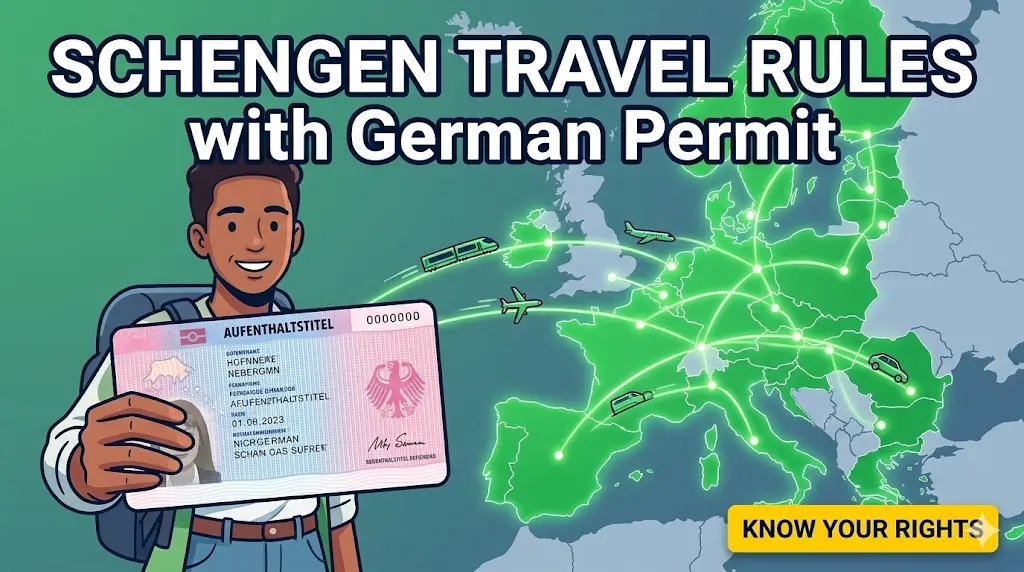
When you hold a valid German residence permit, you are granted incredible mobility rights under the Schengen Agreement. Your German card effectively acts as a substitute for a short-stay tourist visa for all other participating Schengen member states.
If you hold a passport from India, China, or South Africa, you normally have to endure grueling embassy appointments just to visit Italy or Spain for a weekend. However, if you possess a German residence title, you can simply book a flight or train ticket and go. Border guards across the Schengen zone recognize the German permit as absolute proof that you have been vetted, that you are legally residing in Europe, and that you pose no security risk.
You must remember that this privilege only works when you carry your physical German residence permit card alongside your original, valid passport. A photocopy of your card, a photo on your phone, or a letter from your employer will not save you if you are subjected to a random spot check. While there are no hard borders between Schengen countries, random police checks on long-distance FlixBuses, international trains, and at airport gates are incredibly common. If you cannot produce both documents, you can be detained.
Understanding the 90 180 Day Travel Rule
The most misunderstood aspect of living in Europe is the timeline of your mobility. Having a German residence permit means you can live in Germany 365 days a year. It does not mean you can live in France 365 days a year.
When you travel outside of Germany to another Schengen country, you are treated legally as a tourist in that second country. Therefore, your travel is strictly capped by the standard 90/180-day rule. You are legally allowed to spend a maximum of 90 days within any rolling 180-day period in other Schengen member states.
Because there are no passport stamps when you cross internal Schengen borders, many expats mistakenly believe this rule is unenforceable. This is a dangerous gamble. If you rent an apartment in Spain for four months while holding a German Blue Card, you are committing immigration fraud in Spain. Furthermore, if you get into a car accident or need to interact with local police during that illegal overstay, the authorities can easily trace your digital footprints—such as hotel bookings, flight records, and ATM withdrawals—to prove you violated the 90-day limit. This violation can jeopardize your German residency status.
Non Schengen versus Schengen Countries in Europe
Another massive trap expats fall into is confusing the European Union with the Schengen Area. They are two entirely different legal entities. Your German residence permit only grants you visa-free travel to the 29 countries within the Schengen Area.
If you want to visit London, Dublin, or Bucharest, you are leaving the Schengen zone. The United Kingdom and the Republic of Ireland are not Schengen members. If your home country’s passport requires a visa to visit the UK, your German residence permit will not help you; you must apply for a standard UK tourist visa. Conversely, countries like Switzerland, Norway, and Iceland are not in the European Union, but they are full members of the Schengen Area. You can travel to the Swiss Alps or the Norwegian fjords using your German permit without any additional paperwork. Always verify a country’s Schengen status before booking non-refundable flights.
Types of German Residence Documents and Travel Rights
Not all German immigration documents grant you the right to travel. The exact piece of paper or plastic in your wallet dictates whether you can confidently board a flight to Rome or if you will be turned away at the boarding gate.
Traveling with a Plastic Residence Title
If you hold a standard plastic residence card—the Elektronischer Aufenthaltstitel or eAT—you are in the safest possible category. This includes expats holding standard skilled worker permits, EU Blue Cards, student visas, family reunification permits, and permanent settlement permits.
With this card, you enjoy full Schengen mobility rights. You can travel freely for tourism or to visit friends. However, the physical card is useless if the passport it is tied to has expired. The German residence permit is linked to your specific passport number. If you renew your passport at your home country’s embassy in Berlin, your old plastic residence card becomes technically invalid for travel because the numbers no longer match. You must visit your local immigration office to have the permit transferred to your new passport before you cross any borders. If you are aiming for the ultimate level of permanent security, read Permanent Residence Permit Niederlassungserlaubnis: How to Qualify in Germany.
The D Visa Sticker versus Short Stay Visas
When you first move to Germany, you usually arrive with a National D-Visa sticker pasted into your passport by your home country’s embassy. Many newcomers panic, thinking they cannot travel until they get their plastic card months later.
This is a myth. A valid, multiple-entry National D-Visa sticker grants you the exact same Schengen travel rights as the plastic residence permit. You can freely visit other Schengen countries for up to 90 days while you wait for your local municipal appointments. However, you must differentiate this from a Schengen C-Visa. If you entered Europe on a short-stay tourist visa, you cannot convert it into a residence permit internally, and your travel is strictly capped across the whole zone. To clarify this vital distinction, bookmark National Visa D-Visa vs Schengen Visa: Understanding the Difference.
The Fiktionsbescheinigung Travel Trap
This is the single most terrifying bureaucratic trap in the German immigration system. When your current visa is expiring and you are waiting for a renewal appointment, the immigration office will issue you a Fiktionsbescheinigung (a folded green piece of paper) to bridge the legal gap.
Whether you can travel with this document depends entirely on one single checkbox. There are two distinct legal paragraphs under which a Fiktionsbescheinigung is issued.
If the box next to Section 81 Paragraph 4 (§ 81 Abs. 4 AufenthG) is checked, you are safe. This means your previous residence permit remains fully valid. You can travel anywhere in the Schengen zone and return to Germany without issue, provided you carry your passport, your expired plastic card, and the green paper together.
If the box next to Section 81 Paragraph 3 (§ 81 Abs. 3 AufenthG) is checked, your travel rights are frozen. This box is checked if you are applying for your very first residence permit after entering on a visa-free tourist waiver, or if your previous visa completely expired before you applied for a renewal. With a Paragraph 3 document, you are legally allowed to remain in Germany, but you cannot re-enter Germany if you leave. If you fly to Italy with a Paragraph 3 Fiktionsbescheinigung, the airline or border police will deny you boarding on your return flight, stranding you abroad.
| Document Type | Travel within Schengen Permitted? | Conditions |
| Plastic Residence Permit (eAT) | Yes | Must carry valid passport |
| National D-Visa Sticker | Yes | Must be valid and multiple-entry |
| Fiktionsbescheinigung § 81 Abs. 4 | Yes | Carry expired card + passport + green paper |
| Fiktionsbescheinigung § 81 Abs. 3 | Strictly NO | Will be denied re-entry to Germany |
Working and Studying Across Borders
A German residence permit gives you the right to be a tourist in other European countries. It absolutely does not give you the right to integrate into their economies.
The Strict Ban on Working in Other Schengen States
This is a harsh reality check for many expats: your German work permit is explicitly tied to the German labor market. You have zero right to work, take up local employment, or establish a freelance business in France, Italy, or Spain just because you hold a German Blue Card.
If an employer in Amsterdam offers you a job, you cannot simply move there and start working. You must apply for a brand new Dutch highly skilled migrant visa from scratch, entirely independent of your German status. The only exception to this is if your German employer explicitly dispatches you on a temporary, cross-border assignment under the European Posting of Workers Directive (an A1 certificate). Without this corporate legal framework, working locally in another Schengen state is illegal and will result in severe immigration penalties.
Remote Work and Digital Nomad Gray Areas
The rise of remote work has created a massive gray area for expats holding German residence permits. Many wonder if they can simply take their laptop to a beach in Greece and work remotely for their Munich-based employer for a month.
From a pure immigration standpoint, staying in Greece for under 90 days as a tourist is perfectly legal. However, the moment you open your laptop and perform productive labor, you are crossing into complex tax and social security territory. Most German employers strictly prohibit unauthorized cross-border remote work because it can accidentally trigger corporate tax liabilities in the destination country. Furthermore, if you work from Spain for two months, you might violate your German statutory health insurance terms or breach your local municipal registration rules. Always secure written permission from your HR department before attempting the “digital nomad” lifestyle on a German visa.
Short Term Academic Mobility for Students
For international students enrolled at German universities, mobility is slightly more flexible thanks to the EU REST Directive. If you hold a German student residence permit and you want to participate in a formalized exchange program (like Erasmus) in another EU country for up to 360 days, you can often do so without having to apply for a full national visa in the second country.
The destination country’s university will simply notify their local immigration authorities of your arrival under the mobility directive. However, this massive benefit requires you to maintain your primary status in Germany, which means you must continue to prove your financial stability. The easiest way to ensure your finances remain perfectly compliant while you study abroad is to maintain your active German blocked account. By managing your funds through a reliable digital provider like Expatrio, you guarantee that the German immigration office sees a gapless record of financial self-sufficiency, ensuring your permit is not canceled while you are studying in Paris or Madrid. To refresh your memory on how these financial vaults dictate your student status, review Student Visa Blocked Account Sperrkonto: What It Is and How to Set It Up.
Bureaucratic Preparations Before You Cross Borders
Do not treat a trip to a neighboring European country like a domestic flight within the United States. You are crossing sovereign borders, and you must prepare for the worst-case bureaucratic scenarios.
Essential Travel Documents You Must Carry
When traveling within the Schengen zone, the golden rule is redundancy. You must physically carry your original national passport and your original German residence permit card. Digital photos on your iPhone, scanned PDFs in your email, or notarized photocopies are universally rejected by border police and airline gate agents.
If you are subjected to a random spot check on a train crossing into Austria, the federal police will demand the physical plastic. If you cannot produce it, they have the legal authority to pull you off the train, detain you at the station, and run extensive background checks to verify your identity. I have seen expats miss their flights because they left their plastic card in their other wallet, assuming their driver’s license was enough. A German driver’s license is a driving document, not a valid travel or identity document for a non-EU citizen.
Navigating Cross Border Health Insurance
Falling ill outside of Germany is terrifying if you do not understand your coverage. If you are enrolled in the German statutory public health insurance system (such as TK, AOK, or Barmer), your health card has an incredibly powerful feature on the back: the European Health Insurance Card (EHIC).
The EHIC guarantees that if you have a medical emergency in another EU/Schengen country, you are entitled to receive state-provided healthcare under the exact same conditions and at the same cost as people insured in that country. If the local system is free, your care is free. However, the EHIC only covers standard medical emergencies. It does not cover mountain rescue operations, specialized private clinics, or the astronomical cost of medical repatriation flights back to Germany.
Because of these massive gaps, relying solely on your public insurance for travel is dangerous. Savvy expats always supplement their trips with dedicated travel health insurance. Utilizing a digital, English-speaking broker like Feather Insurance allows you to instantly secure affordable travel policies right from your phone before you board your flight. These supplementary policies from Feather Insurance explicitly cover the medical repatriation and private emergency care that the statutory system ignores, ensuring a broken leg in the Alps does not bankrupt you.
Document Legalization for Emergency Situations
If you experience a severe life event while traveling in the Schengen area—such as getting married in Denmark, having a child prematurely in France, or being involved in a severe legal incident requiring foreign police reports—you cannot simply bring those foreign documents back to Germany and hand them to the Ausländerbehörde.
German authorities require foreign civil documents to be officially translated by a court-approved German sworn translator. A French hospital bill or a Spanish police report is bureaucratically meaningless in Berlin until it is legally certified. To bypass the agonizing delay of finding a local translator during an ongoing emergency, veteran expats use digital translation platforms like Lingoking. You simply upload a clear scan of the foreign police report or medical certificate to Lingoking, and they assign it to a certified German sworn professional. The legally binding translations are mailed directly to your German address, ensuring you can immediately resolve the bureaucratic fallout with your local insurance or immigration office the moment you return. Utilizing Lingoking is the smartest safety net you can establish for cross-border administration.
Re-entering Germany and Avoiding Permit Expiration
The most critical aspect of traveling on a German residence permit is ensuring you do not accidentally trigger its expiration. The system assumes you live in Germany; if you leave for too long, they will revoke your status.
The Six Month Expiration Rule
This is the silent killer of expat dreams. Under Section 51 of the German Residence Act, your residence permit automatically expires if you leave Germany for more than six continuous months.
This expiration is not a decision made by a caseworker; it happens automatically by operation of law. If you take a seven-month sabbatical to travel around Asia or return to your home country to care for a sick relative, your plastic residence card becomes a worthless piece of plastic on day 181. When you fly back into Frankfurt, the border guards will scan the card, see the prolonged absence, and deny you entry as a resident.
If you know you need to be out of the country for longer than six months, you must visit the Ausländerbehörde before you leave and formally request an extension. These are granted only in exceptional, temporary circumstances (like an academic research posting abroad or a temporary corporate assignment). Do not risk your entire European future on a prolonged vacation.
Exceptions for EU Long Term Residents
The six-month expiration trap is exactly why veteran expats aggressively pursue permanent residency. However, even the standard German Niederlassungserlaubnis (permanent settlement permit) usually expires after a six-month absence unless you meet highly specific criteria (like having lived in Germany for 15 years).
If your life requires deep international mobility, you should apply for the Erlaubnis zum Daueraufenthalt-EU (EU Long-Term Residence Permit) instead of the standard national permit. This integrated European permit offers massively superior travel allowances. Holders of the EU permit can reside outside the European Union for up to 12 consecutive months, and can live in another EU member state for up to six years, before their German residency is threatened. This is the ultimate travel document for non-EU expats.
What Happens If You Lose Your Card Abroad
Losing your passport and your German residence permit while traveling in another Schengen country is an absolute nightmare scenario. Without the physical card, you legally cannot board a commercial flight back to Germany.
If your wallet is stolen in Rome, your first step is immediately going to the local Italian police station to file a comprehensive theft report. You must then travel to the nearest German embassy or consulate in Italy. You will present the police report and request a special re-entry visa. Because the embassy staff operates in German, presenting an Italian police report can slow the process down. This is another scenario where instantly securing a sworn translation via Lingoking on your phone can expedite your emergency appointment.
Once the embassy verifies your status with your local Ausländerbehörde in Germany, they will issue a temporary visa allowing you to fly home. Upon returning to Germany, you must endure the entire bureaucratic process of ordering a replacement eAT card. Always keep secure, encrypted digital scans of your passport, your residence permit, and your Feather Insurance documents in the cloud so you have proof of your identity when disaster strikes.
Traveling the Schengen area as an expat is a privilege that requires immense administrative responsibility. By deeply understanding the 90/180-day limits, carrying your physical documents religiously, securing supplemental travel coverage via Feather Insurance, and ensuring your financial proofs remain intact through Expatrio, you can explore Europe safely without ever jeopardizing your home in Germany.
References
Primary sources official
- European Commission – Schengen Area: The official European Union portal explaining the border-free zone, the 90/180-day short-stay calculator, and mobility rights for third-country nationals.https://home-affairs.ec.europa.eu/policies/schengen-borders-and-visa/schengen-area_en
- Federal Office for Migration and Refugees (BAMF): Official directives from the German government outlining the expiration rules for residence titles upon leaving the country for extended periods.https://www.bamf.de/EN/Themen/MigrationAufenthalt/ZuwandererDrittstaaten/Migrathek/Niederlassungserlaubnis/niederlassungserlaubnis-node.html
- Make it in Germany: The federal government’s official guide detailing the differences between national visas, short-stay travel rights, and the conditions under which an expat can travel.https://www.make-it-in-germany.com/en/visa-residence/types
Other helpful sources
- Federal Ministry of Justice (Gesetze im Internet): The official English translation of the Residence Act (Aufenthaltsgesetz). Review Section 81 for the crucial differences between Paragraph 3 and Paragraph 4 regarding the Fiktionsbescheinigung.https://www.gesetze-im-internet.de/englisch_aufenthg/
Disclaimer
The information provided in this article is for general informational and educational purposes only and does not constitute professional legal or immigration advice. Schengen travel rules, the specific limits of short trips to other member states, the strict ban on working in other Schengen states, health insurance activation rules managed by brokers and sworn translation regulations for services are highly complex and vary slightly by municipality. Always consult directly with your local Bürgeramt, the Ausländerbehörde, or a certified immigration lawyer regarding your specific legal obligations and residency status in Germany.