German Immigration Terms Explained: A Glossary for Newcomers
Staring at a letter from the Ausländerbehörde filled with thirty-letter compound words can easily induce a panic attack. I vividly remember trying to translate my first residence permit application and feeling completely lost in the bureaucratic maze. This comprehensive glossary breaks down the essential German immigration terms you need to know, transforming confusing legal jargon into clear, actionable English.
Disclosure: This post may contain affiliate links. We may earn a commission at no extra cost to you if you make a purchase through these links. Read full disclosure.
Essential Visa and Residency Permit Categories
Understanding the Aufenthaltstitel
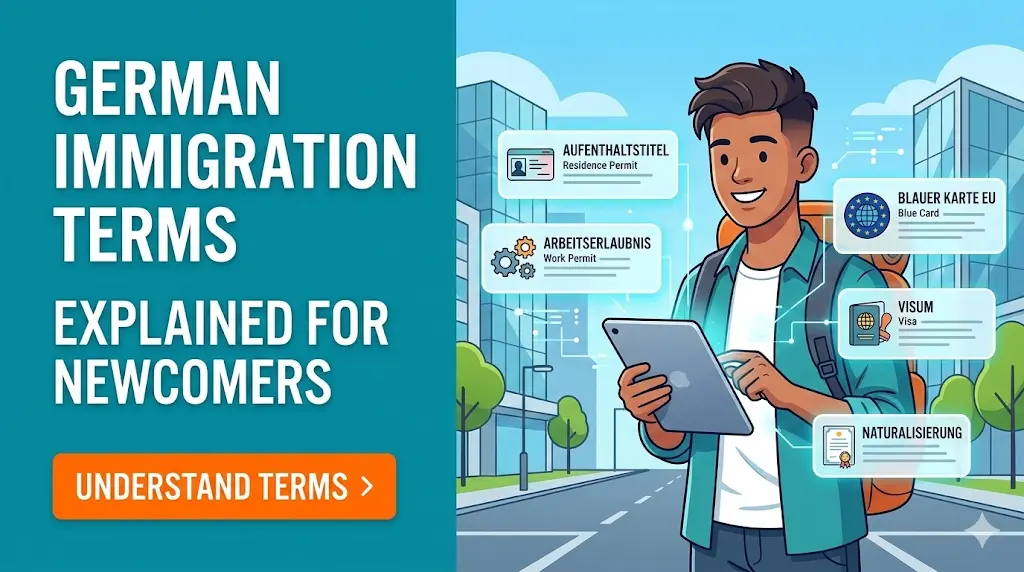
The word Aufenthaltstitel is the absolute foundation of your legal life in Germany. Translated simply as “residence title” or “residence permit,” this is the umbrella term for any legal document that grants a non-EU citizen the right to live, work, or study within German borders. When you first arrive on a national entry visa, your immediate priority is converting that temporary visa into a proper Aufenthaltstitel before your initial 90 days run out. For a comprehensive overview of how this fits into your relocation timeline, you can review Visas and Residence Permits in Germany: Everything You Need to Know.
Since 2011, Germany has issued these permits as a plastic card resembling a standard ID or driver’s license, officially known as the elektronischer Aufenthaltstitel (eAT). This card contains a biometric chip holding your fingerprints, photograph, and specific stipulations regarding your stay. Always check the supplementary green sheet of paper that comes with your eAT, known as the Zusatzblatt; this unassuming piece of paper dictates the exact conditions of your employment and whether you are tied to a specific employer.
| German Term | English Translation | Primary Function |
| Aufenthaltstitel | Residence Permit | The overarching legal right to reside in Germany. |
| eAT | Electronic Residence Title | The physical biometric plastic card you carry. |
| Zusatzblatt | Supplementary Sheet | The green paper detailing your specific work permissions. |
| D-Visum | National Visa | The entry visa issued by the embassy in your home country. |
The Niederlassungserlaubnis Explained
Once you have lived in Germany for several years, the Niederlassungserlaubnis becomes your ultimate goal. This is the German permanent settlement permit. Unlike a standard Aufenthaltstitel, which is tied to a specific purpose like studying or working for a particular company and must be renewed every few years, the Niederlassungserlaubnis grants you the unrestricted right to live and work in Germany indefinitely. You are no longer bound to one employer, and you have a much stronger safety net if you ever face unemployment.
Qualifying for this coveted status requires meeting strict criteria, including holding a valid residence permit for a set number of years (usually three to five, depending on your visa type), demonstrating a secure livelihood without relying on public funds, paying into the statutory pension scheme for at least 60 months, and proving B1-level German language proficiency. If you are aiming for this milestone, reading up on Permanent Residence Permit (Niederlassungserlaubnis): How to Qualify in Germany will help you map out your exact timeline.
The benefits of securing a Niederlassungserlaubnis cannot be overstated. From a practical standpoint, it makes getting approved for a mortgage or a long-term bank loan exponentially easier, as lenders see you as a permanent resident. Furthermore, it eliminates the anxiety of visa renewal appointments, saving you countless hours of gathering paperwork and waiting in immigration office queues. It is the crucial stepping stone for those who eventually wish to apply for full German citizenship.
The Fiktionsbescheinigung Safety Net
The Fiktionsbescheinigung, or “fictional certificate,” is a temporary document that bridges the gap when your current residence permit is expiring, but your local immigration office has not yet processed your renewal application. Bureaucratic backlogs are notoriously common in major German cities. If you apply for an extension on time, the immigration office will issue this document to prove that your legal residency status—and your right to work—continues under the same conditions until they make a final decision.
It is vital to understand the difference between the two main types of Fiktionsbescheinigung, as they dictate your ability to travel outside of Germany. A certificate issued under Section 81 Paragraph 4 (§ 81 Abs. 4) means you are allowed to travel abroad and return to Germany without issues. However, if it is issued under Section 81 Paragraph 3 (§ 81 Abs. 3), usually given to first-time applicants rather than those renewing, you are generally not permitted to re-enter Germany if you leave the Schengen area.
Always carry your Fiktionsbescheinigung alongside your expired residence permit card and your passport. Employers, landlords, and border control officers need to see the combination of these documents to verify your legal status. Do not lose this piece of paper, as replacing it requires another dreaded trip to the immigration authorities, and traveling without it while your main permit is expired will lead to severe complications at passport control.
Crucial Government Offices and Authorities
Navigating the Ausländerbehörde
The Ausländerbehörde (abbreviated as ABH) is the Foreigners’ Registration Office, and it is undoubtedly the most important—and often the most stressful—government building you will visit as an expat. This is the local municipal authority responsible for executing immigration law. They process your residence permit applications, issue your physical biometric cards, grant extensions, and approve changes to your visa conditions (such as switching employers). Every city and district has its own Ausländerbehörde, and you must visit the one responsible for your registered residential address.
Securing an appointment (Termin) at the Ausländerbehörde requires immense patience. In cities like Berlin, Munich, and Frankfurt, appointments book up months in advance, and their email response times can be painfully slow. It is highly recommended to start your renewal process at least three months before your current visa expires. For actionable strategies on securing appointments and communicating effectively with caseworkers, check out Navigating the Ausländerbehörde: Tips for Dealing with German Immigration Offices.
A critical point of frustration for many newcomers is the language barrier. Official administrative language in Germany is strictly German, meaning caseworkers are legally not obligated to speak English with you, and many outright refuse to do so for liability reasons. If your German is not at a conversational level, you should strongly consider bringing a German-speaking friend, colleague, or professional relocation consultant to your appointment to ensure nothing is lost in translation.
The Role of the Bürgeramt
While the Ausländerbehörde handles your right to stay in the country, the Bürgeramt (Citizens’ Office) handles your basic civic registration. Often referred to as the Einwohnermeldeamt or Kundenzentrum depending on the city, this office registers where you physically live. Every single resident of Germany, regardless of nationality, must register their address with the Bürgeramt within 14 days of moving into a new permanent residence.
You will visit the Bürgeramt to complete your Anmeldung (address registration), apply for a police clearance certificate (Führungszeugnis), or get official copies of documents certified. Unlike the immigration office, the Bürgeramt deals with everyday municipal tasks. However, appointment scarcity is just as prevalent here. Many expats use online refresh-bots or check the booking portals early in the morning to snag last-minute cancellations for address registrations.
Do not confuse the responsibilities of these two offices. The Bürgeramt cannot issue or extend a visa, and the Ausländerbehörde cannot register your home address. They operate on separate systems, yet they are deeply interconnected; you cannot get a residence permit from the Ausländerbehörde without first proving you have registered your address at the Bürgeramt.
Interacting with the Bundesagentur für Arbeit
The Bundesagentur für Arbeit (BA), or Federal Employment Agency, plays a massive behind-the-scenes role in the lives of expat workers. When you apply for a work visa, the Ausländerbehörde rarely makes the decision alone. They must send your employment contract and job description to the BA for a process called Zustimmung (approval). The BA evaluates whether your salary meets regional standards, ensuring you are not being underpaid, and occasionally checks if a German or EU citizen could fill the role instead (though this priority check has been largely abolished for skilled workers).
If your residence permit is tied to a specific employer (which is standard for the first two years of a work visa), you cannot simply quit your job and start a new one the next day. You must apply for a change of employer through the Ausländerbehörde, which then triggers a new review by the BA. This approval process can take several weeks, meaning you must carefully time your resignation and start dates.
The BA is also the authority you turn to if you lose your job. If you have been working in Germany and paying social security contributions for at least 12 months, you are generally entitled to Arbeitslosengeld I (unemployment benefits). You must register as a jobseeker with the BA immediately upon learning of your impending unemployment to secure these financial benefits and to receive job hunting support from their advisors.
Foundational Registration and Documentation Steps
Completing Your Anmeldung
Anmeldung is the very first administrative hurdle you will jump through, and it simply means “registration.” By German law, anyone moving into a new apartment must register their address with the local Bürgeramt. Upon completing this short appointment, you receive a Meldebestätigung or Anmeldebestätigung—a stamped piece of paper proving your legal address. This humble document is the golden key to German life; without it, you cannot open a bank account, get a tax ID, sign a cell phone contract, or apply for your residence permit.
The biggest bottleneck for new expats is obtaining the required Wohnungsgeberbestätigung (landlord confirmation form). You cannot register an address with just a lease agreement; your landlord or main tenant must sign this specific form confirming you have moved in. Because temporary Airbnbs or short-term hostels rarely provide this form, finding a qualifying initial apartment is notoriously difficult.
If you move to a new apartment within Germany, you must do an Ummeldung (re-registration). If you leave Germany permanently, you are legally required to do an Abmeldung (de-registration). Failing to de-register when leaving the country means you will continue to be billed for mandatory health insurance and broadcast taxes, accumulating massive debt in your absence.
Securing Your Sperrkonto
A Sperrkonto is a blocked bank account, a unique financial requirement primarily for international students and job seekers from non-EU countries. To get a visa, you must prove you have sufficient financial resources to support yourself without relying on the German state. The government dictates a specific minimum amount you need per year (often revised annually, but typically upwards of €11,000 for students). You must deposit this full amount into a Sperrkonto before your visa appointment.
The “blocked” aspect means you do not have free access to the total sum. Instead, the account is locked, and it only releases a set fraction of the money (e.g., €992) into your regular checking account each month. Setting this up through traditional brick-and-mortar German banks used to take weeks of mailing physical documents. Today, the smartest route is to use digital, government-approved providers like Expatrio, which allow you to open a blocked account entirely online from your home country within 24 hours.
When choosing a provider, look closely at setup fees and monthly maintenance costs. You also want to ensure the provider offers a seamless way to bundle the blocked account with your mandatory health insurance, as you will need proof of both for your visa application. Using modern services like Expatrio streamlines this process significantly, saving you from navigating complicated German banking interfaces.
Translating Documents with Beglaubigte Übersetzung
When applying for visas, university admissions, or professional recognition, you must submit documents like birth certificates, marriage licenses, and university degrees. If these documents are not in German (or sometimes English, depending on the lenient nature of the specific caseworker), you must provide a beglaubigte Übersetzung—a certified translation. A standard translation from a bilingual friend or a generic online agency is strictly rejected by German authorities.
A certified translation can only be performed by a sworn translator (vereidigter Übersetzer) who has sworn an oath at a German regional court. They will attach a formal stamp and their signature, legally vouching for the accuracy of the translation. Sourcing a sworn translator individually can be expensive and time-consuming. Instead, expats frequently rely on vetted platforms like Lingoking to instantly book certified translations for standard immigration documents at fixed, transparent prices.
Additionally, some foreign documents require an Apostille or legalisation from your home country’s government before they are even accepted for translation in Germany. This proves the original document isn’t a forgery. If you need your marriage certificate processed quickly to join your spouse, uploading it to Lingoking guarantees it meets the exact legal standards of the Ausländerbehörde.
Health and Insurance Terminology
Navigating the Krankenkasse System
In Germany, having health insurance is not optional; it is a strict legal requirement for every single resident from day one. Krankenkasse literally translates to “sickness fund,” representing the public health insurance providers in the country (such as TK, AOK, or Barmer). When you apply for any type of residence permit, the immigration officer will demand a membership certificate from a German health insurance provider. Travel insurance from your home country is categorically invalid for long-term residency.
The public Krankenkasse system is solidarity-based. Your monthly premium is calculated as a fixed percentage of your gross salary (around 14.6%, split equally between you and your employer), regardless of your age or medical history. If you have a non-working spouse or children, they are covered under your public plan for free via Familienversicherung (family insurance). Getting registered quickly is crucial, and utilizing digital-first brokers like Feather Insurance allows you to sign up for public insurance in English without navigating confusing German portals.
If you are a student, freelancer, or job seeker, proving adequate coverage is the number one reason visa applications get delayed. Immigration officers are incredibly strict about the wording on your insurance policy. Ensuring you have a compliant policy through a trusted provider like Feather Insurance guarantees your documentation will be accepted without dispute at your visa appointment.
Distinguishing Between Gesetzliche and Private
The German healthcare system is famously dual-track, split between Gesetzliche Krankenversicherung (GKV – public/statutory health insurance) and Private Krankenversicherung (PKV – private health insurance). By default, most employees earning under a specific annual threshold (the Jahresarbeitsentgeltgrenze, €77,400 in 2026) must enroll in the public GKV system. Public insurance covers all medically necessary treatments, doctor visits, and hospital stays, though you may wait longer for non-emergency specialist appointments.
Private insurance (PKV) operates differently. Premiums are based on your age, health status upon entry, and the level of coverage you choose, rather than your income. Only high earners, freelancers, civil servants, and some students are eligible to opt out of the public system and choose private insurance. While PKV often promises shorter wait times and private hospital rooms, premiums can skyrocket as you age, and you must pay out-of-pocket for every doctor’s visit and submit receipts for reimbursement.
Switching from private back to public insurance is legally extremely difficult, and practically impossible once you turn 55. Therefore, expats must think long-term before opting for PKV just to save a few euros in their twenties. Consulting an unbiased expat-focused broker like Feather Insurance is highly recommended, as they can assess your specific visa type, salary, and family planning goals to determine which track legally and financially makes the most sense.
The Importance of Pflegeversicherung
Whenever you secure health insurance in Germany, you are automatically enrolled in Pflegeversicherung, which translates to long-term care insurance. This is a mandatory pillar of the German social security system designed to cover the costs if you become dependent on nursing care due to old age, accidents, or severe illness. You will see this specific deduction itemized on your monthly German payslip.
The contribution rate is a small percentage of your gross income (around 3.6%), and like health insurance, it is shared between the employer and the employee. Interestingly, people without children pay a slightly higher premium surcharge than parents, a demographic policy designed to support the aging population. You cannot opt out of this tax, and you must have it active to maintain legal residency.
While it might feel frustrating to pay for long-term nursing care when you are a healthy professional in your thirties, it provides a massive safety net. The costs of inpatient nursing homes or at-home caregivers in Germany are astronomical. Pflegeversicherung ensures that if tragedy strikes, you will not bankrupt your family paying for basic daily assistance.
Work and Employment Jargon
Decoding the Arbeitsvertrag
An Arbeitsvertrag is your employment contract, and in Germany, it is an incredibly robust, legally binding document heavily regulated by labor laws. For expats applying for work visas, the Ausländerbehörde scrutinizes the Arbeitsvertrag to ensure it is drafted correctly. A standard contract must clearly state your gross monthly salary, working hours, vacation days (the legal minimum is 20 days for a 5-day work week, though 28-30 is standard), and your job description.
Two vital clauses to look for are the Probezeit (probationary period) and the Kündigungsfrist (notice period). The Probezeit usually lasts for the first six months of employment, during which either you or the employer can terminate the contract with just two weeks’ notice without needing to provide a reason. After you pass probation, German labor laws kick in, making it exceedingly difficult for an employer to fire you. The Kündigungsfrist then typically extends to one to three months, protecting both parties from sudden disruptions.
Ensure your contract is signed by both you and the employer’s authorized representative before taking it to your visa appointment. Digital signatures are often rejected by older, traditional caseworkers; insist on having a physically signed hard copy sent to you via mail or courier to guarantee a smooth visa process.
Exploring the Blaue Karte EU
The Blaue Karte EU (EU Blue Card) is the absolute gold standard of work visas for highly skilled non-EU nationals. Modeled loosely after the US Green Card, the Blue Card is designed to attract top academic and professional talent to Germany. To qualify, you generally need a recognized university degree and a binding job offer in Germany with a minimum gross annual salary that meets the government’s set threshold.
The benefits of the Blue Card over a standard employment visa are massive. Firstly, it offers a highly accelerated path to permanent residency (Niederlassungserlaubnis). While standard visa holders must wait up to five years, Blue Card holders can apply for permanent residency in just 33 months, or an incredible 21 months if they can prove B1 German language skills. This speed provides unparalleled peace of mind for expats looking to establish long-term roots.
Secondly, the Blue Card is incredibly family-friendly. Spouses of Blue Card holders are granted immediate, unrestricted access to the German labor market without needing to prove any German language skills prior to arrival. Additionally, if you decide to move to another EU country later, time spent holding a German Blue Card often counts toward long-term EU residency requirements.
Self-Employment as a Freiberufler
Germany makes a very strict, legally defined distinction between a Freiberufler (freelancer) and a Gewerbetreibender (tradesperson/commercial business owner). As an expat, understanding this distinction is vital for both your visa application and your taxes. The Freiberufler status is reserved for specific “catalog professions” that involve independent academic, artistic, writing, teaching, or advisory activities. Examples include doctors, lawyers, tax advisors, journalists, graphic designers, software engineers, and language teachers.
The primary advantage of being classified as a Freiberufler is that you are completely exempt from paying Gewerbesteuer (trade tax), and you are not required to register with the commercial registry (Handelsregister). You simply register your freelance activity with the local tax office (Finanzamt). If you sell physical goods, run a shop, or manufacture products, you are a Gewerbetreibender, which entails much heavier accounting burdens and local trade taxes.
Applying for a freelance visa requires submitting a detailed portfolio, letters of intent from prospective German clients, and a robust financial projection. The Ausländerbehörde wants proof that your freelance work will generate enough income to sustain you and that there is a genuine economic or cultural interest in your services within Germany.
References
Primary sources (official)
- Make it in Germany: The federal government’s official portal for international professionals, featuring a comprehensive glossary of specialized immigration, employment, and integration terms.https://www.make-it-in-germany.com/en/about-the-portal/glossary
- Federal Office for Migration and Refugees (BAMF): The ultimate legal authority’s glossary detailing exact definitions for terms like Fiktionsbescheinigung, Niederlassungserlaubnis, and integration protocols.https://www.bamf.de/EN/Service/Left/Glossary/glossary-node.html
Other helpful sources
- Federal Foreign Office (Auswärtiges Amt): Detailed FAQs defining the terminology used during the visa application process at German embassies worldwide, distinguishing between short and long-term stays.https://www.auswaertiges-amt.de/en/visa-service/buergerservice/faq
Disclaimer
The information provided in this article is for general informational and educational purposes only and does not constitute professional legal or immigration advice. German visa terminology, the strict municipal requirements for address registration, financial deposit thresholds mandated by platforms, health insurance compliance rules managed by brokers, and sworn translation regulations for services are highly complex and subject to continuous legislative updates. Always consult directly with the German embassy, your local Ausländerbehörde (Foreigners Office), or a certified immigration lawyer (Fachanwalt für Migrationsrecht) to evaluate your personal legal standing.