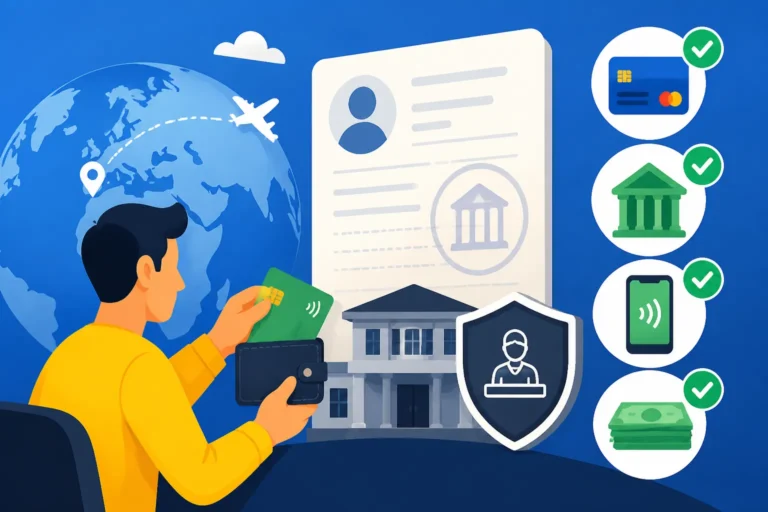
Do German Visas Require Proof of Accommodation? What Counts as Sufficient Housing
Booking an expensive, non-refundable hotel just to satisfy a consulate official, only to realize it won’t work for your local registration, is a crushing expat trap. I once lost hundreds of euros booking a temporary flat that refused to give me the legal paperwork. This guide explains exactly what counts as sufficient housing to secure your German visa.
Disclosure: This post may contain affiliate links. We may earn a commission at no extra cost to you if you make a purchase through these links. Read full disclosure.
The Visa Application vs The Local Registration Catch 22
There is a massive, frustrating difference between the accommodation proof required by the German embassy in your home country and the proof required by the local municipality once you actually arrive. Misunderstanding this difference leads to severe legal friction and financial loss.
Embassy Requirements Before You Arrive
When you apply for a National D-Visa at the German embassy (whether for a work visa, student visa, or job seeker visa), the consular officer wants to ensure you will not be homeless the moment your flight lands. For most individual visas, the embassy’s definition of “proof of accommodation” is relatively relaxed.
Usually, you can satisfy the embassy by providing a hotel booking, a hostel reservation, or a standard Airbnb receipt covering your first two to four weeks in Germany. They simply want to see a localized landing pad. If a friend or relative in Germany is hosting you temporarily, a signed invitation letter from them, accompanied by a copy of their passport and their own rental contract, is generally sufficient for the initial entry visa.
If this invitation letter or supporting documentation is written in a foreign language because your host does not speak German, relying on Lingoking to provide a certified translation ensures the consular officer accepts it without administrative delays. Because Lingoking utilizes court-sworn translators officially recognized by the state, handing their translated documents to the embassy removes any bureaucratic doubt regarding where you will sleep upon arrival.
The Anmeldung Crisis After You Land
The real nightmare begins after you arrive. To convert your temporary entry visa into a physical, long-term residence permit (Aufenthaltstitel), you must register your permanent address at the local citizens’ office (Bürgeramt). This mandatory bureaucratic process is known as the Anmeldung.
A hotel receipt or a standard tourist Airbnb booking will absolutely not work for your Anmeldung. To register locally, you must provide a Wohnungsgeberbestätigung—a highly specific, legally binding document signed by a landlord or property owner confirming you have officially moved into a residential property. Many short-term vacation rentals explicitly refuse to sign this document because it fundamentally alters their tax liability and local residential zoning compliance.
If you cannot get this specific document, you cannot register your address. If you cannot register, you cannot open a local bank account, receive your tax ID, or finalize your visa at the immigration office. Escaping this vicious cycle requires meticulous planning, a survival mechanism deeply analyzed in German Bureaucracy 101: Understanding the Anmeldung, Schufa, and Tax ID.

What Actually Counts as Sufficient Housing in Germany
If you are moving to Germany with dependents, the “relaxed” embassy rules for initial entry immediately vanish. The German government enforces strict mathematical laws regarding how much physical space your family must have to legally reside in the country.
The Minimum Square Footage Rule
For family reunification visas, the immigration office (Ausländerbehörde) will aggressively scrutinize your rental contract (Mietvertrag). By law, you must prove you have “sufficient living space” (ausreichender Wohnraum) for every single family member you intend to bring over.
While specific regional variations exist depending on the federal state, the general federal standard dictates that you must have at least 12 square meters of living space for every family member over the age of six, and 10 square meters for every child under the age of six. Babies under two years old are generally not included in the calculation. Importantly, spaces like kitchens, bathrooms, balconies, and hallways do not count toward this total; the calculation strictly measures actual living and sleeping quarters.
If your apartment is 45 square meters, you might legally be allowed to bring your spouse. However, if you attempt to bring your spouse and a seven-year-old child, your visa application will be rejected purely based on a lack of square footage. Understanding these rigid mathematical constraints is a vital step mapped out in Bringing Your Family to Germany: The Family Reunification Visa.
Furthermore, the authorities will demand absolute proof of your family structure to verify these calculations. Utilizing Lingoking to provide legally sworn, certified translations of your foreign marriage and birth certificates guarantees the authorities can accurately verify the age and status of your dependents to calculate your housing requirements correctly.
Temporary Housing and Sublets
Many expats attempt to solve the housing crisis by securing a sublet (Untermiete). A sublet is perfectly legal and counts as sufficient housing for both the visa and the Anmeldung, provided the main tenant has explicit, written permission from the property owner to sublet the space to you.
If you rent a sublet from someone who is doing it secretly or off the books, you will not receive the mandatory Wohnungsgeberbestätigung, rendering the apartment entirely useless for your immigration paperwork. When evaluating your Cost of Living in Germany: Breakdown of Expenses Rent Food Transport, you must budget for legitimate “aparthotels” or specialized expat housing platforms that explicitly advertise that Anmeldung is possible and provide legally binding contracts.
| Housing Requirement | Initial Entry Visa (Embassy) | Residence Permit Anmeldung (Local Office) |
| Accepted Housing Types | Hotel, Hostel, Airbnb, Friend’s couch | Long-term lease, official sublet, aparthotel |
| Required Document | Booking receipt or informal invitation letter | Wohnungsgeberbestätigung (Landlord Confirmation) |
| Square Footage Limit | None (for a single traveler) | Strictly enforced (12 sqm per adult for families) |
| Financial Tie-in | Blocked account or host’s formal guarantee | Proof of sustained income/savings to pay monthly rent |
How to Secure Proof of Accommodation Without Getting Scammed
Securing legitimate housing before you arrive is terrifying because the German real estate market is flooded with scammers targeting desperate foreigners. You must combine undeniable financial proof with proper documentation to secure a legitimate lease.
Financial Proof for Landlords and Embassies
Whether you are applying for the visa or applying for an apartment, German authorities and landlords demand undeniable proof that you can afford the rent. If you are an international student or utilizing the Job Seeker Visa: Your Ticket to Finding Work in Germany, you do not have a German salary history yet. Local landlords will usually demand a clean local credit report, creating an impossible barrier for newcomers.
To prove you can cover your accommodation, the government mandates a blocked account (Sperrkonto). Veteran expats rely on Expatrio to solve this. Setting up your legally mandated blocked account through Expatrio provides the exact financial confirmation PDF the embassy demands to prove you won’t become homeless. Furthermore, when you finally find a landlord willing to rent to you, showing them your official Expatrio payout schedule proves your financial solvency. This neutralizes their fear that a jobless foreigner will default on the rent, serving as a powerful alternative to a local credit score. Managing these complex cross-border capital requirements is further decoded in Moving Money to Germany: Declaring Savings and Large Transfers.
If you are employed and earning a high salary, you might be aiming for a premium permit, which carries entirely different financial assumptions. Navigating these specific categories is detailed in Understanding the Different Types of German Visas and Residence Permits.
Bureaucratic Lifelines for Families and Students
Alongside proving you have a roof over your head and money in the bank, the embassy will simultaneously check your health insurance. You cannot secure your visa—or sign a residential lease in many high-end buildings—without proving you have comprehensive coverage. Many German landlords also demand to see proof of personal liability insurance to ensure you can cover any accidental damages to the rental property.
To bridge this gap effortlessly, incoming expats use Feather Insurance. Because Feather Insurance specializes in the international community, you can secure fully compliant incoming visa coverage, statutory public health insurance, and crucial personal liability insurance before you even enter the country. Bringing a policy certificate from Feather Insurance to your visa appointment satisfies the caseworker immediately. Once you move into your permanent German apartment, Feather Insurance helps you smoothly transition your address records, a process explored deeply in Public vs Private Health Insurance in Germany: Which is Right for You?.
Finally, once your accommodation is secured, your Anmeldung is complete, and your visa is finalized, you must integrate your daily expenses. You will need to set up SEPA direct debits for your rent and local utilities. Relying on foreign accounts for this will result in massive fees and landlord rejections. Setting up localized financial tools to execute these domestic payments seamlessly is a mandatory final step outlined in How to Pay Rent and Bills in Germany: Banking Tips for Expats.
References
Primary sources (official)
- Make it in Germany – Entry & Visa Process: The federal government’s official portal outlining the requirement to plan and prove your initial accommodation (e.g., hotel, shared flat) before applying for an entry visa. https://www.make-it-in-germany.com/en/visa-residence/procedure/entry-process
- Federal Foreign Office (Auswärtiges Amt) – Visa Information: The central hub for German embassies detailing exactly which documents third-country nationals must present to prove their livelihood and accommodation upon entry. https://www.auswaertiges-amt.de/en/visa-service/visabestimmungen-node
Other helpful sources
- Integreat App – Family Reunification and Living Space: A highly detailed municipal guide explaining the strict legal definitions of “sufficient living space” required by the BAMF to bring family members to Germany. https://integreat.app/essen/en/asylum-and-migration/family-reunification-and-family-reunion
- How To Germany – Family Reunion Visa: An extensive expat guide providing checklists for the required rental contracts, living space calculations, and income proofs needed for the Ausländerbehörde. https://www.how-to-germany.com/visa/long-stay/family-reunion/
Disclaimer
The information provided in this article is for general informational and educational purposes only and does not constitute professional legal, real estate, or immigration advice. German residency laws under the Residence Act (Aufenthaltsgesetz), specifically regarding the mandatory Anmeldung and the strict mathematical formulas calculating “sufficient living space” (ausreichender Wohnraum) for family reunification, are strictly enforced by local immigration authorities (Ausländerbehörden). Attempting to register an address using an unauthorized sublet or a vacation rental that refuses to provide a Wohnungsgeberbestätigung is illegal and can result in the denial of your residence permit. Always consult a certified German immigration lawyer (Fachanwalt für Ausländerrecht) regarding complex family reunification cases.