Biometric Residence Permit (eAT): Understanding Your German Residence Card
Getting handed a thick, official envelope from the Ausländerbehörde only to find a complex plastic card and several confusing PIN letters leaves many newcomers utterly bewildered. I distinctly remember staring at my first German residence card, terrified of losing the flimsy green paper attached to it, completely unsure of what to do next. This guide breaks down exactly what the biometric residence permit entails, how to navigate its digital features, and how to protect your legal status in Germany.
Disclosure: This post may contain affiliate links. We may earn a commission at no extra cost to you if you make a purchase through these links. Read full disclosure.
Understanding the Biometric Residence Permit
The Transition from Paper to Plastic
For decades, getting a visa in Germany meant surrendering your passport to a local government official so they could glue a large, colorful, and easily damaged paper sticker inside it. However, in September 2011, Germany revolutionized this system by introducing the elektronischer Aufenthaltstitel (eAT). This transition aligned Germany with a broader European Union directive aimed at standardizing immigration documents and curbing identity fraud across all member states.
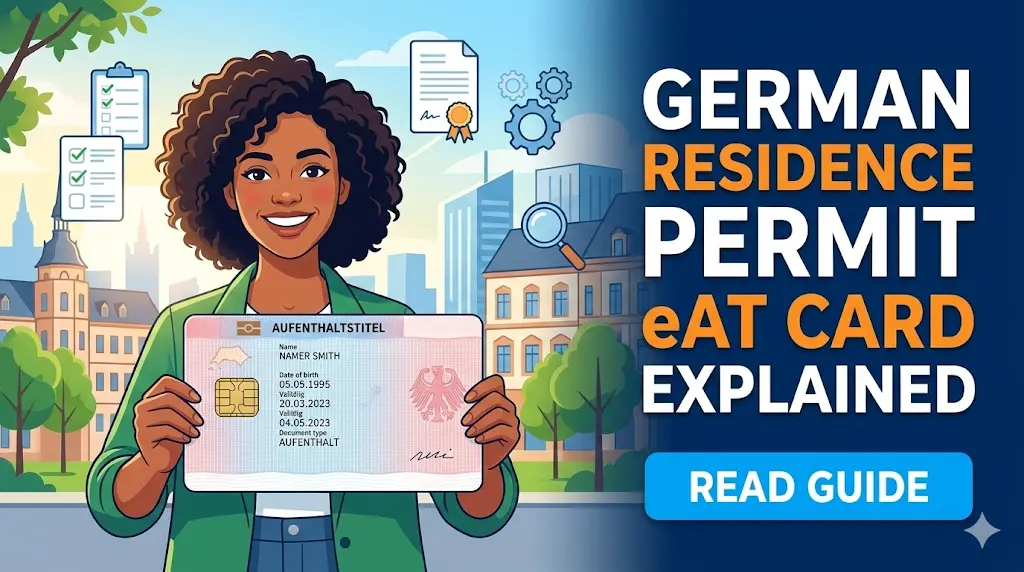
Today, the eAT is a standalone, credit-card-sized plastic document issued to all non-EU citizens who are granted a long-term right to reside in the country. To understand where this document fits into the broader scope of your relocation timeline, you can review our comprehensive guide on German Immigration Terms Explained: A Glossary for Newcomers. The defining feature of this modern card is the highly secure, contactless microchip embedded within the plastic, which stores your biometrics securely and allows for digital identity verification.
It is important to note that the eAT is not a passport replacement. While it serves as your ultimate proof of legal residency within German borders, it is fundamentally tethered to your home country’s passport. You must always carry and present both documents together when crossing international borders or proving your identity to law enforcement.
Anatomy of the German Residence Card
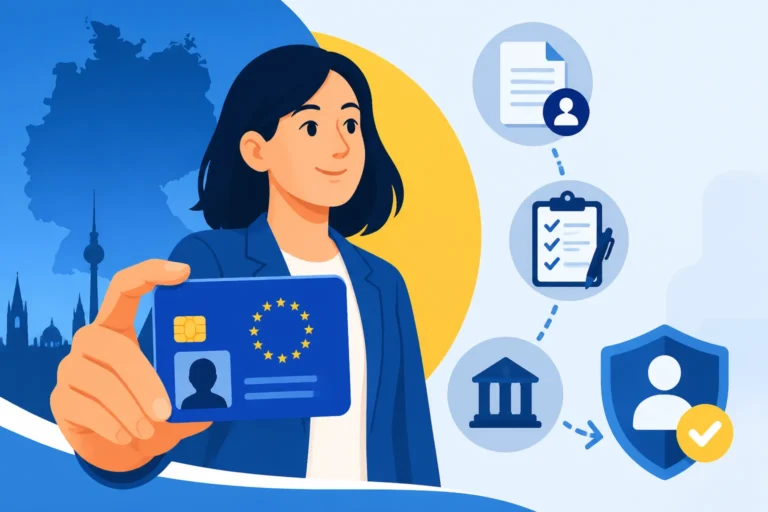
At first glance, the eAT looks very similar to a standard German national ID card (Personalausweis). The front side displays your high-resolution photograph, your full legal name, your date of birth, and your nationality. Crucially, it also explicitly states the expiration date of your current permit and the specific legal paragraph (e.g., “Blaue Karte EU” or “Studium”) under which you are allowed to stay. For a deep dive into these specific legal categories, check out EU Blue Card Germany: Eligibility, Benefits, and Application Process.
The back of the card features your current registered German address, your eye color, your height, and a machine-readable zone at the bottom for quick scanning at border control checkpoints. Hidden inside the card is the RFID chip containing your digital fingerprints and a digital copy of your photograph.
| Feature | Physical Card Display | Digital Chip Storage |
| Personal Data | Name, DOB, Nationality, Address | Name, DOB, Address, Expiration |
| Biometrics | Printed Photograph | Digital Photo, Two Fingerprints |
| Legal Status | Permit Type, Expiration Date | Permit Type, Issuing Authority |
| Functionality | Visual ID Verification | eID (Online Authentication) |
The Crucial Role of the Green Supplementary Sheet
When you finally receive your eAT, it comes accompanied by a folded, green piece of paper officially known as the Zusatzblatt (Supplementary Sheet). Do not throw this paper away, and do not underestimate its importance. The plastic eAT card simply does not have enough physical space to print all the nuanced legal conditions attached to your specific residency status.
The Zusatzblatt spells out the exact, legally binding terms of your employment or stay. If your visa is tied to a specific company, the name of your employer will be printed here. If you are a student restricted to working 120 full days a year, that limitation is recorded on this green sheet.
Employers will always ask to see this document before officially hiring you or signing an employment contract, as it is the only way they can verify your legal right to work. You must keep the Zusatzblatt safely tucked inside your passport right next to your eAT card. If you lose it, you must apply for a replacement at the immigration office, which can delay job starts and cause severe administrative headaches.
The Application and Issuance Process
Securing an Appointment at the Immigration Office
The journey to obtaining your eAT begins with securing a highly coveted appointment (Termin) at your local Ausländerbehörde (Foreigners’ Registration Office). This is notoriously one of the most frustrating bottlenecks in the German immigration system. Wait times for appointments in major metropolitan areas like Berlin, Munich, or Frankfurt can easily stretch into several months. You can find actionable strategies for surviving this process in Navigating the Ausländerbehörde: Tips for Dealing with German Immigration Offices.
When booking your appointment online, you will typically need to select the specific purpose of your stay, whether you are converting a national D-Visa into an eAT or renewing an expiring permit. One of the strictest requirements for securing this appointment is proving that you have comprehensive, continuous health insurance coverage that meets German legal standards. Missing or inadequate insurance proof is the leading cause of application rejections. Utilizing expat-friendly, digital-first brokers like Feather Insurance ensures you arrive with policies strictly tailored to pass the Ausländerbehörde’s rigorous checks, avoiding devastating delays.
Furthermore, if your application relies on foreign birth certificates, marriage licenses, or university diplomas, the immigration office often demands that these documents be translated into German by a court-sworn translator. Trying to find a verified translator on short notice can induce panic. Many expats streamline this requirement by using services like Lingoking to instantly order certified, legally recognized translations of their critical documents well before their appointment date.
Navigating Document Preparation and Biometric Capture
On the day of your appointment, you must present a meticulously organized folder of physical documents. Beyond your passport and health insurance, you will need your official address registration certificate (Meldebestätigung), a recent biometric passport photo adhering to strict German sizing guidelines, and comprehensive proof of financial stability. To review the entire checklist, see Documents Required for German Visa Applications: Complete Guide.
For students and job seekers, proving financial stability almost always requires setting up a Sperrkonto (Blocked Account) holding a state-mandated minimum balance. Navigating traditional German banks for this can take weeks. Savvy newcomers use government-approved digital providers like Expatrio to open a blocked account entirely online from their home country within a matter of hours, receiving the exact confirmation document the caseworker needs to see.
During the appointment itself, the caseworker will physically capture your biometrics. They will scan your submitted passport photo and use a digital fingerprint scanner to record the prints of your two index fingers. You will also be asked to provide a digital signature on an electronic pad. These three elements are then securely encrypted and prepped for the manufacturing phase.
Decoding the Processing Timeline and the PIN Letter
Unlike the old paper stickers that were printed on the spot, the eAT cannot be produced at your local immigration office. All biometric residence cards in Germany are centrally manufactured by the Bundesdruckerei (Federal Printing Office) in Berlin. Because of this centralized system, it typically takes between four to six weeks from the day of your appointment for the physical card to be ready.
About two to three weeks into this waiting period, you will receive a highly secure letter in the mail directly from the Bundesdruckerei. This is the PIN/PUK letter, and receiving it is a strong indicator that your card has been successfully printed. Do not discard this letter! It contains the initial Transport PIN required to activate the digital features of your card, as well as the PUK code needed to unblock it if you enter the wrong PIN too many times.
Once the local Ausländerbehörde receives the plastic card from Berlin, they will either mail it directly to your registered address (a practice increasingly common since the pandemic) or send you a notification letter asking you to book a quick pick-up appointment to collect it in person.
Digital Features and Online Identification
Activating the Online Identification Function
The eAT is far more than a physical piece of plastic; it functions as a legally binding digital identity card, officially known as the Online-Ausweisfunktion or eID. When you pick up your card, this function is usually deactivated by default unless you explicitly request the caseworker to turn it on, or you activate it yourself at home.
To utilize the eID, you must replace the five-digit Transport PIN sent in the mail with a personalized six-digit PIN. You can do this using a certified USB smart card reader connected to your computer, or, much more conveniently, by using an NFC-enabled smartphone (which most modern phones are).
You must download the official government app called “AusweisApp2” (or simply AusweisApp) to your phone or computer. By opening the app, holding your eAT card directly against the back of your smartphone to let the NFC chip scan, and entering your Transport PIN, you can securely set your new, permanent six-digit PIN. Once this is done, your eAT is fully activated for digital use across the German internet.
Practical Bureaucratic Uses for Your Digital Identity
While the adoption of digital government services in Germany has historically been slow, the utility of the eID function has skyrocketed in recent years. Having an activated eAT allows you to bypass the need for physical signatures and in-person appointments for a growing list of critical administrative tasks.
One of the most valuable uses for expats is securely logging into the Elster portal to file annual income tax returns without needing to wait weeks for paper access codes to arrive by mail. You can also use the eID to instantly check your current standing with the German public pension insurance (Deutsche Rentenversicherung), securely open bank accounts online without going through lengthy video-verification calls, and access your digital health records.
In several progressive German cities, an active eID even allows you to complete your address registration (Anmeldung), apply for a police clearance certificate (Führungszeugnis), or register a vehicle entirely online, saving you from enduring the dreaded waiting rooms of the Bürgeramt.
Data Security and Biometric Privacy Concerns
It is completely natural for expats to feel uneasy about handing over their fingerprints and carrying around an RFID-chipped card. However, Germany possesses some of the strictest data privacy and protection laws in the world, and the eAT is designed with rigorous cryptographic security protocols.
The biometric data (your fingerprints and high-resolution photo) stored on the chip is highly restricted. It cannot be read over the internet or accessed by standard commercial entities like banks or landlords. The biometrics can only be accessed by official government authorities possessing specialized reading certificates—namely, border control officers at airports, police officers, and customs officials verifying your identity.
When using the eID function online to prove your identity to a service provider (like an insurance company or a university), the chip explicitly asks for your six-digit PIN every single time. Before any data is transmitted, the AusweisApp displays exactly who is requesting the data and precisely which data points (e.g., just your name and age, but not your address) they want to see. You are always in total control of what information is released.
Dealing with Changes and Emergencies
Updating the Physical Address on Your Card
In Germany, your legal address must always be perfectly up to date. If you move to a new apartment, you are legally obligated to register your new address at the local Bürgeramt within 14 days. When you attend this appointment to get your new registration paper (Meldebestätigung), you must bring your physical eAT card with you.
The Bürgeramt official will print a small, highly adhesive sticker with your new address and carefully place it over the old address on the back of your eAT card. They will then stamp the sticker with an official government seal to prove it is a legitimate update. Simultaneously, they will update the address data digitally stored on the card’s microchip.
Never attempt to write over your old address or place your own sticker on the card. Altering the physical card yourself constitutes tampering with an official government document and can render the eAT invalid, leading to severe complications with landlords, employers, and border control.
Emergency Protocols for Lost or Stolen Cards
Losing your eAT card is a highly stressful event, but you must act immediately to protect your identity and legal status. The absolute first step is to block the card’s eID online function to ensure no one can steal your digital identity. You can do this 24/7 by calling the central German blocking hotline at 116 116 and providing your blocking password (which is printed on your original PIN/PUK letter). If you don’t have the password, you must block it in person at the immigration office or police station.
Next, you must report the loss or theft to the local German police (Polizei) to obtain an official loss report (Verlustanzeige). Finally, you must immediately contact your Ausländerbehörde to report the missing card and schedule an appointment to apply for a replacement.
Replacing a lost card triggers the entire biometric capture and printing process all over again, meaning you will face another 4-6 week wait and a replacement fee. If you need to travel urgently during this waiting period, the Ausländerbehörde can issue a temporary travel document, but you must explicitly request it.
Managing Permit Expiration and Renewal Timelines
Your eAT card is rarely valid forever. Its expiration date is explicitly printed on the front, and it is usually tied to the duration of your employment contract, your study program, or the expiration date of your home country’s passport. You are entirely responsible for tracking this date; the German government will not send you a reminder letter telling you to renew your visa.
You should initiate the renewal process by contacting the Ausländerbehörde roughly three months before your current eAT expires. When proving your continued financial stability during a renewal, using a service like Expatrio to generate verified financial statements or maintaining flawless insurance records via Feather Insurance ensures the caseworker has zero grounds to delay your extension. For a comprehensive timeline on this process, see Renewing Your German Visa or Residence Permit: Timeline and Process.
If you apply for your renewal on time, but the immigration office is too backlogged to issue your new eAT before the old one expires, they will issue you a Fiktionsbescheinigung (fictional certificate). This vital paper document bridges the gap, legally extending your current residency and work rights until the new plastic card arrives from Berlin.
References
Primary sources (official)
- Federal Office for Migration and Refugees (BAMF): The official portal detailing the security features, the online ID function, and the legal basis of the electronic residence title (eAT).https://www.bamf.de/EN/Themen/MigrationAufenthalt/ZuwandererDrittstaaten/Migrathek/eAufenthaltstitel/eaufenthaltstitel-node.html
- Federal Ministry of the Interior and Community (BMI): Detailed technical explanations regarding the strict data privacy laws and the activation of the Online-Ausweisfunktion for digital bureaucracy.https://www.personalausweisportal.de/Webs/PA/EN/citizens/german-ID-card/electronic-residence-permit/electronic-residence-permit-node.html
Other helpful sources
- Make it in Germany: The federal government’s practical guide for international professionals explaining the process of converting visas into long-term settlement permits.https://www.make-it-in-germany.com/en/visa-residence/living-permanently/settlement-permit
Disclaimer
The information provided in this article is for general informational and educational purposes only and does not constitute professional legal or immigration advice. German visa policies, municipal appointment procedures for the eAT, financial deposit requirements via platforms, health insurance compliance rules managed by brokers and sworn translation regulations for services are highly complex and subject to continuous legislative updates. Always consult directly with your local municipal immigration office (Ausländerbehörde) or a certified immigration lawyer (Fachanwalt für Migrationsrecht) to evaluate your personal legal standing and document requirements.