Special Visa Rules for Canadians, Australians, and New Zealanders in Germany
Staring at the ceiling of my overpriced Berlin Airbnb, I suddenly realized the immense privilege of my passport was a double-edged sword; I could enter Germany without a visa, but I couldn’t legally rent an apartment or work without navigating a bureaucratic nightmare within 90 days. This guide breaks down the specific legal privileges, hidden traps, and visa pathways exclusively available to Canadians, Australians, and New Zealanders moving to Germany.
Disclosure: This post may contain affiliate links. We may earn a commission at no extra cost to you if you make a purchase through these links. Read full disclosure.
The Privilege of Visa-Free Entry and Its Hidden Traps
Holding a passport from Canada, Australia, or New Zealand grants you an incredible level of global mobility. When it comes to German immigration, this mobility translates into a highly specific legal status that separates you from the vast majority of third-country nationals. However, this legal advantage is frequently misunderstood, leading to devastating administrative consequences for expats who arrive unprepared.
Section 41 Exemption Explained
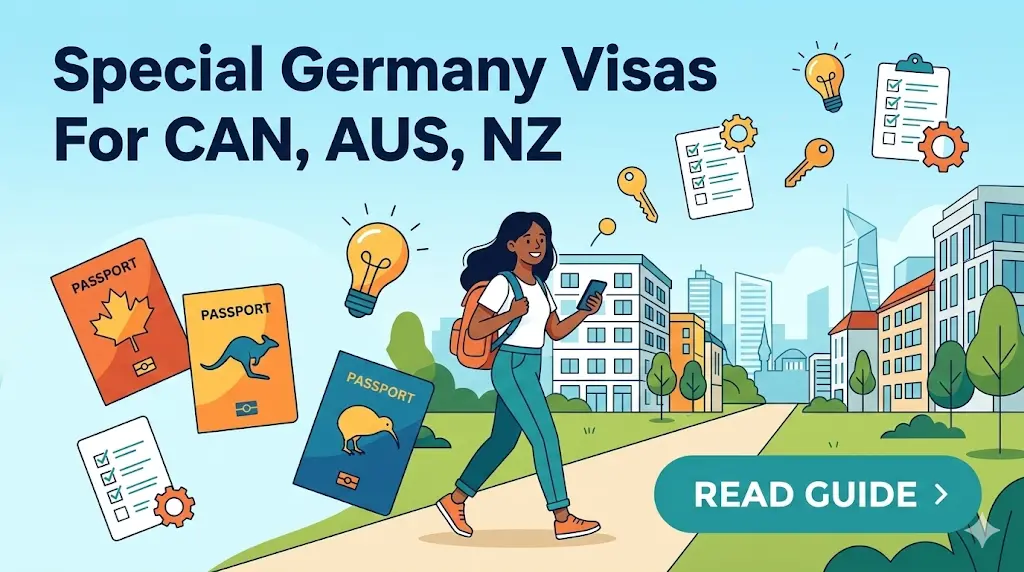
The foundation of your immigration privilege is buried within Section 41 of the German Residence Ordinance (Aufenthaltsverordnung). This specific legal clause lists a handful of “privileged nations,” including Australia, Canada, Israel, Japan, New Zealand, the Republic of Korea, the UK, and the USA. If you hold a passport from one of these countries, you are granted a monumental logistical shortcut: you do not need to apply for a National Visa (Type D) at the German embassy in your home country before you relocate.
For a citizen of India or Brazil, moving to Germany requires securing a highly sought-after embassy appointment in their home country, submitting mountains of paperwork, and waiting months for approval before they can legally board a flight with the intention of staying long-term. As a Canadian, Australian, or Kiwi, you bypass this entirely. You are legally permitted to pack your bags, fly directly to Frankfurt, Munich, or Berlin, enter the country on your visa-free privileges, and apply for your long-term residence permit directly at the local German immigration office (Ausländerbehörde).
This allows you to physically attend job interviews, tour apartments in person, and negotiate employment contracts while already on the ground. It is an unparalleled advantage that makes the transition feel seamless at first. However, to truly comprehend how this privilege fits into the broader spectrum of European immigration law, you must study the foundational concepts outlined in our guide on Visas and Residence Permits in Germany: Everything You Need to Know.
The Ninety-Day Ticking Clock
While entering Germany without prior embassy approval feels like a loophole, it is actually a terrifying race against time. The moment the border police stamp your passport at the airport, a strict, unforgiving countdown begins. You are operating under the standard Schengen rule, which dictates that you can remain in the Schengen Area for a maximum of 90 days within any rolling 180-day period.
This 90-day window sounds like a long time until you realize the sequential nature of German bureaucracy. You cannot simply walk into an immigration office on day 89 and demand a work permit. To apply for a residence permit, you must first have a registered German address. To get a registered address, you must find a landlord willing to rent to a foreigner who doesn’t yet have a visa or a German bank account. Many expats from privileged nations spend their first 45 days desperately hopping between expensive short-term rentals just to secure the physical piece of paper required to register their address.
If your 90-day window expires while you are still hunting for a job or waiting for a municipal appointment, you are suddenly residing illegally in the European Union. You cannot reset this clock by taking a weekend trip to the UK or Switzerland; the calculation is a rolling 180-day period. You must formally submit your residence permit application before those 90 days expire to legally freeze your status.
Why Visa-Free Doesn’t Mean Work-Free
The most dangerous misconception among Canadians, Australians, and New Zealanders is equating visa-free entry with immediate working rights. Section 41 allows you to enter Germany for the purpose of applying for a residence permit, but it absolutely does not allow you to engage in gainful employment until that permit is physically in your hands.
If you arrive in Berlin on day one, secure a job offer on day ten, and start working on day fifteen without having an approved work visa, you are committing a severe immigration violation. If the authorities discover this—which they often do when your employer attempts to register you for payroll taxes and public health insurance—you face massive financial fines, immediate termination of your employment, and potential deportation.
You are allowed to attend interviews, sign an employment contract, and negotiate your starting date, but your actual first day of work must be postponed until the local immigration office officially approves your status. This means you must arrive with enough financial savings to survive several months of paying rent and buying groceries without a local income stream.
Youth Mobility and Working Holiday Visas
For young adults from Canada, Australia, and New Zealand, the German government offers one of the most flexible and exciting immigration pathways in the world: the Working Holiday Visa (or Youth Mobility Agreement, depending on your nationality). This visa is designed to foster cultural exchange while allowing you to legally fund your travels.
Eligibility for Canadians, Australians, and Kiwis
The Working Holiday Visa (WHV) is rooted in bilateral agreements between Germany and your home countries. The primary criteria for eligibility revolve around your age and your nationality. For citizens of Australia and New Zealand, you must be between the ages of 18 and 30 (inclusive) at the time you file your application. This means you can apply up until the day before your 31st birthday.
For Canadian citizens, the agreement is even more generous. Under the Youth Mobility Agreement (YMA), Canadians can apply for this visa between the ages of 18 and 35 (inclusive). This extended age bracket makes Germany an incredibly attractive destination for Canadian professionals who want to take a mid-career sabbatical or transition their lives to Europe later in their thirties.
Regardless of your specific nationality, you cannot bring dependent family members, such as children, with you on this specific visa. You must also prove that your primary intention is to holiday and experience German culture, with employment acting as an incidental means to supplement your travel funds. However, in practice, the German authorities grant immense leeway regarding how you spend your twelve months.
Application Strategies and Age Limits
Because you belong to a privileged nation under Section 41, you have two distinct strategies for applying for the WHV. You can apply at the German embassy in Ottawa, Sydney, or Wellington before you depart, or you can fly to Germany and apply at the local Ausländerbehörde.
Applying from your home country is highly recommended if you want to eliminate post-arrival anxiety. If you secure the visa before you fly, it is valid the moment you land. This means you can step off the plane and start working the very next day. If you choose to apply locally after arriving in Germany, you must wait weeks or months for your municipal appointment, during which time you are strictly forbidden from earning any money.
To secure the visa, you must prove you have sufficient financial resources to survive the initial phase of your trip. The embassy typically requires you to show at least €2,466 in available funds, plus the cost of a return flight ticket. If you are applying locally in Germany and need to secure these funds in a way that satisfies strict bureaucratic scrutiny, utilizing a certified provider like Expatrio to open a government-approved blocked account is an excellent way to guarantee the caseworker accepts your financial proof without question.
Pros and Cons of the Working Holiday Route
The greatest advantage of the WHV is its unparalleled flexibility. Unlike standard work permits that tie you to a single, specific employer, the WHV grants you open access to the labor market. You can work in a café in Munich for three months, move to Berlin to work at a tech startup for six months, and then spend the rest of your year traveling.
However, there are nationality-specific restrictions you must carefully navigate. While Canadians and New Zealanders can generally work for the same employer for the entire 12-month duration of the visa if they choose, Australians are often restricted to working for a single employer for a maximum of six months. After six months, an Australian must switch jobs.
The major downside to the WHV is its absolute lack of permanence. The visa is strictly valid for a maximum of one year and cannot be casually extended. Furthermore, time spent on a WHV does not usually count toward the required years for permanent residency in Germany. If you fall in love with the country and decide you want to stay, you must successfully transition your status to a long-term skilled worker permit before your WHV expires.
Transitioning to Long-Term Skilled Employment
If you age out of the Working Holiday bracket, or if you decide you want to turn your German adventure into a permanent relocation, you must navigate the complex transition to a long-term corporate work visa. Germany is desperate for skilled labor, and professionals from Canada, Australia, and New Zealand are highly sought after by local recruiters.
Upgrading to the EU Blue Card
The EU Blue Card is the premium tier of European work visas, designed specifically to attract highly educated professionals. If you possess a Canadian, Australian, or New Zealand university degree that is officially recognized in Germany, and you secure a binding job offer that meets a specific salary threshold, the Blue Card is your golden ticket.
The German government adjusts the minimum salary threshold annually. Currently, it hovers around €45,300 for standard professions, and drops even lower to roughly €41,042 for “shortage occupations” like IT specialists, engineers, and scientists. This lower threshold also applies to young professionals who graduated within the last three years.
The long-term benefits of the Blue Card are monumental. It offers a hyper-accelerated path to permanent residency, allowing you to settle indefinitely in Germany after just 21 to 27 months, depending on your German language skills. Furthermore, if you are bringing a spouse from back home, the Blue Card exempts them from having to prove any German language proficiency before their dependent visa is approved. To understand the exact salary figures and the rigorous academic checks required, you must consult EU Blue Card Germany: Eligibility, Benefits, and Application Process.
Navigating the Skilled Worker Permit
Not everyone qualifies for the high salary thresholds of the Blue Card, and Germany urgently needs skilled tradespeople, mid-level managers, and administrative professionals. If you have a recognized vocational qualification or a university degree but your salary offer falls below the Blue Card limit, you will apply for the standard Skilled Worker Visa (Fachkräftevisum).
The core requirement here is that your professional qualifications must perfectly align with the job you are being hired to do. However, recent legislative reforms have drastically loosened the rules. The government has entirely abolished the old “priority check” (Vorrangprüfung) which used to force employers to prove no German or EU citizen could do your job before hiring you.
Today, if your qualification from Sydney or Toronto is recognized, and you have a matching contract offering the standard local market salary, the job is yours. The authorities simply want to ensure you are not being financially exploited by a German employer attempting to undercut local wages. To fully grasp these new, relaxed regulations and how to prove your foreign equivalence, read Germany’s Skilled Worker Visa: Requirements and How to Apply.
Managing the Auslaenderbehoerde Backlog
Whether you are transitioning from a WHV to a Blue Card, or entering Germany visa-free to apply for your first Skilled Worker permit, your final boss is the local Foreigners’ Office (Ausländerbehörde). You must secure an appointment here to convert your application into a physical, plastic residence card.
In major cities favored by English speakers, such as Berlin, Munich, and Frankfurt, these offices are catastrophically understaffed and overwhelmed. Finding an available appointment slot often requires checking their online portals at 6:00 AM every single morning for weeks.
If your 90-day visa-free entry window or your WHV is expiring and you cannot secure an appointment, you must act strictly according to the law to freeze your status. If you officially apply via email, mail, or the online portal before your current legal status expires, the office will issue you a Fiction Certificate (Fiktionsbescheinigung), legally extending your presence until they process your card.
Freelance and Self-Employment Pathways
Canadians, Australians, and Kiwis possess a strong cultural affinity for independent contracting and entrepreneurship. However, translating that “sole trader” mentality into the rigid, highly regulated German legal system is one of the most frustrating experiences an expat can endure.
Freiberufler versus Commercial Business
In the Anglosphere, an independent contractor is just an independent contractor. In Germany, the government strictly divides self-employment into two entirely separate legal and tax categories: the Freelancer (Freiberufler) and the Commercial Business Owner (Gewerbetreibende). Your entire visa application hinges on classifying yourself correctly.
A Freiberufler is someone who offers services based on specialized, often academic, knowledge. This includes writers, artists, doctors, independent lawyers, language teachers, and software developers. The German state grants these liberal professions immense administrative privileges, including total exemption from the heavy local trade tax (Gewerbesteuer).
If you buy products to resell them, run an e-commerce store, manufacture physical goods, or act as a digital marketing agency owner who subcontracts work, you are a commercial business. You must apply for an Entrepreneur Visa, which requires comprehensive business plans, proof of massive capital investment, and complex commercial registrations. If you apply for the easier freelance visa while secretly running a commercial business, the tax authorities will forcefully reclassify you and penalize you heavily.
Securing German Clients and Letters of Intent
The most devastating hurdle for remote workers and digital nomads hoping to use the German freelance visa is the “local economic interest” requirement. You cannot simply move to Munich to work independently for clients located exclusively in Melbourne, Auckland, or Vancouver.
The German authorities generally demand that your freelance work benefits the domestic German economy directly. To prove this, you must submit formal “Letters of Intent” (Absichtserklärungen) from at least two prospective clients based inside Germany. These letters must state that the German company intends to hire you for specific projects once your visa is approved.
There is a famous, unwritten exception to this rule in the city of Berlin. Because Berlin actively courts international creatives, the local immigration office frequently waives the strict German client requirement for certain highly specialized IT consultants, musicians, and artists, granting the visa even if the bulk of their clientele remains abroad. However, banking your entire relocation strategy on the subjective leniency of a Berlin caseworker is incredibly risky.
The Bureaucratic Demands of Independence
Getting the freelance visa approved is only the preliminary stage. The real administrative marathon begins when you face the German tax infrastructure. You must officially register your business with the local tax office (Finanzamt) by filling out a notoriously complex Tax Registration Questionnaire (Fragebogen zur steuerlichen Erfassung).
Once processed, the tax office will issue you a dedicated Tax Number (Steuernummer), which you must list on every single formal invoice you generate. You must also decide whether to opt into the Small Business Owner Regulation (Kleinunternehmerregelung), which legally exempts you from charging 19% Value Added Tax (VAT) to your clients if your projected revenue is low.
Furthermore, you must prove absolute financial solvency to the immigration office. They want to ensure you will not become a burden on the state if your freelance business fails. To bridge the gap between arriving in Germany and securing your first paid invoices, the authorities will demand proof of massive personal savings. Utilizing a certified digital provider like Expatrio to open a government-approved blocked account allows you to cleanly isolate your baseline survival funds from your volatile freelance income, easily satisfying the caseworker’s demands.
Securing Your Bureaucratic Foundation
Regardless of whether you are entering on a Working Holiday Visa, securing a high-paying Blue Card, or battling for a freelance permit, every single expat from a privileged nation must conquer the same foundational bureaucratic hurdles to survive in Germany.
The Critical First Step of Address Registration
Your entire life in Germany hinges on a single administrative process known as the Anmeldung. By law, anyone moving to Germany must register their residential address at the local citizens’ office (Bürgeramt) within 14 days of moving into an apartment.
Without the physical Meldebescheinigung (Certificate of Registration) handed to you by the clerk, you cannot open a standard German bank account to receive your corporate salary. You cannot sign a cell phone contract, get home internet, or receive your personal Tax Identification Number. Most importantly, the immigration office will not even look at your residence permit application until you are officially registered in their district.
Because securing a permanent apartment requires a credit score (SCHUFA) you do not yet have, almost all incoming expats survive their first months by renting highly overpriced, temporary furnished housing that explicitly permits legal registration. You must aggressively confirm with any short-term housing provider that they will issue the required landlord confirmation letter (Wohnungsgeberbestätigung) before you hand them a deposit.
Mandatory Health Insurance Realities
This is a brutal wake-up call for expats relying on the excellent public healthcare systems of Canada, Australia, or New Zealand: your provincial health card or Medicare card is useless here. You absolutely cannot receive a German residence permit without proving you have comprehensive local health insurance.
The German system is divided into public and private sectors. If you are entering as a salaried corporate employee, you will generally be mandated to join the statutory public health insurance system (gesetzliche Krankenkasse). If you are a freelancer or arriving on a Working Holiday Visa, public funds will often reject you upon arrival, forcing you into the private market (Private Krankenversicherung).
The immigration office will rigorously check your private policy to ensure it meets the strict criteria set by the German government. Cheap, temporary “backpacker” policies purchased online are fiercely rejected by the authorities. To ensure your insurance portfolio is utterly bulletproof, using an English-first, specialized expat broker like Feather Insurance is absolutely critical. They specifically tailor insurance packages for expats navigating the rigid German visa system, ensuring the paperwork you hand to the immigration officer is flawlessly compliant.
Translating Foreign Documents and Blocked Accounts
The German state does not operate in English, and they do not inherently trust foreign documents. Even though your university diplomas, marriage certificates, and birth certificates from Sydney, Toronto, or Auckland are already in English, they must often be formally translated into German before they are presented to the immigration authorities, especially if you are applying for family reunification or specialized professional recognition.
You cannot translate these documents yourself, and the German authorities almost exclusively demand formal translations executed by a “Sworn Translator” legally recognized by the German regional courts. They demand absolute legal accountability for every translated word. Finding these specific, certified translators can cause massive delays. Utilizing a dedicated platform like Lingoking connects you directly with German-certified sworn translators who turn around legally flawless, perfectly formatted documents that carry the exact stamps and seals the immigration office demands.
Finally, if you are applying for a student visa, a freelance visa, or a job-seeker permit, you face the ultimate financial hurdle: the proof of funds. The German government refuses to subsidize your transition. You must prove you have a lump sum of roughly €12,000 readily available. The authorities mandate these funds be transferred into a highly regulated German Blocked Account (Sperrkonto). By utilizing Expatrio, you can open a government-approved blocked account entirely online within days, securely locking your foreign currency into the required Euro escrow account and instantly generating the exact PDF confirmation document the immigration office demands.
References
Primary sources (official)
- Federal Ministry of Justice – Section 41 AufenthV (Privileges for nationals of certain countries): https://www.gesetze-im-internet.de/englisch_aufenthv/englisch_aufenthv.html
- Federal Foreign Office (Auswärtiges Amt) – Working Holiday Visa Programme: https://australien.diplo.de/au-en/service/visa/long-term/working-holiday-2640582
Other helpful sources
- German Missions in Canada – Youth Mobility Agreement: https://canada.diplo.de/ca-en/consular-services/visa/working-holiday-2653142
Disclaimer
This guide is for informational purposes only and does not constitute formal legal, financial, or immigration advice. German immigration laws, working holiday age brackets, visa privileges for specific nationalities, and municipal processing requirements change frequently and depend heavily on the subjective discretion of local authorities. Always consult the official websites of the German embassy in your home country, the Federal Office for Migration and Refugees (BAMF), or seek professional counsel from a certified German immigration lawyer before making binding relocation decisions, transferring funds, or submitting formal visa applications.