Immigration to Germany from India and Other High-Application Countries: Tips and Insights
Watching an incredible job offer vanish because you cannot secure a visa appointment is a devastating reality for thousands of applicants. I remember refreshing the VFS portal at 3 AM for weeks, terrified my German employer would rescind my contract before I even got an interview slot. This guide breaks down the specific, agonizing hurdles applicants from India and other high-volume countries face, providing actionable strategies to bypass the bottlenecks and successfully relocate.
Disclosure: This post may contain affiliate links. We may earn a commission at no extra cost to you if you make a purchase through these links. Read full disclosure.
The Reality of High Volume Immigration
When you apply for a German visa from countries with massive applicant pools—such as India, Nigeria, Pakistan, or Turkey—you are not just fighting the standard German bureaucracy. You are fighting a catastrophic logistical bottleneck. The German consulates in these regions are perpetually overwhelmed, and understanding this structural disadvantage is the first step to overcoming it.
Dealing with Embassy Bottlenecks and VFS Global
In most high-application countries, the German embassy does not handle initial visa appointments directly. They outsource the document collection and biometric capture to external service providers, most notably VFS Global. This introduces a notoriously frustrating layer of administrative friction. Getting an appointment slot at a VFS center in Mumbai, New Delhi, or Lagos can sometimes take three to six months, simply because the demand for German visas exponentially outpaces the available staff.
This bottleneck is the single highest cause of expat anxiety. You cannot simply walk into an embassy and demand to be seen. You must navigate clunky online portals that frequently crash, deal with fully booked calendars, and constantly monitor the system for sudden cancellations. Many applicants resort to hiring third-party agencies just to secure an appointment slot, though the embassies strongly advise against this.
When you finally do secure an appointment, the scrutiny at these specific regional centers is intense. The officers are trained to meticulously verify every single piece of paper because document fraud rates in high-volume regions are historically higher. If a single photocopy is missing or a signature is slightly out of place, they will not hold your file pending the missing document; they will reject your application at the desk and force you to book a new appointment months in the future. To prepare your file flawlessly, you must memorize the Documents Required for German Visa Applications: Complete Guide.
Why Employers Rescind Offers Due to Delays
The most heartbreaking aspect of the high-volume bottleneck is the disconnect between German corporate expectations and international logistical reality. When a Berlin tech startup or a Munich engineering firm offers you a job, their HR department usually assumes you can start within four to six weeks. They do not comprehend that securing a visa appointment in your home country might take four months, and the processing time might take another two.
When you inform a German employer that your start date needs to be pushed back by half a year, many simply panic. They need the position filled immediately to meet their operational goals. Consequently, they withdraw the job offer and hire someone who is already physically residing in the European Union. This structural bias makes it incredibly difficult for highly skilled workers in India or similar countries to compete on a level playing field.
You must proactively manage your future employer’s expectations from the very first interview. You need to confidently explain the visa timeline in your region and, more importantly, offer them concrete administrative solutions to speed up the process. By presenting yourself as knowledgeable about German immigration law, you reassure the employer that hiring you is worth the wait.
The Fast Track Procedure for Skilled Workers
Fortunately, the German government recognized that losing top global talent to administrative delays was destroying their economy. To combat the VFS bottlenecks in high-volume countries, they introduced the Beschleunigtes Fachkräfteverfahren, or the Fast-Track Procedure for Skilled Workers. This is your ultimate weapon against the waiting list.
Under this procedure, you do not initiate the visa process from your home country. Instead, your future German employer acts as your authorized representative. They take your documents and initiate the entire visa approval process directly with their local municipal immigration office in Germany. The employer pays a federal processing fee of 411 euros, which legally binds the German domestic agencies to strict, accelerated processing deadlines.
Once the local German authorities verify your qualifications and employment contract, they issue an advance approval document called the Vorabzustimmung. When you possess this document, you are legally guaranteed a fast-tracked visa appointment at the German embassy or VFS center in your home country within three weeks. You bypass the agonizing regular waiting list entirely. You must aggressively advocate for your HR department to utilize this procedure, as many smaller German companies are completely unaware of its existence.
| Feature | Standard Visa Application Process | Fast Track Procedure for Skilled Workers |
| Initiated By | The applicant in their home country. | The employer inside Germany. |
| Appointment Wait Time | Often 3 to 6 months in high-volume countries. | Guaranteed within 3 weeks of advance approval. |
| Cost | Standard visa fee (approx. €75). | Employer pays €411 fee + standard visa fee. |
| Best Suited For | Applicants without corporate sponsorship. | Highly skilled workers with a binding job offer. |

Essential Academic Verification and The APS Certificate
Germany is a nation built on formalized, certified qualifications. The government does not care how skilled you are in practice if you cannot prove your academic background on paper. For applicants from specific high-volume countries, this verification process involves an extra, highly restrictive layer of bureaucracy.
What is the APS Certificate and Who Needs It
If you are applying for a student visa, a job-seeker visa, or an employment visa based on your academic degrees, and you hold a degree from India, China, or Vietnam, you are legally required to obtain an APS Certificate. The Akademische Prüfstelle (APS) is a joint institution of the German Embassy and the German Academic Exchange Service (DAAD).
The APS was implemented specifically to combat the high rates of forged university degrees and fraudulent academic transcripts originating from these specific nations. Before you can even book a visa appointment, you must submit your entire academic history to the APS board for intensive verification. They will contact your university directly to ensure you actually attended classes and graduated with the grades you claim.
Obtaining the APS certificate is a notoriously slow process, often adding several months to your overall relocation timeline. You must apply for it the absolute second you decide you want to move to Germany. Without the physical APS certificate in hand, the VFS center will immediately reject your visa application. This certificate has become the definitive bottleneck for Indian students and professionals, requiring extreme patience and meticulous document preparation.
Navigating the Anabin Database for University Recognition
Regardless of whether you need an APS certificate or not, every single skilled worker moving to Germany must prove that their foreign university degree is officially recognized as equivalent to a German higher education qualification. You cannot simply present your diploma; you must prove the German state respects your specific institution.
You do this by searching the Anabin database, a massive central registry maintained by the Central Office for Foreign Education (ZAB). You must find your specific university and your exact degree program in this database. If your institution is listed as H+, it means Germany recognizes it. You must print out these specific database pages and include them in your visa application file.
If your university or specific degree is not listed in Anabin—which is very common for newer private universities or highly specialized degrees in countries like Nigeria or the Philippines—you must apply for an individual Statement of Comparability from the ZAB. This is a completely separate bureaucratic process that involves mailing your transcripts to Germany for a manual review. It costs roughly 200 euros and can take up to three months, further compounding your wait time.
Authenticating and Legalizing Your Documents
The German state does not inherently trust documents issued by foreign governments. A birth certificate from Mumbai, a marriage certificate from Lagos, or a university degree from Lahore holds no legal weight in Germany until it is authenticated. Depending on your home country’s international treaties, you will need either an Apostille or Consular Legalization.
If your country is not a member of the Hague Apostille Convention, you face the grueling process of Consular Legalization. This means your local government ministries must first verify the document, and then you must take it to the German embassy so their lawyers can independently verify your local government’s verification.
Once authenticated, any document not originally in German or English must be formally translated. The German authorities will routinely reject translations done by generic local agencies. They demand formal translations executed by a Sworn Translator recognized by the German regional courts. Utilizing a managed platform like Lingoking is the safest route here. They connect you directly with certified sworn translators who format your documents perfectly and apply the legally binding stamps the embassy demands. Do not risk a rejection by skimping on cheap translations; use Lingoking to ensure your legalized documents are bulletproof. To track all these required steps logically, rely on a Germany Immigration Checklist: 10 Steps to Moving Legally.
Securing the Right Visa for Your Qualifications
Once your academic background is verified, you must choose the correct immigration pathway. The German system meticulously categorizes foreign workers, and choosing the wrong visa type based on your salary or profession will lead to swift rejection.
The EU Blue Card Route for Tech and Engineering
The EU Blue Card is the absolute gold standard of European work permits. It is explicitly designed for highly qualified academics and IT professionals from outside the European Union. If you possess a recognized university degree and secure a binding job offer from a German employer, you are the prime target demographic.
The defining characteristic of the Blue Card is its strict minimum salary threshold. However, recent legislative reforms have aggressively slashed these numbers to make the card more accessible. For standard professions, the threshold sits around 45,300 euros. For bottleneck professions—which includes mathematicians, engineers, doctors, and crucially, IT specialists—the threshold drops to roughly 41,042 euros.
The long-term benefits are staggering. It offers a hyper-accelerated path to permanent residency, allowing you to settle indefinitely after just 21 to 27 months. In a massive recent update, IT specialists from high-application countries can now obtain an EU Blue Card even without a formal university degree, provided they can prove at least three years of relevant professional experience. To understand the exact financial figures and the step-by-step application, consult EU Blue Card Germany: Eligibility Benefits and Application Process.
Standard Skilled Worker Permits and Shortage Occupations
If your salary offer falls below the Blue Card limit, or if your qualification is vocational rather than academic, you will apply for the standard Skilled Worker Visa. Germany urgently needs skilled tradespeople, mid-level managers, and healthcare workers just as much as it needs software engineers.
The primary requirement for this visa is that your professional qualifications must perfectly match the job you are being hired to do. You cannot use a nursing degree from the Philippines to secure a visa for a marketing position in Munich. If you are applying as a tradesperson, you must prove your vocational training is equivalent to a German apprenticeship, a process handled by specific professional chambers in Germany.
The salary requirement here is more flexible than the Blue Card. The government simply requires that your salary matches the standard local market rate for your specific role and region, ensuring foreign workers are not used for wage dumping.
The New Opportunity Card for Job Seekers
For decades, the only way to move to Germany was to secure a concrete job offer from thousands of miles away. For professionals in high-volume countries, trying to convince a German employer to hire them sight-unseen was an insurmountable barrier. The introduction of the Chancenkarte completely revolutionizes this process.
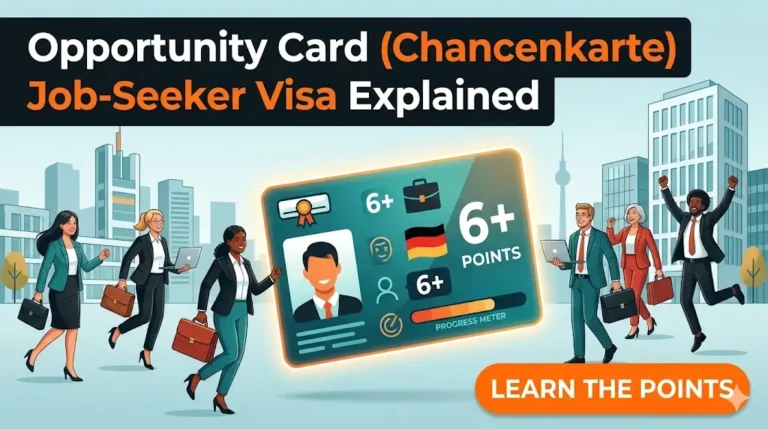
The Opportunity Card is a points-based job-seeker visa. It allows you to move to Germany for up to one year specifically to search for employment, attend in-person interviews, and network with local companies without the stress of securing a job offer beforehand. You accumulate points based on your age, educational qualifications, professional experience, and German and English language skills.
If you score at least six points and can prove you have the financial means to support yourself, you receive the card. Crucially, during this job hunt, you are legally permitted to work part-time up to 20 hours a week to sustain your living expenses, a massive lifeline that previous visas never offered.
Financial Proofs and Health Insurance Mandates
The German government provides a robust social safety net for its citizens, but it absolutely refuses to subsidize newly arrived expats. You must provide undeniable proof that you will not become a financial or medical burden on the state during your transition.
Surviving the Blocked Account Requirement
If you are applying for a student visa, a freelance visa, or the Opportunity Card, you face the ultimate financial hurdle. Because you are arriving without a guaranteed corporate salary, the government requires absolute assurance that you can cover your living expenses for your first year.
Currently, this requires proving you have access to a lump sum of roughly 12,000 euros. You cannot simply present a screenshot of a savings account from a bank in India or Nigeria. The German authorities mandate that these funds be transferred into a highly regulated German Blocked Account, known as a Sperrkonto. Once deposited, the money is locked, and the account will only release a maximum monthly allowance (around 1,000 euros) to your regular checking account after you arrive.
Setting this up using traditional brick-and-mortar German banks from abroad is a nightmare of mailing physical, notarized documents. Utilizing a certified digital provider like Expatrio is absolutely essential. They allow you to open a government-approved blocked account entirely online within days. They handle the complex international transfers safely and instantly generate the exact PDF confirmation document the embassy demands to approve your visa.
Public vs Private Health Insurance for Incoming Expats
You absolutely cannot receive a German visa without proving you have comprehensive health insurance. The German system is divided into statutory public insurance and private insurance, and choosing the wrong one can lead to a lifetime of financial regret.
If you are entering Germany as a salaried corporate employee earning below a very high threshold, you are legally mandated to join the statutory public health insurance system. This system covers almost everything with zero hidden deductibles, and the cost is split evenly between you and your employer. If you are arriving as a freelancer or a job seeker on the Opportunity Card, public funds will often reject you upon arrival, forcing you into the private market.
Navigating the private sector alone is dangerous, as picking a non-compliant policy will result in instant visa rejection at the embassy. To avoid jeopardizing your immigration status, consulting a specialized, English-first broker like Feather Insurance is highly recommended. They ensure you are enrolled in premium private or public policies that the immigration office universally accepts.
Managing Bridging Insurance Before Employment Starts
There is a terrifying catch-22 regarding insurance timing. Your comprehensive German corporate health insurance usually does not activate until the exact day your university semester or your employment contract officially begins.
However, you will likely fly to Germany a few weeks early to find an apartment and settle in. The embassy will not issue your visa if you have an insurance gap between the day your flight lands and the day your long-term insurance starts. To bridge this gap, you must purchase Incoming Travel Insurance.
This is a temporary policy that covers acute emergencies. Because managing multiple policies is chaotic, digital brokers like Feather Insurance can instantly set up both your required incoming bridging travel insurance and enroll you in your permanent public policy simultaneously, giving you one cohesive document to hand to the embassy. If you are using Expatrio for your blocked funds, they also offer bundled value packages that include this required bridging insurance, significantly reducing your administrative headache.
Post Arrival Bureaucracy in Germany
Getting the visa glued into your passport and boarding your flight feels like the ultimate victory, but it is merely the end of the tutorial. The real administrative marathon begins the moment you land in Frankfurt, Berlin, or Munich.
The Catch Twenty Two of Address Registration
The absolute foundation of your legal existence in Germany is the Anmeldung. By law, anyone moving to Germany must register their residential address at the local citizens’ office within 14 days of moving into an apartment.
Without the physical registration certificate handed to you by the clerk, you cannot open a standard German bank account to receive your salary or access your Expatrio blocked funds. You cannot sign a cell phone contract, get home internet, or receive your personal Tax Identification Number.
The paradox is that to rent a long-term apartment, landlords universally demand to see a local bank account and a German credit score, which you do not have. Almost all incoming expats survive their first months by renting highly overpriced, temporary furnished housing that explicitly permits legal registration. You must aggressively confirm with any short-term housing provider that they will issue the required landlord confirmation letter before you hand them a deposit.
Transitioning Your Visa at the Auslanderbehorde
The National Visa you received from the embassy in your home country is usually only valid for three to six months. It is merely a temporary entry ticket. Before this time runs out, you must convert your temporary entry rights into a physical, plastic Electronic Residence Title.
This requires booking an appointment at the local Foreigners’ Office, the Ausländerbehörde. In major metropolitan hubs, these offices are notoriously understaffed and overwhelmed. You must bring all the original documents you initially showed the embassy, plus your new address registration, your German bank statements, and your final employment contract.
The caseworkers possess immense discretionary power, often speak only German, and expect your paperwork to be perfectly organized. If your entry visa is expiring and you cannot secure an appointment, you must act strictly according to the law to freeze your status by applying for a Fiction Certificate.
Bringing Your Family and the Spousal Language Hurdle
Moving abroad is a monumental family decision. If you hold a standard Skilled Worker Visa, your legally married spouse and minor children have the right to join you in Germany.
However, unlike the premium EU Blue Card—which automatically waives all language requirements for dependents—the standard Skilled Worker Visa often requires joining spouses from countries like India or Nigeria to prove basic German language proficiency. They must pass a recognized A1 Goethe-Institut exam in their home country before their visa is granted. This frequently forces families into months of agonizing geographical separation while the spouse studies.
Once your spouse does arrive, their dependent residence permit will grant them entirely unrestricted access to the German labor market, allowing them to work full-time immediately. If you need their foreign university degrees translated to help them secure a local job, returning to Lingoking ensures their credentials are ready for strict German HR departments.
References
Primary sources official
- Make it in Germany – The German Government’s portal for skilled workers: https://www.make-it-in-germany.com/en/
- Federal Foreign Office – Visa regulations and FAQs: https://www.auswaertiges-amt.de/en/visa-service/buergerservice/faq
Other helpful sources
- Federal Office for Migration and Refugees (BAMF) – Entry and Residence: https://www.bamf.de/EN/Themen/MigrationAufenthalt/migrationaufenthalt-node.html
Disclaimer
This guide is for informational purposes only and does not constitute formal legal or immigration advice. German immigration laws, APS certificate requirements, and embassy processing timelines change frequently and vary heavily depending on the applicant’s country of origin. Always consult the official website of the German embassy in your home country, the Federal Office for Migration and Refugees (BAMF), or seek professional counsel from a certified German immigration lawyer before making binding relocation decisions or submitting formal visa applications.