Germany Work Visa & Immigration Guide for Professionals
Landing a lucrative job in Germany is incredibly exciting, but realizing your entry visa expires before your local registration appointment is pure panic. I remember frantically refreshing the immigration office website at 6 AM every morning, terrified of accidental deportation. This comprehensive guide breaks down the complex German work visa system, guiding you from embassy paperwork to permanent residency.
Disclosure: This post may contain affiliate links. We may earn a commission at no extra cost to you if you make a purchase through these links. Read full disclosure.
Decoding the German Work Visa System for Professionals
Before you book a flight or sign an employment contract, you must grasp the fundamental legal architecture of German immigration. Many professionals assume the rules for moving are similar to booking a tourist vacation. In reality, the German system is highly compartmentalized, and understanding the specific bureaucratic terminology is the very first major hurdle you will face.
The Difference Between Visas and Residence Permits
One of the most frequent points of confusion for incoming professionals is the distinction between a visa and a residence permit. In everyday conversation, expats use these terms interchangeably, but to the German government, they are entirely different legal documents. A visa is strictly an entry document issued by the German embassy or consulate in your home country. It gives you the legal right to cross the German border for a specific, pre-approved purpose, such as starting a new job or seeking employment.
A residence permit, on the other hand, is your long-term right to stay and live in the country. Once you arrive in Germany on your entry visa, that entry document will typically expire within three to six months. Before that expiration date hits, you must transition your legal status by applying for a physical residence permit card. You cannot live and work in Germany indefinitely on the visa sticker glued into your passport; you must obtain the localized plastic card.
Today, this long-term permit is issued exclusively as an Electronic Residence Title. It is a highly secure, credit-card-sized plastic document containing a contactless biometric chip that stores your fingerprints and photograph. This card explicitly states your auxiliary conditions, outlining exactly what you are legally allowed to do in Germany, such as whether your work permit is tied to one specific employer or whether you have open market access.
It is vital to remember that your German residence permit is legally tethered to the validity of your home country’s passport. If your national passport expires, your German residence permit card technically becomes invalid for travel, even if the expiration date printed on the permit itself is still years in the future. Whenever you renew your passport at your home embassy, you must book a separate bureaucratic appointment to transfer your residency data to the new document.
Understanding Your Legal Status Upon Arrival
If you are planning to relocate, you must apply for a National Visa, often referred to as a Type D visa. This is entirely different from a standard Schengen tourist visa. Attempting to move to Germany on a tourist visa, sign a full-time employment contract, and then ask the authorities to change your status is generally illegal and can result in immediate deportation. The Type D visa is granted for a specific long-term purpose and requires preliminary approval from local German authorities before the embassy can issue it.
There is a massive exception to this rule for citizens of specific “privileged” nations. If you hold a passport from the United States, Canada, Australia, New Zealand, Japan, South Korea, Israel, or the United Kingdom, you do not need to apply for a Type D National Visa in your home country. You are legally permitted to fly directly to Germany, enter the country on your visa-free privileges, and apply for your long-term work permit directly from within the country.
While this sounds like a massive logistical advantage, it is actually a double-edged sword that catches many expats off guard. The ticking clock starts the moment you clear German passport control. You have exactly 90 days to find an apartment, register your address, secure a job offer, gather translated documents, and submit your formal application to the local immigration office. If you fail to submit the paperwork before day 90, you are residing illegally.
For those who must apply from abroad, the waiting game can be agonizing. Depending on your local consulate’s backlog, securing the initial visa appointment alone can take weeks, and the processing time can drag on for several months. For a deeper understanding of these preliminary steps and entry documents, review our complete guide on Visas and Residence Permits in Germany: Everything You Need to Know.
The Critical Role of the Ausländerbehörde
The local immigration office is the absolute center of your bureaucratic universe once you arrive in Germany. Every city and district operates its own office, and they hold sole responsibility for issuing, extending, and revoking your right to live and work in the country. Your entire experience with German immigration will largely depend on the specific municipal office managing your case.
Dealing with this office is universally cited as the most stressful aspect of living in Germany. In major economic hubs like Berlin, Munich, or Frankfurt, these offices are notoriously understaffed, overwhelmed, and heavily reliant on paper-based processes. Securing an appointment can take months of checking their online booking portals at the crack of dawn, hoping to secure a slot that someone else has just canceled.
When you finally secure an appointment, you must arrive flawlessly prepared. The caseworkers possess a significant amount of discretionary power over your application. They often speak only German and expect your paperwork to be meticulously organized in the exact order requested on their official checklists. Approaching them with extreme politeness and a perfectly arranged folder is non-negotiable.
Bringing a native German-speaking colleague or a professional relocation consultant with you can dramatically alter the outcome of your appointment. They can de-escalate tension, translate complex legal requirements on the spot, and advocate for your case if the caseworker is being exceptionally difficult. For strategies on surviving this specific bureaucratic gauntlet, read Navigating the Ausländerbehörde: Tips for Dealing with German Immigration Offices.
The EU Blue Card Route for Highly Skilled Workers
Germany is actively battling a severe demographic shift and a massive shortage of skilled labor. To combat this, the government heavily prioritizes the EU Blue Card, which is widely considered the holy grail of German work visas. It is designed specifically to attract highly qualified professionals from outside the European Union.
Eligibility Requirements and Salary Thresholds
To qualify for an EU Blue Card, you must clear two massive administrative hurdles. First, you must possess a university degree that is fully recognized in Germany. Second, you must have a binding job offer or an active employment contract from a German company that guarantees a gross annual salary meeting the government’s strict minimum threshold.
This salary threshold is adjusted annually by the Federal Ministry of the Interior. Recent legislative overhauls have significantly lowered the required salary to make Germany more competitive globally. Furthermore, the threshold is even lower for professionals working in “shortage occupations.” These include mathematicians, engineers, doctors, IT specialists, and scientists, where the local labor market is desperate for international talent.
Before you apply, you must verify that your specific university and your exact degree program are listed as recognized in the German Anabin database. If your degree is from a lesser-known institution and is not listed, you will have to undergo a lengthy “Statement of Comparability” process through the Central Office for Foreign Education before your visa can even be considered by the embassy.
In a massive recent update, IT specialists can now obtain an EU Blue Card even without a formal university degree, provided they can prove they have at least three years of relevant professional experience and a job offer meeting the specific IT salary threshold. To understand the exact financial figures and step-by-step application requirements, consult our detailed breakdown on the EU Blue Card Germany: Eligibility, Benefits, and Application Process.
Fast Tracking Your Permanent Residency
The most profound benefit of securing an EU Blue Card is the hyper-accelerated track to permanent residency. Under standard German immigration law, a foreign worker must typically contribute to the system for a grueling five years before they can apply to settle indefinitely. The Blue Card radically alters this timeline.
If you hold a Blue Card, you can apply for a permanent settlement permit after just 33 months of highly qualified employment, provided you have paid into the statutory pension scheme during that time. You only need to demonstrate basic, A1-level German language skills to qualify for this 33-month track, making it incredibly accessible for professionals who work primarily in English.
For those who are highly motivated, the timeline can be slashed even further. If you aggressively study and pass a certified B1 German language exam, you can apply for permanent residency after an astonishing 21 months. This makes Germany one of the fastest countries in the Western world to offer permanent settlement to top-tier international talent.
It is crucial to note that this timeline requires continuous employment. If you lose your job or change employers without notifying the authorities, the clock may reset. You must maintain continuous pension contributions and keep the immigration office informed of any changes to your professional status to protect your fast-track eligibility.
Family Benefits and Spousal Rights
Relocating for a career is rarely a solo endeavor, and the Blue Card offers unparalleled benefits for your dependents. Under standard German family reunification laws, a joining spouse is typically required to prove basic German language skills by passing a Goethe-Institut exam in their home country before a visa is granted. This often forces families into months of stressful separation.
The spouses of EU Blue Card holders are entirely exempt from this language requirement. Your husband or wife can apply for their dependent visa immediately, regardless of whether they speak a single word of German. This massive concession recognizes that highly skilled professionals will simply choose to move to other countries if their families face draconian bureaucratic barriers.
Furthermore, once your spouse arrives in Germany, they are immediately granted unrestricted access to the German labor market. Their residence permit will state that gainful employment is permitted. They can work full-time for any company, start a freelance business, or operate as a self-employed entrepreneur without needing separate approval from the employment agency.
When planning your relocation, you can submit the visa applications for yourself, your spouse, and your minor children concurrently at the embassy. This ensures that the entire family receives their entry visas at the same time, allowing you to fly to Germany together and begin your new life without agonizing geographical separation.
The Standard Skilled Worker Visa Pathway
Not every professional qualifies for the high salary thresholds of the Blue Card, and Germany urgently needs skilled tradespeople, mid-level managers, and healthcare workers just as much as it needs software engineers. For these individuals, the standard Skilled Worker Visa provides a robust and reliable pathway to relocation.
Matching Qualifications to Job Offers
If you have a recognized vocational qualification or an academic degree but your salary offer falls below the Blue Card limit, you can apply for the standard Skilled Worker Visa. The core philosophy of this visa is that your specific qualifications must directly match the job you are being hired to do. You cannot use a nursing degree to get a visa for a marketing position.
Germany places a massive emphasis on formalized training. If you are applying as a tradesperson or non-academic worker, you must prove that your vocational training is equivalent to a German apprenticeship. This equivalence check is executed by specific professional chambers in Germany, and it can be a complex, multi-month process requiring extensive documentation of your curriculum and practical hours.
The salary requirement for the standard Skilled Worker Visa is heavily scrutinized but much more flexible than the Blue Card. The government simply requires that your salary matches the standard local market rate for your specific role and region. This prevents companies from importing foreign labor simply to undercut local German wages.
Recent legal reforms have introduced more flexibility, allowing skilled workers with recognized degrees to take on jobs in related fields, rather than strictly identically matched roles. However, the burden of proof remains on the applicant and the employer to demonstrate why the hire is logically sound and economically beneficial.
Navigating the Federal Employment Agency Approval
Unlike the Blue Card, which is heavily streamlined, the standard Skilled Worker Visa often requires formal approval from the Federal Employment Agency. When you submit your visa application, the embassy routes your employment contract and job description directly to this agency for a comprehensive labor market check.
Historically, this involved a “priority check,” where the agency had to prove that no suitable German or EU citizen could fill the role before offering it to you. Thankfully, this incredibly restrictive priority check has been abolished for recognized skilled workers. You no longer have to worry about a local candidate legally stealing your job offer at the last minute.
Instead, the agency now focuses strictly on assessing your working conditions. They meticulously review your employment contract to ensure you are receiving the correct number of statutory vacation days, that your working hours comply with federal law, and that your compensation is fair. If the employer tries to exploit you with substandard conditions, the agency will veto the visa.
Your employer plays a massive role in this stage. They must fill out a specific declaration of employment form detailing the job requirements and compensation. If your HR department is inexperienced with international hiring, their mistakes on this form can delay your visa approval by months.
Processing Times and Realistic Expectations
The processing time for a standard Skilled Worker Visa is notoriously unpredictable and depends entirely on the workload of the local immigration office in the specific German city where your company is located. Because the embassy must coordinate with domestic agencies, the standard wait time usually ranges from two to four months after your initial appointment.
To combat these massive delays, Germany introduced the “Fast-Track Procedure for Skilled Workers.” Under this scheme, your future employer can act as your authorized representative and initiate the visa process directly with the local immigration office in Germany, bypassing the initial embassy bottleneck.
This fast-track process legally binds the domestic agencies to strict processing deadlines. Once the domestic approval is granted, you are guaranteed a visa appointment at your local embassy within three weeks. However, this premium service comes with a fee that the employer must pay, and many smaller German companies are completely unaware that this mechanism even exists.
As an applicant, you must aggressively manage your own expectations and those of your employer. German companies are accustomed to long notice periods, but they can still grow impatient. Maintaining constant, transparent communication with your HR department regarding the status of your paperwork is essential to ensuring they do not rescind the job offer out of sheer frustration with the bureaucracy.
The Opportunity Card (Chancenkarte) for Job Seekers
Recognizing that many talented professionals want to move but struggle to secure complex interviews from thousands of miles away, Germany recently revolutionized its system by introducing the Opportunity Card. This visa is designed to let you hunt for a job on the ground.
How the Points Based System Operates
The Opportunity Card is a points-based job-seeker visa heavily inspired by immigration models used in Canada and Australia. It allows you to move to Germany for up to one year specifically to search for employment, attend in-person interviews, and network with local companies without the stress of securing a job offer beforehand.
To qualify, you must accumulate a minimum of six points based on a strict criteria matrix. You earn points based on your age (younger applicants receive more points), your educational qualifications, your years of professional experience, your German and English language skills, and whether you have previous ties to Germany, such as having lived there previously for study.
There is a fundamental prerequisite before you can even begin counting points: you must possess a vocational qualification or an academic degree that is fully recognized by the country in which you obtained it, and you must prove at least A1-level German skills or B2-level English skills. You cannot apply if you possess zero language capabilities or lack formal training.
The points calculation can be complex, and you must provide certified proof for every single point you claim.
Financial Proof and Blocked Accounts
Because you are arriving in Germany without a guaranteed salary, the government requires absolute assurance that you will not become a financial burden on the state during your job hunt. You must prove you possess sufficient financial resources to cover your rent, groceries, and health insurance for the entire year.
Currently, this requires proving you have access to over 1,000 euros per month. You cannot simply present a screenshot of a savings account from your home country. The German authorities mandate that these funds be transferred into a highly regulated “Blocked Account.” Once the money is deposited, it is locked, and the account will only release a maximum monthly allowance to you after you arrive in Germany.
Setting up this specialized account from abroad used to be a nightmare of notarized physical documents. Today, using a certified digital provider like Expatrio allows you to open a government-approved blocked account entirely online within days. They provide the exact confirmation documents the embassy demands to approve your Opportunity Card.
Managing your finances carefully during this year is critical. While the blocked account guarantees your basic survival, the cost of living in cities like Munich or Hamburg can easily exceed the monthly payout limit. You must arrive with additional liquid savings to cover the massive security deposits required to rent a German apartment.
Transitioning to a Full Work Visa
The Opportunity Card is strictly a temporary bridge; it cannot be extended indefinitely. The entire goal is to use this twelve-month window to secure a qualifying job offer. Once you secure a contract, you do not have to return to your home country to change your visa status.
During your job search, the Opportunity Card grants you crucial part-time working rights. You are legally permitted to work up to 20 hours per week in any secondary job—such as waiting tables or working in retail—to supplement your income while you search for a professional role. More importantly, it allows you to undertake two-week trial employment periods with potential employers in your specific field.
When you finally sign a full-time contract that meets the requirements for an EU Blue Card or a standard Skilled Worker Visa, you simply book an appointment at your local immigration office. You present your new employment contract, and they will process the transition from your job-seeker status to a full, long-term residence permit, allowing you to begin your career seamlessly.
Freelance and Self Employment Visas
Germany strictly regulates self-employment, and obtaining a visa to work for yourself is notoriously difficult. The country is built on traditional corporate employment, and the bureaucracy views independent contractors with intense skepticism.
Freiberufler versus Gewerbetreibende Classifications
The German system rigidly divides the self-employed into two entirely distinct legal and tax categories: Freelancers and Commercial Business Owners. Your visa application process, your tax burden, and your legal obligations will look vastly different depending on which category your profession falls into.
A freelancer is limited to specific “catalog professions.” These generally include highly educated, independent professionals such as artists, writers, doctors, specialized IT consultants, lawyers, and language teachers. If your work relies heavily on your personal intellectual capital rather than buying and selling goods, you likely fall into this category.
If you want to open a retail store, start a restaurant, launch an import/export business, or run an e-commerce empire, you are considered a commercial business owner. This requires applying for a full Entrepreneur Visa. The hurdle here is astronomically higher. You must prove your business will have a massive positive impact on the local German economy, requiring comprehensive business plans and proof of significant capital investment.
Misclassifying yourself can lead to severe tax penalties and visa rejection. If you claim to be a freelance IT consultant but actually sell software licenses, the tax office will forcefully reclassify you.
Building a Bulletproof Application Portfolio
Applying for a freelance visa is infinitely more complex than applying for a standard corporate work visa. Because you do not have a single employer guaranteeing your salary, the authorities want absolute assurance that you can immediately generate enough revenue to support yourself and pay for your own health insurance.
To prove this, you must submit a robust portfolio of documents. The most critical component is your letters of intent. You must provide legally binding letters from at least two prospective clients based in Germany, stating that they intend to hire you for specific projects and outlining the expected financial compensation. The authorities want to see a genuine local economic demand for your specific services.
Additionally, you must provide a meticulous financial forecasting plan, a comprehensive resume detailing your past freelance success, and a detailed description of your intended business operations. If your portfolio looks amateurish or your financial projections are unrealistic, the caseworker will reject your application immediately.
Language constraints also play a major role here. While not strictly required by law for all freelance professions, caseworkers are highly hesitant to approve freelancers who speak zero German, assuming they will struggle to navigate domestic contracts and tax obligations. Preparing your entire portfolio in flawless professional German is highly recommended.
The Complexity of Expat Health Insurance
One of the most terrifying hurdles for incoming freelancers is securing acceptable health insurance. Under German law, you absolutely cannot receive any visa without proving you have comprehensive health coverage. However, the system makes this incredibly difficult for the self-employed.
The German statutory public health insurance funds are notoriously hostile to new expats arriving without a corporate job. If you apply as a freelancer, public funds will almost always reject you because you have no prior contribution history in the European system. This forces you into the private health insurance sector.
Navigating the private sector alone is dangerous, as many cheap, temporary expat policies are rejected by the embassy for not meeting the strict legal requirements for a long-term freelance visa. Using an English-first, specialized broker like Feather Insurance is an absolute lifesaver in this scenario. They offer tailored, embassy-approved private health insurance policies explicitly designed for freelancers navigating the rigid German visa system.
Securing this insurance requires long-term planning. Private premiums for freelancers can be expensive, and they must be factored into the financial forecasting plan you submit to the immigration office. You must prove that your projected freelance income can comfortably cover your living expenses and your monthly insurance premiums without fail.
Surviving the Bureaucracy Before and After Arrival
The success of your relocation relies entirely on the quality of your paperwork and your ability to execute administrative tasks in a highly specific, chronological order. The German bureaucracy does not forgive mistakes, and skipping a step will paralyze your entire transition.
Mastering the Embassy Appointment and Translating Documents
Your initial visa appointment at the German embassy in your home country is a strict verification exercise. The consular officers are not there to help you build your case or offer friendly advice; they are there to cross-reference your paperwork against a rigid checklist. If a single document is missing or formatted incorrectly, you will be sent home to start over.
Crucially, the German authorities will not accept documents in foreign languages. Your birth certificates, marriage certificates, and university diplomas must be translated into German. However, you cannot use a generic online translation agency or have a bilingual friend do it. The embassy demands formal translations executed by a Sworn Translator who is legally recognized by the German regional courts.
Finding these specific, certified translators from thousands of miles away can cause massive delays. Utilizing a dedicated platform like Lingoking is essential. They connect you directly with German-certified sworn translators who turn around legally flawless, perfectly formatted documents that carry the exact stamps and seals the embassy demands, ensuring your paperwork is never rejected at the desk.
Furthermore, documents from certain countries require formal legalization or an Apostille stamp to prove they are not forged. You must research your home country’s specific authentication requirements months before your embassy appointment, as securing an Apostille from a domestic government office can often take longer than the German visa process itself.
The Registration Checkpoint (Anmeldung)
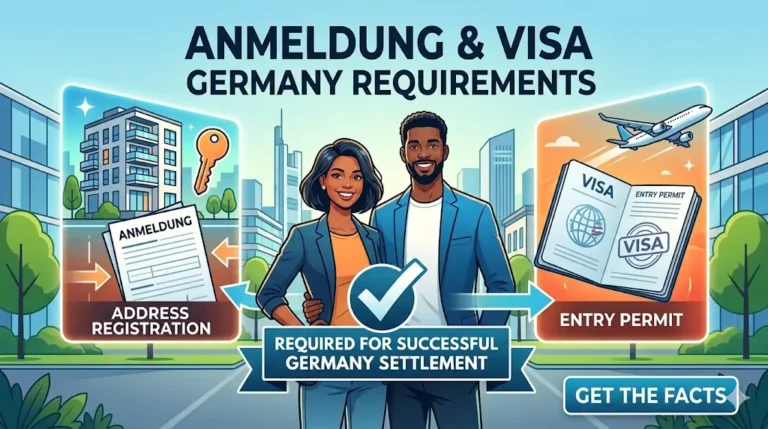
The absolute foundation of your legal existence in Germany is the Anmeldung. By law, anyone moving to Germany must register their residential address at the local citizens’ office within 14 days of moving into an apartment. You cannot open a proper bank account, get a tax ID, or apply for your residence permit until this step is complete.
To complete this address registration, you need a specific, legally binding document from your landlord called a Confirmation of Residence. This creates a brutal paradox for incoming expats: You need the Anmeldung to get a tax ID and a bank account to rent a long-term apartment, but landlords won’t rent to you without a bank account and a tax ID.
Most expats survive this by booking specialized, temporary furnished housing for their first few months. You must explicitly ask the temporary housing provider if they provide the necessary registration paperwork before you hand over any money. If they refuse, you cannot legally register there, and your entire bureaucratic timeline will stall.
Bridging Expiring Visas with the Fiktionsbescheinigung
The most terrifying scenario for any professional is watching your 90-day entry visa expire next week when your local immigration appointment isn’t scheduled for another two months. If you find yourself in this situation, do not panic, but you must act strictly according to the law to protect your legal status.
If you have officially applied for your residence permit or booked an appointment via the online portal before your current visa expires, your legal residency status is automatically frozen and extended under Section 81 of the German Residence Act. To prove this to your employer and border control, the immigration office will issue you a Fiction Certificate.
This green piece of paper acts as a legal bridge. It explicitly states that your previous visa conditions remain entirely valid until a final decision is made on your new application. With this certificate, you can legally continue working, and you can even travel outside of Germany and re-enter without issue.
However, you must carry this green paper alongside your expired visa and your passport at all times. It is your ultimate shield against deportation while the understaffed bureaucracy slowly processes your file. If you fail to apply before your original visa expires, you are not eligible for this certificate, plunging you into illegal residency status.
Long Term Horizons and Dual Citizenship
The ultimate goal for many professionals who endure the initial bureaucratic friction is long-term stability. Germany heavily rewards those who integrate, pay their taxes, and contribute to the social system with robust pathways to permanent residency and, eventually, one of the most powerful passports in the world.
Securing Your Niederlassungserlaubnis
A permanent settlement permit fundamentally changes your life in Germany. It frees you completely from the anxiety of the immigration office. You never have to renew your visa again, your right to stay is no longer tied to a specific employer, and you gain immense security against deportation and economic downturns.
To qualify for the standard settlement permit, you generally need to have held a temporary residence permit for five consecutive years. Crucially, you must prove that you have paid into the German statutory pension scheme for at least 60 months. Additionally, you must demonstrate that you can secure your livelihood without claiming state welfare benefits and pass a B1 German language exam to prove your societal integration.
As detailed earlier, highly skilled professionals holding an EU Blue Card can fast-track this process significantly, applying after just 21 or 33 months. Regardless of your visa type, maintaining immaculate financial records, preserving your employment history, and aggressively learning the language are the keys to unlocking this permanent freedom.
Navigating the Overhauled Citizenship Laws
Historically, Germany enforced incredibly strict laws regarding naturalization, generally forcing immigrants to permanently renounce their original home country passport to become German. This draconian policy deterred millions of well-integrated, long-term residents from ever applying for citizenship.
However, in 2024, Germany passed a historic, sweeping overhaul of its nationality law. The most massive and celebrated change is that dual citizenship is now permitted for everyone. You no longer have to surrender your American, Indian, British, or Canadian passport to hold a German one.
Furthermore, the required residency time for naturalization was drastically reduced. Previously set at a grueling eight years, you can now apply for German citizenship after just five years of legal residency. If you demonstrate special integration achievements, such as passing a C1 level German language exam or excelling in your career, you can apply after just three years. This monumental shift makes Germany one of the most attractive countries in the world for highly skilled immigrants seeking a powerful second passport.
References
Primary sources (official)
- Make it in Germany – The German Government’s portal for skilled workers: https://www.make-it-in-germany.com/en/
- Federal Foreign Office (Auswärtiges Amt) – Visa regulations and official forms: https://www.auswaertiges-amt.de/en/visa-service/buergerservice/faq
Other helpful sources
- Service-BW – General information on residence titles and the eAT: https://www.service-bw.de/en_US/web/guest/lebenslage/-/vz/Aufenthaltstitel%2Bbeantragen%2Boder%2Bverlaengern-5000494-lebenslage-0
Disclaimer
This guide is provided for informational purposes only and does not constitute official legal or immigration advice. German immigration laws, salary thresholds, and processing requirements change frequently and can vary by municipality. Always consult the official website of the German embassy in your home country, or seek professional counsel from a certified German immigration lawyer, before making binding relocation decisions or submitting formal visa applications.