Aparthotels and Serviced Apartments in Germany: Kitchens and Long Stays
Three weeks into a Munich project, eating takeaway Döner on a hotel bed because the room had nothing but a kettle: that is how many long stays in Germany go wrong. This guide explains how to choose an aparthotel or serviced apartment with a usable kitchen, how to read German listings, and how to book long stays on Booking.com without unpleasant surprises.
Disclosure: This post may contain affiliate links. We may earn a commission at no extra cost to you if you make a purchase through these links. Read full disclosure.
Why Aparthotels Make Sense for Long Stays in Germany
The Hotel Room Fatigue Nobody Warns You About
My first extended stay in Germany was eleven nights in a perfectly nice business hotel near Frankfurt’s Messe. By night four I had eaten in every restaurant within walking distance. By night seven I was rinsing socks in the sink and drying them on the heated towel rail. By night ten I was spending real money on dinners I didn’t even enjoy. A standard German hotel room works well for a weekend. Over a longer stay it slowly wears you down.
Germany makes this harder in a few specific ways. Restaurant kitchens in smaller towns often close earlier than visitors expect. Many places stop serving hot food well before late evening, especially outside the big cities. Sundays are quiet, and supermarkets are shut. If your only food option is the hotel restaurant or a petrol station sandwich, you feel it quickly. A kitchen, even a small one, gives you control over when, what and how much you eat.
Laundry is the other quiet problem. Hotel laundry services are priced for emergencies, not routine use. Public laundromats, called Waschsalons, exist in cities but are scarce in residential suburbs and almost absent in small towns. An aparthotel with a washing machine in the unit, or a shared laundry room in the building, saves you hours of hunting and a lot of irritation.
Who Actually Benefits From a Kitchen Stay
The obvious group is business travellers on multi-week projects: engineers commissioning machinery in Baden-Württemberg, consultants rotating through Düsseldorf, trainers covering for colleagues in Hamburg. But they are far from the only ones. Families travelling with toddlers are another major group, and for them a fridge and a hob can make or break the trip. Warming milk, cooking plain pasta for a fussy eater, or keeping yoghurt cold are all impossible in a hotel room with a minibar.
Slow travellers are a growing segment too. If you plan to base yourself in Leipzig for two weeks and take day trips to Dresden and Weimar, an apartment-style stay makes the whole trip feel more like living there. People in transition need these stays as well: newcomers waiting for their rental keys, people between flats, and visiting relatives who come for a month at a time.
Then there are travellers with dietary needs. If you are coeliac, managing diabetes, or keeping strictly kosher or halal, eating out in rural Germany can be exhausting. A kitchen lets you shop at a supermarket or a specialist store and cook safely. It takes a whole layer of worry out of the trip.
What You Give Up Compared to a Full Hotel
Aparthotels are not hotels with a fridge added. Reception may be staffed only during business hours, or replaced entirely by a code sent to your phone. Daily housekeeping is often not included. Cleaning may happen weekly, on request, or for an extra charge. There is usually no restaurant, no room service and no concierge to recommend a dinner spot.
For some travellers this is freeing. For others, especially first-time visitors who don’t speak German, it can feel lonely or stressful when something goes wrong at nine in the evening. Before you book, think honestly about how much help you want on site. That one question shapes which property type suits you.
Aparthotel, Serviced Apartment, Boardinghouse, or Ferienwohnung
Decoding the German Accommodation Labels
German has its own vocabulary for apartment-style stays, and listings use the terms loosely. An “Aparthotel” usually means a building run like a hotel, with a reception or check-in desk, but where every unit has some form of kitchen. A “Serviced Apartment” tends to sit higher in the market. The furnishing is more residential, the stays are longer, and services like weekly cleaning and linen changes are built in.
The “Boardinghouse” is a very German concept that confuses English speakers. It has nothing to do with the English boarding house. A German Boardinghouse is a serviced apartment building aimed at business travellers and project workers on stays of weeks or months. They are common near industrial areas, trade fair grounds and corporate campuses. For a deeper side-by-side look at these long-stay formats, see Monthly Stays in Germany: Hotel vs Boardinghouse vs Furnished Rental.
A “Ferienwohnung”, often shortened to FeWo, is a holiday apartment. These are frequently privately owned, sometimes part of the owner’s own house, and common in tourist regions like the Baltic coast, the Black Forest and the Bavarian Alps. They usually offer the most space and the fullest kitchens, but the least service.
Side-by-Side Comparison of Long-Stay Options
| Property type | Typical kitchen | Reception | Cleaning | Best suited to |
|---|---|---|---|---|
| Standard hotel | None, sometimes a kettle | Usually around the clock | Daily | Short city breaks |
| Aparthotel | Kitchenette or compact kitchen | Staffed or digital check-in | Weekly or on request | One to four weeks, couples, solo travellers |
| Serviced apartment | Full or compact kitchen | Office hours or app support | Weekly is common | Business travellers, relocations |
| Boardinghouse | Kitchenette to full kitchen | Office hours | Weekly or fortnightly | Project workers, multi-month stays |
| Ferienwohnung | Usually full kitchen | Owner or key box | Final clean at checkout | Families, rural and coastal trips |
Matching the Property to Your Trip
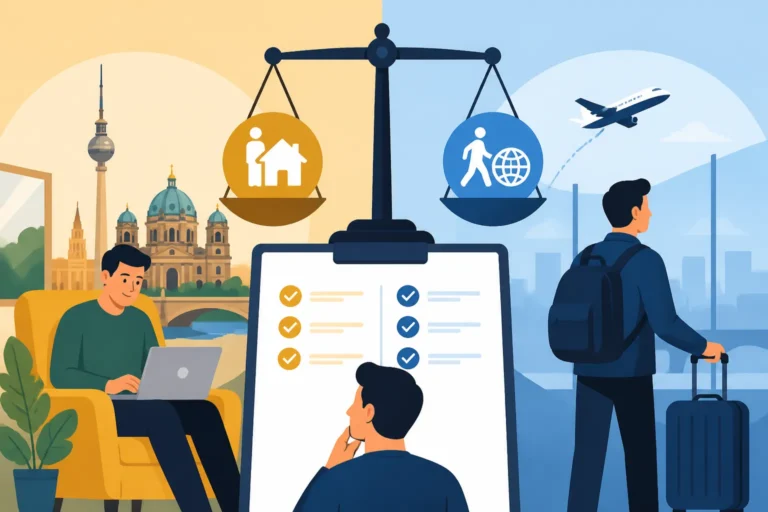
Think about three variables: length of stay, how often you will cook, and how much hand-holding you want. A couple spending ten days in Berlin who plan to cook breakfast and the odd dinner will be very happy in a central aparthotel with a kitchenette. A family of four spending two weeks on Rügen wants a Ferienwohnung with a proper oven and a dishwasher. A project engineer in Ingolstadt for three months is the textbook Boardinghouse guest.
Here is a scenario I see constantly. Someone books a cheap “apartment” in a rural Ferienwohnung for a work trip, assuming it runs like a hotel. They arrive at seven in the evening to a key box, a laminated sheet of house rules in German, and an owner who doesn’t answer the phone after dinner. Nothing is wrong with the property. It simply was never built for that kind of guest. The property type tells you a lot about the experience before you even look at the photos.
On Booking.com you can filter by property type: Apartments, Aparthotels, Holiday homes and so on. Doing this before you scroll through results saves a surprising amount of time.
The Kitchen Question: What “Kitchen” Really Means in a German Listing
Kitchenette Versus Full Kitchen
This is where most disappointment happens. In German listings, a “Küche” is a kitchen and a “Küchenzeile” is a kitchen run along one wall. A “Kochnische” or “Pantryküche” is a kitchenette, sometimes no more than a two-ring hob, a sink and a small fridge hidden behind cupboard doors. All of these can appear in an English listing simply as “kitchen” or “kitchenette.”
A two-ring hob is fine for eggs, pasta and stir-fries. It gets frustrating once you need to boil potatoes and cook a sauce at the same time. Ovens are the big variable. Many aparthotel kitchenettes have no oven at all, or only a combination microwave. If you plan to roast vegetables or bake for kids, check for the word “Backofen” or an oven in the facility list.
Dishwashers, called “Spülmaschine” or “Geschirrspüler”, are common in Ferienwohnungen and higher-end serviced apartments but far from guaranteed in budget aparthotels. Over a three-week stay, washing up by hand in a small sink becomes a nightly chore. If that bothers you, make a dishwasher a filter requirement, not a hope.
German Kitchen Terms Worth Knowing
| German term | What it means | What to check |
|---|---|---|
| Kochnische or Pantryküche | Kitchenette, often hidden in a cabinet | Number of hob rings, fridge size |
| Küchenzeile | Single-wall kitchen | Whether it includes an oven |
| Einbauküche or EBK | Fitted kitchen | Usually a full set of appliances |
| Induktionskochfeld | Induction hob | Your pans must be magnetic |
| Ceranfeld | Glass-ceramic electric hob | Works with most flat-bottomed pans |
| Backofen | Oven | Often missing in kitchenettes |
| Spülmaschine | Dishwasher | Bring or buy dishwasher tablets |
| Waschmaschine | Washing machine | In-unit or shared laundry room |
Induction hobs deserve a special mention. Many newer German aparthotels use them, and they are fast and safe. They do, however, need cookware with a magnetic base. Properties normally provide compatible pans. But if you travel with your own pot for a specific dish, or a child’s favourite little saucepan, it may not work. For more on how room descriptions are worded, see Reading German Hotel Listings: Room Types, Bed Sizes, and Terms Decoded.
Equipment Gaps and How to Check Before You Book
Even a well-equipped kitchen may be missing things you consider basic. A sharp knife is the classic one. Others include a decent chopping board, a baking tray, a colander or a kettle. Some aparthotels supply a starter pack with a few dishwasher tabs, sponge and washing-up liquid. Others supply nothing, and you will be at a Rossmann or dm drugstore on your first evening.
The most reliable fix is to message the property before arrival. Booking.com has built-in messaging for each reservation, and German properties are generally quick and precise in their replies. Ask specific questions. “Is there an oven?” gets a clearer answer than “Is the kitchen fully equipped?” I usually send a short list: oven, dishwasher, kettle, toaster, enough plates for the number of guests, and whether a washing machine is in the unit or shared.
Photos help too, but read them carefully. A close-up of a coffee machine and a bowl of apples tells you nothing. Look for a wide shot that shows the hob and the space around it. If every kitchen photo is cropped tight, assume the kitchen is small.
Booking Long Stays on Booking.com Without Surprises
Filters That Actually Matter for Kitchen Stays
When I help friends plan a long stay in Germany, I almost always start them on Booking.com. The reason is simple: the filters let you narrow a city of hundreds of options down to a shortlist that genuinely fits. The ones I set immediately are the property type, “Kitchen” or “Kitchenette” under facilities, and “Washing machine” if the stay runs past a week. For families, I add the number of bedrooms. Many listings marketed as apartments are studios with a sofa bed.
The map view matters more in Germany than people think. A cheaper aparthotel on the edge of the city can cost you time every day on S-Bahn connections. Before you commit, check where the nearest supermarket is. A REWE, Edeka, Aldi or Lidl within walking distance makes a kitchen stay work. A twenty-minute walk to buy milk does not. For tips on what to expect once you are inside, see Navigating German Supermarkets: Grocery Shopping Tips and Tricks.
Reviews on Booking.com come from guests who completed a stay, which makes them more useful than anonymous feedback. Sort by recent reviews and search the text for words like “kitchen”, “oven”, “noise”, “Wi-Fi” and “cleaning.” Long-stay guests tend to write the most detailed reviews, because small annoyances add up over weeks.
A Step-by-Step Process for Booking a Long Aparthotel Stay
- Decide your non-negotiables before you search: kitchen type, washing machine, number of bedrooms, workspace and maximum travel time to your main destination.
- Open Booking.com, enter your dates and city, and filter by property type and kitchen facilities first.
- Switch to map view and check each shortlisted property against supermarkets and public transport stops.
- Read the full facility list and the “Fine print” or house rules section of each shortlisted listing, looking for cleaning frequency, linen changes, check-in times and any final cleaning fee.
- Read recent reviews, focusing on comments from guests who stayed a week or longer.
- Message your top two or three properties with specific questions about kitchen equipment, laundry and weekly cleaning.
- Compare the total price for the full stay, including any taxes and fees shown at checkout, rather than the nightly headline figure.
- Choose your cancellation terms carefully, weighing flexibility against price for the length of the commitment.
- After booking, save the property’s arrival instructions offline and confirm your check-in time through the platform’s messaging.
Step seven is where many people go wrong. Long-stay pricing can include a one-off cleaning charge, called “Endreinigung”, plus local tourist taxes. These look small on a one-night search but matter over a month. Booking.com shows the property’s taxes and charges before you pay, so read that breakdown rather than trusting the per-night number in the search results.
Cancellation, Payment and Long-Stay Rates
The longer the stay, the more a non-refundable rate is a gamble. A project can be cut short, a flat can come through early, or a family member can fall ill. Many properties offer a cheaper non-refundable option next to a flexible one. For a long stay, the gap between them translates into real money either way. I wrote a separate piece on making that call: Refundable vs Non-Refundable Rates in Germany: When the Discount Is Worth It.
Payment terms vary by property. Some charge through the platform when you book. Others take payment at the property, and many German aparthotels take a pre-authorisation on your card at check-in. Read the payment section of the listing. Make sure your card has room for any hold, especially if you are on a corporate card with a low limit.
Many aparthotels and Boardinghouses build lower nightly rates into longer bookings, and some show a weekly or monthly price directly. If you are staying a month or more and the listed rate seems high, message the property and ask whether a long-stay rate exists. For negotiation tactics, see Long-Stay Discounts in Germany: Negotiating Weekly and Monthly Rates. If you are torn between platforms for apartment-style stays, the differences in registration and cancellation rules are covered in Booking.com vs Airbnb in Germany: Registration Rules, Fees, and Cancellation.
Living Day to Day in a German Aparthotel
Check-In, the Meldeschein, and Keyless Entry
Almost every German accommodation provider, aparthotels included, will ask you to fill in a registration form called the Meldeschein when you arrive. It records your name, address and nationality, and for many foreign guests your passport details as well. This is routine and not a sign that anything is wrong. Some properties send a digital version beforehand, so you can complete it on your phone.
Keyless entry is increasingly common, especially in newer city-centre aparthotels in Berlin, Munich, Cologne and Hamburg. You typically receive a door code or a digital key on the day of arrival. It works smoothly most of the time, but have a plan for when it doesn’t. Keep the property’s emergency phone number saved, keep your phone charged, and don’t arrive with a dead battery late at night.
If you are relocating and need to register your address with the city, be aware that an aparthotel is not automatically a place you can register from. Whether that is possible depends on the property and your circumstances. Before relying on a long stay for official registration, read Accommodation That Supports an Anmeldung: What Hotels Cannot Provide and confirm directly with the property.
Shopping, Sundays, Recycling and Quiet Hours
The first real test of a kitchen stay in Germany is usually Sunday. Most supermarkets are closed, so if you arrive Saturday evening with an empty fridge, you will be living on whatever you can find. Exceptions include shops inside main railway stations and some airport shops, which are often busy. Plan a proper shop on Saturday. For a full rundown of what stays open, see What Closes on Sundays in Germany?
Then comes the bin question. Aparthotels with self-catering kitchens usually provide separate bins, and guests are expected to sort packaging, paper, glass, organic waste and general rubbish. Bottles and cans with a deposit marking can be returned to supermarket machines for the Pfand. Staff tend to notice when guests ignore the system. To avoid an awkward note from housekeeping, read How to Sort Waste Correctly in Germany before your first week.
Quiet hours, known as Ruhezeit, matter in apartment-style buildings because many share walls and stairwells with permanent residents. Avoid running the washing machine late at night, slamming doors, or holding a loud dinner party on a Sunday afternoon. It sounds strict. In practice it mostly means being considerate, and following it keeps your stay friction-free.
Working From an Aparthotel and Handling Problems
For remote workers and business travellers, the desk and Wi-Fi matter as much as the kitchen. A small round dining table is not a workstation for eight hours a day. Look for listings that mention a desk, and read reviews for comments on internet speed and stability. If you will be on video calls daily, ask the property directly about bandwidth. For a full approach to workspace-focused booking, see Digital Nomad Stays in Germany: Booking for Wi-Fi, Desks, and Quiet.
When something breaks, and over a long stay something eventually will, report it promptly and in writing. A dishwasher that won’t drain, a hob ring that doesn’t heat, or a shower that runs cold are all things properties fix routinely, but only once they know. Messaging through your booking creates a dated record. That helps if the issue drags on or affects your stay significantly.
Language is rarely a major barrier at city aparthotels, where staff and app support usually work in English. Rural Ferienwohnung owners may speak little English, though. A translation app helps, and so does keeping messages short and simple. Polite, clear written questions tend to get faster answers than phone calls.
Regional Differences and Final Booking Strategy
Big Cities Versus Rural Germany
In Berlin, Munich, Frankfurt, Hamburg and Düsseldorf you will find dense clusters of modern aparthotels and serviced apartment brands, many with digital check-in and compact, well-designed kitchenettes. The trade-off is space. Units are often studios or one-bedroom layouts, and kitchens lean towards the compact. Families may need to book two units or look slightly further out.
In rural and coastal regions, the market shifts heavily towards Ferienwohnungen. On the Baltic and North Sea coasts, in the Allgäu and around Lake Constance, apartments are often larger, with proper kitchens, balconies and sometimes gardens. They may, however, have minimum stay requirements in peak season, fixed arrival days, and a final cleaning charge. Read the house rules before you set your heart on one.
Trade fair cities deserve a warning. When major events take over Frankfurt, Hanover, Cologne or Munich, apartment-style stays book out fast and prices rise sharply. Business travellers should check event calendars before committing to dates and book well ahead of those weeks. Also keep local tourist taxes in mind, as these vary widely by city and region; see Germany’s City Tax by Region: Kurtaxe, Bettensteuer, and What You Pay.
Seasonal Timing and Availability
Summer and the Christmas market season are the tightest periods for apartment stays in popular destinations. Family-sized units with full kitchens are the first to go, because there are fewer of them. If you need two bedrooms and a dishwasher in Dresden in December, or a sea-view FeWo on Usedom in July, book early.
Late autumn outside the Christmas period, and late winter in non-ski regions, are typically calmer. Long-stay guests often find more choice and more willingness to talk about rates then. If your dates are flexible, set up a few saved searches and compare availability across different weeks before you decide.
Why Booking.com Is My First Stop for Kitchen Stays in Germany
After years of moving between cities in Germany, Booking.com is still where I start every kitchen-focused search. The reasons are practical. It lists a huge range of aparthotels, serviced apartments, Boardinghouses and Ferienwohnungen in one place. The facility filters let you insist on a kitchen, washing machine or oven instead of hoping for them. Guest reviews from completed stays reveal the details that matter over a long stay, and reservation messaging gives you a written record with the property.
It is not a magic button. You still need to read listings properly, ask the right questions and compare total costs. But the combination of filters, verified reviews and clear price breakdowns does most of the hard work. If you are planning a stay of a week or longer in Germany, open Booking.com, set your kitchen and laundry filters first, and build your shortlist from there.
Disclaimer
This article is for general informational purposes only and does not constitute professional advice. Laws, prices and regulations vary by location and change over time. Consult a qualified professional for guidance on your specific situation.