Currency Exchange in Germany: Where to Convert Money and Avoid Fees
Exchanging money in Germany can be a confusing and costly experience if you are unfamiliar with the local financial landscape. This comprehensive guide helps expats and tourists navigate exchange rates, avoid hidden ATM fees, and find the most cost-effective ways to access euros.
Disclosure: This post may contain affiliate links. We may earn a commission at no extra cost to you if you make a purchase through these links. Read full disclosure.
The Reality of Cash and Currency in Germany
Before you decide how and where to exchange your home currency into euros, it is vital to understand how money physically changes hands in Germany. Despite rapid digitalization across Europe, the German financial culture retains a unique set of behaviors and preferences that directly impact how you should manage your travel funds or relocation budget.
Why Cash Still Rules in the German Economy
The stereotype that “cash is king” (Bargeld lacht) in Germany is largely true, although the landscape has shifted noticeably since the pandemic. Unlike Scandinavian countries or the UK, where you can easily buy a pack of gum with a smartphone or a smartwatch, Germany still harbors a deep cultural attachment to physical banknotes and coins. Privacy concerns, a traditional aversion to consumer debt, and an ingrained preference for tangible assets keep cash circulation incredibly high.
As an expat or a tourist, you will routinely encounter situations where electronic payments are simply not accepted. Many local bakeries (Bäckereien), small cafes, independent restaurants, and beloved fast-food stalls (like your neighborhood Döner Kebab shop) operate on a strictly cash-only basis. Even some doctors’ offices or local government bureaus (Bürgerämter) may refuse international credit cards.
Attempting to live in or travel through Germany without physical euros in your wallet is an exercise in frustration. You must plan to have a steady supply of cash on hand. This means you will frequently interact with ATMs or exchange services, making it absolutely crucial to understand the fee structures associated with currency conversion so your daily expenses do not balloon out of control.
Understanding the Euro and Exchange Rates
To avoid getting ripped off when converting your money, you must understand the concept of the mid-market exchange rate. Also known as the interbank rate, this is the exact midpoint between the buy and sell prices of two currencies on the global market. It is the “real” exchange rate—the one you see when you look up currency values on Google, Reuters, or Bloomberg.
Retail banks, airport kiosks, and independent exchange bureaus almost never give consumers the mid-market rate. Instead, they make their profit by offering a “tourist rate,” which includes a hidden markup. For example, if the real mid-market rate is 1 USD to 0.95 EUR, an exchange kiosk might only offer you 0.88 EUR for every dollar. That spread represents their profit margin, and it comes directly out of your pocket.
When evaluating any currency exchange service in Germany, your primary goal is to find the option that offers a rate as close to the mid-market rate as possible. Providers that heavily advertise “Zero Commission” or “No Fees” usually hide their exorbitant costs entirely within a terrible exchange rate. Always check the offered rate on your phone against the real mid-market rate before handing over your cash or swiping your card.
The Danger of Dynamic Currency Conversion
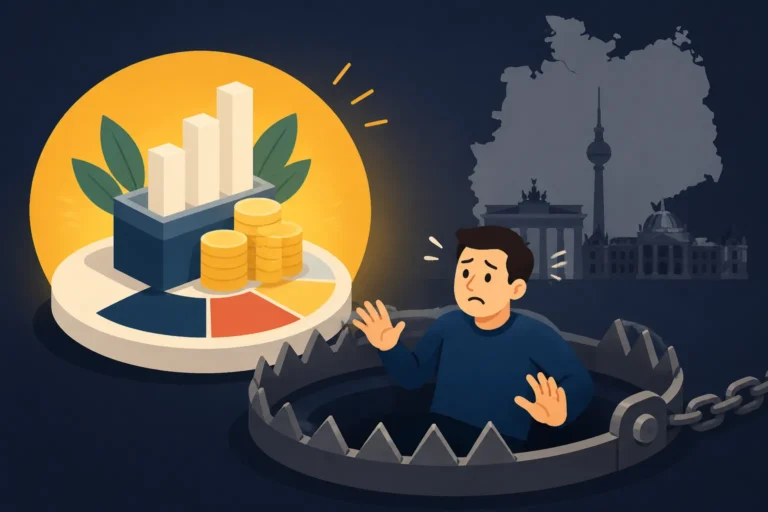
The single most expensive trap you will encounter when paying with a foreign card or withdrawing cash in Germany is Dynamic Currency Conversion (DCC). DCC is a financial service offered at card terminals and ATMs that asks if you want your transaction processed in your home currency instead of the local currency (euros).
When a terminal prompts you with a screen asking, “Pay in USD or Pay in EUR?”, it is using psychological manipulation. It feels safer and more familiar to select your home currency because you immediately understand the value. However, if you choose your home currency, you are giving the German merchant’s bank the authorization to define the exchange rate. They will almost universally apply a markup of 5% to 12% above the real mid-market rate.
The golden rule of spending money internationally is simple: always choose to pay in the local currency. When prompted by a machine in Germany, always select “Pay in EUR” or “Continue without conversion.” By doing this, you force your own home bank to process the currency exchange. While your home bank might charge a foreign transaction fee, their exchange rate will almost always be vastly superior to the predatory DCC rate offered by the local German terminal.

Exchanging Physical Cash Upon Arrival
If you prefer arriving in Germany with physical cash in hand, or if you bring cash from your home country to exchange locally, you have a few distinct options. However, dealing with physical banknotes is generally the most expensive way to access euros.
Airport and Train Station Exchange Kiosks
Upon landing at major hubs like Frankfurt Airport, Munich Airport, or arriving at a central train station (Hauptbahnhof), you will immediately see brightly lit currency exchange kiosks operated by companies like Reisebank, Travelex, or Global Exchange. The convenience they offer is undeniable, especially if you desperately need euros for a taxi or a train ticket right away.
However, this convenience comes at a staggering premium. Airport and train station kiosks are notorious for offering the absolute worst exchange rates in the country. Because they operate in high-rent locations with a captive audience of tired travelers, their profit margins are immense. They often charge a flat handling fee on top of an exchange rate markup that can easily exceed 10%.
If you absolutely must exchange physical cash at the airport to survive your first few hours, exchange the absolute minimum amount necessary to get to your accommodation. Never exchange your entire travel budget or relocation funds at an airport kiosk. You are much better off waiting until you reach the city center to find more competitive options or utilizing an ATM.
High Street Banks and Local Branches
In the past, going to a local, traditional German bank branch—like a Sparkasse, Commerzbank, or Deutsche Bank—was a standard way to exchange foreign currency. Today, this process has become significantly more restricted. Due to stringent anti-money laundering regulations and the declining use of foreign physical cash, many local bank branches simply no longer offer currency exchange services to walk-in customers.
If a traditional bank does offer exchange services, they usually reserve them exclusively for their own account holders. If you are an expat who has just finished Opening a Bank Account in Germany, your local bank might exchange your US Dollars or British Pounds for a relatively reasonable fee. The exchange rates offered by traditional banks are generally better than airport kiosks, but still fall short of the real mid-market rate.
For tourists or newly arrived expats without a local account, walking into a random German bank and asking to exchange cash will likely result in a polite refusal. You will usually be redirected to the nearest independent currency bureau or told to use the ATM in the lobby.
Independent Currency Exchange Bureaus
In the commercial centers and tourist districts of major German cities, you will find independent currency exchange bureaus, often labeled as “Wechselstube” or “Geldwechsel.” These establishments vary wildly in quality, reliability, and pricing. Some are highly reputable and offer competitive rates, while others border on predatory.
The advantage of a city-center Wechselstube is that competition sometimes drives their rates down. If you walk down a busy street near a major tourist attraction, you might find three or four bureaus within a few blocks. This allows you to shop around, compare the exchange rates displayed on their electronic boards, and ask about their fixed commission fees before handing over your money.
When using an independent bureau, it is crucial to do the math yourself. Do not just look at the “Buy” rate on the board. Ask the teller exactly how many euros you will receive for your specific amount of foreign currency after all fees and commissions are deducted. Count your money carefully before leaving the counter, and always ask for a printed receipt.
Using ATMs to Withdraw Euros in Germany
For the vast majority of expats and tourists, using an automated teller machine (Geldautomat) to withdraw euros directly from a foreign checking account is the most practical and cost-effective way to get physical cash. However, navigating the German ATM landscape requires vigilance to avoid unnecessary surcharges.
Bank ATMs versus Independent Operators
Not all ATMs in Germany are created equal. The safest and generally most affordable machines belong to traditional, established banking networks. Look for ATMs operated by Sparkasse, Volksbank, Deutsche Bank, Commerzbank, or Postbank. These machines are usually attached to physical bank branches and are highly regulated. They offer fair, standard wholesale exchange rates (provided by Visa or Mastercard) and are transparent about any local access fees.
Conversely, you must be extremely wary of independent, third-party ATM operators. The most infamous of these is Euronet, known for their brightly colored yellow and blue machines strategically placed in high-traffic tourist areas, near historic monuments, inside convenience stores, and outside late-night bars.
These independent machines are essentially designed to extract maximum fees from foreign cards. They frequently charge exorbitant out-of-network access fees (sometimes up to 5 or 6 EUR per transaction) and are incredibly aggressive with their Dynamic Currency Conversion prompts, using deceptive interface design to trick you into accepting terrible exchange rates. Whenever possible, walk the extra block to find an ATM attached to a real German bank.
Foreign Transaction Fees and ATM Surcharges
When you withdraw euros using a foreign debit card, you are fighting a two-front war against fees: fees charged by your home bank, and fees charged by the German ATM owner. Understanding how these interact is key to managing your Cost of Living in Germany or keeping your vacation budget intact.
Your home bank will likely charge a Foreign Transaction Fee (often around 3% of the withdrawal amount) to cover the cost of currency conversion. Additionally, they may charge an out-of-network ATM fee for using a machine that doesn’t belong to them (often a flat 2 to 5 USD/GBP).
On the German side, the local ATM operator may charge an access fee (Betreibergebühr). By law, German ATMs must notify you of this fee on the screen before dispensing cash, giving you the option to cancel the transaction. To minimize the impact of flat fees, it is far more economical to make one large withdrawal of 300 EUR rather than making ten smaller withdrawals of 30 EUR, thereby triggering flat fees multiple times.
Best Practices for Cost-Effective Withdrawals
The most critical best practice at any German ATM is to firmly decline Dynamic Currency Conversion. When the machine asks if you want to be charged in your home currency with a “guaranteed” exchange rate, always press “Decline Conversion,” “Without Conversion,” or select the option to be charged in EUR. This ensures the Visa or Mastercard network handles the conversion at near mid-market rates.
Another excellent strategy for expats and long-term visitors is to eliminate the home-bank fees entirely by using a modern, travel-friendly financial product. Before moving to Germany, you can open an account with a platform that explicitly waives foreign transaction fees.
For instance, utilizing a digital account from N26 provides an elegant solution. Once you are settled, a local account prevents you from constantly paying international markup fees for daily cash needs. Furthermore, ensuring your digital financial activities are secure on public networks is crucial; running a reliable service like NordVPN on your phone while checking your mobile banking apps prevents data interception on unsecured Wi-Fi hotspots near ATM locations.
Digital Solutions and Multi-Currency Accounts
The modern way to handle currency exchange completely bypasses physical kiosks and legacy bank wires. Financial technology (FinTech) platforms have democratized foreign exchange, allowing consumers to convert money at institutional rates directly from their smartphones.
Peer-to-Peer Transfer Services
If you are an expat relocating to Germany, you will likely need to move substantial sums of money before you even arrive—perhaps to pay a real estate agent, secure a temporary rental, or fund your initial living expenses. Using a traditional bank wire to convert your home currency into euros is incredibly expensive due to hidden exchange rate markups and SWIFT network intermediary fees.
The optimal solution is utilizing peer-to-peer transfer services. A platform like Wise fundamentally changes the currency exchange process. Instead of moving money across borders via expensive correspondent banks, they maintain local bank accounts in dozens of countries. You simply transfer your home currency into their local account in your country, and their German account instantly pays out euros to your destination at the real mid-market exchange rate.
This method provides absolute transparency. You see the exact exchange rate, the small upfront percentage fee, and the precise amount of euros that will arrive in Germany before you commit to the transaction.
Neo-Banks and Travel Cards
For daily spending, both online and in physical stores across Germany, carrying a card optimized for foreign exchange is a game-changer. Neo-banks and digital-first financial institutions have designed their products specifically to cater to the borderless lifestyle of expats, digital nomads, and frequent travelers.
A localized digital account like N26 operates directly from your smartphone. Even before you receive your physical debit card in the mail, you can often add a virtual card to Apple Pay or Google Pay to start making purchases. Crucially, these modern platforms generally do not charge a markup on the exchange rate when you use their card to pay in a foreign currency, relying instead on the highly competitive interbank rate provided by Mastercard or Visa.
Having a multi-currency travel card allows you to operate seamlessly in the German economy while your primary income might still be rooted in another country. It is the perfect bridge tool while you are Finding an Apartment in Germany and getting your permanent local banking infrastructure established.
Digital Security for Managing Money Abroad
While digital banking and app-based currency exchange are highly convenient, they introduce new security vulnerabilities. Expats and tourists are frequently on the move, relying on public Wi-Fi networks in airports, cafes, and train stations to check their balances, initiate transfers, or monitor exchange rates.
Public Wi-Fi networks are notoriously insecure. Cybercriminals can easily intercept unencrypted data transmitted over these networks, potentially gaining access to your banking passwords and financial profiles. The cost of a compromised bank account vastly exceeds any currency exchange fees you might save.
To safeguard your financial data, utilizing a Virtual Private Network is non-negotiable. Running an application like NordVPN on your mobile device and laptop encrypts your internet connection, creating a secure tunnel for your data. This ensures that even if you are authorizing a massive currency exchange on a sketchy cafe Wi-Fi network, your banking credentials remain completely hidden from malicious actors.
| Exchange Method | Exchange Rate Quality | Convenience | Best Used For |
| Digital P2P (e.g., Wise) | Excellent (Mid-Market) | High (Smartphone/Web) | Rent deposits, sending salary home, large sums |
| German Bank ATM | Very Good (Visa/MC Rate) | High | Daily cash withdrawals (always decline DCC!) |
| Traditional Bank Wire | Poor (Hidden Markups) | Moderate | Generally avoid due to high costs and slow speed |
| City Wechselstube | Variable | Moderate | Exchanging small amounts of foreign cash in a pinch |
| Airport Kiosk | Terrible | Very High | Absolute emergencies only |
Managing Large Currency Conversions for Expats
Converting fifty dollars for a taxi ride requires different strategies than converting fifty thousand dollars to start a new life in Europe. When dealing with large sums, fractional percentage differences in exchange rates can result in thousands of euros gained or lost.
Funding an Apartment Deposit or Relocation
One of the largest initial expenses you will face is securing housing. Landlords in Germany typically require a security deposit (Kaution) equal to three months of “cold rent” (rent excluding utilities). Depending on the city, this can easily amount to 3,000 to 6,000 EUR. You must transfer this money to a specific German escrow account.
Do not initiate a standard SWIFT wire transfer from your home bank to cover this deposit. Traditional banks often apply a 3% to 5% markup on the exchange rate for international wires. On a 5,000 EUR deposit, that hidden markup could cost you 250 EUR, plus whatever flat wire fees and intermediary correspondent bank fees are tacked on along the way.
Instead, execute these large, critical transfers using specialized digital platforms. Utilizing Wise allows you to lock in the mid-market exchange rate for a set number of hours while you initiate the transfer from your home bank. This guarantees exactly how many euros will arrive in your landlord’s account, preventing awkward situations where intermediary bank fees cause your deposit transfer to fall short of the required amount. You can read more about typical housing costs in our deep dive into the Cost of Living in Germany.
Repatriating Savings and Investments
For long-term expats, managing wealth across borders becomes a complex challenge. You might be earning euros in Germany but want to maintain an investment portfolio denominated in US Dollars or British Pounds, or perhaps you plan to eventually return home and need to repatriate your German savings.
Retail currency exchange services, even digital ones, are not designed for active investors managing robust portfolios. If you are regularly converting currencies to buy foreign stocks or international index funds, you need an institutional-grade platform.
Conclusion
For cross-border investors, utilizing a platform like Interactive Brokers is incredibly strategic. It provides a true multi-currency brokerage account, allowing you to deposit euros from your German account via a free SEPA transfer, convert those funds into almost any global currency at near-zero spread interbank rates, and immediately deploy that capital into the global markets.
This eliminates the friction and high costs associated with retail currency exchange, ensuring your money goes directly toward wealth generation rather than bank fees.
References
Primary sources (official)
- Federal Financial Supervisory Authority (BaFin): Official consumer guidance on credit card contracts, interest rate caps, and European payment regulations. https://www.bafin.de/EN/Verbraucher/Bank/Produkte/Kreditkarten/kreditkarten_node_en.html
- Deutsche Bundesbank: Current data on credit card usage, merchant fees, and the integration of international payment systems in Germany. https://www.bundesbank.de/en/tasks/payment-systems
- SCHUFA Holding AG: Information on how credit card applications and limits impact your credit score and the mandatory data transparency rules. https://www.schufa.de/en/
Other helpful sources
- Make it in Germany: The official government portal for qualified professionals, offering practical advice on choosing financial services and managing credit as an expat. https://www.make-it-in-germany.com/en/living-in-germany/money-insurance/bank-account
- Stiftung Warentest (Finanztest): Germany’s leading independent testing organization with the latest 2026 comparisons of credit card fees, insurance perks, and exchange rates. https://www.test.de/kreditkarten-vergleich
Disclaimer
The information provided in this article is for educational and informational purposes only and does not constitute financial, investment, or legal advice. Currency exchange rates are highly volatile and fluctuate continuously based on global market conditions. Fees, terms, and conditions of banks, ATMs, and digital transfer platforms are subject to change. Always independently verify the total cost of a currency exchange transaction, including all markup margins and fixed fees, directly with the provider before executing a transfer. We assume no liability for any financial losses resulting from the decisions made based on the contents of this guide.