Data Coverage on German Trains: Why ICE Signal Drops and What Helps
There are few things more frustrating than settling into your seat on a German ICE train, ready to get some work done or stream your favorite show, only to watch that coveted Wi-Fi symbol mockingly vanish into the digital ether. Or worse, seeing your phone's glorious 5G signal drop to a miserable E as soon as the train leaves a major city. This guide is here to shed light on why Germany's supposedly advanced rail network often feels like a digital black hole and, more importantly, to introduce you to a real game-changer like Airalo that can actually keep you connected.
Disclosure: This post may contain affiliate links. We may earn a commission at no extra cost to you if you make a purchase through these links. Read full disclosure.
The Frustrating Reality of German Train Wi-Fi and Signal Drops
Ah, the German train journey! Rolling through picturesque landscapes, sipping your Kaffee, and… staring at a loading screen. If you've spent any significant time traveling by train in Germany, especially on the high-speed ICE routes, you've likely encountered the connectivity conundrum. It's not just you; it's a shared, collective groan among passengers.
The "Free Wi-Fi" Illusion on Deutsche Bahn ICE Trains
Deutsche Bahn (DB) proudly advertises "free Wi-Fi" on its ICE trains. And yes, technically, it's there. You log in, agree to the terms, and for a glorious few minutes, you might even get a decent connection. But then, almost inevitably, it slows to a crawl, buffers endlessly, or disconnects entirely. It feels less like a convenience and more like a cruel tease, especially when you have an important email to send, a meeting to attend, or just want to unwind with some entertainment.
I remember once being on an ICE from Berlin to Hamburg, trying to finish an article. Every time we entered a tunnel or passed through a particularly dense forest, my connection would just vanish. It wasn't just slow; it was gone. And the moment it would reappear, it was only long enough to tempt me back before disappearing again. This isn't just a minor annoyance; for many of us, it disrupts work, disconnects us from family, and adds unnecessary stress to what should be a comfortable journey. The promise of being able to work or stream on the go often falls flat, leaving you with little more than a blinking cursor and a growing sense of exasperation. If you're looking for broader advice on using the train system, you might find our guide on Getting Around Germany: Trains, Buses, Flights, and Car Hire helpful.
Why German Train Connectivity Struggles: A Technical Deep Dive (Sort Of)
So, why is this a thing? Germany is a technologically advanced nation, right? Well, it boils down to a few factors, some of which are unique to the way mobile infrastructure developed here.
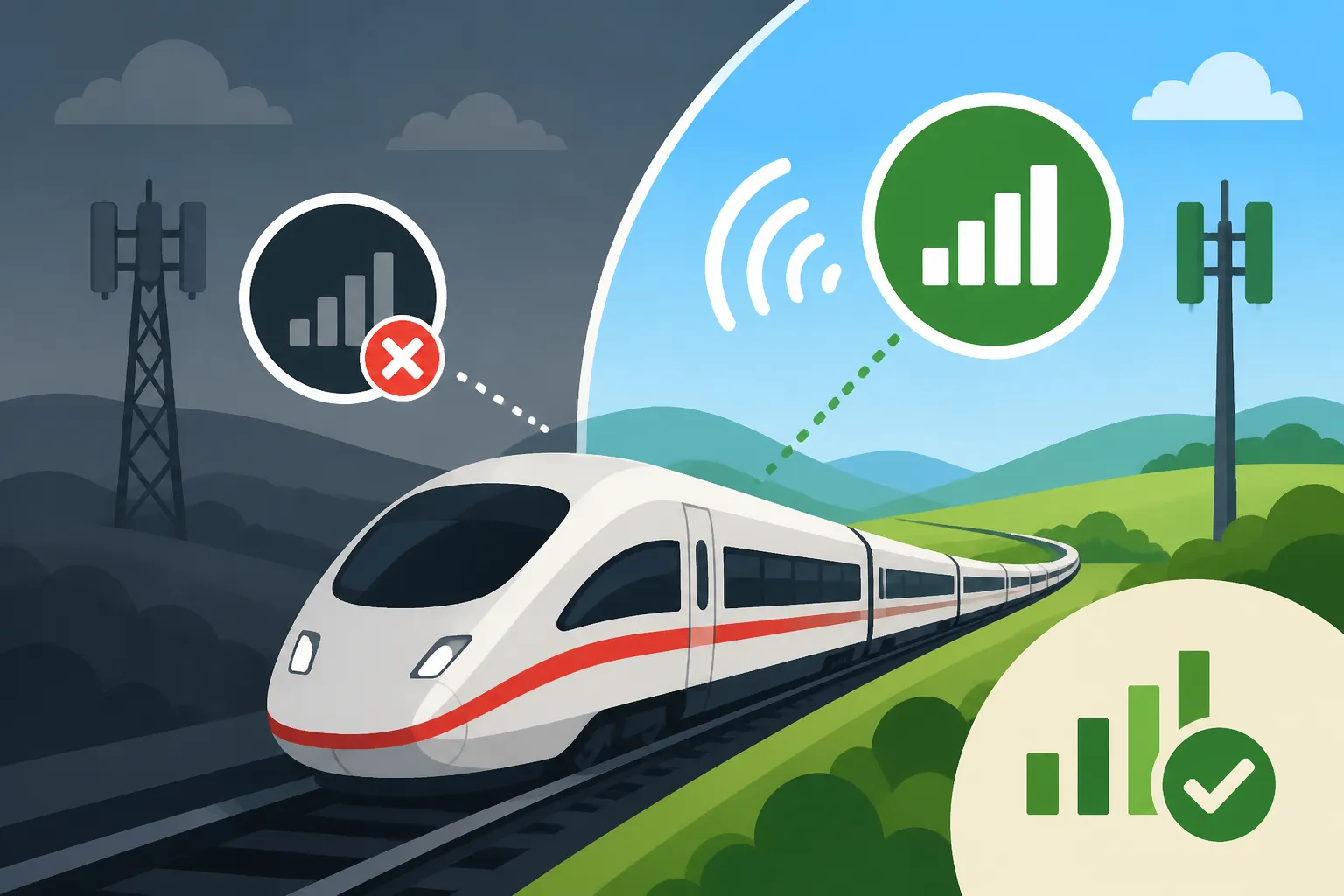
Firstly, physical geography and population density play a huge role. Germany is not uniformly flat or urban. The ICE network crisscrosses vast stretches of rural areas, dense forests, and even mountainous regions (especially in the south). Mobile network towers, while plentiful, are primarily designed to serve stationary users in towns and cities. They're not always strategically placed to provide seamless, high-speed coverage to an object hurtling through the landscape at 200+ km/h. When the train zooms past a tower, the signal has only a tiny window to establish and maintain a connection, and the handover to the next tower isn't always smooth.
Secondly, infrastructure limitations along the tracks are a major culprit. While Germany has invested heavily in rail, the dedicated fiber optic cables and advanced antenna systems that would provide consistent internet directly to the trains haven't kept pace everywhere. In many older sections of the railway, the train's Wi-Fi system still relies on aggregating signals from the standard cellular networks (Telekom, Vodafone, O2) that your own phone uses. If those networks are patchy, the train's Wi-Fi will be, too. Plus, the metal shell of a train acts like a Faraday cage, dampening external signals before they even reach your device. Add in numerous tunnels, where signals simply can't penetrate, and you have a recipe for connectivity chaos. This isn't just a German problem, but it's particularly noticeable here because of the expectation of efficiency.
It's a stark contrast to the modern connectivity you might be used to elsewhere, making it one of those delightful little culture shocks that expats experience daily. You might be able to handle this particular challenge by referring to our broader guide on Travel Logistics in Germany: Money, Safety, and Connectivity.
Navigating the Connectivity Desert: Traditional Solutions and Their Limitations
Before the advent of modern solutions, we expats tried everything to keep connected. And while some methods offered a slight improvement, none were truly bulletproof. Let's talk about what many of us have relied on, and why they often still fall short.
Your German SIM Card: Better, But Still Not Perfect
For many, getting a local German SIM card from one of the major providers – Telekom, Vodafone, or O2 – is the first step towards better connectivity. And it's true, having a local SIM is almost always better than trying to rely on the train's often anemic Wi-Fi. These networks generally offer stronger signals across the country and, outside of the specific challenges of a fast-moving train, provide solid data. Telekom, in particular, is often lauded for having the widest and most reliable coverage, especially in rural areas.
However, even with the best German SIM, you'll still encounter those infuriating dead zones. Tunnels remain impenetrable, and certain stretches of track, particularly through dense forests or hilly terrain, are simply not well-served by cell towers optimized for high-speed travel. You might find your streaming video buffers just as the plot thickens, your important video call pixelates into oblivion, or your map application refuses to load precisely when you're trying to figure out your next connection. It’s better than nothing, but it's far from a seamless experience. If you're still deciding on your main provider, our guide on Internet and Mobile Phone Plans in Germany: Getting Connected Fast offers a comprehensive overview.
The Download-Before-You-Go Strategy: A Necessary Evil
For years, the unofficial motto of German train travel was: "Download everything you might possibly need." This involves meticulously pre-downloading movies, podcasts, e-books, offline maps, and any work documents before you even step foot on the platform. It's a sensible strategy for surviving the inevitable connectivity droughts, ensuring you at least have something to keep you occupied or informed.
The problem, of course, is that it's a reactive solution to a proactive problem. What if your plans change mid-journey? What if you need to look up an urgent piece of information that you couldn't possibly have anticipated? Or what if you just want to spontaneously chat with a friend, share a moment from your journey, or check real-time updates for your connection? The "download-before-you-go" method doesn't account for real-time needs, making every train journey feel like a carefully choreographed exercise in digital self-sufficiency. It adds a layer of mental load to your trip, turning a potentially relaxing ride into another item on your to-do list.
The Modern Solution: Embrace the Power of eSIMs with Airalo
After countless frustrating journeys, many of us expats started looking for a smarter way to stay connected. That's where the beauty of eSIM technology, particularly a service like Airalo, truly shines. It’s not just an alternative; for train travel in Germany, it's often the most reliable answer to your data woes.
What Exactly is an eSIM and Why Is It a Game-Changer?
An eSIM, or "embedded SIM," is a digital SIM card that's built directly into your phone. Unlike a traditional physical SIM, there's no tiny plastic card to insert or swap. Instead, you activate an eSIM profile digitally, often through an app or a QR code. It’s essentially a software-based SIM that allows you to easily switch between different mobile networks without ever touching your phone's hardware.
For travelers and expats, this is an absolute game-changer. Imagine landing in a new country and, within minutes, having a local data plan activated on your phone, ready to go, all without hunting for a local SIM store or dealing with language barriers. That's the power of an eSIM. It allows for incredible flexibility, letting you purchase data packages for specific countries or regions. Airalo is one of the leading providers in this space, offering a huge variety of plans for virtually anywhere in the world, including Germany. This means you can keep your existing physical SIM (your home number, for example) active for calls and texts, while using the Airalo eSIM purely for data, giving you the best of both worlds.
Airalo on German Trains: How It Boosts Your Connectivity
Now, let's get down to how Airalo specifically helps conquer the data deserts on German trains. The fundamental advantage of Airalo, or any eSIM provider, is that it gives you access to local networks quickly and flexibly. Airalo partners with local carriers in Germany, meaning when you buy a Germany-specific eSIM package, you're essentially getting data access on one of the robust local networks, such as Telekom, Vodafone, or O2.
Why is this better than the train's Wi-Fi? Because the train's Wi-Fi is often trying to aggregate signals from these same networks, but it's doing so through a system that might be overloaded or less efficient. By using Airalo directly on your device, you're tapping into the cellular network as directly as possible. While no solution can magically create a signal in a deep tunnel, Airalo significantly improves your chances of consistent connectivity in general coverage areas.
Think of it this way: your phone, with an active Airalo eSIM, will automatically try to connect to the strongest available local network signal along your route. If one carrier is stronger in a particular rural stretch, your phone (via the eSIM) can utilize that signal more effectively than the train's shared Wi-Fi. This means fewer drops, faster speeds when a signal is present, and a far more reliable connection for those crucial moments. Whether you're checking your next stop, sending a quick message, or simply enjoying some uninterrupted music, Airalo helps you stay connected as you traverse the beautiful (but sometimes digitally barren) German countryside. It’s a proactive step towards a smoother, more enjoyable travel experience. Don't just survive your train journey; actually enjoy it with reliable data from Airalo. For more on getting connected while traveling, you might want to read about Mobile Data and eSIMs for Travel in Germany.
Step-by-Step: Getting and Using Airalo for Your German Train Travel
Getting Airalo set up is surprisingly simple, even for those of us who tend to get overwhelmed by new tech. Here’s a straightforward guide to getting connected before your next ICE journey:
- Check Phone Compatibility: First things first, ensure your smartphone supports eSIM technology. Most newer models (iPhone XS and later, many Samsung Galaxy S and Fold series, Google Pixel 3 and later, etc.) are compatible. A quick online search for "[Your Phone Model] eSIM compatibility" will give you the answer.
- Download the Airalo App: Head to your phone's app store (Apple App Store or Google Play Store) and download the free Airalo app. It’s intuitive and user-friendly.
- Choose Your Plan: Open the Airalo app and search for "Germany" or a broader "Europe" plan if you're traveling across multiple countries. You'll see various data packages with different data allowances (e.g., 1GB, 5GB, 10GB) and validity periods (e.g., 7 days, 30 days). Choose the one that best suits your travel duration and data needs. Remember to factor in your train journey length!
- Install the eSIM: Once you've purchased your plan, Airalo will guide you through the installation process. This usually involves either scanning a QR code with your phone's camera (if installing on another device or a printed code) or following a direct installation link within the app. Your phone will prompt you to add the cellular plan. Give it a clear name like "Airalo Germany" to easily distinguish it from your primary SIM.
- Activate Data Roaming (for the eSIM): After installation, go to your phone's cellular settings. You'll see your new Airalo eSIM listed. Make sure "Data Roaming" is turned ON for the Airalo eSIM. Don't worry, with a data-only eSIM, this won't incur exorbitant charges; it simply allows the eSIM to connect to the local partner networks in Germany. Crucially, ensure your primary physical SIM’s data roaming is turned OFF if you only want to use Airalo for data to avoid unexpected charges.
- Switch to Airalo: When you're ready to use your Airalo data, simply go into your phone's cellular settings and select "Airalo Germany" as your primary data source. Your phone will then connect to the strongest available network in Germany.
This streamlined process makes Airalo an indispensable tool for both tourists making short trips and expats who frequently travel within Germany or across Europe. It offers a cost-effective and flexible way to ensure you're always just a few taps away from reliable data. You can easily top up your data or buy another package directly through the app if you run out, ensuring seamless connectivity wherever your journey takes you.
Tips for Maximizing Your Data Coverage on German Trains (with Airalo and Beyond)
Even with the marvels of an Airalo eSIM, a bit of savvy planning and smart phone habits can go a long way in improving your train travel experience. Let's combine our knowledge to give you the best chance of staying connected.
Smart Settings and Phone Habits
Sometimes, the simplest adjustments can make a big difference. When you're aboard an ICE train and notice your data struggling:
- Turn off Train Wi-Fi: Seriously, if you're using your Airalo eSIM or a regular German SIM, disable the Deutsche Bahn Wi-Fi. Your phone might be clinging to a weak, oversubscribed Wi-Fi signal instead of prioritizing your stronger cellular connection, leading to a poorer overall experience. Give your phone one job, and it will do it better.
- Manage Background App Refresh: Many apps consume data in the background without you even realizing it. Go into your phone's settings and restrict background app refresh for non-essential applications. This conserves data and allows your phone to focus its energy on maintaining a connection for the app you're actively using.
- Offline is Still Golden: Even with Airalo, there will be moments of no signal (like deep tunnels). Continue to download maps (Google Maps allows you to download entire regions for offline use), entertainment, and important documents before you travel. This isn't a replacement for live data, but a crucial fallback. Knowing your way around a city even without internet can be a lifesaver, and our guide on Understanding German Addresses: How to Read and Write Your Address Correctly can help you prepare.
- Restart Your Phone: The classic tech support advice. Sometimes, a quick restart can help your phone reset its network connections and find the best available signal. It's a small step that often yields surprising results.
Planning Your Journey with Connectivity in Mind
While spontaneity is great, a little foresight can save you from digital despair on longer journeys:
- Check Route Connectivity: Unfortunately, DB doesn't provide a detailed "connectivity map" for specific routes. However, if you know your route passes through long tunnels (e.g., in the Black Forest or certain sections near Hanover), anticipate signal drops. Use these moments for planned offline activities or simply to enjoy the scenery.
- Travel Off-Peak if Possible: On popular routes, train Wi-Fi (if you’re even attempting to use it) can be heavily congested during peak hours. Traveling early in the morning, late in the evening, or mid-day on weekdays might offer a slightly better experience due to fewer users vying for bandwidth.
- Keep Your Airalo Ready: Having your Airalo eSIM pre-installed and ready to switch to is your ultimate insurance policy. If your primary German SIM struggles, or if you're a tourist relying on it as your main connection, the ability to switch to a robust eSIM data plan instantly provides unparalleled peace of mind. It’s specifically designed for flexibility and reliable data, making it an essential companion for those frequent trips on the ICE.
Leveraging Different Networks with an eSIM
This is one of the most powerful, yet often overlooked, advantages of using an Airalo eSIM for your travels. Unlike a physical SIM, which locks you into a single network provider, many eSIMs, including Airalo, are designed to work with multiple local carriers depending on their agreements.
For instance, an Airalo eSIM for Germany might have roaming agreements with both Telekom and Vodafone. This doesn't mean you can manually switch between them in your phone's settings (your phone automatically picks the best one). However, the underlying technology gives your device a broader chance to find a stronger signal. If Telekom has a weak spot along a particular stretch of track, but Vodafone is stronger, your eSIM is potentially better equipped to leverage that alternative coverage compared to a physical SIM tied solely to one network. This inherent network flexibility makes Airalo a more resilient option, especially in areas where coverage can vary wildly between providers. It’s like having a team of network scouts constantly working to find you the best signal, even when you're barreling through the German countryside on an ICE train.
Staying connected is part of staying safe and informed while traveling. Our guide on Staying Safe in Germany: Common-Sense Tips for Travelers emphasizes how crucial communication can be in an unfamiliar environment.
| Feature | Train Wi-Fi (Deutsche Bahn) | Local German Physical SIM (e.g., Telekom) | Airalo eSIM (Germany/Europe Plan) |
|---|---|---|---|
| Reliability on ICE | Very poor, highly inconsistent, frequent drops | Moderate, still experiences drops in rural areas/tunnels | Good, leverages local networks for better consistency; more resilient to local network fluctuations |
| Speed | Often slow, throttled, or non-existent | Generally good when signal is strong | Fast, utilizes local 4G/5G where available |
| Ease of Setup | Simple login on train's portal | Purchase/register in-store, physical swap | Instant digital activation via app/QR code, no physical swap |
| Cost | Free | Monthly contract/prepaid packages | Flexible data packages (e.g., 1GB for 7 days, ideal for travel) |
| Network Flexibility | Limited, relies on train's aggregated signal | Single network provider | Access to best available local network via roaming agreements, more resilient |
| Usage | Best for light browsing, not reliable for work/streaming | Good for daily use, but limited on fast trains | Excellent for supplementary data, travel, or primary data for digital nomads |
| Overall Experience | Frustrating and unreliable | Generally good, but train travel remains a challenge | Significantly improves connectivity and peace of mind on trains |
Disclaimer
The information provided in this article is intended for general guidance and informational purposes only, and does not constitute professional advice. While we strive to keep the information up-to-date and correct, we make no representations or warranties of any kind, express or implied, about the completeness, accuracy, reliability, suitability, or availability with respect to the website or the information, products, services, or related graphics contained in this article for any purpose. Any reliance you place on such information is therefore strictly at your own risk. Technology, network coverage, and service offerings (including those from Airalo or Deutsche Bahn) can change rapidly. Always check the latest terms and conditions directly with service providers and verify phone compatibility before making any purchases or travel plans.