Holding Euros, Pounds, and Dollars in One Account: What Converting Costs
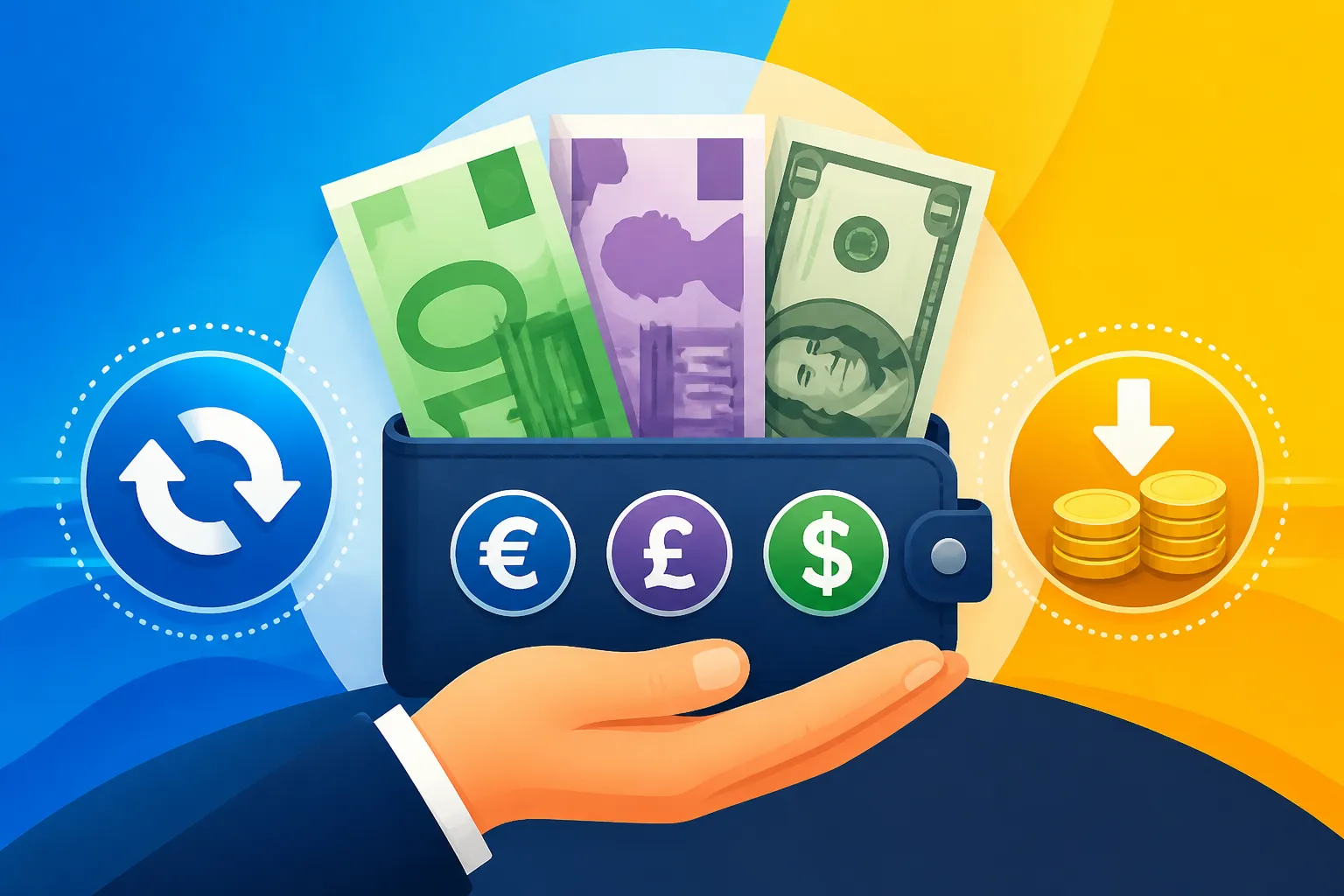
You get paid in euros, your pension still lands in pounds, and a US client pays you in dollars. Every time one currency becomes another, someone takes a cut, and German banks rarely show you how big it is. This guide explains where conversion costs hide and how a multi-currency account from Wise lets you keep all three currencies in one place.
Disclosure: This post may contain affiliate links. We may earn a commission at no extra cost to you if you make a purchase through these links. Read full disclosure.
Why Juggling Three Currencies in Germany Gets Expensive
When I first moved to Germany, I had three financial lives. I had a German salary paid into a Girokonto, a UK savings account I was too nervous to close, and a trickle of US dollar freelance income from an old client in Chicago. I assumed moving money between them would cost “a small fee.” It took me most of a year to work out how much I was losing. The fees were not what hurt. The exchange rates I was quietly being given were.
If you are in a similar spot, you are not being careless. The German banking system was built for people who earn, spend, and save in euros. The moment you step outside that, you are paying for the privilege, often without seeing a line item on your statement.
The Hidden Margin Nobody Prints on Your Kontoauszug
Most people expect conversion to cost a visible fee. In practice, the larger cost usually sits inside the exchange rate. Every currency pair has a mid-market rate, the midpoint between buy and sell prices on global markets. It is the rate you see when you search for “GBP to EUR.” Banks and many payment providers do not give you that rate. They give you a worse one and keep the difference, which is called the spread or markup.
Here is a typical scenario. Sarah, a British teacher in Hannover, sends a few thousand pounds from her UK high-street bank to her Sparkasse account to cover a rental deposit. Her UK bank charges a flat international payment fee, which she notices. It also applies its own exchange rate, which she does not notice. Then the receiving side may add an incoming payment charge. When she compares what arrived against the mid-market conversion of what she sent, a noticeable chunk has disappeared. None of it appears as a single clear fee.
The German bank statement, the Kontoauszug, will usually show the amount credited and perhaps a reference rate. It will rarely tell you how far that rate sits from the market. If you want to decode the other lines on those statements, the guide on Understanding German Bank Statements: Fees and Transactions Explained walks through the abbreviations.
Why Your German Girokonto Is Not Built for This
A standard German current account is a euro account. It has an IBAN and handles SEPA transfers within the eurozone well. If you are still getting your head around how that infrastructure works, start with Understanding the German Banking System: IBAN, SEPA, and More. Pounds or dollars arriving in that account are converted to euros on arrival, at the bank’s rate, at that moment. You get no choice about timing and no option to keep the money in its original currency.
Some traditional banks offer a Fremdwährungskonto, a separate foreign currency account. In my experience these come with drawbacks for ordinary expats:
- They often require a separate account opening process, sometimes in person at a branch.
- They can carry their own monthly account maintenance charges.
- Conversions between your euro account and the foreign currency account still go through the bank’s own rate, with its own spread.
- The online banking interfaces are frequently German-only and not designed for frequent switching.
They are useful for some business customers. For someone who wants to hold a pension in pounds and a client payment in dollars without fuss, they tend to be expensive and clunky.
Three Common Expat Money Patterns
Over the years I have noticed that most multi-currency expats in Germany fall into a few patterns. Knowing which one you are helps you see where your money leaks.
The inbound earner. You live on a euro salary but receive regular income in another currency, such as freelance payments, rental income from a flat back home, or a foreign pension. Your risk is a poor rate every time that income lands. The guide on Currency Fluctuations: Managing Money if You’re Paid in a Foreign Currency goes deeper into the timing side.
The outbound payer. You earn in euros but owe money in pounds or dollars, such as a UK mortgage, US student loans, or support for family. You lose a little on every monthly payment. If a home-country mortgage is your main concern, Paying an Overseas Mortgage While Living in Germany covers the setup.
The two-way holder. You move back and forth: euro salary, pound savings, dollar travel spending, and perhaps a plan to return home one day. You do not want to convert everything to euros only to convert it back later. Each round trip costs you twice.
The two-way holder is the person a multi-currency account suits best. Inbound earners and outbound payers benefit as well.
What Converting Actually Costs: Banks vs a Multi-Currency Account
Here is the side-by-side view. I am deliberately not giving you specific figures, because rates and fees change constantly and every provider updates its pricing. What matters is where the cost sits and whether you can see it before you commit.
Comparing the Main Conversion Routes
| Route | Where the cost usually hides | Can you see the full cost upfront | Can you hold the currency instead of converting | Local account details in GBP and USD |
|---|---|---|---|---|
| German high-street bank receiving foreign money | Exchange rate markup plus possible incoming payment charges | Rarely in full | Not on a standard Girokonto | No |
| Home-country bank sending abroad | Exchange rate markup plus outgoing international transfer fee | Fee yes, markup often unclear | Depends on the bank | Only in its home currency |
| Fremdwährungskonto at a German bank | Account fees plus the bank’s own conversion rate | Partially | Yes, usually one currency per account | Usually no |
| Card payment with dynamic currency conversion | Merchant’s or terminal operator’s chosen rate | Shown on the screen, but rarely compared to market | No | Not applicable |
| Airport or station exchange counter | Wide buy-sell spread built into the board rate | Rate visible, markup not stated | No, cash only | Not applicable |
| Wise multi-currency account | Transparent conversion fee on top of the mid-market rate | Yes, shown before you confirm | Yes, many currencies in one account | Yes, alongside a euro IBAN |
The key column is the third one. With most traditional routes you find out what you paid afterwards, if at all. A transparent model shows you the rate and the fee before you press confirm, so you can compare it against any other offer on the spot.
How the Wise Pricing Model Works
The main reason I moved my multi-currency life over to Wise was the pricing model. It does not depend on a hidden markup. Conversions use the mid-market rate, the one you find on independent currency sites, and a separate conversion fee is shown in the app before you agree to anything. The fee varies by currency pair and amount, so check the provider’s own pricing page for current figures rather than relying on any number you read in a blog post, including this one.
In practice this changes how you behave. When I wanted to move pounds into euros for a large furniture purchase, I could see exactly how many euros I would get, compare that with what my UK bank quoted, and decide. With the UK bank I would have needed a calculator and a market rate in another browser tab to work out the real cost.
There are a few other cost shapes to know about so nothing surprises you:
- Converting between balances. You pay the conversion fee when you move money from one currency balance to another, not for holding it.
- Receiving money. Receiving in local currencies through the local account details is generally cheap or free. Some incoming payment types, such as certain international wires, can carry a charge. The app shows this.
- Card spending. If you pay in a currency you already hold, no conversion is needed. If you do not hold it, the card converts from another balance at the transparent rate.
- Cash withdrawals. A limited number of free ATM withdrawals per month is included, with a fee after that. The provider’s pricing page has the current allowance.
- Account details and card. Getting certain account details or ordering a physical card may involve a one-time cost. Check the pricing page when you sign up.
A Worked Scenario: Sarah, Tom, and the Round-Trip Problem
Let me make this concrete with two people I know, names changed.
Sarah, the teacher from earlier, gets a small UK pension top-up in pounds every month and still pays a UK phone contract and a storage unit in Manchester. Under her old setup, the pension landed in her UK account. Each month she sent most of it to her German Sparkasse, losing a cut. She then paid the UK bills from what was left in pounds, which was fine. Once a year she visited home and withdrew pounds from an ATM using her German card, losing a second cut on money that had already been pounds.
Once she switched, the pension lands in her GBP balance using UK account details. The UK bills come out of that same balance in pounds, with no conversion. Only the surplus she needs in euros gets converted, and she converts it in larger chunks when she chooses, rather than automatically each month. On visits home she spends from the GBP balance on her card. The round trip is gone.
Tom is an American software developer in Munich. He invoices a US client in dollars. His client used to wire dollars to his German bank, which converted them on arrival at its own rate and sometimes deducted an intermediary charge on the way. Now Tom gives the client US account details. The client sends a domestic US payment, which is simpler and cheaper for everyone. The dollars sit in Tom’s USD balance until he decides to convert. Because he also pays for some US software subscriptions in dollars, a chunk of that money never needs converting at all. If you are freelancing like Tom, the article on Getting Paid by Overseas Clients as a Freelancer: Where the FX Margin Disappears covers invoicing in more detail.
Setting Up One Account for Euros, Pounds, and Dollars
This part is less painful than most German admin, which is a pleasant change from Bürgeramt appointments and forms you can only submit by post.
Step-by-Step: Opening and Configuring Your Balances
- Sign up in the app or on the website. You will be asked for your residential address in Germany. Your Meldebescheinigung address is the safest one to use so it matches your other documents.
- Verify your identity. Expect to photograph your passport or residence permit and take a selfie or short video. Have your documents ready and be in good lighting. Most rejected verifications I have seen came from blurry photos.
- Open a euro balance first. This gives you a euro IBAN. Many expats use it alongside their German Girokonto rather than replacing it.
- Add a GBP balance and a USD balance. Request the local account details for each. For pounds you get UK-style details for receiving domestic UK payments. For dollars you get US-style details for receiving domestic US transfers.
- Order the debit card. It spends from whichever balance matches the purchase currency, and converts automatically if you do not hold that currency.
- Send your new details to the people who pay you. Your UK pension provider, US client, or tenant back home can pay you as if you were a local.
- Set up direct debits and payments in each currency. UK bills can come out of the GBP balance, US subscriptions from the USD balance, and so on.
- Turn on notifications and, if you like, rate alerts. These help you convert when the rate suits you rather than when a bank decides.
If you are still in your first weeks and do not have a German account yet, see Living in Germany Without a German Bank Account: What Breaks and What Works. It explains which German payments still prefer a traditional bank.
Should It Replace Your German Bank?
My honest answer is no, not entirely, and I say that as someone who uses Wise every week. Here is why I keep both:
| Task | Better handled by a German Girokonto | Better handled by a multi-currency account |
|---|---|---|
| Receiving your German salary | Yes, employers and payroll expect it | Possible, but less common |
| Paying rent by Dauerauftrag | Yes, landlords are used to it | Works with a euro IBAN, but some landlords hesitate |
| Building a SCHUFA history | Yes, traditional accounts usually report | Generally not relevant |
| Holding pounds and dollars | No, usually converts on arrival | Yes |
| Receiving foreign income in local currency | No | Yes, with local account details |
| Spending abroad without conversion | Only in euros | Yes, in held currencies |
| Seeing the conversion cost before you commit | Rarely | Yes |
German direct debits (Lastschrift) and older contracts sometimes expect a German bank. That should not happen legally within SEPA, but I have met plenty of gym contracts and utility forms that were fussy about non-German IBANs. Keeping a free or low-cost German account for salary, rent, and German bills, then using the multi-currency account for anything involving pounds or dollars, gives you the best of both. To keep the German side lean, see How to Reduce Bank Fees in Germany.
Card Spending in Germany and on Trips
Day to day in Germany, you will mostly spend euros, and your card simply draws from the euro balance. The multi-currency setup really helps on trips to the UK or US, and when shopping online from British or American retailers.
One trap catches almost everyone: dynamic currency conversion. You are at a shop in London or a restaurant in New York, and the card terminal offers to charge you “in your home currency,” meaning euros. It looks helpful. It almost never is, because the rate on that screen is set by the terminal operator or the merchant’s provider and usually includes a generous markup. Always choose to pay in the local currency. If you already hold pounds or dollars, the payment comes straight from that balance with no conversion. The same applies at foreign ATMs that offer to convert for you: decline and pay in local currency.
For a broader look at which card to use for which purchase, the guide Which Card to Use in Germany: Fee Comparison Across a Month of Real Spending runs through a month of real spending. If you are planning airport cash, Currency Exchange in Germany: Where to Convert Money and Avoid Fees explains why exchange counters are usually the most expensive option.
Making Multi-Currency Holding Work Long Term
Opening the account is easy. Using it well over years, through tax seasons and exchange rate swings, takes a little more thought.
Timing Your Conversions Without Gambling
Once you can hold currencies, you face a new temptation: waiting for the “perfect” rate. I have watched friends hold pounds for months, hoping for a better rate, while they needed euros for rent. That is speculation, not saving.
A calmer approach that has worked for me:
- Keep a buffer in the currency you spend. Hold enough euros for a couple of months of German living costs so you never have to convert in a hurry.
- Keep money in the currency you will spend it in. If you have UK bills or plan to move back, leave that money in pounds. Do not convert it to euros and back.
- Convert surplus in regular chunks. Converting a set portion every month or quarter smooths out the ups and downs, so you neither win big nor lose big on timing.
- Use rate alerts for one-off large conversions. For a house deposit or large purchase, set an alert at a rate you would be happy with. If it does not trigger, convert anyway when you need the money.
- Write down your reasoning. It sounds dull, but noting why you converted when you did stops second-guessing later.
The guide on How to Handle Currency Risk When Paid in Foreign Currency in Germany goes deeper on hedging if large sums are involved.
The Tax Angle Nobody Warns You About
This is where my veteran expat paranoia kicks in, and it is worth a few minutes of your attention. In Germany, foreign currency balances can be treated as assets for income tax purposes. If you acquire foreign currency and then dispose of it, for example by converting it back to euros or spending it, within a short holding period, any gain from exchange rate movements may count as a private sale transaction. Small gains may fall under an exemption threshold. Larger ones may need declaring.
I am not saying this to scare you. Most people holding a modest pension buffer or travel money will never get close to anything that matters. But if you are converting large sums, such as an inheritance, house sale proceeds, or a large freelance contract, the rules around holding periods and how gains are calculated can matter. Keep your transaction history. A transparent account helps here, because every conversion is time-stamped with the exact rate used, and you can export statements for your records.
For the bigger picture of how Germany treats money and assets held abroad, read Taxing Worldwide Income: How Germany Taxes Foreign Income and Assets. If you invoice in foreign currencies as a freelancer, record-keeping matters for VAT too, and Foreign-Currency Invoices and German VAT: Exchange Rate Record-Keeping explains which rates your Steuerberater will want to see. For anything substantial, pay for an hour with a tax adviser. It will cost far less than getting it wrong.
Safety, Safeguarding, and Peace of Mind
One question I get a lot from newcomers: “Is my money as safe as in a German bank?” It is a fair question, and the honest answer is that the protection works differently.
Traditional German banks are covered by deposit guarantee schemes. Electronic money institutions, the category many fintech providers fall into, are usually required instead to safeguard customer funds, keeping them separate from the company’s own money so they can be returned if the company fails. That is a real protection, but it is not the same as a deposit guarantee. Check how your chosen provider protects funds in its own documentation for European customers.
My personal approach, and the one I suggest to friends:
- Use the multi-currency account for active balances, meaning money coming in, going out, and being converted.
- Do not treat it as the only home for your entire life savings.
- Keep long-term euro savings at a German bank or a regulated savings product, and long-term savings in other currencies wherever makes sense for your plans.
- Turn on two-factor authentication and keep the app updated.
- Learn how to freeze your card in the app before you ever need to.
If you are also keeping accounts open back home, Cross-Border Banking: Managing Your Home Country Account While in Germany explains the practical side, including what to do when your home bank asks awkward questions about your foreign address.
Moving Larger Sums From the UK or US Into Germany
The final scenario, and often the biggest one financially, is the one-off large transfer: savings brought over to buy property, a lump sum from selling a car back home, or an inheritance. Here the gap between a hidden markup and a transparent fee on the mid-market rate can be large in absolute terms, because even a small percentage difference on a big amount adds up.
For these transfers I recommend:
- Get a quote from your home bank, including both the fee and the exchange rate, and note the rate it uses.
- Get a quote in the multi-currency app for the same amount and compare euros received.
- If the amount is very large, also ask a specialist currency broker for a quote, because brokers sometimes negotiate on big sums.
- Expect compliance checks. Have proof of where the money came from ready, such as a sale contract, payslips, or inheritance documents. Large transfers can be delayed while these are reviewed.
- Do not rush into a transfer the week your notary appointment is due. Allow time for checks.
There are dedicated walkthroughs for the two most common corridors: Moving Money From the UK to Germany: GBP to EUR Without the Markup and Moving Money From the US to Germany: USD to EUR Transfer Routes Compared.
If you are tired of finding out what a conversion cost only after the money has moved, the simplest step is to open a Wise account, add euro, pound, and dollar balances, and run your next transfer through it with your bank’s quote open beside it. Once you compare the numbers yourself, it is hard to go back to rates you cannot see.
Disclaimer
This article is for general informational purposes only and does not constitute professional advice. Laws, prices and regulations vary by location and change over time. Consult a qualified professional for guidance on your specific situation.