German Corporate Buzzwords: Common Terms in Office Talk
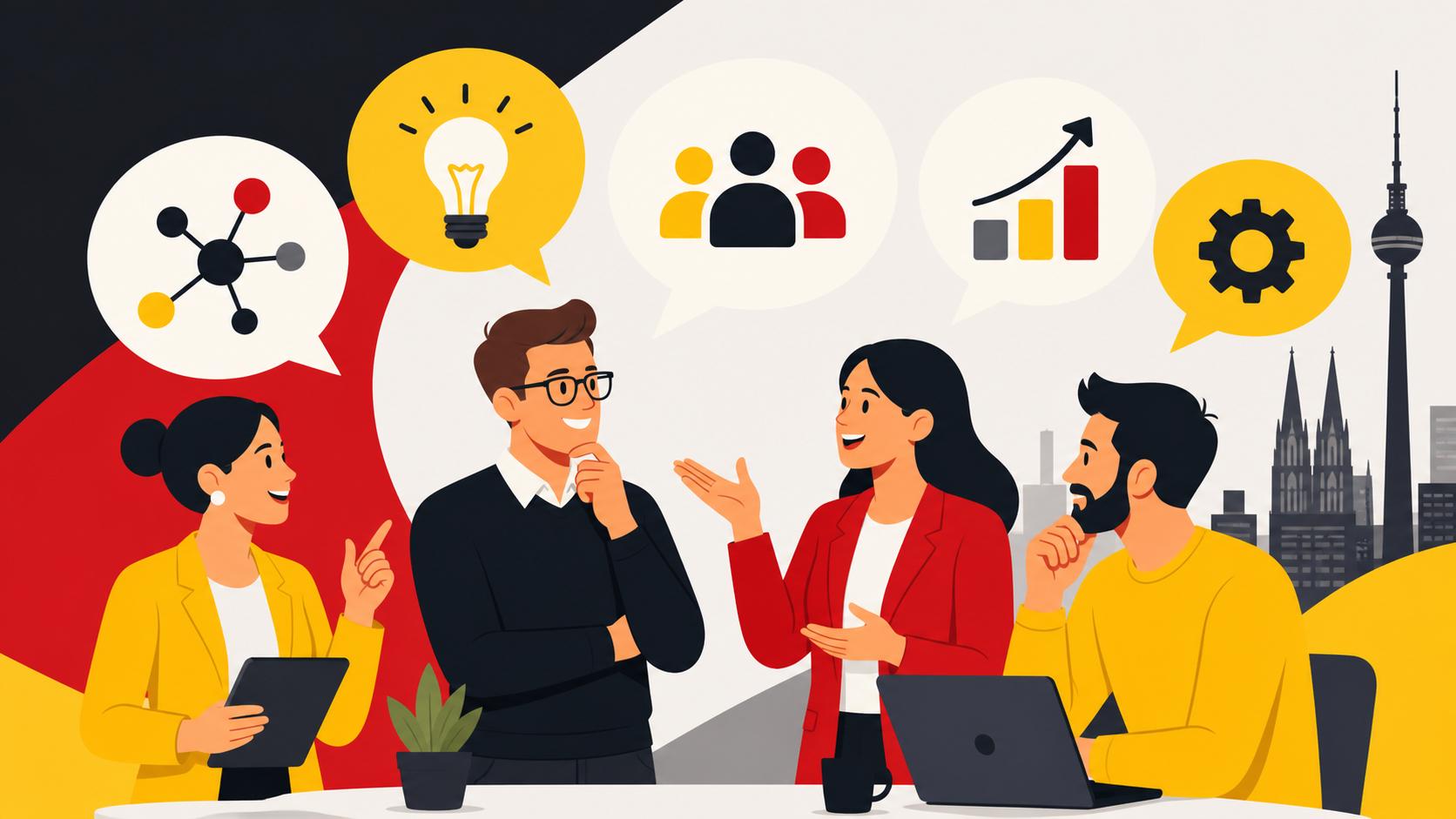
Navigating a German office meeting can feel like you have been dropped into a secret society where everyone speaks a coded cipher of administrative jargon and hybrid English. My first month in a Frankfurt tech firm was spent mostly nodding at "synergies" and "deadlines" while privately wondering why everyone was so obsessed with a "Jour Fixe." This guide decodes the most common German corporate buzzwords to help you navigate your new professional life with confidence.
Disclosure: This post may contain affiliate links. We may earn a commission at no extra cost to you if you make a purchase through these links. Read full disclosure.
The Cultural Context of German Office Talk
The German workplace is often portrayed as a bastion of pure efficiency and directness, but the reality is more nuanced. While Germans do value clarity, the modern office has developed its own layer of "Business Deutsch" that can be incredibly opaque to newcomers. This isn't just about learning new words; it is about understanding the social hierarchy and the expectations of professionalism that these words convey. When you hear these terms, you aren't just hearing a task; you are hearing a cultural standard for how that task should be performed.
Understanding the Work Culture in Germany: Etiquette, Hierarchy, and Office Norms is the first step toward decoding the language. You will notice that even in the most traditional industries, the vocabulary is shifting. However, the underlying values of punctuality and structure remain. For instance, the way a German colleague asks for a "Feedback" is often much more formal and structured than what you might expect in London or New York. They aren't looking for a casual chat; they are looking for a documented analysis.
The evolution of "Denglish"—the portmanteau of Deutsch and English—is particularly prevalent in corporate settings. You might find it ironic that while searching for English-Speaking Jobs in Germany: Finding Work When You Don’t Speak German, you end up in an office where half the technical terms are English anyway. But be careful: the way these English words are used often follows German grammatical rules and social contexts, which can lead to "false friends" and misunderstandings.
Directness vs Corporate Jargon
While Germans are famous for being direct, the corporate world introduces a level of polite abstraction. Instead of saying "You made a mistake," a manager might talk about a "Optimierungspotenzial" (potential for optimization). This allows them to maintain the German standard of factual correctness while adhering to the diplomatic requirements of a professional environment. It is a delicate balance to strike, and one that takes years of "I've-been-there" experience to master.
I remember my first performance review where I was told my "Prozessverständnis" (understanding of processes) was "ausbaufähig" (expandable). In my head, I thought, "Great, they think I can grow!" In reality, "ausbaufähig" is a classic German corporate euphemism meaning "it’s currently not good enough." Learning these nuances is just as important as Writing a German-Style CV and Cover Letter: Tips for Success because it dictates how you survive once you actually get the job.
The Denglish Phenomenon in the Modern Workplace
You will frequently hear words like "Meeting," "Team," "Workflow," and "Task" used in the middle of otherwise perfect German sentences. This can be a double-edged sword for expats. On one hand, it makes the initial immersion easier. On the other, it can make you lazy about learning the proper German equivalents. To truly integrate, you need to understand which English words are "standard" and which ones make you sound like you aren't trying to learn the language.
Platforms like GermanPod101 are excellent for this because they often have specific lessons on business dialogue that highlight these Denglish trends. I used it to learn the difference between a "Termin" (a fixed appointment) and a "Meeting" (which is often more collaborative). If you rely solely on English, you might miss the subtle power dynamics at play when a senior leader chooses a traditional German term over a trendy Denglish one.
Essential Meeting and Strategy Buzzwords
Meetings are the heart of the German bureaucracy. Whether you are in a startup or a DAX-listed corporation, the "Sitzungskultur" (meeting culture) is unavoidable. To participate effectively, you must master the vocabulary of scheduling and strategy. If you don't, you will find yourself constantly asking for clarifications, which can undermine your perceived "Kompetenz."
One of the most important concepts to understand is the "Jour Fixe." This is a recurring meeting, usually at the same time and place every week or month. It is the backbone of German project management. If you miss a Jour Fixe without a very good reason—and a "Krankmeldung" or doctor's note to prove it—it is seen as a major breach of Understanding German Work Contracts: Probation, Notice Periods, and More. Punctuality for these meetings is not a suggestion; it is a requirement.
Scheduling and Strategy Terms
In your first few weeks, you will likely hear someone talk about the "Fahrplan" (timetable/roadmap) for a project. This isn't just for trains; it refers to the strategic steps and milestones of a business goal. Along with this, you’ll hear about "Milestones," but often referred to as "Meilensteine." Germans love a good Meilenstein because it provides a clear, measurable point of progress.
| German Buzzword | Literal Translation | Office Meaning |
|---|---|---|
| Jour Fixe | Fixed Day | A recurring status meeting for a specific project. |
| Fahrplan | Driving Plan | The project roadmap or strategic timeline. |
| Abstimmung | Tuning/Coordination | The process of getting everyone on the same page before a decision. |
| Prio A | Priority A | The most urgent task that must be done immediately. |
| Schnittstelle | Interface | A department or person who acts as a bridge between two areas. |
| Zielvorgabe | Target Requirement | The specific KPIs or goals set by management. |
If you are struggling to keep up with the pace of these meetings, consider taking some targeted business German classes through Lingoda. I found their small group sessions particularly helpful for practicing "Abstimmung"—the art of coordinating with colleagues. Being able to say "Wir müssen uns hier noch mal abstimmen" (We need to coordinate on this again) is a powerful way to slow down a process that is moving too fast for you to follow.
Feedback and Performance Language
Performance reviews in Germany are a serious affair. You won't just get a "good job." You will get "konstruktive Kritik." One buzzword you will hear constantly is "Fehlermanagement" (error management). Germany is slowly moving toward a "Fehlerkultur" (error culture) where mistakes are seen as learning opportunities, but in many traditional offices, the focus is still on "Vermeidungsstrategien" (avoidance strategies).
When a manager talks about your "Performance" (yes, they use the English word), they are often looking at your "Effizienz" and "Zuverlässigkeit." If they tell you to "einen Zahn zulegen" (literally: add a tooth), they are using an old idiom that means you need to speed up. It is a bit more colorful than typical corporate speak, but it is very common in the German "Mittelstand" (small to medium-sized businesses). Understanding these expectations is vital to maintaining your German Workplace Rights: Overtime, Breaks, and Vacation Days Explained, as performance and hours often go hand-in-hand in the eyes of management.
Email and Digital Communication Slang
German emails are a world of their own. They can range from incredibly formal to surprisingly brief. If you are coming from a culture where emails start with "I hope you had a great weekend," the German "Sehr geehrte Damen und Herren" can feel like a cold bucket of water. But even within these formal structures, buzzwords and abbreviations are everywhere.
Digital communication is where Denglish truly thrives. You will "einladen" (invite) people to a "Call," "forwarden" (forward) an email, and "cc-en" (copy) your boss. However, the internal logic of the office remains. For example, "ASAP" is common, but it is often replaced by the German "umgehend" or "zeitnah." These mean "promptly" or "in a timely manner," but in a German office, they carry a weight of urgency that "as soon as possible" sometimes lacks in English.
Common Abbreviations and Short-hand
In internal chats like Slack or Microsoft Teams, you will see a lot of German-specific abbreviations. "VG" stands for "Viele Grüße" (Many regards), and "LG" for "Liebe Grüße" (Kind regards). You should only use "LG" with colleagues you know well. If you are unsure, stick to the slightly more formal "Herzliche Grüße."
Another common one is "u.A.w.g." which stands for "um Antwort wird gebeten" (an answer is requested/RSVP). You might also see "z.H." (zu Händen), which means "to the attention of." While you are busy Learning German: Best Ways for Students to Improve Language Skills, these little shortcuts will save you a lot of time. I once spent ten minutes trying to figure out what "MfG" meant at the end of a very stern email, only to realize it was just the standard "Mit freundlichen Grüßen" (With friendly regards).
Signing Off Professionally
The way you end an email says a lot about your standing in the company. In the early stages of your career or when dealing with high-level management, stick to the classics. As you build Professional Networking in Germany: LinkedIn vs Xing and More, you will notice the language softens. "Beste Grüße" is a great middle-ground sign-off that works in almost any corporate situation.
If you are working remotely, you might hear the term "Home-Office" (used as a noun in Germany to describe the act of working from home). A colleague might say, "Ich bin morgen im Home-Office." Make sure you don't confuse this with the UK meaning of the "Home Office" (government department). In Germany, it is simply your remote work setup. Knowing these distinctions is helpful when you are navigating Job Interview Tips for Germany: What to Expect and How to Impress, as you can clarify your remote work expectations using the local terminology.
Social and Cultural Office Speak
The German workplace isn't just about the work; it is also about the rituals that define the day. Perhaps the most important "buzzword" isn't a business term at all, but a cultural one: "Mahlzeit." Between 11:30 AM and 1:30 PM, you will hear this in the hallways, the elevators, and the canteen. It literally means "mealtime," but it functions as a universal lunchtime greeting.
Then there is the "Feierabend." This is more than just "finishing work." It is a sacred German concept that represents the boundary between your professional and private life. When someone says "Schönen Feierabend," they aren't just saying goodbye; they are acknowledging that your work time is over and your personal time has begun. Respecting this boundary is a key part of maintaining a healthy Work-Life Balance in Germany: How Germans Balance Work and Leisure. If you send a "Task" to a colleague after their "Feierabend" has started, don't expect a reply until the next morning.
After-Work and Casual Terms
While "After-Work-Party" is a common Denglish term in big cities like Berlin or Munich, the more traditional term is "Get-together" or simply "Bierchen trinken." Don't be fooled by the casual nature of these events; they are often where the real "Networking" happens. In a German context, these are social but still somewhat professional. You are expected to be friendly but not overly personal until the "Du-Reform" has happened (the moment a senior colleague invites you to use the informal "Du" instead of "Sie").
Adjusting to these social cues is often the hardest part of Coping with Culture Shock: Adjusting to Life in Germany. You might feel like your colleagues are cold because they don't talk about their weekends on Monday morning, but then they will spend two hours at the Christmas market drinking Glühwein with you in December. The "office talk" changes completely in these settings, becoming much more relaxed, though still rarely touching on sensitive topics like politics or salary.
Conflict and Resolution Buzzwords
When things go wrong, the vocabulary shifts to "Problemlösung" (problem-solving) and "Klärungsbedarf" (need for clarification). If a colleague says, "Da besteht noch Klärungsbedarf," they are politely telling you that they disagree with you or that your explanation was insufficient. It is a signal to stop and address the issue deeply rather than brushing past it.
You might also hear about "Engpässe" (bottlenecks). Identifying an "Engpass" is a classic German way of pointing out a flaw in a process without necessarily blaming a specific person. Using these terms can help you navigate conflicts more effectively. Instead of saying "Thomas is slow," you can say "Wir haben hier einen Engpass in der Bearbeitung" (We have a bottleneck in the processing). It’s professional, factual, and very German.
Resources like GermanPod101 and Lingoda often have modules on "Conflict in the Workplace" that are worth their weight in gold for an expat. They teach you how to stand your ground using the right linguistic level of "Direktheit." Learning to say "Ich sehe das anders" (I see that differently) instead of a blunt "You're wrong" will earn you a lot of respect in a German office.
Disclaimer
This guide is intended for informational purposes only. The meanings and usage of corporate buzzwords can vary significantly by industry, region, and individual company culture within Germany. While the author has personal experience in the German workplace, language trends are constantly evolving. For specific legal or contractual advice regarding your employment in Germany, always consult with a qualified legal professional or your company's HR department.