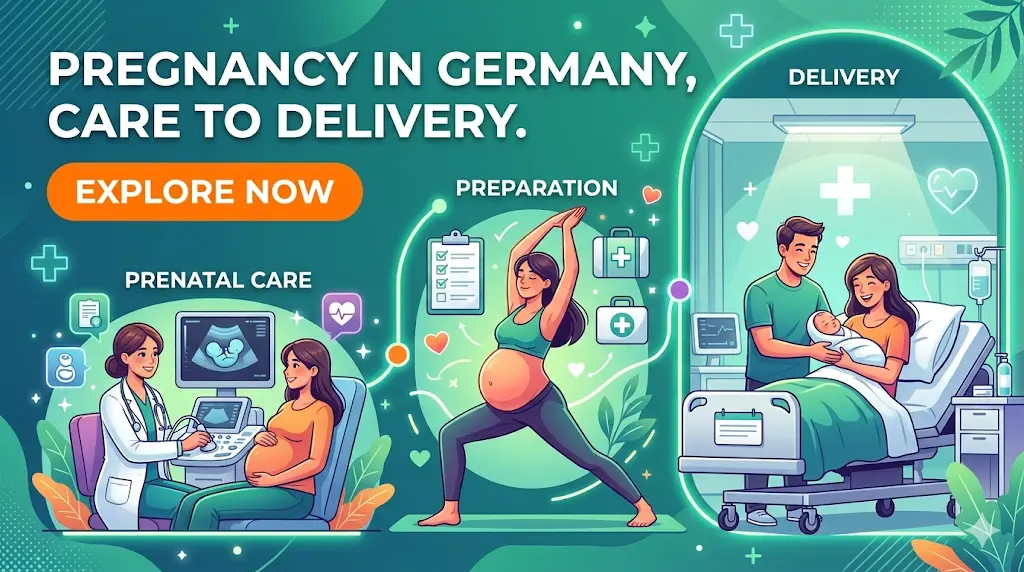
Pregnancy and Childbirth in Germany: Prenatal Care to Delivery
Discover everything expats need to know about navigating pregnancy in Germany. This comprehensive guide explores prenatal medical care schedules, the crucial role of midwives, delivery options, and how the robust healthcare system supports mothers from conception to childbirth.
Disclosure: This post may contain affiliate links. We may earn a commission at no extra cost to you if you make a purchase through these links. Read full disclosure.
Early Pregnancy and Choosing Your Medical Support Team
Confirming the Pregnancy and Obtaining the Mutterpass
The journey of pregnancy in Germany begins the moment you see a positive result on a home test. Unlike some countries where you might not see a doctor until the end of your first trimester, the German healthcare system encourages you to schedule an appointment with your gynecologist (Frauenarzt) relatively early, typically around the seventh or eighth week of gestation. During this initial visit, the doctor will perform a transvaginal ultrasound to confirm the viability of the pregnancy, check the fetal heartbeat, and determine your estimated due date. This early medical confirmation provides peace of mind and officially triggers the robust support mechanisms provided by the German state.
Upon confirmation of a viable pregnancy, you will be issued one of the most important documents you will carry in Germany: the Mutterpass (Mother’s Passport). This small, legally standardized booklet serves as the comprehensive medical log for your entire pregnancy. It records your blood type, iron levels, ongoing weight tracking, blood pressure readings, and the detailed results of every single ultrasound and screening you undergo. Because emergencies can happen at any time, doctors explicitly instruct pregnant women to carry their Mutterpass with them everywhere they go, from a quick trip to the grocery store to a weekend getaway across the border.
Understanding how to navigate these initial appointments is crucial for expats who might be unfamiliar with the direct-access medical system. You do not need a referral from a general practitioner to see a gynecologist for pregnancy confirmation. If you are still trying to understand how specialized reproductive care is structured in the country, reviewing Women’s Health in Germany: Gynecologists, Maternity Care, and More will provide you with the foundational knowledge required to confidently start your prenatal journey.
Selecting a Gynecologist for Prenatal Appointments
In Germany, your Frauenarzt serves as your primary medical manager throughout your pregnancy. This physician is responsible for monitoring the medical health of both the mother and the developing fetus, conducting the statutory ultrasound screenings, and ordering necessary blood and urine diagnostics. Because you will be visiting this doctor frequently—initially every four weeks, and then every two weeks as you approach your due date—finding a practitioner with whom you feel entirely comfortable is absolutely essential. For international residents, locating a doctor who speaks fluent English is often the top priority to ensure complex medical terminology is perfectly understood.
Expats frequently utilize digital booking platforms like Doctolib to filter local gynecological clinics by languages spoken and accepted insurance types. It is important to note that popular clinics in major hubs like Berlin, Munich, or Frankfurt are often operating at maximum capacity. If you wait too long to establish a relationship with a Frauenarzt, you may encounter clinics that have enacted temporary freezes on accepting new publicly insured patients. However, clinics are generally highly accommodating to newly pregnant women and will make efforts to fit you into their prenatal care schedule if you inform them of your positive test result.
The type of health insurance you hold can also subtly influence your booking experience. Patients with private health policies often find it easier to secure expedited appointments at specialized private practices (Privatpraxen) that do not accept statutory insurance. If you hold a comprehensive private policy from premium providers like Ottonova, you may enjoy flexible scheduling, enhanced clinical environments, and the ability to utilize digital concierge services to find an English-speaking doctor.
The Critical Task of Finding a Hebamme Early
While your gynecologist oversees the medical diagnostics of your pregnancy, the Hebamme (midwife) provides the essential holistic, practical, and emotional support. In the German maternity system, midwives hold a profound level of authority and respect. By law, a doctor is not permitted to deliver a baby in a hospital without a midwife present, barring extreme medical emergencies. Furthermore, midwives provide invaluable prenatal counseling, lead birthing preparation classes, and conduct postpartum home visits to monitor the baby’s weight and assist the mother with physical recovery and breastfeeding.
However, Germany is currently experiencing a severe, systemic shortage of licensed midwives. Securing a Hebamme is notoriously the most stressful logistical challenge a newly pregnant expat will face. It is an unwritten rule that you must begin searching for and contacting freelance midwives almost the exact week you receive a positive pregnancy test. If you wait until your second trimester to begin emailing local midwives, you will almost certainly find that every practitioner in your city is fully booked for your due date month, leaving you without dedicated postpartum support.
Expats should leverage specialized search portals like Ammely or Hebammensuche to filter midwives by postal code, expected due date, and language capabilities. You must also distinguish between a Beleghebamme (a specialized midwife who remains on call to personally attend your hospital birth) and a standard Nachsorgehebamme (a midwife who only provides postpartum care at your home).
Comprehensive Prenatal Care and Medical Screenings
Statutory Ultrasound Checks and Routine Appointments
The baseline prenatal care provided under the German statutory health insurance system is magnificently thorough. Your routine appointments are meticulously scheduled to monitor every phase of fetal development. During a standard checkup, a medical assistant will test your urine for protein and sugar, check your weight, measure your blood pressure, and sometimes draw blood to check your hemoglobin (iron) levels. The doctor will then perform a physical examination to check the position of the cervix and assess the growth of the uterus, ensuring everything aligns with your gestational age.
A defining feature of German prenatal care is the provision of three major, legally mandated ultrasound screenings (Basis-Ultraschalluntersuchungen). These are fully funded by public health insurance and occur roughly around the 10th, 20th, and 30th weeks of pregnancy. The first ultrasound confirms the heartbeat and determines the exact due date. The second, often called the “organ screening,” is a highly detailed examination where the doctor systematically reviews the fetal brain, heart chambers, spine, and limbs to rule out structural anomalies. The third ultrasound assesses the baby’s final growth trajectory, amniotic fluid volume, and physical positioning in preparation for birth.
This structured schedule guarantees that potential complications are identified long before they become critical threats. For publicly insured expats, walking into these appointments knowing that the core diagnostics are 100 percent covered provides immense financial relief. If you are still trying to understand exactly which procedures are legally mandated versus which are optional, reviewing Public Health Insurance gesetzliche Krankenkasse: What It Covers and Costs provides an excellent breakdown of your statutory rights.
Navigating Supplementary Elective Screenings IGeL
While the statutory baseline care is exceptionally robust, German gynecologists frequently present pregnant patients with a catalog of elective, supplementary diagnostics known as IGeL services (Individuelle Gesundheitsleistungen). These are optional medical tests that the public sickness funds deem non-essential for a standard, low-risk pregnancy. Consequently, if you choose to undergo an IGeL procedure, you must pay for it entirely out of your own pocket. A common example is the blood test for Toxoplasmosis or Cytomegalovirus (CMV), which many women elect to take for peace of mind despite the out-of-pocket fee.
Another highly popular elective diagnostic is the Non-Invasive Prenatal Test (NIPT), frequently referred to by commercial brand names like the Harmony Test. This sophisticated blood test screens fetal DNA present in the mother’s bloodstream to identify chromosomal abnormalities such as Down syndrome (Trisomy 21). While the statutory insurance will cover the NIPT in very specific, high-risk scenarios determined by the doctor, younger women with low-risk profiles generally must self-fund this test, which can cost several hundred euros. Additionally, advanced 3D or 4D keepsake ultrasounds are strictly classified as private lifestyle expenses.
Evaluating which IGeL tests are genuinely necessary requires open, honest communication with your Frauenarzt. Privately insured expats often experience a distinct advantage here, as comprehensive private tariffs frequently encompass a much broader range of preventative screenings by default. If you utilize a modern digital broker like Feather Insurance, you can easily review your policy documents in English to determine exactly which advanced prenatal diagnostics are automatically covered, shielding your family from unexpected medical invoices.
Managing Nutrition and Preventative Health During Pregnancy
The German medical community places a massive emphasis on preventative health and nutritional optimization during pregnancy. Your doctor will immediately advise you to begin supplementing with high-quality Folic Acid (Folsäure) to prevent neural tube defects, alongside targeted doses of Iodine and often Iron, depending on your ongoing blood work results. Dietary advice in Germany is notably strict; pregnant women are strongly cautioned against consuming raw milk cheeses (Rohmilchkäse), raw fish like sushi, and traditional German raw meat delicacies such as Mett or Teewurst to eliminate the risk of Listeria and Toxoplasmosis infections.
Because the physical demands of pregnancy heavily deplete your body’s natural reserves, maintaining a holistic approach to your wellness is critical. Expats frequently discover that premium prenatal multivitamins, specialized probiotics for gut health, and magnesium supplements are surprisingly expensive when purchased at local German brick-and-mortar pharmacies (Apotheken). To manage these recurring costs, many savvy international mothers bypass local retail markups by bulk-ordering high-grade, scientifically tested prenatal supplements through global wellness platforms like iHerb.
Integrating these nutritional strategies with safe, pregnancy-approved physical activities—such as specialized prenatal yoga or swimming—can drastically reduce common ailments like pelvic girdle pain and gestational fatigue. Many sickness funds even subsidize certified preventative exercise classes designed specifically for expectant mothers. Integrating these holistic habits into your daily routine is a core strategy advocated in our Healthy Living in Germany: Wellness, Fitness, and Mental Health Guide.
Preparing for Delivery and Choosing a Birth Location
Hospital Births Versus Birthing Centers
As you enter your third trimester, deciding where to deliver your baby becomes the focal point of your preparations. The German healthcare system offers several distinct, highly safe environments catering to different birthing philosophies. The vast majority of births occur in the maternity ward (Kreißsaal) of a standard or university hospital (Krankenhaus). Hospitals offer the ultimate medical safety net; they are fully equipped to administer epidurals (PDA), perform emergency Cesarean sections, and house specialized Neonatal Intensive Care Units (NICU) to handle premature births or sudden infant distress.
For women experiencing low-risk, uncomplicated pregnancies who desire a highly natural, holistic birthing experience, a Geburtshaus (birthing center) is an increasingly popular alternative. These facilities are entirely operated by teams of experienced midwives and intentionally resemble comfortable, home-like environments rather than sterile clinical wards. They prioritize movement, water births, and continuous emotional support, but they strictly do not offer heavy medical interventions like epidurals or continuous electronic fetal monitoring. If a severe complication arises, the midwives are trained to execute an immediate, coordinated transfer to a nearby partner hospital.
To help expecting parents evaluate these contrasting environments, consider the following comparative breakdown:
| Feature / Facility | Hospital (Krankenhaus) | Birthing Center (Geburtshaus) |
| Medical Interventions | Full access (Epidurals, C-sections) | Minimal to none (Natural pain relief only) |
| Leading Authority | Midwife-led, Doctor steps in if needed | Exclusively Midwife-led |
| Emergency Infrastructure | On-site NICU and surgical theaters | Requires ambulance transfer to a hospital |
| Postpartum Stay | Typically 2-4 days inpatient stay | Ambulant (Go home a few hours after birth) |
| Atmosphere | Clinical, highly monitored | Homely, relaxed, highly personalized |
Understanding these profound structural differences allows you to align your birth preferences with the appropriate facility.
Pre Registering at Your Chosen Facility
Regardless of whether you choose a high-tech university hospital or an intimate birthing center, you must formally pre-register at the facility several weeks before your estimated due date. This bureaucratic process is known as the Anmeldung zur Geburt. Typically occurring between the 34th and 36th weeks of pregnancy, this appointment ensures that the facility has your complete medical history fully documented in their system long before you arrive in the throes of active labor.
During the Anmeldung appointment, a hospital midwife or doctor will meticulously review your Mutterpass, discussing any risk factors identified during your prenatal care. This is also the ideal time to articulate your specific birth preferences, such as your desire for a water birth, delayed cord clamping, or specific labor positions. You will also meet with an anesthesiologist to review the risks and sign the consent forms for an epidural (PDA) and an emergency C-section. Signing these legal documents while you are calm and clear-headed prevents you from having to process complex medical legalese while enduring intense contractions.
Furthermore, most hospitals highly encourage expectant parents to attend a Kreißsaalbesichtigung, which is a guided tour of the delivery rooms and the maternity ward. These informational evenings allow expats to familiarize themselves with the physical layout of the hospital, understand where to park in an emergency, and ask the clinical staff targeted questions regarding their policies on birthing partners and postnatal care, significantly reducing anxiety as the due date approaches.
Drafting a Birth Plan and Pain Management Options
Drafting a birth plan is a highly recommended exercise for expats delivering in Germany. The German medical culture surrounding childbirth is notably less interventionist than in many North American systems. Natural physiological birth is heavily championed, and doctors generally do not rush to administer labor-inducing drugs or perform elective C-sections without robust clinical justification. Writing down your preferences ensures that the attending midwives understand your boundaries, particularly if you are navigating the intense experience of labor in a second language.
When it comes to pain management, German maternity wards offer a broad spectrum of options ranging from holistic to highly medicalized. Midwives frequently utilize alternative pain relief methods, including specialized breathing techniques, warm water immersion in a birthing tub, acupuncture, homeopathy, and antispasmodic suppositories. If you require stronger pharmacological relief, nitrous oxide (laughing gas) and intravenous opioid painkillers are commonly available.
The ultimate tool for pain management is the Periduralanästhesie (PDA), the German term for an epidural. While epidurals are universally available in hospitals, the German approach is to use them judiciously. Midwives will often encourage laboring women to try alternative coping mechanisms first, rather than administering a PDA the moment they walk through the hospital doors. Clear communication regarding your pain threshold and your desire for a PDA is vital.
The Delivery Process and Immediate Postpartum Care
Labor Room Dynamics and the Role of Your Midwife
When active labor begins and you arrive at the hospital’s maternity ward, you might be surprised by the clinical dynamics. In Germany, the delivery process is almost exclusively led and managed by a hospital midwife. When you are admitted to the Kreißsaal, the midwife will monitor your contractions, track the baby’s heart rate, coach you through the physical exertion of labor, and guide the actual delivery of the infant. The atmosphere is generally calm, deeply supportive, and focused entirely on empowering the mother.
The medical doctor (obstetrician) typically remains completely in the background during a standard, uncomplicated vaginal delivery. In many cases, the doctor will only enter the delivery room during the final pushing phase to witness the birth and handle any immediate perineal suturing required after delivery. The doctor is only called upon to actively intervene if the labor stalls, fetal distress is detected, or if mechanical assistance—such as a vacuum extraction or an emergency Cesarean section—becomes clinically necessary.
This midwife-led model can be a profound culture shock for expats accustomed to systems where an obstetrician micromanages every minute of labor. Embracing the authority and deep physiological expertise of the German midwife is essential for a positive birthing experience. If you have hired a freelance Beleghebamme, she will accompany you to the hospital and manage your birth personally, providing unparalleled continuity of care, though you will have to pay an out-of-pocket “on-call” fee for her services.
Hospital Stays and the Family Room Familienzimmer
Following the delivery, mother and baby are transferred to the postnatal ward (Wochenbettstation). The standard inpatient stay in a German hospital is noticeably longer than in many other countries to ensure maternal recovery and establish successful breastfeeding. For an uncomplicated vaginal delivery, you can expect to stay for two to three days. If you delivered via a Cesarean section, the hospital stay is typically extended to four or five days. During this time, nurses and lactation consultants provide continuous, hands-on support.
Standard statutory public insurance guarantees a bed in a shared room, typically housing two to three mothers and their newborns. For expats desiring absolute privacy and the continuous presence of their partner, requesting a Familienzimmer (family room) is highly sought after. A family room operates like a private hotel suite within the hospital, allowing the partner to sleep over and share all meals, fundamentally transforming the initial postpartum bonding experience. However, family rooms are subject to availability on the day of birth and cannot be guaranteed in advance.
Crucially, the statutory public health insurance system does not cover the cost of a Familienzimmer. You will be billed a daily surcharge for this hotel-style upgrade, which typically ranges from 50 to 150 euros per night, depending on the hospital. Managing these unexpected, private medical invoices requires efficient financial planning. If you need to transfer funds from an overseas account to settle your hospital discharge bill quickly, utilizing transparent, low-fee borderless platforms like Wise ensures you aren’t penalized by exorbitant traditional banking exchange rates.
Bureaucratic Steps After Birth Securing the Geburtsurkunde
The moment your child is born in Germany, an intense, highly specific bureaucratic sequence begins. Your absolute first administrative priority is officially registering the birth at the local registry office (Standesamt) to secure the child’s birth certificate (Geburtsurkunde). Without this official certificate, you cannot apply for statutory child benefits (Kindergeld), parental allowance (Elterngeld), or add your newborn to your health insurance policy.
Fortunately, many German hospitals feature an internal registration office or operate a dedicated courier service that transports your documents directly to the Standesamt on your behalf, sparing exhausted new parents from having to physically travel to a government building. To utilize this service, you must arrive at the hospital with a meticulously prepared folder of original documents. This typically includes the passports of both parents, your own original birth certificates, and your marriage certificate. If these documents were issued outside of Germany, they must usually be officially translated by a sworn translator and bear an international Apostille stamp.
Once the Standesamt processes the paperwork, they will mail multiple, purpose-specific copies of the Geburtsurkunde directly to your home address. You will use these specialized copies to apply for state financial benefits and to officially trigger your child’s free family co-insurance under the statutory public system.
Financial Support and Insurance Considerations
Understanding Maternity Leave Mutterschutz
The German state fiercely protects the physical, emotional, and financial well-being of expectant mothers through highly progressive labor legislation. The cornerstone of this protection is the Maternity Protection Act (Mutterschutzgesetz). By law, an employed pregnant woman is strictly forbidden from working during the six weeks immediately preceding her estimated due date, and for the eight weeks immediately following the birth of the child (twelve weeks for premature or multiple births). This fourteen-week absolute protection period guarantees that the mother can focus entirely on preparation and recovery without professional stress.
During this mandatory Mutterschutz period, you do not suffer any financial penalty. The mother continues to receive 100 percent of her standard average net salary. This financial continuity is jointly funded by the state and the employer. Your statutory sickness fund pays a set daily maternity benefit (Mutterschaftsgeld), and your employer is legally obligated to “top up” the remaining difference so that your income remains completely stable. To activate this benefit, your Frauenarzt will issue an official certificate detailing your expected due date, which you must submit to your employer and your insurance company seven weeks before birth.
Following the mandatory Mutterschutz period, the financial support transitions into Elterngeld (Parental Allowance), which compensates parents for the loss of income if they choose to temporarily stop working to raise their newborn. These profound social safety nets drastically reduce the financial terror of starting a family abroad.
How Public and Private Health Insurance Cover Costs
When it comes to the sheer volume of medical care required during pregnancy and childbirth, the German statutory public health insurance system (GKV) is magnificently generous. If you are publicly insured, your sickness fund absorbs virtually 100 percent of the costs for all medically necessary prenatal care, the entire hospital delivery, the epidural, the hospital stay, and the invaluable postpartum visits from your freelance midwife. The billing is entirely cashless; you simply present your electronic health card (eGK), and you will not see a single invoice for these massive clinical interventions.
For high-earning expats or successful freelancers who have opted into the private health insurance sector (PKV), the medical coverage is equally comprehensive but fundamentally upgrades the exclusivity of the care environment. A premium private tariff often guarantees that your prenatal ultrasounds are performed using the most advanced 3D technology, automatically covers all advanced elective screenings (like the NIPT), and ensures you are accommodated in a private single-bed room following delivery. Furthermore, private policies routinely include chief physician treatment (Chefarztbehandlung), guaranteeing that the head obstetrician actively manages your hospital birth.
Choosing between the absolute financial predictability of the public system and the premium, highly personalized comforts of the private sector is a monumental decision for young expat couples planning a family. If you are currently evaluating your insurance trajectory, utilizing digital-first brokerage platforms like Feather Insurance allows you to model these exact maternity scenarios in English.
Handling Out of Pocket Medical Expenses
While the overarching medical costs of childbirth are insulated by insurance, expat parents must proactively budget for a variety of peripheral, out-of-pocket expenses that arise during the maternity journey. As previously mentioned, securing a Familienzimmer at the hospital is a private expense. If you hire a specialized Beleghebamme to personally attend your hospital birth, you must pay a Rufbereitschaftspauschale (on-call fee), which guarantees she will drop everything to rush to the hospital when you go into labor. This fee typically ranges from 500 to 1,000 euros and is generally not reimbursed by public sickness funds.
Additionally, the postpartum period—often referred to as the “fourth trimester”—requires significant physiological support. The German system fully funds physical rehabilitation via postpartum pelvic floor courses (Rückbildungskurse), but it does not cover the cost of specialized postnatal nutrition or holistic recovery tools. Expats frequently invest heavily in high-grade omega-3 supplements to combat postnatal brain fog, premium lactation teas to support breastfeeding, and highly specialized organic dermacosmetics for infant care.
To manage these ongoing recovery costs efficiently without paying local retail markups, savvy international mothers order their specialized postpartum wellness kits through global platforms like iHerb. Managing the logistical and financial realities of these out-of-pocket expenses—from paying your midwife’s on-call invoice using transparent transfer tools like Wise to stocking your nursery with essential supplements—ensures that you remain perfectly equipped to handle the immense transition into parenthood in Germany.
Conclusion
Experiencing pregnancy and childbirth in Germany is a profoundly empowering and exceptionally well-supported journey. The system’s unique blend of high-tech medical diagnostics overseen by your Frauenarzt and the deeply holistic, hands-on guidance provided by the Hebamme ensures that both mother and baby are fiercely protected from conception through postpartum recovery.
By proactively navigating the early bureaucratic steps, understanding the strict divisions between statutory coverage and elective IGeL services, and preparing your documentation for the hospital Anmeldung, expats can fully leverage Germany’s world-class maternity infrastructure. Embracing the robust protections of Mutterschutz and utilizing intelligent financial and insurance strategies guarantees that you can welcome your new child with absolute medical confidence and profound peace of mind.
References
Primary sources (official)
- Federal Ministry for Family Affairs, Senior Citizens, Women and Youth (BMFSFJ) – Maternity Protection Act: https://www.bmfsfj.de/bmfsfj/meta/en/publications-en/maternity-protection-act-138470
- Make it in Germany (Official Portal) – Parental Benefit and Maternity Leave: https://www.make-it-in-germany.com/en/living-in-germany/family-reunification/parental-benefit
Other helpful sources
- The German Midwives Association (Deutscher HebammenVerband): https://www.hebammenverband.de/
- Ammely (Official German Midwife Search Platform): https://www.ammely.de/
Disclaimer
The information provided in this article is for general informational and educational purposes only and does not constitute professional medical, legal, or financial advice. The German healthcare system, maternity leave regulations (Mutterschutz), and statutory insurance policies regarding pregnancy are highly complex and subject to continuous legislative updates. Always consult directly with a qualified healthcare professional, a licensed gynecologist or midwife, your specific Krankenkasse, or a certified independent insurance broker regarding your unique prenatal health needs, birth plans, and legal insurance obligations in Germany.