Religious Communities in Germany: Finding Churches, Mosques, and Temples
Arriving in a secular yet deeply traditional country makes finding a place of worship incredibly isolating, especially when local services are entirely in German and you are handed a surprising church tax bill. I spent my first Sunday wandering Munich, desperately searching for an English-speaking congregation. This guide helps you navigate church taxes, locate diverse religious communities, and practice your faith abroad.
Disclosure: This post may contain affiliate links. We may earn a commission at no extra cost to you if you make a purchase through these links. Read full disclosure.
Understanding Freedom of Religion in Germany
The Constitutional Right to Faith
Germany’s Basic Law guarantees freedom of faith and conscience, allowing everyone to practice their religion openly and without fear of persecution. The relationship between church and state in Germany is highly unique. While there is no official state religion, the government cooperates extensively with recognized religious communities. This cooperative model means the state collects taxes on behalf of major churches, oversees religious education in public schools, and incorporates faith-based organizations into its vast social welfare system. For expats coming from countries with a strict separation of church and state, this deep intertwining can feel completely alien.
However, the reality of practicing openly in Germany is nuanced. German society is incredibly tolerant, but religion is widely considered a highly private matter. You will rarely find people discussing their faith at the workplace or engaging in public proselytizing. This quiet, reserved approach to spirituality can feel lonely for an expat who comes from a country where religion is a loud, communal, and highly visible part of daily life.
It is completely normal to feel disconnected when your spiritual routine is disrupted by a cross-border move. The loss of your home congregation is a valid and heavy part of the relocation process. Recognizing that finding a new spiritual home takes time is an essential step in Coping with Culture Shock: Adjusting to Life in Germany. Be patient with yourself as you navigate this new, deeply private religious landscape.
The Kirchensteuer Church Tax System
One of the most massive and frustrating financial shocks expats face is the German church tax, known as the Kirchensteuer. If you officially declare yourself as a member of the Catholic, Protestant, or Old Catholic church, the German state automatically deducts an additional 8 to 9 percent of your income tax liability directly from your gross monthly salary. This is not a voluntary donation; it is a legally binding tax collected by the federal tax office on behalf of the church.
The trap usually occurs during your first week in the country. When you register your address at the local citizens’ office, the clerk will hand you a form asking for your religious affiliation. Many expats casually check “Catholic” or “Protestant” because they were baptized, completely unaware that this simple checkmark authorizes a significant monthly payroll deduction. To fully grasp how this registration dictates your life, you should read our breakdown on Anmeldung (Address Registration) vs Visa: Why Both Are Needed in Germany.
Leaving the church to stop paying this tax is known as Kirchenaustritt, and it is a bureaucratic nightmare. You cannot simply email your local parish. You must book a formal appointment at your local district court (Amtsgericht) or civil registry office, appear in person with your passport, and pay an administrative fee ranging from 30 to 60 euros. Only then will the court issue a certificate that legally instructs the tax office to stop the deductions.
| Feature | Paying Church Tax Registered | Opting Out Kirchenaustritt |
| Financial Impact | Automatic deduction of 8-9% of your income tax liability | Instant increase in your net monthly take-home pay |
| Access to Sacraments | Full access to baptisms, weddings, and funerals | Denied access to official church weddings and sacraments |
| Employment Rights | Eligible to work for church-run hospitals, schools, and charities | May be legally disqualified from working at church-affiliated institutions |
| Community Support | Actively funds local parish activities and community maintenance | Must find private, non-tax funded ways to support the community |
Navigating Secularism Versus Tradition
Germany presents a fascinating paradox to foreigners: it is an increasingly secular country that stubbornly clings to deeply religious traditions. Church attendance has been declining for decades, yet the entire national calendar revolves around Christian holidays. You will get days off for Ascension Day, Whit Monday, and Corpus Christi, even if your local colleagues treat them strictly as opportunities for a long weekend rather than days of religious observance.
The most jarring tradition for expats is the concept of the Sunday rest, or Ruhetag. Rooted in Christian tradition, federal law mandates that all retail shops, supermarkets, and malls remain strictly closed on Sundays. While this enforced rest day provides dedicated time to practice your faith or spend time with family, it causes massive anxiety for newcomers who forget to buy groceries on Saturday. When searching for a quiet apartment on Wunderflats, keep in mind that living near a central train station might be your only saving grace on a Sunday, as station supermarkets are legally allowed to remain open.
Adapting to this environment requires balancing your own beliefs with the local rhythm. You must learn to respect the quietness of Sundays, meaning no loud vacuuming or glass recycling, while building a routine that nourishes your own spirituality.
Finding Your Christian Community
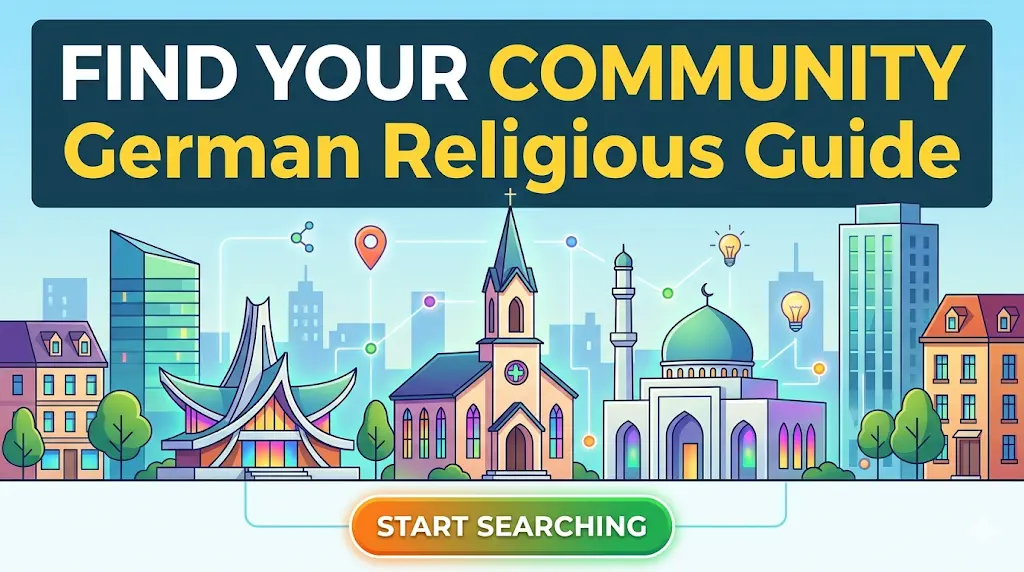
Protestant and Catholic Landscapes
The Christian landscape in Germany is roughly divided geographically. The southern and western states, particularly Bavaria and the Rhineland, are heavily Catholic, boasting stunning cathedrals and deeply embedded public traditions like regional religious holidays. In contrast, the northern and eastern states lean heavily toward Protestantism or secularism, a lingering effect of the historical division during the Cold War.
When you walk into a local German parish, whether Catholic or Protestant, you will find a congregation that is generally welcoming but highly traditional. The services, hymns, and sermons will be entirely in German, which can make participating incredibly difficult if you are still grappling with the language barrier. Furthermore, the atmosphere might feel much more formal and reserved than the energetic, modern services you might be accustomed to back home.
However, do not be afraid to reach out to the local priest or pastor. Many German clergy members speak excellent English and understand the isolation expats face. Even if you cannot follow the Sunday sermon, integrating into the local parish through volunteering or community dinners is a powerful way to practice your faith while slowly improving your German listening skills.
English Speaking and International Churches
For expats who crave a service they can fully understand, major German cities offer vibrant international and English-speaking churches. These range from traditional Anglican and Episcopal congregations to modern, non-denominational charismatic megachurches. Cities like Berlin, Frankfurt, and Munich host incredibly diverse congregations filled with international students, diplomats, and tech workers.
These international churches often double as massive expat hubs. Beyond Sunday worship, they organize mid-week small groups, career networking events, and practical seminars on navigating German bureaucracy. Finding an international church is often the fastest way to build a supportive, likeminded friend group. When you are new to the country, fellow church members are usually the first to offer help with navigating the complex tax systems, which we detail further in Understanding Taxes in Germany: An Expat’s Guide to the German Tax System.
Locating these congregations usually requires a quick digital search. Most international churches maintain active Facebook pages and organize their social gatherings through digital platforms. If you want to learn more about networking in your new city, reading Finding Your Community: Expat Groups, Clubs, and Meetups in Germany will provide you with the tools to connect with these groups before you even unpack your bags.
Orthodox Communities and Expats
The Orthodox Christian community in Germany has grown exponentially over the last decade, driven largely by the influx of expats and refugees from Eastern Europe, the Balkans, and the Middle East. You can find thriving Greek, Russian, Serbian, and Syrian Orthodox communities, particularly in industrial hubs and large metropolitan areas.
The challenge for many Orthodox expats is that these specific churches are not in every neighborhood. Depending on your specific tradition, you might find yourself traveling an hour by regional train every Sunday just to reach a parish that celebrates the Divine Liturgy in your native language. This commute can be exhausting, but the reward is a tight-knit community that completely understands your specific cultural background.
These communities are incredibly robust. They offer extensive social support networks, native language classes for children, and assistance with translating foreign civil documents. If you are preparing to get married within the Orthodox church and need your foreign civil status officially recognized by the German state, you can read our guide on Legalizing and Translating Documents for German Visa Applications to ensure your paperwork meets the strict legal standards.
Islamic Life and Mosques in Germany
The Diversity of the Muslim Community
Islam is the second-largest religion in Germany, making up a massive and vibrant part of the cultural fabric. Historically, the Muslim community was predominantly of Turkish descent, stemming from the guest worker programs of the 1960s. Consequently, many of the largest and most established mosques in Germany are run by DITIB, the Turkish-Islamic Union. In these mosques, the Friday Khutbah is often delivered in Turkish and German.
However, recent waves of immigration have radically diversified the Islamic landscape. Today, there are massive communities of expats and refugees from Syria, Afghanistan, Pakistan, North Africa, and the Balkans. This diversity is beautiful but can be frustrating for newcomers. An Arab expat might struggle to find a local mosque that preaches in Arabic, while a Pakistani student might search endlessly for an Urdu-speaking congregation.
Another significant frustration is the physical visibility of mosques. Due to strict historical zoning laws and occasionally complex local politics, many mosques in Germany are not traditional, standalone buildings with minarets. They are often “Hinterhofmoscheen,” hidden away in inner courtyards, converted apartments, or pushed out into commercial industrial parks (Gewerbegebiete). It can feel incredibly alienating to travel to a gray industrial zone on the outskirts of the city just to perform Friday prayers.
Finding Halal Resources and Local Mosques
Despite the architectural invisibility, finding halal food and Islamic resources is remarkably easy in Germany. Turkish supermarkets are an absolute lifesaver for Muslim expats. Even in smaller, mid-sized German towns, you will almost always find a local Turkish grocer offering certified halal meat, fresh produce, and familiar spices that standard German supermarkets completely ignore.
When you want to live in a temporary flat from Wunderflats, prioritizing diverse neighborhoods like Neukölln in Berlin or the multicultural districts of Cologne ensures you will have instant access to these essential resources. Wunderflats makes it incredibly easy to secure short-term housing in these vibrant hubs, allowing you to test out the community and confirm that your local halal butcher and preferred mosque are within walking distance before you commit to a permanent, unfurnished lease.
During Ramadan, these diverse neighborhoods come alive. The sense of community during Iftar is profound, with many local restaurants and mosques hosting open, communal dinners. To find the exact prayer times and locate the most relevant mosques for your specific background, relying on digital directories and local university Islamic societies is highly effective.
Integrating Faith Into German Daily Life
Practicing Islam in a corporate German environment requires open communication. German labor law protects your constitutional right to practice your religion, meaning you are theoretically allowed to pray at work. However, the law also dictates that your religious practice cannot disrupt the operational workflow of the business. You must proactively speak with your HR department to find a mutually agreeable quiet space and time for your daily prayers.
Wearing religious symbols, such as the hijab, is legally protected in the private sector, and recent court rulings have increasingly protected it in the public sector as well. Despite this legal protection, it is a valid and exhausting frustration that Muslim women occasionally face staring or microaggressions, particularly in more rural, conservative areas of the country.
Another massive hurdle is navigating religious holidays. Unlike Christian holidays, Eid al-Fitr and Eid al-Adha are not federally recognized public holidays in Germany. If you want to celebrate with your family or attend morning prayers, you must legally request time off using your standard annual vacation days.
Exploring Other Global Faiths
Jewish Communities and Synagogues
Germany’s Jewish community is steeped in a complex, tragic history, yet today it is experiencing a profound and vibrant resurgence. This growth is largely driven by a massive influx of Jewish expats from Eastern Europe, the United States, and particularly Israel. Cities like Berlin and Frankfurt now boast dynamic, youthful Jewish populations with thriving cultural scenes, kosher restaurants, and diverse congregations ranging from strictly Orthodox to progressive and reform synagogues.
However, the reality of attending a synagogue in Germany can be deeply jarring for expats accustomed to the relaxed security of congregations in North America or the UK. Due to ongoing security concerns, Jewish institutions in Germany are heavily guarded by armed police officers and physical barricades. You generally cannot simply walk off the street into a Friday night service; you are almost always required to register in advance, submit a copy of your passport, and pass through a security checkpoint.
While this high level of security is entirely necessary for safety, it can feel incredibly intimidating and unwelcoming at first. Once inside, however, the communities are incredibly warm and supportive. They frequently host young professional networking dinners and cultural festivals. If you are looking to expand your professional network within these groups, you can read Nightlife and Networking: Using Social Events to Advance Your Career to navigate these dual-purpose social events.
Hindu Buddhist and Sikh Temples
The presence of Hindu, Buddhist, and Sikh communities is growing rapidly, fueled by international students and highly skilled tech workers arriving from India and Southeast Asia. However, because these communities are relatively new compared to the established Christian and Islamic populations, dedicated temples are quite rare and typically confined to the absolute largest metropolitan areas.
If you are looking for a Mandir, a Vihara, or a Gurdwara, you must be prepared for a significant commute. These temples are almost exclusively located on the far outskirts of the city or in neighboring suburban towns where large commercial spaces are affordable. The deep comparative analysis of this reality is stark: while the pro is that you find an intensely loyal, tight-knit community that preserves your exact cultural traditions, the con is that practicing your faith becomes a massive logistical undertaking that consumes your entire weekend.
Furthermore, celebrating massive festivals like Diwali or Vaisakhi usually requires the community to rent out large, secular municipal halls. If you are trying to celebrate at home and cannot find specific prayer items or statues in the local German retail market, ordering from Amazon Germany is usually the fastest and most reliable method to get international items delivered. Amazon Germany provides access to a massive marketplace of imported cultural goods that simply do not exist in standard German home goods stores.
Building an Inter Faith Support System
Regardless of your specific religion, expats of all faiths share incredibly similar struggles in Germany. The crushing weight of the bureaucracy, the alienation of the language barrier, and the intense homesickness are universal experiences. Building an inter-faith support system with other international residents is an incredibly effective way to survive your first year.
Many universities and city integration councils host inter-faith dialogues and cultural exchange nights. Engaging in these events allows you to share resources. An expat from a different religious background might be the exact person who recommends the perfect English-speaking doctor or a brilliant immigration lawyer.
When you leverage these diverse networks, you quickly realize that the expat community is its own unique tribe. If you arrived in Germany on a student visa, leaning on your university’s international societies can connect you to these diverse groups effortlessly. For tips on utilizing these academic networks, review Alumni Networks: Leveraging University Connections for Your Career.
Practical Tips for Integrating Your Faith
Finding Community Spaces in Your City
When you relocate to Germany, the physical geography of your housing choice deeply impacts your spiritual life. If your faith requires daily or weekly communal attendance, choosing an apartment on the opposite side of the city from your place of worship will lead to rapid burnout.
When using Wunderflats to book your first apartment, you can check the integrated map feature to see if your prospective temporary home is within reasonable walking or transit distance of a specific church or mosque. Wunderflats makes it remarkably easier to test out a specific neighborhood and its community vibes before you commit to signing a binding, multi-year lease on an unfurnished apartment.
If your specific religious community is too small to own a dedicated building, do not be afraid to look for shared spaces. Many local German community centers (Bürgerhäuser) or even larger, progressive Protestant churches frequently rent out their back rooms to smaller, international faith groups for weekend services.
Sourcing Religious Items and Texts
A highly specific frustration for religious expats is the inability to find appropriate spiritual literature or ritual items. Walk into a standard German bookstore like Thalia or Hugendubel, and you will find their religion section is almost entirely academic, predominantly Christian, and exclusively in the German language. Finding an English-language Quran, a specific Torah commentary, or a specialized Buddhist text on the high street is virtually impossible.
To bypass this frustrating retail barrier, Amazon Germany is going to be your absolute best friend. Searching for specific religious articles on Amazon Germany saves you the endless frustration of trying to explain what an incense burner or a specific prayer mat is to a confused local shopkeeper in broken German.
You can also use Amazon Germany to order specific kosher or halal certified pantry staples in bulk. If you live in a smaller, rural German town where Turkish supermarkets or specialty kosher grocers are completely non-existent, utilizing e-commerce ensures you can maintain your dietary laws without driving three hours to a major city every single weekend.
Connecting With Likeminded Expats
Finding your spiritual home in Germany is not a passive activity; it requires aggressive networking. Do not expect the community to magically find you. You must actively search Facebook groups, use the Meetup app, and check the bulletin boards at your local university or international office.
It is also crucial to balance your life. While your religious community provides incredible comfort and a vital link to your home culture, you must ensure you do not completely isolate yourself from the broader secular expat community or local German society. Balance is the key to avoiding long-term culture shock.
Finally, remember that establishing your spiritual life abroad takes just as much time and patience as mastering the local language or securing your long-term visa. Be gentle with yourself during the transition. If you are still trying to sort out the foundational administrative hurdles of your relocation, take a deep breath and start with our comprehensive overview in Moving to Germany: Comprehensive Visa & Immigration Guide.
References
Primary sources (official)
- Federal Office for Migration and Refugees (BAMF) – Freedom of faith: https://www.bamf.de/SharedDocs/Videos/EN/Integration/Grundgesetz/grundgesetz-film-5-glauben.html?nn=282388
- BAMF Brief Analysis – Religious affiliation and everyday religious practice: https://www.bamf.de/SharedDocs/Anlagen/EN/Forschung/Kurzanalysen/kurzanalyse1-2025-religionszugehoerigkeit-gefluechtete.pdf?__blob=publicationFile&v=11
- Make it in Germany (Official Portal) – Church tax: https://www.make-it-in-germany.com/en/service/glossary/glossar/do/show/kirchensteuer
- Federal Ministry of the Interior and Community (BMI) – Integration and Values: https://www.bmi.bund.de/SharedDocs/pressemitteilungen/EN/2024/11/kabinett-integrationskurse.html
Other helpful sources
- Expatica Germany – Religion in Germany: https://www.expatica.com/de/living/integration/religion-in-germany-106798/
- Pew Research Center – Religious Landscape in Western Europe: https://www.pewresearch.org/religion/2018/05/29/being-christian-in-western-europe/
Disclaimer
The information provided in this article is for general informational purposes only and is based on the real-world experiences of expats living in Germany. The legal frameworks regarding freedom of religion, the collection and rates of the church tax (Kirchensteuer), and local zoning laws for religious buildings are highly complex and subject to frequent changes by local and federal authorities. This article does not constitute legal, tax, or immigration advice. Always consult the official website of your local tax office (Finanzamt), civil registry court (Amtsgericht), or a certified German tax advisor to ensure you fully understand your financial liabilities and rights regarding religious affiliation in Germany.