German Education System: Universities, Vocational Training, and More Explained
Understanding that children are separated into different academic tracks at age ten is a terrifying shock for expat parents. I spent agonizing months fighting the local bureaucracy just to get my daughter into a standard primary school. This guide demystifies the heavily tracked German education system, from the initial daycare battle to vocational apprenticeships and tuition-free universities.
Disclosure: This post may contain affiliate links. We may earn a commission at no extra cost to you if you make a purchase through these links. Read full disclosure.
The Early Years from Kita to Grundschule
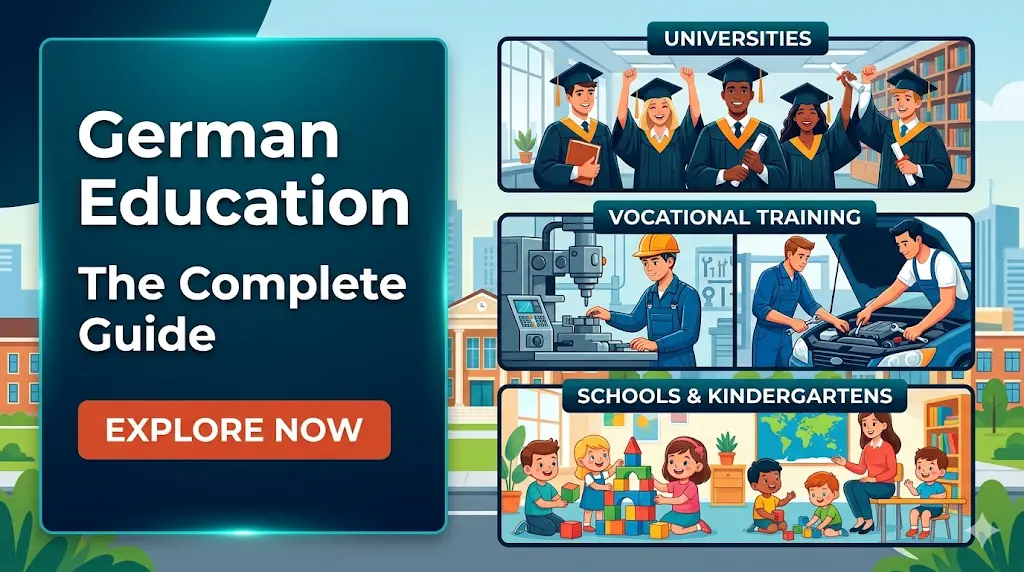
Navigating the early childhood education system in Germany is less about pedagogy and more about administrative warfare. Before your child even sets foot in a classroom, you will experience the notorious German bureaucratic machine firsthand. Germany offers universities, applied sciences, and vocational training, combining theory and practice, preparing students for academic and skilled careers effectively.
The Battle for Kita Spots
The term Kita (Kindertagesstätte) is the umbrella term for both Kinderkrippe (for children under three) and Kindergarten (ages three to six). By German law, every child over the age of one has a legal right to a childcare spot. However, the reality on the ground is a severe, nationwide shortage of educators (Erzieher) and physical facilities. This legal right often means nothing if there are literally no chairs available in your city.
For expats, the realization that you must apply for a Kita spot before your child is even born is deeply frustrating. The process often involves acquiring a Kita-Gutschein (childcare voucher) from your local youth welfare office (Jugendamt), which dictates how many hours of subsidized care you are entitled to based on both parents’ working hours.
Once you have the voucher, the real battle begins: the Kita interviews. Facility directors want to know if your family fits their specific educational philosophy. Trying to explain your parenting style in broken German is intimidating. Investing in intensive language sprints through Lingoda to master conversational German specifically for these parent-educator interviews can dramatically increase your chances of securing a coveted spot.
Grundschule and the Crucial Fourth Grade
Compulsory schooling begins at age six with Grundschule (primary school). The first day of school is a massive cultural event, symbolized by the Schultüte—a giant, brightly decorated paper cone filled with sweets and school supplies. However, expats are often shocked to discover that German primary schools generally operate on a half-day schedule. If both parents work, you must separately apply and pay for Hort (after-school care), which has its own devastatingly long waiting lists.
The primary school curriculum heavily emphasizes independence and socialization over rigorous academic drilling. You will quickly notice that parents are actively discouraged from walking their children directly to the classroom door. Six-year-olds are expected to walk or take the public bus to school independently, a concept that absolutely terrifies many North American and Asian expats who are used to heavy supervision.
The true stress of Grundschule arrives abruptly in the fourth grade (around age nine or ten). This is when the Übertrittszeugnis (transition recommendation) is issued. Based primarily on a child’s grades in German, Math, and General Studies, teachers dictate which of the three secondary school tracks the child is intellectually suited for. The immense pressure this puts on expat families is staggering. To fully understand the nuances of these complex parent-teacher conferences, utilizing GermanPod101 to learn specific educational vocabulary is a lifesaver.
Secondary Education The Three Tiered Sorting Hat
The German secondary education system is widely criticized by expats for forcing children to choose their lifelong career paths before puberty. Understanding how these three tracks operate is crucial for your child’s future.
Hauptschule and Realschule Paths
The Hauptschule (grades 5 through 9) is the lowest academic tier, designed to prepare students for basic manual trades and vocational apprenticeships. Historically, it was the backbone of the German blue-collar workforce. Today, however, there is a significant social stigma attached to this track, and many expats fight vehemently to keep their children out of it, fearing it severely limits their future earning potential.
The Realschule (grades 5 through 10) is the middle tier. It provides a broader general education and concludes with the Mittlere Reife (intermediate school-leaving certificate). This track is highly respected and perfectly aligns with Germany’s advanced vocational training system, preparing students for mid-level white-collar jobs, nursing, IT administration, and advanced technical trades.
Expats often panic when their child is recommended for a Realschule instead of the highest academic track. While the system claims to possess Durchlässigkeit (permeability)—meaning a student can excel in Realschule and later transfer to the higher track—the practical reality is that transferring requires exceptional grades and fighting severe administrative friction. For adults trying to map these qualifications to their own careers, see Working in Germany: Comprehensive Guide for Foreign Professionals.
The Gymnasium and the Abitur
The Gymnasium (grades 5 through 12 or 13, depending on the state) is the elite academic track. It is the direct route to the Abitur, the general higher education entrance qualification required to study at a traditional university. The curriculum is heavily theoretical, demanding high-level critical thinking and a massive volume of homework.
The workload in a Gymnasium is notoriously brutal. Students are required to learn at least two, sometimes three, foreign languages. For an expat child who is already struggling to learn German as a second language, being thrown into a Gymnasium environment where they must simultaneously learn French or Latin through the medium of German can result in immediate academic burnout.
If your child is placed in a Gymnasium, you must be prepared to offer intense academic support. Many expat families rely heavily on private tutors. Enrolling your teenager in structured, grammar-intensive online courses via Lingoda can help them bridge the gap between casual playground German and the highly academic, complex sentence structures required to write a successful history essay.
Gesamtschule as the Alternative
Because of the intense anxiety surrounding the early tracking system, many states have introduced the Gesamtschule (comprehensive school). This school type combines the Hauptschule, Realschule, and Gymnasium under one roof. Students are not rigidly separated at age ten; instead, they learn together and are streamed into different difficulty levels for specific subjects like math and languages as they grow older.
Expats overwhelmingly prefer the Gesamtschule because it closely mimics the high school models of the US, UK, and Australia. It allows late bloomers the time to mature and improve their German language skills without being permanently boxed out of a university education. A student can graduate from a Gesamtschule with an Abitur just as they would from a traditional Gymnasium.
The catastrophic downside is the scarcity of these schools. Because they are so popular among both expats and progressive German parents, the waiting lists are astronomical. Admission is often strictly based on municipal zoning boundaries (Einzugsgebiet).
| Secondary Track | Grade Levels | Final Qualification | Career Trajectory |
| Hauptschule | 5 – 9 | Hauptschulabschluss | Basic manual trades, crafts |
| Realschule | 5 – 10 | Mittlere Reife | Advanced vocational training, white-collar administration |
| Gymnasium | 5 – 12/13 | Abitur | University studies, academic professions |
| Gesamtschule | 5 – 13 | Varies by student | Flexible (Trades or University) |
Vocational Training The Duale Ausbildung
If there is one aspect of the German education system that is universally praised, it is the Duale Ausbildung (dual vocational training). It is the engine that drives the German Mittelstand and provides a highly respected, debt-free alternative to university.
How the Dual System Works
The dual system is exactly what it sounds like: training divided between two distinct locations. A trainee, known as an Azubi (Auszubildender), spends roughly 70 percent of their week working practically within a company, and 30 percent sitting in a Berufsschule (vocational school) learning the theoretical background of their trade, alongside general subjects like economics and civics.
There are over 320 officially recognized training occupations in Germany, ranging from traditional crafts like carpentry and plumbing to highly modernized roles in IT systems integration, mechatronics, and banking. The standard duration is two to three and a half years, culminating in a rigorous final examination administered by the Chamber of Industry and Commerce (IHK) or the Chamber of Crafts (HWK).
The brilliance of this system is that the curriculum is co-designed by the government and actual industry leaders. This ensures that the skills being taught at the Berufsschule directly match the current demands of the labor market. When an Azubi graduates, they are fully operational professionals, completely bypassing the “entry-level experience” paradox that plagues university graduates worldwide.
Finding an Apprenticeship as a Foreigner
Securing an apprenticeship is identical to hunting for a full-time job. You must submit a formal Lebenslauf (CV) and an Anschreiben (cover letter), and pass formal job interviews. Large companies like BMW or Siemens often begin recruiting for their apprenticeship programs 12 to 18 months in advance.
For non-EU foreigners, the bureaucratic hurdles have recently been lowered. Under the updated Skilled Immigration Act, you can apply for a visa specifically for the purpose of seeking or undertaking vocational training (Section 16a or 17 of the Residence Act).
However, the ultimate gatekeeper is language. To survive vocational school and communicate safely on a factory floor, you must possess a solid B1, ideally B2, level of German. The exams are entirely in German, and there is no leniency for foreigners. To aggressively prepare for these trade-specific language requirements, utilizing GermanPod101 to master technical vocabulary and workplace idioms is absolutely essential before applying.
The Financial Reality of an Azubi
Unlike university students, an Azubi is a salaried employee from day one. You receive an Ausbildungsvergütung (training allowance) paid directly by the company. As of recent legal updates, the minimum allowance for the first year of training is generally around 700 to 800 euros per month, scaling up in the second and third years depending on the specific industry tariff agreements.
While earning money to learn sounds fantastic, 800 euros a month is brutally insufficient to survive independently in major metropolitan areas like Munich, Frankfurt, or Berlin. Unless you have savings or are living with parents, you will likely need to apply for state subsidies like Berufsausbildungsbeihilfe (BAB) or housing allowance, provided your visa allows access to public funds. You must rigorously calculate your budget using realistic metrics from Cost of Living in Germany: Breakdown of Expenses (Rent, Food, Transport).
Despite the initial financial squeeze, the long-term Return on Investment (ROI) is stellar. The retention rate is incredibly high; most companies hire their Azubis immediately upon graduation because they have already invested three years into molding them into the perfect employee. You enter the workforce completely free of student debt, with highly sought-after, certified skills.
Higher Education Universities and Fachhochschulen
Germany is a global magnet for international students, largely due to its high academic standards and lack of tuition fees. However, navigating the higher education landscape requires understanding the strict division between academic and applied sciences.
Traditional Universities Universitaet
The traditional Universität (Uni) is focused heavily on theoretical knowledge, pure research, and academic independence. If you wish to study medicine, law, pharmacy, or humanities, or if your ultimate goal is to pursue a Ph.D. and a career in academia, you must attend a traditional university.
The teaching style here is a massive culture shock for expats accustomed to the hand-holding of American or British colleges. In a German Uni, professors will not chase you for homework, take attendance, or care if you fail. You are entirely responsible for structuring your own learning, registering for your own exams, and pacing your degree. The environment is highly anonymous; it is common to sit in massive lecture halls with 800 other students.
This freedom requires immense self-discipline. Many international students fail their first year simply because they cannot adapt to the lack of structure. The exams at the end of the semester usually count for 100 percent of your grade. If you fail to prepare, there are no “extra credit” assignments to save your GPA.
Universities of Applied Sciences Fachhochschule
The Fachhochschule (FH), or University of Applied Sciences, is the pragmatic sibling of the traditional university. The curriculum here is strictly tailored to the immediate needs of the labor market. The primary fields of study are engineering, business administration, computer science, and social work. You cannot study medicine or law at an FH, nor can you directly earn a Ph.D.
Expats and international students frequently prefer the FH model. The class sizes are significantly smaller, resembling high school classrooms rather than massive auditoriums. The curriculum is rigidly structured, meaning you follow a set timetable rather than designing your own. Most importantly, practically every FH degree includes a mandatory Praxissemester (internship semester) where you must work in a real company for six months.
This mandatory industry exposure means FH graduates often have a significantly easier time finding their first job compared to their traditional university counterparts. Employers value the hands-on experience and the practical, project-based thesis work that defines the FH system.
The Myth of Free Tuition and Hidden Costs
The global headline that “college in Germany is free” is mostly true, but highly misleading. While public universities in 15 of the 16 federal states do not charge tuition fees (the state of Baden-Württemberg charges non-EU students 1,500 euros per semester), studying is far from free.
Every student must pay a Semesterbeitrag (semester contribution) twice a year. This fee ranges from 150 to 350 euros. It is not tuition; it funds the student union, the dining halls (Mensa), and crucially, includes the Semesterticket, which gives you unlimited access to local public transportation for six months.
The real financial burden of studying in Germany is the cost of living. Renting a room in a shared flat (WG), buying groceries, and paying for mandatory student health insurance will easily cost between 900 and 1,200 euros a month. If you fail to account for these living expenses, your “free” education will quickly bankrupt you. To understand how the mandatory health insurance deductions impact your monthly budget, read Health Insurance in Germany: Public vs Private.
Navigating the Application Bureaucracy
Applying to a German university as a foreigner is not a matter of writing a compelling personal essay; it is a brutal, cold evaluation of your high school transcripts and language certificates.
Uni Assist and Foreign Degree Recognition
Unlike systems where you apply directly to a university portal, international applicants in Germany usually must process their applications through a centralized clearinghouse called Uni-Assist. This organization does not grant admission; their sole job is to evaluate your foreign high school diploma or Bachelor’s degree, verify its authenticity, and convert your grades into the German grading system.
The frustration with Uni-Assist is legendary among expats. You must upload flawlessly scanned, officially certified copies and certified translations of every single academic document you have ever received. If a stamp is slightly blurry or a translation is not from a sworn translator, Uni-Assist will reject the application, and the tight enrollment deadlines will pass.
Before paying the Uni-Assist fees (which cost 75 euros for the first application and 30 euros for each subsequent one), you must check the Anabin database. This official government database tells you explicitly whether your foreign high school diploma is recognized as equivalent to the German Abitur. If it is not, you will be forced to attend a Studienkolleg (preparatory year) before you can even apply. Navigating these databases requires the same immense patience needed when Navigating the Auslaenderbehoerde: Tips for Dealing with German Immigration Offices.
Language Requirements and Certificates
If you wish to enroll in a German-taught Bachelor’s or Master’s program, your conversational German is irrelevant. Universities require proof of highly advanced academic German, typically a C1 level. The only certificates universally accepted are the TestDaF (Test of German as a Foreign Language), the DSH (German Language University Entrance Examination), or the Goethe-Zertifikat C2.
These exams do not just test grammar; they test your ability to synthesize scientific texts, understand complex university lectures, and write structured academic arguments. Preparing for the TestDaF is grueling. Using generic language apps will not suffice. You must use specialized, rigorous platforms like Lingoda to prepare for the exact formatting, speaking prompts, and extreme time limits of these official exams.
While there is a massive surge in English-taught Master’s programs, English-taught Bachelor’s programs at public universities are still exceedingly rare. Even if your program is entirely in English, you will still need basic German to survive the university administration, sign your rental contracts, and interact with the local immigration office. Do not arrive with zero German skills.
The Numerus Clausus NC Explained
In Germany, university admission is generally objective. There are no interviews, no extracurricular activity reviews, and no legacy admissions. The only metric that matters is your grade average. For highly competitive subjects (like Medicine, Psychology, or Business Administration), universities utilize the Numerus Clausus (NC).
The NC is not a pre-set requirement; it is a historical cutoff. It simply represents the grade of the worst applicant who was admitted the previous semester. The German grading system runs from 1.0 (perfect) to 4.0 (barely passing). If a Psychology program has an NC of 1.2, it means you essentially need near-perfect high school grades to be admitted.
If your converted foreign grade does not meet the NC, your application is rejected. In the past, students could accumulate Wartesemester (waiting semesters) to eventually gain entry into medicine regardless of their grades, but recent supreme court rulings have drastically restricted this system, placing even heavier emphasis on standardized testing and excellent grades.
Student Life and Financial Survival
Getting accepted into the university is only the first administrative hurdle. Securing housing and funding your daily life requires aggressive planning and a deep understanding of German student visa laws.
Housing BAfOeG and Blocked Accounts
The most desperate struggle for international students is finding a place to sleep. University dormitories (Studentenwohnheime) are heavily subsidized and incredibly cheap, but there is nowhere near enough supply. Waiting lists can stretch for three to four semesters. Consequently, most students live in a Wohngemeinschaft (WG)—a shared private apartment. You must secure housing before you arrive, or you will be sleeping in an expensive hostel while competing with fifty other students for a single WG room.
For non-EU citizens, the immigration office will not grant your student visa unless you can prove you have the financial means to support yourself. You must deposit a legally mandated sum (currently around 11,208 euros per year) into a Sperrkonto (Blocked Account). This account is frozen, and it only pays out exactly 1/12th of the total sum (around 934 euros) into your normal checking account each month. To set up this complex financial infrastructure safely from abroad, review Opening a German Bank Account: N26, DKB, and Traditional Banks.
While German citizens and some EU nationals can receive state funding called BAföG (half grant, half zero-interest loan), non-EU international students are almost universally excluded from this financial aid. You must rely entirely on your blocked account, personal savings, or part-time work to survive.
Working as a Werkstudent
Because BAföG is generally unavailable for expats, working alongside your studies is a necessity. The German government allows non-EU students holding a Section 16b student visa to work exactly 120 full days or 240 half days per calendar year. Exceeding this limit by even one hour is a violation of your visa conditions and can lead to immediate deportation.
The ultimate goal for any international student is to secure a job as a Werkstudent (working student). This is a part-time role (up to 20 hours a week during the semester) directly related to your field of study. Under the Werkstudentenprivileg, you are exempt from paying unemployment and nursing care insurance contributions, which means your net take-home pay is significantly higher than a standard part-time retail job.
Beyond the financial benefits, a Werkstudent position is your foot in the door of the German corporate world. It allows you to build a local network, understand German office culture, and dramatically increases your chances of being offered a full-time contract upon graduation, seamlessly transitioning you into the skilled workforce.
References
Primary sources official
- KMK (Standing Conference of the Ministers of Education and Cultural Affairs): The official body coordinating education policy across all 16 federal states, providing the legal definitions of school tracks and higher education standards.https://www.kmk.org/en/bildungsministerkonferenz/bildungsthemen/educational-paths-and-qualifications.html
- Make it in Germany: The official government portal detailing the legal requirements, visa processes, and structure of the Dual Vocational Training system (Duale Ausbildung).https://www.make-it-in-germany.com/en/study-vocational-training/training-in-germany/vocational
Other helpful sources
- DAAD (German Academic Exchange Service): The definitive guide for international students seeking information on university programs, the Uni-Assist application process, and blocked accounts.https://www.daad.de/en/studying-in-germany/
Disclaimer
The information provided in this article is for general informational and educational purposes only and does not constitute professional legal, immigration, or academic advising. The German education system is heavily decentralized, and specific tracking rules, curriculum designs, and university admission requirements vary drastically depending on the specific federal state (Bundesland). While utilizing language learning platforms can significantly improve your ability to meet mandatory language requirements, your ultimate success in securing visas, apprenticeships, or university admission rests upon your specific academic history and the discretionary approval of state authorities. Always consult directly with the specific university’s international office or the Federal Employment Agency for the most current legal and administrative requirements.