Having a Baby in Germany: Hospital vs Birth Center and Postnatal Care
Navigating childbirth in Germany offers expecting parents a deeply supportive, uniquely structured medical environment. This comprehensive guide details the critical differences between hospital deliveries and birthing centers, the indispensable role of German midwives, and the unparalleled postnatal care that ensures a safe transition into parenthood.
Disclosure: This post may contain affiliate links. We may earn a commission at no extra cost to you if you make a purchase through these links. Read full disclosure.
Understanding Your Birthing Options in Germany
The Philosophy of Childbirth and Midwifery
The German approach to childbirth is fundamentally anchored in the belief that pregnancy and labor are natural physiological processes rather than inherently dangerous medical conditions. At the absolute center of this philosophy is the midwife, known in German as the Hebamme. Unlike in many other Western medical systems where an obstetrician acts as the ultimate authority for all pregnancies, the German system grants midwives a profound level of professional autonomy and respect. By strict German law, a medical doctor is not permitted to deliver a baby without a midwife present, barring an extreme and sudden medical emergency.
Midwives are considered the primary experts in normal, low-risk pregnancies and childbirth. They are highly trained professionals who guide expectant mothers through every phase of the journey, from early prenatal consultations and birthing preparation classes (Geburtsvorbereitungskurs) to the intense physical exertion of labor and the deeply vulnerable weeks of the postpartum period. This midwife-led model ensures that the birthing environment remains focused on the mother’s physical empowerment and emotional well-being. For expats accustomed to highly medicalized, doctor-led systems, shifting your trust to the expertise of a Hebamme is a beautiful, albeit culturally different, experience.
Because the midwife plays such an omnipresent role, integrating their guidance with your routine clinical checkups is essential. While your gynecologist handles the formal ultrasound diagnostics, your midwife will often handle routine prenatal checks, address your daily anxieties, and prepare your body for labor. If you are just beginning your prenatal journey, establishing this core medical team is a crucial first step perfectly outlined in Pregnancy and Childbirth in Germany: Prenatal Care to Delivery.
Overview of Hospital Births
The vast majority of women in Germany—typically over 95 percent—choose to give birth in a hospital setting (Krankenhaus). German hospitals provide the ultimate medical safety net and are classified into different tiers based on their capacity to handle emergencies. Level 1 Perinatal Centers are usually massive university hospitals equipped with advanced neonatal intensive care units (NICU) capable of caring for extremely premature infants. Standard municipal hospitals offer robust maternity wards (Kreißsaal) perfectly suited for standard, uncomplicated deliveries but may lack the specialized infrastructure for severe neonatal anomalies.
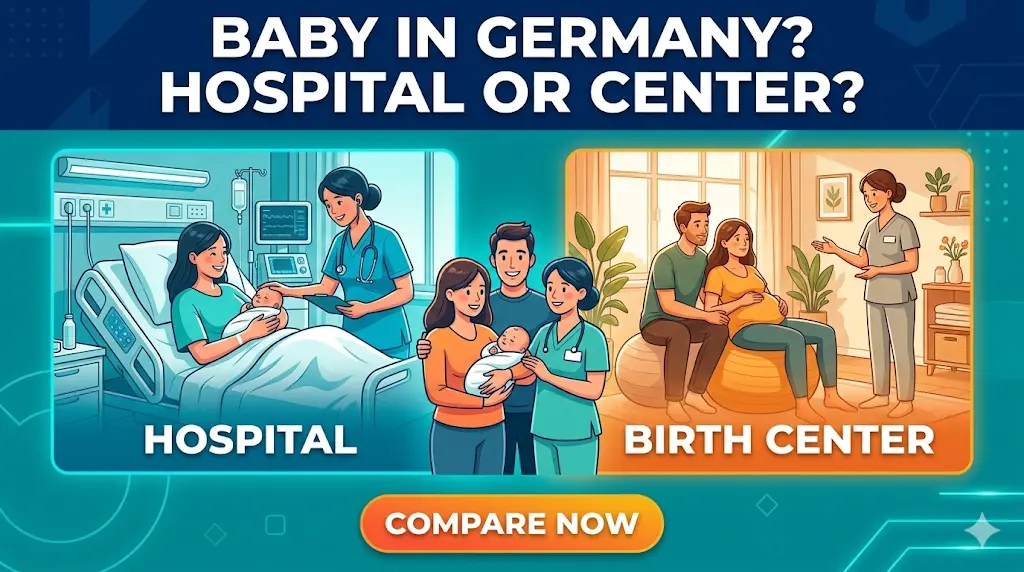
Choosing a hospital birth guarantees immediate, 24/7 access to a comprehensive suite of medical interventions. If labor stalls, if fetal distress is detected, or if you request advanced pharmacological pain relief like an epidural, the hospital infrastructure is perfectly primed to respond within minutes. Modern German maternity wards are designed to be surprisingly comfortable, often featuring dimmable lighting, birthing tubs, hanging ropes, and exercise balls, attempting to merge the clinical safety of a hospital with the holistic atmosphere of a natural birth room.
It is highly recommended that expectant parents attend an informational evening (Infoabend) and a guided tour of the delivery ward at their prospective hospitals during the second trimester. This allows you to evaluate the atmosphere, understand the hospital’s specific protocols regarding birthing partners, and register your file in advance. For a broader perspective on how hospital admissions and inpatient stays function across the country, reviewing Hospitals in Germany: What to Expect for Inpatient and Emergency Care provides excellent foundational context.
Overview of Birth Centers and Home Births
For women experiencing low-risk, healthy pregnancies who desire an intervention-free birthing experience, a Geburtshaus (birthing center) presents a magnificent alternative to the hospital environment. A Geburtshaus is an independent, non-clinical facility entirely owned and operated by a team of midwives. There are absolutely no doctors on staff. These centers are meticulously designed to feel like a cozy, serene home, featuring large double beds, oversized birthing pools, and ambient environments completely devoid of beeping monitors or bright surgical lights.
The philosophy of a birth center focuses exclusively on natural physiological birth. Because there are no anesthesiologists present, heavy pharmacological pain relief, such as an epidural, is completely unavailable. Midwives utilize alternative, holistic pain management techniques, including warm water immersion, specialized breathing, massage, and homeopathy. Delivering in a Geburtshaus requires a deep psychological commitment to natural labor and absolute trust in your body and your attending midwives.
Home births (Hausgeburten) are also legally permitted and fully integrated into the German healthcare framework. If you choose a home birth, two specialized midwives will come to your residence with portable medical equipment to monitor fetal heart rates and maternal vitals during labor. Both birth center deliveries and home births are fully covered by statutory health insurance. However, you must explicitly confirm these plans with your insurance provider in advance.
Delivering in a German Hospital
Medical Interventions and Pain Management
When delivering in a German hospital, the availability of pain management is vast, but the cultural approach to administering it is notably conservative. German midwives generally encourage laboring women to cope with contractions using natural methods for as long as possible. Upon arriving at the Kreißsaal, you will likely be offered a warm bath, antispasmodic suppositories, or acupuncture before pharmacological solutions are introduced. If you require stronger relief, the staff can administer nitrous oxide (laughing gas) or intravenous opioid painkillers like Meptolid.
The most potent form of pain relief is the epidural, known in Germany as a PDA (Periduralanästhesie). While PDAs are universally available in hospitals, they are not administered automatically or at the very first sign of pain. You must actively request one. Crucially, before a hospital will administer an epidural during active labor, you must have completed an Anästhesiegespräch (anesthesia consultation) weeks prior to your due date. During this pre-registration appointment, an anesthesiologist will explain the risks, evaluate your spine, and have you sign the necessary legal consent forms while you are clear-headed and not distracted by intense contractions.
The threshold for surgical intervention, such as an emergency or elective Cesarean section (Kaiserschnitt), is carefully managed. German doctors do not rush to perform C-sections without robust clinical justification, prioritizing vaginal deliveries whenever medically safe. If an intervention becomes necessary, the hospital staff will seamlessly transition you to an adjoining surgical theater.
The Role of the Medical Team and Beleghebamme
The staffing dynamic in a German delivery room can be surprising for international parents. During a standard hospital birth, you will be assigned a duty midwife (Diensthebamme) who works in shifts. She will be the primary medical professional managing your labor, coaching your pushing, and monitoring the baby’s heart rate via a CTG machine. Because she works for the hospital, she may be attending to multiple laboring women simultaneously, and if your labor spans across shift changes, you will experience a handover to a completely new midwife.
The obstetrician (Arzt) typically remains completely outside the room during the bulk of the labor. The doctor is usually only paged to enter the Kreißsaal during the final minutes of the pushing phase to witness the birth and perform any necessary perineal suturing afterward. The doctor steps into a leading role only if labor stalls, the baby’s heart rate drops precipitously, or mechanical assistance like a vacuum extraction (Saugglocke) is required.
For expats who desire guaranteed one-on-one, continuous care from a familiar face, hiring a Beleghebamme (an attending freelance midwife) is a highly coveted solution. You hire this midwife privately during your pregnancy. When you go into labor, she drops everything, travels to the hospital with you, and utilizes the hospital’s facilities to deliver your baby personally. This provides unparalleled emotional continuity. However, securing a Beleghebamme is fiercely competitive and requires paying an out-of-pocket “on-call” fee. If you need to transfer funds securely to pay this specialized professional fee, utilizing borderless financial platforms like Wise ensures you avoid exorbitant traditional banking exchange rates.
Inpatient Stay and Family Rooms
Following a hospital delivery, mother and baby are moved to the postnatal ward (Wochenbettstation). The standard inpatient recovery time in Germany is notably extensive to ensure the mother is physically stable and breastfeeding is successfully established. For an uncomplicated vaginal birth, you can expect to stay for two to three nights. If you deliver via a Cesarean section, the stay is typically extended to four or five nights. During this time, hospital nurses and lactation consultants check your vitals, monitor your bleeding, and assist with latching the baby.
Under statutory health insurance, you are guaranteed a bed in a shared room, typically accommodating two to three mothers and their newborns. For many expats, sharing a small room with strangers during the deeply vulnerable and exhausting days immediately following childbirth is less than ideal. To secure a private, intimate bonding experience, parents can explicitly request a Familienzimmer (family room). This acts like a private hotel suite within the maternity ward, featuring a double bed so the partner can sleep over, share all meals, and actively participate in the first days of newborn care.
It is vital to know that a Familienzimmer is never guaranteed; it is granted strictly on a first-come, first-served basis depending on ward capacity on the day of delivery. Furthermore, public insurance does not cover the cost of the partner’s accommodation and catering. You will be billed a daily surcharge, typically ranging from 80 to 150 euros, upon discharge. Premium private health insurance tariffs often cover single-room accommodations by default. For an evaluation of these premium benefits, exploring Health Insurance in Germany: Understanding Public vs Private Coverage is highly recommended.
Opting for a Birth Center
The Natural Birth Environment
Choosing to deliver in a Geburtshaus requires an entirely different mindset compared to a hospital birth. The environment is explicitly designed to minimize stress, fear, and clinical intervention. The birthing suites look like high-end, cozy bedrooms rather than medical wards, complete with soft lighting, personal music, essential oil diffusers, and expansive birthing tubs. The objective is to foster a deeply relaxing atmosphere that encourages the mother’s body to naturally release oxytocin and endorphins, facilitating a smoother physiological progression of labor.
In a birth center, you are supported by a small, dedicated team of midwives whom you have met extensively during your prenatal appointments. There are no shift changes with strangers, and you receive continuous, undivided one-on-one care. The midwives utilize active birthing positions, encouraging the mother to walk, squat, use a birthing stool, or labor in the water. Continuous electronic fetal monitoring, which requires the mother to be strapped to a bed, is generally avoided in favor of intermittent monitoring using a handheld Doppler.
This environment empowers women to listen to their bodily instincts without feeling rushed by hospital schedules or clinical timelines. Because this is a highly specific, niche pathway, birth centers book up incredibly fast. Expats interested in this route must contact their local Geburtshaus within the very first weeks of confirming their pregnancy.
Transfer Protocols and Emergency Preparedness
The primary concern most parents have regarding birth centers is safety during an emergency. German birth centers adhere to exceptionally rigorous safety protocols and strict exclusion criteria. If you develop gestational diabetes, preeclampsia, or if your baby is breech, the birth center will medically disqualify you from delivering there and will transfer your care to a hospital long before labor begins. They exclusively handle low-risk pregnancies.
During labor, birth center midwives are highly trained to recognize the earliest warning signs of maternal exhaustion, stalled dilation, or fetal distress. If an intervention becomes necessary—such as the mother deciding the pain is too immense and requesting an epidural, or if a complication arises that requires a doctor’s assistance—the midwives will execute a coordinated transfer to a partner hospital. Most birth centers are strategically located within a ten-minute drive of a major medical facility.
Transfers are relatively common, especially for first-time mothers, and the vast majority are non-urgent (e.g., the mother is simply too exhausted to continue pushing). In the rare event of a severe, acute emergency, an ambulance is dispatched immediately, and the midwife accompanies the mother to the hospital to provide a seamless clinical handover to the obstetric surgeons. This integrated safety net ensures that pursuing a natural birth does not compromise the ultimate safety of the mother or child.
Ambulant Births and Going Home Early
A defining characteristic of delivering in a Geburtshaus is that it almost universally culminates in an “ambulant birth” (ambulante Geburt). Unlike a hospital where you stay for several days to recover, a birth center does not function as an inpatient facility. If the delivery is successful and both the mother and baby are stable, healthy, and feeding well, you are discharged to go home just three to four hours after the birth.
This rapid discharge allows the new family to immediately return to the comfort, privacy, and familiar bacteria of their own home. However, the German medical system only permits an ambulant birth if a highly specific safety condition is met: you must have absolute, documented proof that you have secured a freelance postpartum midwife (Nachsorgehebamme) who is contracted to visit your home the very next day.
Without a confirmed postpartum midwife to perform the crucial day-one medical checks on the newborn and monitor the mother’s initial bleeding, birth center midwives and hospital staff will strongly advise against an early discharge. Securing this postnatal support is non-negotiable.
Comprehensive Postnatal Care in Germany
The Crucial Role of the Postpartum Midwife
The period immediately following childbirth, known as the Wochenbett (childbed), is treated with profound cultural and medical reverence in Germany. The state fundamentally believes that new mothers should rest, heal, and bond with their infants without the stress of traveling to clinical appointments. To facilitate this, the German healthcare system provides the magnificent benefit of the Nachsorgehebamme (postpartum midwife).
Your postpartum midwife will visit you directly at your home almost every single day during the first week or two after birth. During these intimate visits, she conducts comprehensive medical evaluations. For the baby, she weighs them to ensure proper growth, checks the healing of the umbilical cord stump, monitors for neonatal jaundice, and observes their overall vitality. For the mother, she checks blood pressure, examines the healing of perineal tears or C-section incisions, palpates the uterus to ensure it is shrinking correctly, and provides exhaustive, hands-on assistance with breastfeeding and latching difficulties.
As the weeks progress and the family stabilizes, the frequency of these visits decreases, but you remain entitled to midwifery support for up to twelve weeks postpartum, or even longer if you encounter persistent breastfeeding issues. This home-based medical and emotional support system drastically reduces the incidence of severe postpartum depression and prevents minor physical complications from escalating into hospital readmissions.
Pediatric U Checks and Early Medical Care
While the midwife handles the daily monitoring, the official medical responsibility for the infant quickly transitions to the pediatrician (Kinderarzt). The German pediatric system operates on a highly structured schedule of mandatory developmental examinations known as the U-Untersuchungen (U-checks). These checkups track the child’s physical, cognitive, and neurological growth milestones from the moment of birth through adolescence, meticulously recorded in a yellow booklet called the U-Heft.
The very first examination, the U1, occurs immediately after birth in the delivery room to assess basic reflexes and breathing. The crucial U2 examination must take place between the 3rd and 10th day of life. During the U2, the doctor conducts a thorough head-to-toe physical assessment, performs a metabolic heel-prick blood test to screen for rare genetic disorders, and administers a Vitamin K drop to prevent bleeding disorders. If you stay in the hospital, the U2 is performed on the ward before discharge. If you had an ambulant birth, you must schedule the U2 with your chosen pediatrician.
Because pediatric clinics in expat-heavy cities are frequently overcrowded, it is absolutely essential to secure a Kinderarzt while you are still in your third trimester of pregnancy. Registering your unborn child with a clinic guarantees they will be seen within the strict 10-day window required for the U2.
Physical Recovery and Pelvic Floor Rehabilitation
The German medical community recognizes that the trauma of carrying a child and the physical exertion of delivery profoundly impact a woman’s musculoskeletal system. To prevent long-term, debilitating complications such as urinary incontinence, lower back pain, or pelvic organ prolapse, the healthcare system highly prioritizes structured physical rehabilitation. Every mother is legally entitled to attend a formal postpartum gymnastics course known as a Rückbildungskurs.
These specialized courses, typically taught by licensed midwives or physical therapists, begin roughly six to eight weeks after a vaginal delivery (or slightly later for a C-section). Over the course of eight to ten weeks, mothers are guided through targeted exercises designed to systematically rebuild the deep core musculature, heal abdominal separation (diastasis recti), and restore maximum pelvic floor integrity. The costs of the Rückbildungskurs are completely absorbed by your statutory health insurance, though private patients should verify their specific tariff limits.
Supporting this rigorous physical recovery requires optimal physiological replenishment. Expats frequently discover that specialized postnatal recovery items—such as high-grade Omega-3s to combat hormonal brain fog, premium lactation-supporting herbal teas, and soothing perineal recovery sprays—are exceptionally expensive in local German pharmacies. To bypass these retail markups, savvy mothers bulk-order their holistic postnatal recovery kits through international wellness platforms like iHerb, ensuring their bodies are fortified with high-quality nutrients while the German state handles their structural rehabilitation.
Financial Aspects and Insurance Coverage
How Public and Private Health Insurance Handle Costs
When evaluating the financial reality of having a baby in Germany, the statutory public health insurance system (GKV) stands out as magnificently generous. If you are enrolled in a public sickness fund like TK or AOK, virtually 100 percent of the medically necessary costs associated with your pregnancy, delivery, and postpartum care are completely covered. This includes all routine prenatal doctor visits, the three statutory ultrasounds, the entire hospital delivery, the epidural, the inpatient stay, and the weeks of home visits from your postpartum midwife. The billing is entirely cashless; you present your electronic health card, and you will not see a single invoice.
For expats who earn above the income threshold and have opted for comprehensive private health insurance (PKV), the medical coverage is equally vast but fundamentally upgrades the exclusivity of the environment. Premium private tariffs often guarantee that prenatal ultrasounds are performed using advanced 3D technology, automatically cover expensive elective screenings like the NIPT (Harmony Test), and assure you are accommodated in a private single-bed room following delivery. Furthermore, private policies typically guarantee chief physician treatment (Chefarztbehandlung), ensuring the head obstetrician actively manages your hospital birth.
Choosing between the absolute financial predictability of the public system and the premium comforts of the private sector is a monumental decision for families. If you are currently evaluating your trajectory, utilizing digital-first brokerage platforms like Feather Insurance allows you to model these exact maternity scenarios in English. By comparing different policies side-by-side, you can determine if a public fund or a premium private tariff from providers like Ottonova best aligns with your family planning goals.
Managing Out of Pocket Expenses for Upgrades
While insurance insulates parents from catastrophic medical debt, expats must proactively budget for a variety of peripheral, out-of-pocket expenses that arise when pursuing premium birthing experiences. As highlighted earlier, securing a Familienzimmer at the hospital is a strictly private expense, costing up to 150 euros per night. If you hire a specialized Beleghebamme to personally attend your hospital birth, you must pay an un-reimbursable Rufbereitschaftspauschale (on-call fee), typically ranging from 500 to 1,000 euros, guaranteeing she will rush to the hospital the moment you go into labor.
Additionally, many international residents are increasingly opting to hire a Doula—a trained, non-medical professional who provides continuous emotional, physical, and informational support before, during, and after childbirth. Because Doulas are not recognized medical personnel in Germany, their comprehensive birthing packages (which can cost between 800 and 1,500 euros) must be paid entirely out of pocket.
Managing these sudden, large private invoices requires efficient financial logistics, especially for expat couples relying on savings held in foreign bank accounts. Executing a traditional cross-border wire transfer to pay a hospital surcharge or a midwife’s on-call invoice can trigger terrible exchange rates and exorbitant hidden banking fees. Utilizing transparent, highly efficient borderless financial platforms like Wise allows expat parents to seamlessly convert and transfer international funds, ensuring these critical medical support bills are settled rapidly without bleeding money to banking friction.
Navigating Bureaucracy and Maternity Leave Benefits
The German state fiercely protects the financial stability of expectant mothers through highly progressive labor legislation known as Mutterschutz (Maternity Protection). By law, an employed pregnant woman is strictly forbidden from working during the six weeks immediately preceding her estimated due date, and for the eight weeks immediately following the birth. During this fourteen-week absolute protection period, the mother continues to receive 100 percent of her standard average net salary, jointly funded by her sickness fund and her employer.
Following the mandatory Mutterschutz period, the financial support transitions into Elterngeld (Parental Allowance). This phenomenal state benefit compensates parents for the loss of income if they choose to temporarily stop working or drastically reduce their hours to care for their newborn. Elterngeld pays approximately 65 to 67 percent of your prior average net income, up to a maximum cap of 1,800 euros per month, for up to 14 months if both parents share the leave. This structural support dramatically reduces the financial terror of raising an infant abroad.
To secure these funds, as well as statutory child benefits (Kindergeld), you must navigate a dense maze of bureaucracy immediately following the birth. The very first step is registering the child at the local registry office (Standesamt) to obtain the official birth certificate (Geburtsurkunde). Without this document, no state funds can be released.
Conclusion
Having a baby in Germany provides expat parents with an incredibly empowering, medically secure, and holistically supportive experience. Whether you choose the robust, high-tech safety net of a modern hospital Kreißsaal or the serene, intervention-free environment of a midwife-led Geburtshaus, the system is designed to prioritize the physiological and emotional health of both mother and child.
By proactively securing a dedicated postpartum midwife, leveraging the state’s massive financial protections like Mutterschutz and Elterngeld, and thoughtfully managing the costs of premium upgrades with intelligent financial tools, you can confidently navigate the bureaucratic hurdles and focus entirely on the joyous transition into your new family life in Germany.
References
Primary sources (official)
- Federal Ministry for Family Affairs, Senior Citizens, Women and Youth (BMFSFJ) – Maternity Protection Act: https://www.bmfsfj.de/bmfsfj/meta/en/publications-en/maternity-protection-act-138470
- Make it in Germany (Official Portal) – Parental leave and benefits: https://www.make-it-in-germany.com/en/living-in-germany/family-life/financial-support-families
Other helpful sources
- Ammely (Official German Midwife Search Platform): https://www.ammely.de/
- The German Midwives Association (Deutscher HebammenVerband): https://www.hebammenverband.de/
Disclaimer
The information provided in this article is for general informational and educational purposes only and does not constitute professional medical, legal, or financial advice. The German healthcare system, maternity leave regulations (Mutterschutz), statutory insurance policies, and clinical guidelines regarding childbirth are highly complex and subject to continuous legislative updates. Always consult directly with a qualified healthcare professional, a licensed gynecologist or midwife, your specific Krankenkasse, or a certified independent insurance broker regarding your unique prenatal health needs, birth plans, and legal insurance obligations in Germany.