Hospitals in Germany: What to Expect for Inpatient and Emergency Care
Navigating the German hospital system can be overwhelming during a crisis. This guide explains the different types of clinics, the admission process for planned and emergency care, and what to expect during an inpatient stay to ensure you receive the best treatment possible.
Disclosure: This post may contain affiliate links. We may earn a commission at no extra cost to you if you make a purchase through these links. Read full disclosure.
Understanding the Landscape of German Hospitals
The Three Main Categories of Hospitals
Germany boasts a high density of medical facilities, but they are not all operated by the same entities. There are roughly 1,900 hospitals in Germany, which fall into three primary categories: public, non-profit, and private. Public hospitals (Öffentliche Krankenhäuser) are run by local or federal governments and often include massive university clinics. Non-profit hospitals (Freigemeinnützige Krankenhäuser) are typically operated by religious or charitable organizations like the Red Cross, Caritas, or Diakonie.
Private hospitals (Privatkrankenhäuser) are run as commercial enterprises. While public and non-profit hospitals are integrated into the statutory billing system and accept all patients, some smaller private clinics may cater exclusively to those with private insurance or those willing to pay out-of-pocket. Regardless of the owner, all hospitals must adhere to strict national quality standards, meaning the medical care remains world-class across the board. If you are exploring your coverage options, reviewing Public Health Insurance (gesetzliche Krankenkasse): What It Covers and Costs or Private Health Insurance in Germany: Benefits, Costs, and Eligibility will help clarify which facilities are most accessible to you.
University Clinics and Maximum Care Facilities
University hospitals (Universitätskliniken) represent the pinnacle of the German medical system. These institutions are “maximum care” facilities, meaning they possess every possible medical discipline and the most advanced technology available. Because they are research-oriented, they are often the best choice for rare diseases, complex surgeries, or experimental therapies.
However, because university clinics are often overloaded, they primarily handle the most severe cases or those referred by other specialists. For standard procedures, a “central service” or “regular service” hospital in your local district is often more than sufficient and may offer a more personal touch. Understanding how these facilities fit into the broader system is a key part of Healthcare in Germany: A Comprehensive Guide for Expats.
Specialized Clinics vs. General Hospitals
While many hospitals are “general” (Allgemeine Krankenhäuser), Germany also has a high number of specialized clinics (Fachkliniken). These focus exclusively on one area, such as orthopedics, cardiology, or psychiatric care. If you require a knee replacement, your specialist might refer you to a dedicated orthopedic clinic rather than the local general hospital.
Specialized clinics often have higher success rates for specific procedures because their staff performs them with extreme frequency. When choosing a facility for a planned surgery, it is worth researching the “Quality Reports” (Qualitätsberichte) that all German hospitals are legally required to publish annually. This transparency is a hallmark of the system, much like the clear-cut rules found in Navigating Medical Care in Germany: Doctors, Hospitals, and Pharmacies.

Emergency Care and Immediate Assistance
Calling 112 vs 116 117
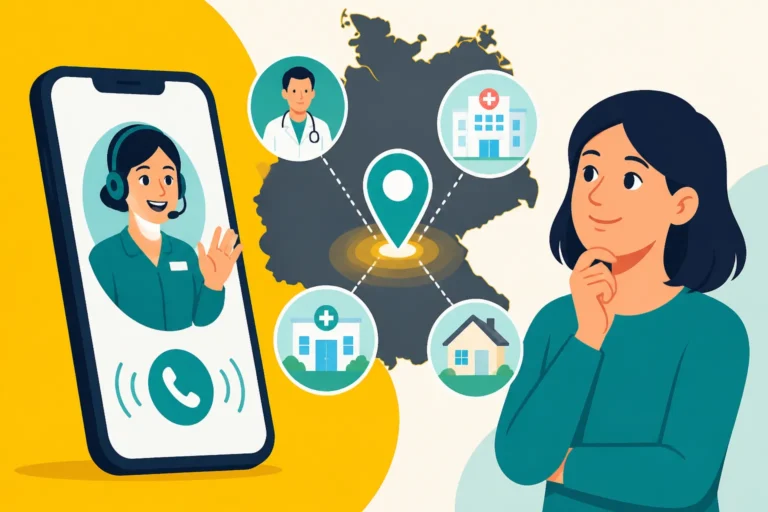
The most important numbers to remember in Germany are 112 and 116 117. Dial 112 for life-threatening emergencies, such as a suspected heart attack, stroke, severe accident, or unconsciousness. This number connects you to the emergency rescue service (Rettungsdienst) and fire brigade. The dispatchers usually speak English in metropolitan areas and will send an ambulance (Rettungswagen) or an emergency doctor (Notarzt) if necessary.
If your situation is urgent but not life-threatening—for example, a high fever on a Saturday or a deep cut that won’t stop bleeding but isn’t a “trauma”—you should call 116 117. This is the medical on-call service (Ärztlicher Bereitschaftsdienst). They can direct you to an on-call practice (Bereitschaftspraxis) or send a doctor to your home. This prevents hospital emergency rooms from being clogged with non-emergency cases.
Visiting the Notaufnahme (Emergency Department)
If you decide to go to the hospital yourself, you will head to the Notaufnahme. Be prepared for a triage system: patients are treated based on severity, not arrival time. A minor broken bone may result in a wait of several hours if the staff is busy with a major accident.
When you arrive, you will need your health insurance card and ID. If you don’t have insurance, you will still be treated in an emergency, but you will receive a substantial bill later. To avoid financial stress during a crisis, ensuring you have proper coverage via providers like Feather Insurance or Ottonova is essential. Managing sudden medical bills or international transfers for those without local accounts can be simplified using Wise.
What to Expect in an Ambulance
German ambulances are staffed by highly trained paramedics (Notfallsanitäter) and sometimes an emergency doctor. They are equipped with advanced life-support technology. If you are transported to the hospital, your statutory insurance usually covers the cost, minus a small co-payment (typically €5 to €10).
It is a common expat myth that ambulances are free taxis; if you call 112 for a trivial reason and the paramedics determine it wasn’t an emergency, your insurance may refuse to pay, leaving you with a bill of several hundred euros. For more on these costs, check Travel Health Insurance: What Expats Need for Schengen Visa & Short Trips.
The Admission Process: Planned and Unplanned
Elective Admissions and the Einweisung
For a planned surgery or diagnostic stay, you cannot simply walk into a hospital. You need a referral known as an Einweisung from your specialist or Finding a Doctor (Hausarzt) in Germany: How to Choose and Register. Once you have this document, you must contact the hospital’s central admission office (Patientenaufnahme) to schedule your stay.
During the pre-admission appointment, you will meet with the surgeons and anesthesiologists. You will sign several legal documents, including consent forms and data protection agreements. This is also the time to decide on “optional services” (Wahlleistungen), such as a private room or treatment by the chief physician, which are standard for those with private insurance but extra for public patients.
Emergency Admission and Triage
In an emergency, the admission process happens at your bedside or in the emergency bay. The staff will prioritize your medical stability over paperwork. However, as soon as you are stable, an administrative staff member will ask for your Gesundheitskarte.
If you are unconscious and alone, the hospital will still treat you. They will search for ID or contact the police to identify your insurance status. For expats, having a “medical ID” on your phone or a card in your wallet with your insurance details is highly recommended. For more on getting your initial documents, see How to Get Health Insurance in Germany: Step-by-Step for Newcomers.
Documentation and Initial Tests
Upon admission, you will undergo a series of baseline tests, including blood work and potentially an EKG or X-ray. You will be asked about your medical history, allergies, and current medications. It is helpful to have a printed list of your medications ready, especially if you use specific brands from iHerb that may have different names in Germany.
The following table summarizes the key differences in the admission process:
| Feature | Elective (Planned) Admission | Emergency Admission |
| Prerequisite | Referral (Einweisung) from a doctor | Immediate medical need |
| Scheduling | Booked weeks or months in advance | Immediate / No appointment |
| Choice of Hospital | Usually free choice of facility | Usually taken to the nearest facility |
| Administrative Start | Central admission office | Bedside or Emergency Dept |
| Primary Goal | Specific treatment or surgery | Stabilization and diagnosis |
Inpatient Life: What to Expect on the Ward
Germany has a well-developed healthcare system with modern hospitals, highly trained medical staff, and clear procedures for both inpatient treatment and emergency care. Understanding how hospitals operate can help patients and expatriates navigate the system more confidently when medical attention is required.
Hospitals in Germany range from university medical centers to regional clinics and specialized facilities. Large institutions such as Charité – Universitätsmedizin Berlin and University Hospital Heidelberg are known for advanced research and complex treatments. These facilities often handle referrals for specialized procedures, while smaller local hospitals provide routine inpatient care and emergency services.
Emergency care is available through hospital emergency departments known as Notaufnahme. Patients experiencing serious conditions such as severe injuries, chest pain, or breathing difficulties can go directly to the emergency department or call the national emergency number 112 for ambulance services. Upon arrival, patients are assessed through a triage process, which prioritizes treatment based on medical urgency rather than arrival time. This means individuals with life threatening conditions are treated immediately, while others may wait longer depending on the severity of their symptoms.
For non-life-threatening issues, patients are often encouraged to contact an out-of-hours medical service rather than visiting emergency departments. Germany operates a nationwide medical on-call service reachable by dialing 116 117, which helps patients find appropriate care when regular clinics are closed.
Inpatient care begins once a physician determines that hospitalization is necessary. Patients are typically admitted to shared hospital rooms, though private rooms may be available depending on insurance coverage. Public health insurance generally covers medically necessary hospital stays, including physician care, nursing services, medication administered during hospitalization, and basic accommodation. Patients may be required to pay a small daily co-payment for the first several days of hospitalization.
Hospital stays involve structured routines. Doctors conduct daily ward rounds to review patient progress, adjust treatment plans, and answer questions. Nurses manage medications, monitor vital signs, and assist with recovery activities. Many hospitals also provide physiotherapy, diagnostic imaging, and specialist consultations within the same facility. Patients should bring their health insurance card and identification when visiting a hospital, as these are required for registration and billing. After discharge, hospitals often provide medical reports, prescriptions, and follow up instructions for continued care with a family doctor or specialist, ensuring continuity of treatment within Germany’s coordinated healthcare system. Discharge planning may also include rehabilitation referrals, physiotherapy appointments, or home care support, depending on the patient’s condition and recovery needs.
Visitors are usually allowed during designated hours, although policies may vary by hospital department. Larger hospitals often provide multilingual support services, especially in cities with international populations. However, basic German language skills can still be helpful when communicating with staff. Overall, German hospitals maintain high clinical standards and emphasize efficiency, safety, and patient care. Understanding emergency procedures, admission processes, and insurance coverage helps patients navigate inpatient treatment more smoothly and ensures they receive appropriate medical attention when needed.
Room Types and Shared Facilities
In the German public system, the standard is a shared room with two or three beds. Rooms are gender-segregated. While the rooms are clean and modern, privacy is limited to a curtain or screen. You will share a bathroom with your roommates.
If you value privacy, you can request a single (Einbettzimmer) or double room (Zweibettzimmer), but be prepared to pay a daily surcharge of €100 to €200 if your insurance doesn’t cover it. Private insurance or a supplemental plan often includes these upgrades automatically. For students, who often have tighter budgets, knowing these limits is vital, as discussed in Health Insurance for Students in Germany: Affordable Options and Requirements.
Daily Routine and Hospital Meals
Hospital life in Germany follows a strict, early schedule. Breakfast is usually served around 7:30 AM, lunch at noon, and a light dinner (usually bread, cheese, and cold cuts) at 6:00 PM. Doctors usually conduct their “rounds” (Visite) early in the morning, between 8:00 AM and 10:00 AM.
Rounds are often brief. If you have questions for the doctor, write them down beforehand. You may only have two minutes with the lead physician, so being concise is key. If you are a freelancer managing your own time and recovery, understanding this routine helps you coordinate with clients, as explored in Health Insurance for Freelancers and Self-Employed: Navigating the System.
What You Must Bring Yourself
One of the biggest surprises for expats is that German hospitals do not provide basic toiletries or “hospital gowns” for daily wear. You are expected to bring your own:
- Pajamas and comfortable daytime clothes (like a tracksuit)
- Slippers and sturdy shoes for walking the halls
- Towels, washcloths, and all toiletries (shampoo, toothbrush, etc.)
- Personal entertainment (books, tablet, headphones)
While some modern hospitals have WiFi, it is often slow or requires a daily fee. Having a local SIM card with a good data plan is a lifesaver.
Costs, Billing, and Discharge
The €10 Daily Co-payment
For those with statutory public insurance, the “hotel” portion of your hospital stay is not entirely free. You are legally required to pay a co-payment of €10 per day, for a maximum of 28 days per calendar year. This means the most you will pay for a standard hospital stay in a year is €280.
Children and teenagers under 18 are exempt from this fee, as are women admitted for childbirth. The hospital usually sends an invoice for this amount to your home address a few weeks after discharge. Settling these small domestic bills is easy with Wise if your funds are primarily in a non-Euro account.
Private Invoices and Reimbursements
If you have private insurance, you will receive a much more detailed set of invoices. The hospital will bill for the “DRG” (Diagnosis Related Group) flat rate, and the doctors will send separate invoices for their personal services.
You pay these bills yourself and then submit them to your insurance for reimbursement. This process is usually very fast with digital-first insurers like Ottonova. For a comparison of how this works versus the public system, see Health Insurance in Germany: Understanding Public vs Private Coverage.
The Entlassungsbrief (Discharge Letter)
When you are discharged, you will receive an Entlassungsbrief. This is a critical document that outlines your diagnosis, the treatment you received, and the medications you must continue taking. You must give a copy of this to your Hausarzt immediately.
The hospital will also provide you with enough medication for the first few days (especially over a weekend) and a prescription for more. For follow-up care and seeing specialists after your stay, refer to Specialists and Referrals: How to See a Specialist Doctor in Germany.
Conclusion
A hospital stay in Germany is characterized by high-efficiency and top-tier medical care, but the “cultural” experience can be a shock to those used to more service-oriented systems. By knowing the difference between a 112 emergency and a 116 117 urgent call, preparing your own “hospital bag” with toiletries and pajamas, and understanding the €10 daily co-payment, you can navigate your inpatient care with confidence.
Whether your stay is a planned surgery or an unexpected emergency, the German hospital network is designed to get you back on your feet as quickly and safely as possible.
References
Primary sources (official)
- Federal Ministry of Health (BMG) – Hospital Care: https://www.bundesgesundheitsministerium.de/en/en.html
- German Hospital Directory (Deutsches Krankenhausverzeichnis): https://www.deutsches-krankenhausverzeichnis.de/en/
Other helpful sources
- Make it in Germany – Healthcare & Hospitals: https://www.make-it-in-germany.com/en/living-in-germany/healthcare
- European Commission – Health Care in Germany: https://ec.europa.eu/social/main.jsp?catId=559
Disclaimer
The information provided in this article is for general informational and educational purposes only and does not constitute professional medical, legal, or financial advice. German hospital regulations and insurance policies are subject to change. Always consult directly with a qualified healthcare professional, your insurance provider, or a certified legal expert regarding your specific medical needs and insurance obligations in Germany.