Cross-Border Banking: Managing Your Home Country Account While in Germany
Logging into your home country bank account only to find it frozen because of a “suspicious” foreign login from Germany is a blood-chilling expat rite of passage. I remember spending two hours on hold internationally, praying my mortgage payment wouldn’t bounce. This guide explains how to legally maintain your foreign bank accounts, manage cross-border transfers, and navigate German tax reporting.
Disclosure: This post may contain affiliate links. We may earn a commission at no extra cost to you if you make a purchase through these links. Read full disclosure.
The Legal and Tax Realities of Dual Country Banking
The biggest misconception expats bring to Germany is the belief that their financial life is split into two completely separate, unconnected spheres. You might assume the German government has no idea what is happening in your checking account back in Toronto, London, or Sydney. Thanks to modern international banking regulations, this is entirely false.
Reporting Foreign Accounts to the Finanzamt
Once you complete your city registration and officially become a resident, you enter the German tax system. As a resident, you are subject to unlimited tax liability, meaning the German tax authority (Finanzamt) expects you to report your global wealth and income. This is an administrative reality deeply explored in Taxing Worldwide Income: How Germany Taxes Foreign Income and Assets.
You are not required to tell the Finanzamt the total balance of your foreign checking or savings accounts just for the sake of it, as Germany does not currently levy a wealth tax on the principal amount of your cash. However, you are legally mandated to report any yield those accounts generate. If your home country savings account generates $50 in interest over the calendar year, that $50 must be declared on your German tax return under the Anlage KAP (income from capital assets).
Furthermore, thanks to the Common Reporting Standard (CRS) and FATCA for Americans, your home country bank is actively sharing your account data with the German authorities. If you try to hide a high-yield savings account or a foreign certificate of deposit, the Finanzamt will eventually find out. The penalties for tax evasion—even accidental tax evasion born of expat ignorance—are incredibly steep. Embracing total financial transparency is the only way to survive the local bureaucracy.
Understanding the Double Taxation Traps
If you keep your money in a home country bank, you are likely earning some form of interest or dividend. The immediate panic for expats is the fear of being taxed twice: once by the home country where the bank is located, and once by Germany.
Double Taxation Agreements (DBAs) exist to prevent this. Germany has treaties with over 90 countries. Typically, these treaties stipulate that interest or capital gains are primarily taxed in your country of residence (Germany). If your home country bank automatically withholds a “non-resident tax” on your interest, you can usually claim a credit for this on your German tax return.
However, managing this requires meticulous record-keeping. You cannot submit your foreign bank statements in dollars or pounds; the Finanzamt requires you to convert every taxable foreign event into euros using the official exchange rate for the exact day the transaction occurred. This accounting nightmare forces many expats to rethink how much money they truly want to leave parked in foreign accounts while residing in Europe.
The AWV Reporting Requirement for Large Transfers
When you maintain accounts in two countries, you will inevitably need to move money between them. Perhaps you are transferring a chunk of your home country savings to Germany to pay for a rental deposit, or sending your German salary back home to pay a student loan.
If you transfer any amount exceeding 12,500 euros (or the foreign currency equivalent) across the German border, you trigger the Außenwirtschaftsverordnung (AWV) reporting requirement. You are legally required to report this transaction to the German Central Bank (Bundesbank) by the 7th day of the following month. Failing to make this simple phone call can result in fines of up to 30,000 euros.
It is vital to understand that this is purely a statistical reporting requirement, not a tax declaration. You are simply telling the central bank that money crossed the border. If you are moving your own savings between an account in your name abroad to an account in your name in Germany, it is often exempt, but the moment a third party is involved, the reporting rule applies. To navigate the mechanics of these large transfers safely, you must deeply review Moving Money to Germany: Declaring Savings and Large Transfers.
Transferring Money Without Losing Your Savings
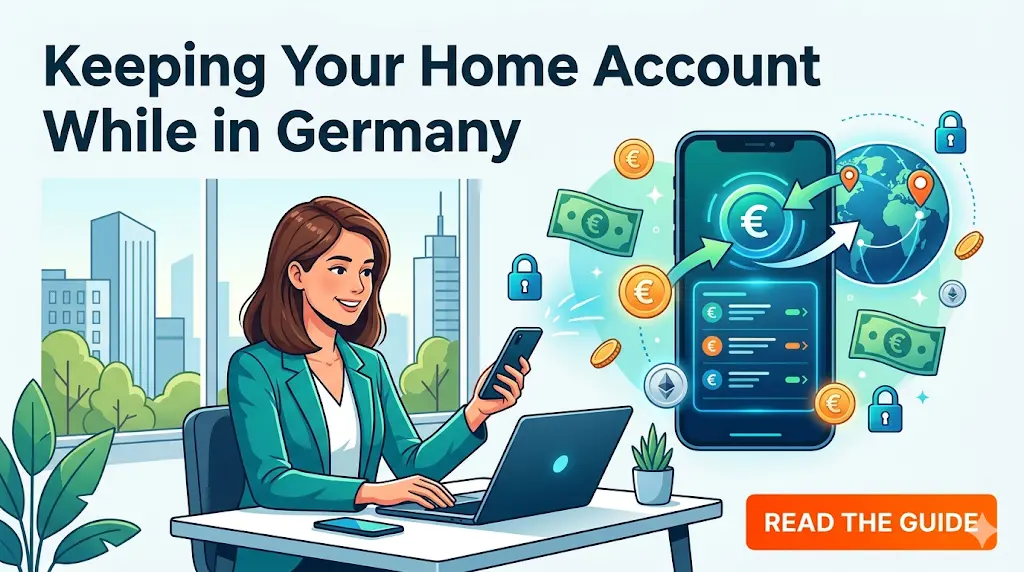
The actual mechanics of moving money between your home country bank and your new German life is where expats bleed cash without even realizing it. Traditional banks rely on your ignorance of international finance to siphon off massive margins.
The Hidden Fees of Traditional SWIFT Transfers
If you log into your traditional bank account back home and request a wire transfer to your German IBAN, the bank will initiate a SWIFT transfer. The SWIFT network is ancient, slow, and involves multiple intermediary banks passing your money along a digital chain.
Your home bank will charge you an upfront fee to send the wire. Then, one or two intermediary banks will take a cut (correspondent fees). Finally, your German bank might charge you an incoming international wire fee. But the true theft lies in the exchange rate markup. Traditional banks rarely give you the mid-market exchange rate—the rate you see when you search the currency pair on Google. They pad the rate by 3% to 5%.
On a transfer of $10,000, a 4% hidden exchange rate markup means you lose $400 instantly, not including the flat wire fees. For expats already struggling to budget for the high Cost of Living in Germany: Breakdown of Expenses (Rent, Food, Transport), giving up half a month’s rent to banking fees is unacceptable.
Navigating Exchange Rate Fluctuations
Currency volatility is a silent predator for expats managing cross-border lives. If your home country currency weakens significantly against the euro, the savings you plan to transfer will suddenly buy you far less in Germany.
You cannot control macroeconomic currency shifts, but you can control the execution of your transfers. The modern expat strategy involves entirely bypassing the traditional SWIFT network for currency conversion. By using specialized FinTech platforms, you can lock in the real mid-market exchange rate for a small, transparent upfront fee.
When you use Wise to move your funds, you actually send your money to a local account in your home country. Wise then uses its own euro reserves in Europe to deposit the equivalent amount into your German account. Because the money never actually crosses borders via the SWIFT system, you avoid intermediary fees and predatory exchange rate markups. Taking control of this process is the first major victory in your expat financial journey.
Bridging the Gap Between Two Financial Lives
Creating a seamless bridge between your old life and your new one requires the right combination of accounts. You need a functional local account to receive the converted funds and handle your daily German life.
Many expats pair a conversion service like Wise with a digital-first German bank account like N26. Traditional German savings banks (Sparkassen) often have outdated, German-only apps and charge monthly maintenance fees. In contrast, opening an N26 account provides you with a fully functional German IBAN, a modern app in English, and seamless integration with incoming SEPA transfers.
When my home country tax refund hit my old checking account, I instantly transferred it via Wise, and within hours it was sitting in my N26 account, ready to be used for German groceries. This exact triangulated setup shields you from terrible exchange rates while satisfying the rigid direct-debit requirements of German utility companies and landlords.
| Transfer Strategy | Exchange Rate Quality | Speed | Best Use Case |
| Traditional Bank Wire (SWIFT) | Poor (3-5% markup) | 3-5 Days | Legal escrows demanding direct bank-to-bank SWIFT |
| FinTech (e.g., Wise) | Excellent (Mid-market rate) | 1-2 Days | Monthly salary transfers, moving personal savings |
| Credit Card Cash Advance | Terrible (High markup + fees) | Immediate | Absolute emergencies only |
Managing Foreign Credit Scores and Debt
Leaving your home country does not mean your financial obligations there disappear. Managing student loans, mortgages, and credit scores from thousands of miles away requires careful automation and strategic planning.
Keeping Your Home Country Credit Alive
When you move to Germany, your home country credit score essentially goes into hibernation. The German financial system uses the Schufa to track your local creditworthiness, and they do not care about your flawless 800 FICO score from the United States or your pristine Experian rating from the UK. To understand how the local scoring system evaluates you from scratch, review German Bureaucracy 101: Understanding the Anmeldung, Schufa, and Tax ID.
However, you should not let your foreign credit score die. You might move back one day, or you might need a foreign loan. To keep your home country credit file active, the best strategy is to keep your oldest foreign credit card open.
Use this credit card for a small recurring subscription (like Netflix or Spotify) and set it to auto-pay in full every month from your remaining home country checking account. This ensures continuous, positive reporting to your home country credit bureaus. The challenge here is that banks periodically require you to update your physical address, and they hate international addresses. Maintaining a mailing address with a trusted family member is usually the safest workaround to prevent the card from being canceled.
Paying Off Foreign Student Loans and Mortgages
If you are earning a salary in euros but have a student loan denominated in dollars or pounds, you are exposed to constant currency risk. Your monthly loan payment will fluctuate based entirely on the forex market.
Automating these payments is vital to avoid missing deadlines due to time zone differences or forgotten logins. You cannot set up a direct debit from a German bank to a foreign loan servicer. The most efficient method is to calculate your loan obligations for the next six months, transfer that exact amount from your German account via Wise when the exchange rate is favorable, and park it in your home country checking account.
Your foreign loan servicer then simply auto-drafts the payment from that local account. This strategy insulates you from month-to-month currency panic and ensures your debt obligations are met without incurring international processing fees.
How Foreign Debt Affects Your German Schufa
A major source of anxiety for expats is whether their massive foreign student debt will prevent them from securing a German apartment or getting a local cell phone contract.
The comforting reality is that the German Schufa system does not communicate with foreign credit bureaus. Your foreign student loans, foreign mortgages, and foreign credit card balances do not appear on your Schufa report. When a German landlord pulls your Schufa, they only see your financial behavior within Germany since the day you registered your residence.
While you must absolutely declare your debt obligations if you apply for a German mortgage or a massive bank loan (as they will ask for a self-disclosure of global liabilities), your day-to-day consumer life in Germany is completely unaffected by the debt you left behind in your home country.
Integrating Global Investments and Brokerage Accounts
Managing basic checking accounts is relatively simple, but if you have a portfolio of stocks, ETFs, or mutual funds back home, you are stepping into a heavily regulated and heavily taxed compliance nightmare.
The Complications of Holding Foreign ETFs and Mutual Funds
If you hold foreign mutual funds or ETFs in a home country brokerage account, you must tread incredibly carefully in Germany. The German tax system applies a specific, punitive taxation rule called the Vorabpauschale (advance lump sum) to accumulating funds.
Even if you do not sell the asset, Germany taxes the theoretical yield of the fund every year. Furthermore, if the foreign fund does not report its financial data according to strict German tax transparency laws (which almost no non-European funds do), you could be subjected to punitive, estimated taxation that decimates your returns.
For American expats, the situation is even worse. The IRS classifies most European ETFs as Passive Foreign Investment Companies (PFICs), which triggers catastrophic reporting requirements and taxation in the US. You are effectively trapped between two incompatible tax regimes. If you are planning for the long term, understanding how these global investments impact your future requires deeply researching Retiring in Germany: Financial Considerations for Expats on Pensions.
Consolidating Your Global Investment Portfolio
Because of these compliance nightmares, many home country brokerage firms will simply close your account the moment you tell them you have moved to Germany. They do not want to deal with the cross-border reporting requirements of the Common Reporting Standard (CRS) or FATCA.
If you log in from a German IP address consistently, the compliance department will flag your account, demand proof of residency, and force you to liquidate your holdings within 30 days if you cannot provide a local address. Being forced to sell your portfolio triggers immediate capital gains tax in both your home country and Germany.
To prevent this, savvy expats transfer their holdings to a globally compliant brokerage before they leave, or shortly after arriving. Utilizing a platform like Interactive Brokers is a highly effective strategy. Because Interactive Brokers operates globally and has European entities, they fully understand expat compliance. They will not close your account just because you moved to Berlin, and they allow you to hold multi-currency accounts, meaning you can invest in US, European, or Asian markets from a single dashboard.
Understanding German Capital Gains Tax on Foreign Yields
Whether your investments are sitting in a legacy account back home or consolidated in a global platform, you must understand how Germany taxes the yield.
Germany applies a flat capital gains tax (Abgeltungssteuer) of 25%, plus a solidarity surcharge (totaling roughly 26.375%). If you use a German domestic broker, they automatically calculate and withhold this tax for you. If you use a foreign broker or a global platform like Interactive Brokers, no taxes are automatically withheld for the German state.
You are entirely responsible for manually calculating your gains, converting them to euros using the daily ECB exchange rate, and declaring them on the Anlage KAP of your tax return. The massive advantage of using established international platforms is that they generate comprehensive annual tax reports tailored to European standards, transforming an impossible accounting task into a manageable weekend project.
Closing vs Maintaining Your Home Country Bank Accounts
Eventually, every long-term expat faces the difficult decision of whether to maintain their home country bank accounts or sever their financial ties completely.
When the Bank Threatens to Close Your Account
The harsh reality is that most retail banks do not want non-resident customers. Maintaining accounts for people living in foreign tax jurisdictions is a massive liability for compliance departments.
If your home country bank discovers you no longer reside in the country, they will send you a legally mandated letter giving you 30 to 60 days to close the account. They will restrict your debit cards and freeze your online access. This is especially true for banks in the UK and the US, which face severe regulatory scrutiny. If you rely on that account to pay a lingering student loan or to receive a final tax refund, a forced closure is a logistical disaster.
Using Virtual Addresses and Family Proxies
To prevent forced closures, many expats attempt to mask their move. They change their mailing address on the bank profile to their parents’ house or use a premium virtual mail-forwarding service. They also use VPNs to ensure they only log into their banking app from a home country IP address.
While this strategy is incredibly common, you must understand that it violates the terms of service of almost every major retail bank. If they catch you using a mail forwarder, the account closure will be immediate and unapologetic. Using a family member’s address is safer, but it still requires someone in your home country to open your physical mail and scan important compliance notices to you.
Creating a Sustainable Long Term Setup
If you are staying in Germany for a one-year work assignment, playing the VPN and family-address game is usually fine. However, if you are planning to build a life here, secure permanent residency, and navigate the complexities of Navigating the Ausländerbehörde: Tips for Dealing with German Immigration Offices, you need a sustainable setup.
A sustainable setup means consolidating. Close the five random checking and savings accounts you accumulated in your twenties. Keep exactly one home country checking account alive (using a trusted family address) purely to service lingering local debt or receive occasional local payments.
Move your daily financial life entirely to your German accounts like N26. Shift your investments to a globally compliant broker like Interactive Brokers. Use Wise as the permanent, frictionless bridge between the two worlds. By actively stripping away the financial clutter in your home country, you drastically reduce your German tax reporting burden and protect yourself from automated compliance freezes.
References
Primary sources (official)
- Deutsche Bundesbank – Foreign Trade and Payments Reporting: The official central bank guidelines regarding the AWV reporting requirement for any cross-border transfer exceeding 12,500 euros. https://www.bundesbank.de/en/tasks/statistics/reporting-requirements
- Bundeszentralamt für Steuern (BZSt): The Federal Central Tax Office’s official definitions of unlimited tax liability, foreign income reporting, and the application of double taxation agreements. https://www.bzst.de/EN/Private_individuals/Foreign_Tax_Relations/foreign_tax_relations_node.html
Other helpful sources
- Make it in Germany – Bank Account: The federal government’s official portal outlining the rights of expats to open basic payment accounts and the standard required documentation. https://www.make-it-in-germany.com/en/living-in-germany/money-taxes/bank-account
- BaFin – Federal Financial Supervisory Authority: The German financial regulator’s guidelines on cross-border banking, anti-money laundering, and the legal obligations of banks to verify customer residency. https://www.bafin.de/EN/Aufsicht/BankenFinanzdienstleister/bankenfinanzdienstleister_node_en.html
Disclaimer
The information provided in this article is for general informational and educational purposes only and does not constitute professional financial, tax, or legal advice. German tax laws regarding unlimited tax liability, the punitive taxation of non-transparent foreign funds (Vorabpauschale), and central bank reporting requirements (AWV-Meldepflicht) are strictly enforced and highly complex. Utilizing financial tools like Wise, N26, and Interactive Brokers can optimize your cross-border capital management, but does not absolve you of your legal reporting obligations to the Finanzamt or your home country’s tax authority.