Understanding Arbeitslosengeld I vs II: Unemployment Benefits Explained
Getting handed a termination letter when your right to live in Germany is tied to your employment is a unique level of terror. I vividly remember the gut-wrenching panic of navigating the unemployment office in broken German, terrified I would be deported the next day. This guide decodes the critical differences between Arbeitslosengeld I and II, helping you secure your benefits.
Disclosure: This post may contain affiliate links. We may earn a commission at no extra cost to you if you make a purchase through these links. Read full disclosure.
The Immediate Panic and the Strict Reporting Rules
When expats lose their jobs in Germany, they often freeze. In many home countries, applying for unemployment is a process you initiate when you are ready. In Germany, bureaucratic deadlines begin ticking the exact second you are informed of your termination, and missing them will cost you thousands of euros.
The Three Day Registration Rule and the Agentur für Arbeit
The most critical mistake you can make is delaying your registration with the federal employment agency. German law dictates a highly strict reporting obligation. You must officially register as a jobseeker at the Agentur für Arbeit up to three months before your employment ends. If your employer hands you a termination letter with a notice period shorter than three months, you have exactly three days to register.
If you miss this three-day window because you were overwhelmed or simply unaware of the law, the employment agency will hit you with a Sperrzeit. This is a blocking period where they completely withhold your unemployment money for up to twelve weeks. To protect yourself, you must log into the official online portal or physically walk into your local Agentur für Arbeit immediately. Navigating this initial administrative shock requires the same level of meticulous documentation you used when surviving German Bureaucracy 101: Understanding the Anmeldung, Schufa, and Tax ID.
Visa Implications and the Ausländerbehörde
For expats, the Agentur für Arbeit is only half the battle. If you hold a tied work visa or an EU Blue Card, your legal residency is fundamentally anchored to your employment contract. Losing your job does not mean you are deported at midnight, but it does mean the clock is ticking.
You are legally obligated to inform your local immigration office that your employment has ended. Generally, the immigration office will grant you a grace period—often three to six months—to remain in the country and search for a job that meets the criteria of your current visa. During this highly stressful grace period, receiving your statutory unemployment payouts is your absolute lifeline. Knowing exactly how these payouts are classified by the state determines whether your visa will be extended or revoked.
Arbeitslosengeld I Is the Insurance You Paid For
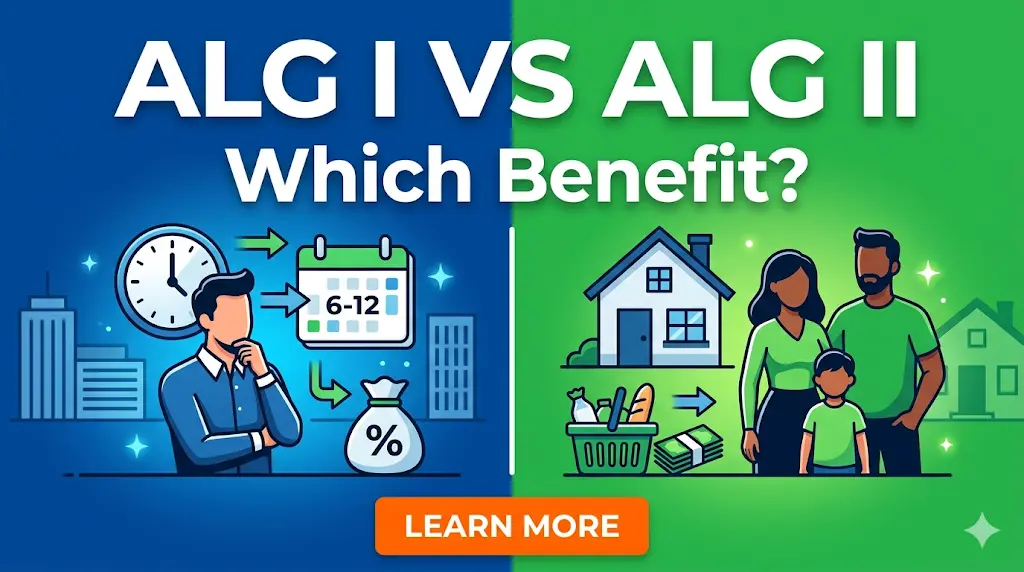
There is a massive, highly stigmatized misconception among expats regarding Arbeitslosengeld I (ALG 1). ALG 1 is not welfare, and it is not a state handout. It is an insurance payout that you have been legally mandated to fund since your first day of work in Germany.
Qualifying for ALG 1 and the Anwartschaftszeit
When you look at your monthly German payslip, you will see a deduction for Arbeitslosenversicherung (unemployment insurance). Because you have been forced to pay into this system, you have a legal right to draw from it when crisis strikes.
To qualify for ALG 1, you must fulfill the qualifying period. This means you must have been employed and paying into the statutory unemployment insurance system for at least twelve months within the last thirty months before registering as unemployed. If you meet this threshold, your nationality and your visa status do not prevent you from receiving the money. The duration of your payout depends on your age and how long you contributed, but for most professionals under fifty, it maxes out at twelve months of support.
Calculating How Much You Will Actually Receive
The financial shock of transitioning to ALG 1 is brutal. The system does not replace your full salary. By default, ALG 1 pays out 60 percent of your previous flat-rate net income. If you have at least one dependent child, that rate increases slightly to 67 percent.
Losing 40 percent of your net income overnight can instantly jeopardize your ability to cover rent and basic utilities. To survive this period, you must aggressively audit your recurring expenses. This is where having a modern banking setup becomes essential. By routing your ALG 1 payouts into an agile account like N26, you can instantly analyze your spending analytics. N26 allows you to immediately identify and cancel unnecessary subscriptions that are draining your newly reduced liquidity. Furthermore, you can use their digital sub-accounts to actively quarantine your rent money the second the government payout clears, guaranteeing your housing is never at risk while you search for your next role. Scaling back your lifestyle to match this new baseline is an uncomfortable process mapped out in Cost of Living in Germany: Breakdown of Expenses Rent Food Transport.
Arbeitslosengeld II and the Expat Welfare Trap
When your twelve months of ALG 1 run out, or if you lose your job before you hit the twelve-month qualifying period, the German system filters you into Arbeitslosengeld II. This system was officially rebranded as the Bürgergeld, but the underlying mechanics—and the extreme danger it poses to expats—remain the same.
Means Testing and Basic Support
Unlike ALG 1, which is a pure insurance payout based on your previous salary, ALG 2 (Bürgergeld) is a means-tested social welfare program handled by the Jobcenter. It is designed to cover the absolute bare minimum existence level. It pays for your basic rent, heating, and provides a flat-rate monthly stipend for food and daily necessities.
Because it is means-tested, the government will ruthlessly audit your global finances before giving you a single euro. If you have significant savings, offshore investments, or a heavily funded Rainy Day Fund: Saving an Emergency Fund in Germany How Much and Where, the Jobcenter will legally force you to burn through your own assets before they step in to provide state assistance.
Why ALG 2 Can Threaten Your Residence Permit
This is the most critical distinction every foreign worker must understand: drawing ALG 2 is highly toxic to your immigration status.
Under German immigration law, most temporary residence permits and all permanent settlement permits require you to prove that your livelihood is secured independently, without relying on public funds. Because ALG 1 is classified as an insurance payout, receiving it does not typically violate this requirement. However, ALG 2 is classified as state welfare. If you apply for Bürgergeld, the immigration office will immediately flag your file. Relying on this basic welfare can lead to your visa extension being outright denied, effectively ending your expat journey in Germany.
| Feature | Arbeitslosengeld I (ALG 1) | Arbeitslosengeld II (Bürgergeld) |
| System Type | Statutory Unemployment Insurance | Tax-Funded Social Welfare |
| Funding Source | Your monthly payroll deductions | The general federal tax budget |
| Payout Amount | 60% or 67% of your previous net salary | Flat rate for basic existence plus rent |
| Means-Tested? | No (Based solely on previous income) | Yes (All global assets and savings audited) |
| Expat Visa Impact | Safe (Classified as insurance) | Dangerous (Classified as public funds) |
Financial Survival Strategies During Unemployment
Surviving a sudden job loss in Europe requires immediate, calculated financial pivots. You must bridge the gap between your reduced ALG 1 income and your fixed global liabilities.
Securing Severance and Daily Liquidity
If you are fortunate enough to negotiate an Abfindung (severance package) during your termination, you must protect that capital aggressively. A severance payout is fully taxable, and managing the sudden influx of cash while on a reduced monthly unemployment stipend is tricky. The best strategy is to instantly lock the majority of the severance away in a dedicated N26 sub-account, treating it as an untouchable emergency extension rather than a sudden windfall.
If your termination ultimately forces you to leave Germany, or if you simply decide to return to your home country to regroup, you cannot leave that severance sitting in a legacy German bank. Traditional banks will quietly extract massive network fees and terrible exchange rates when you eventually try to pull the money overseas. To protect your exit capital, utilize Wise to move your severance out of the Eurozone. You can execute the transfer through Wise to secure the real mid-market exchange rate, ensuring your hard-earned settlement crosses the border completely intact and ready to fund your next chapter.
Pausing Investments and Handling Home Country Debts
One of the most terrifying aspects of expat unemployment is that your foreign liabilities do not care about your German visa status. If you are paying a mortgage in the UK or servicing a student loan in the US, those bills are still due every month, but now you must pay them using a severely reduced ALG 1 stipend.
To ensure your reduced income stretches across borders, you must abandon traditional bank wires immediately. Executing cross-border debt payments via legacy banks while unemployed is financial suicide due to their hidden markup spreads. By routing your monthly foreign debt obligations through Wise, you bypass the expensive SWIFT network entirely, preserving every possible euro of your government payout. Learning to orchestrate these efficient, low-cost capital flows is a vital survival mechanism detailed in Cross-Border Banking: Managing Your Home Country Account While in Germany.
Finally, if you have been responsibly building a global investment portfolio, a job loss is not the time to panic-sell your assets. Liquidating your global ETFs triggers massive, unnecessary capital gains taxes that will heavily complicate your final Understanding Your Tax Assessment Steuerbescheid: After You File in Germany. If your long-term wealth is secured in a robust, internationally portable brokerage like Interactive Brokers, simply pause your monthly contributions. Because Interactive Brokers charges incredibly low maintenance fees and allows your portfolio to cross borders seamlessly if you are forced to relocate, you can leave your wealth compounding untouched while you navigate the immediate crisis. Securing your future through geographic independence is the ultimate defense, an approach fully decoded in Should You Invest in German or International Stocks Diversifying as an Expat.
References
Primary sources (official)
- Bundesagentur für Arbeit: The official federal portal detailing the exact eligibility requirements, the mandatory 12-month qualifying period, and the online registration process for Arbeitslosengeld I. https://www.arbeitsagentur.de/arbeitslos-arbeit-finden/arbeitslosengeld
- Bundesministerium für Arbeit und Soziales (BMAS): The Federal Ministry of Labour and Social Affairs provides the official legal framework and current payout rates for the basic income support system known as Bürgergeld (formerly ALG II). https://www.bmas.de/DE/Arbeit/Grundsicherung-Buergergeld/Buergergeld/buergergeld.html
- Make it in Germany: The federal government’s official platform for skilled international workers explaining the direct consequences of job loss on tied residence permits and EU Blue Cards. https://www.make-it-in-germany.com/en/visa-residence/living-in-germany/loss-of-job
Other helpful sources
- Finanztip – Arbeitslosengeld 1: Germany’s leading independent financial advice portal offering a deep mathematical breakdown of exactly how your ALG 1 net payout is calculated based on your specific tax class. https://www.finanztip.de/arbeitslosengeld/
- Settle in Berlin – Unemployment Benefits Germany: A highly practical, step-by-step expat guide detailing the bureaucratic nightmare of registering at the Agentur für Arbeit and how to avoid the dreaded Sperrzeit penalties. https://www.settle-in-berlin.com/unemployment-benefits-germany-alg-1/
Disclaimer
The information provided in this article is for general informational and educational purposes only and does not constitute professional financial, tax, or legal immigration advice. Eligibility for German unemployment insurance (Arbeitslosengeld I) and basic income support (Bürgergeld) is strictly determined by the Bundesagentur für Arbeit and the Jobcenter. Relying on state welfare funds (Bürgergeld) can severely jeopardize your current residence permit and future immigration applications. The strict three-day reporting deadline (Meldepflicht) is legally binding, and failure to comply will result in significant financial penalties.