Citizenship vs Permanent Residency in Germany: Which to Aim For?
Deciding whether to lock down permanent residency or go all the way for German citizenship is a paralyzing choice that haunts every long-term expat. I spent months agonizing over giving up my original passport just to avoid the immigration office forever, right before the laws finally changed. This guide breaks down the core differences, pros and cons, and requirements so you can choose your ultimate German path.
Disclosure: This post may contain affiliate links. We may earn a commission at no extra cost to you if you make a purchase through these links. Read full disclosure.
Understanding Your Long Term Options in Germany
The Bureaucratic Fatigue Factor
Living in Germany as a third-country national means navigating an endless maze of paperwork, and the absolute worst part is the constant fear of visa renewal. Every two to three years, expats have to scramble to gather payslips, beg HR for a new contract confirmation, and wake up at dawn to fight for an appointment at the local immigration office. The anxiety of potentially losing your job and having only three months to find a new one or face deportation creates an underlying, chronic sense of insecurity.
Both Permanent Residency and Citizenship offer a permanent escape hatch from this endless, exhausting cycle. Holding either status means you no longer need permission from the state to change jobs, start a freelance business, or simply exist in the country. You finally switch from being a temporary guest on a leash to a stable resident with long-term security.
However, the paths to these two milestones—and the rights they ultimately confer—are vastly different. While many expats view permanent residency as the finish line, recent sweeping changes to German nationality laws have radically altered the landscape, making citizenship an incredibly viable and attractive option for those who previously refused to consider it.
Defining Permanent Residency and the Niederlassungserlaubnis
Permanent residency, officially known as the Niederlassungserlaubnis, is the ultimate upgrade to your standard temporary visa. It is a highly coveted status that allows you to live and work in Germany indefinitely without being tied to a specific employer or academic institution. If you want to quit your corporate tech job and open a bakery, the Niederlassungserlaubnis gives you the legal right to do so.
You also gain full, unrestricted access to the German social security net. If you lose your job while holding permanent residency, you can register as unemployed and claim benefits (Arbeitslosengeld) without the immediate, terrifying threat of your visa being canceled and being kicked out of the country. This provides a massive layer of psychological safety for expats.
However, it is vital to understand that your permanent residency is heavily tethered to your physical presence within the borders of Germany. It is only “permanent” as long as you actually live here. Furthermore, you remain a citizen of your home country, meaning you still travel on your original passport and must adhere to all its global visa restrictions. If your home country’s passport is weak, a Niederlassungserlaubnis will not help you skip the line at a US or UK border checkpoint.
Defining German Citizenship and Einbuergerung
German citizenship (Einbürgerung) is the absolute final boss of the immigration journey. When you become a naturalized German citizen, you are fundamentally no longer considered a foreigner; you become a permanent member of the state with identical rights to someone born in Berlin or Munich. You are issued a German passport, which is consistently ranked as one of the most powerful travel documents in the entire world.
More importantly, citizenship is absolute and irrevocable in almost all circumstances. You can leave Germany for ten years, live on a beach in Bali, work in Canada, and return to Germany whenever you want without ever losing your status. You answer to no immigration officer.
Historically, Germany had incredibly strict laws forbidding dual citizenship for non-EU nationals, which forced many expats to stick with permanent residency because they simply could not stomach renouncing their homeland. However, with the monumental reform to the nationality law enacted in June 2024, Germany finally embraced modern immigration realities, dropping the renunciation requirement and making the German passport highly accessible to the millions of expats building their lives here.

Core Differences and Comparative Analysis
Travel Freedom and Time Outside Germany
The most restrictive and often misunderstood element of the Niederlassungserlaubnis is the strict legal limit on how long you can leave the country. By law, if you leave Germany for more than six consecutive months without prior written permission from the immigration office, your permanent residency automatically expires and is legally void. You cannot simply use PR as a backup plan while moving back to your home country or taking a multi-year expat assignment in Dubai.
German citizenship removes this geographical anxiety entirely. As a citizen, you have the absolute right to freedom of movement. You can relocate to another country within the European Union to live and work without needing a visa, or you can move to another continent for decades. Your German passport will always guarantee your right to return home to Germany, no questions asked.
This difference is the primary deciding factor for many highly mobile expats. If you dream of taking a year-long sabbatical to travel the world or anticipate moving back home to care for aging parents, relying on a permanent residency card is incredibly risky, whereas citizenship offers bulletproof peace of mind.
Civic Duties Voting and Passport Power
Another massive distinction lies in your right to civic participation. As a permanent resident, you are heavily taxed exactly like a German citizen, funding the schools, roads, and government programs. Yet, you have absolutely no say in how those taxes are spent. Unless you are an EU citizen (who can vote in local municipal elections), PR holders cannot vote in state or federal elections, nor can they run for political office. You are a taxpayer, but not a voter.
When you naturalize, you gain full democratic rights. You get a voice in the Bundestag elections, allowing you to vote on the policies that directly affect your life, housing, and income. You shift from being a spectator to an active participant in the country’s future.
Furthermore, citizenship grants you powerful consular protection. If you are traveling globally and run into severe trouble—such as losing your passport, being caught in a natural disaster, or facing a medical emergency in a foreign country—German embassies worldwide are legally obligated to provide you with assistance and repatriation, a safety net that permanent residents simply do not have.
Family Reunification and Passing on Status
If you hold a Niederlassungserlaubnis and decide to marry a non-EU citizen who lives abroad, bringing them to Germany involves the standard, rigorous family reunification visa process. They will need to prove basic German language skills just to get an entry visa, and you will need to prove you have enough living space and income to support them.
If you are a German citizen, bringing your foreign spouse to Germany is significantly streamlined and bypasses many of the strictest income and language hurdles applied to foreigners. The German state highly prioritizes the family unit of its citizens.
Most importantly, citizenship is passed down by blood. Any children you have after becoming a German citizen will automatically be German citizens at birth, regardless of where in the world they are born. They are immediately granted lifelong access to the entire European Union. A permanent residency cannot be inherited in this way; children of PR holders born outside Germany face completely different, much more difficult immigration hurdles.
| Feature | Permanent Residency (PR) | German Citizenship |
| Right to Reside & Work | Yes, indefinitely (within Germany) | Yes, indefinitely (across the EU) |
| Maximum Time Abroad | 6 Months (unless exceptions apply) | Unlimited |
| Voting Rights | No (except local elections for EU citizens) | Yes, full voting and office-holding rights |
| Passport Issued | No (You keep your home passport) | Yes (One of the world’s strongest) |
| Dual Status Allowed | Yes | Yes (Under the new 2024 law) |
| Revocability | Yes, if you leave or commit severe crimes | Extremely rare/virtually impossible |
Navigating the Financial and Administrative Requirements
Proving Financial Stability and Pension Contributions
The German state wants absolute, documented certainty that you will not become a financial burden on the public welfare system. For permanent residency, you typically need to prove that you have paid into the statutory pension scheme (Rentenversicherung) for at least 60 months, though this is significantly reduced for highly skilled workers.
To prove your financial stability during your early visa years, many expats rely on structured financial tools. Setting up your finances correctly with providers like Expatrio is a massive advantage. While Expatrio is heavily used by incoming students to establish blocked accounts, having a flawless financial track record from day one builds the continuous proof of liquidity the government eventually wants to see. Later, when applying for PR or citizenship, you must provide extensive documentation, which you can learn to decode in our guide on Understanding Your German Payslip: Gross vs Net Salary Explained.
For citizenship, the financial requirements are even stricter. You must prove you can support yourself and your dependent family members entirely without recourse to public funds like the Bürgergeld (citizen’s allowance). If you are relying on state unemployment benefits when you apply, your citizenship application will almost certainly be paused or denied.
Health Insurance Non Negotiables
Germany’s strict mandate for comprehensive health insurance applies equally to both PR and citizenship applications. You must prove continuous, gapless coverage for the entirety of your legal stay in the country. Handing an immigration officer a cheap, temporary travel insurance policy will result in an instant, non-negotiable rejection of your permanent status.
This is where utilizing specialized expat providers like Feather Insurance becomes critical. The case workers at the Ausländerbehörde will meticulously scrutinize your policy to ensure it meets strict BaFin (Federal Financial Supervisory Authority) standards. Securing your public or private coverage through Feather Insurance guarantees that your policy satisfies all legal requirements.
Moreover, Feather Insurance makes generating the specific, highly bureaucratic administrative letters required by the immigration office incredibly simple and entirely in English. You won’t have to spend hours on hold with a traditional German insurance company begging for a coverage confirmation document. To understand exactly what the immigration office is looking for, review our deep dive into Health Insurance in Germany: Understanding Public vs Private Coverage.
Language Skills and Integration Proof
You cannot legally permanently settle in Germany or claim its passport without speaking the language. For a standard permanent residency application, you must demonstrate a B1 level of German according to the CEFR framework. For citizenship, B1 is also the absolute baseline requirement under the newly reformed laws.
In addition to language proficiency, citizenship requires you to pass the Leben in Deutschland (Life in Germany) naturalization test. This exam proves your foundational knowledge of German history, democratic values, the legal system, and your commitment to the constitutional order.
Preparing for these language and cultural hurdles is not something you can do overnight. The most effective way to guarantee you pass both the B1 language exam and the naturalization test is by enrolling in a state-sponsored course. You can find out how to apply for these highly subsidized classes in our comprehensive guide on German Integration Courses: Language & Orientation for New Residents.
The Path to Permanent Residency
Standard Timelines and Fast Tracks
The standard wait time for a Niederlassungserlaubnis is 5 years of continuous, legal residence in Germany while working and paying into the pension system. However, Germany faces a massive skilled labor shortage and offers multiple fast tracks to retain highly educated international talent.
If you hold an EU Blue Card, your timeline is drastically accelerated. You can apply for permanent residency after just 33 months of highly qualified employment. If you push yourself to achieve a B1 German language certificate, that waiting period is slashed to just 21 months. This is one of the fastest paths to permanent status in the entire European Union.
Graduates of German universities also enjoy a highly favorable fast track. If you complete a bachelor’s or master’s degree in Germany, you can apply for permanent residency after just 24 months of holding a job that is directly related to your academic qualifications. For a full breakdown of every available timeline, read Permanent Residency in Germany: Requirements and How to Apply.
Gathering the Right Documentation
The physical paperwork required for PR is extensive and unforgiving. You will need your valid home country passport, your current Biometric Residence Permit (eAT): Understanding Your German Residence Card, an active and permanent employment contract, and a formal landlord confirmation (Wohnungsgeberbestätigung) proving you have adequate living space. Ensure your housing documents perfectly align with the rules outlined in Anmeldung (Address Registration) vs Visa: Why Both Are Needed in Germany.
You will also need to request a specific printout from the German pension authority (Rentenversicherungsverlauf) proving exactly how many months you have contributed. Organizing this dossier meticulously is the key to a fast approval. Case workers are exhausted; handing them a perfectly tabbed and indexed binder makes their job easier and heavily works in your favor.
Dealing with Foreign Documents and Translations
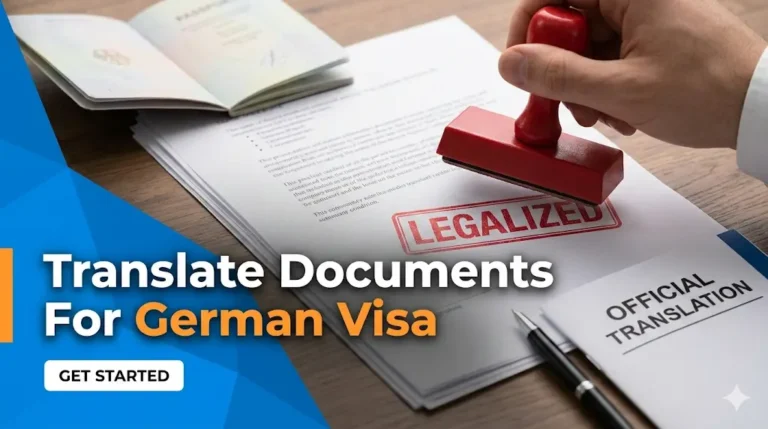
When applying for permanent status, you will inevitably need to present crucial civil documents from your home country, such as your original birth certificate, your marriage certificate (if applying with a spouse), or foreign university degrees to prove your qualifications.
The German immigration office operates strictly in the German language and does not accept documents in English, Spanish, or any other foreign language. You must obtain sworn, certified translations. This is exactly why veteran expats rely on Lingoking.
Using Lingoking guarantees that your vital documents are translated by court-sworn professionals and will be accepted by the strictest German bureaucrats. Trying to save money by submitting a self-translated marriage certificate will get your entire application thrown out, whereas a Lingoking certified document with the correct legal seals sails through the process smoothly. For more on preparing foreign paperwork, consult Legalizing and Translating Documents for German Visa Applications.
The Journey to German Citizenship
The Impact of the New Dual Citizenship Law
For decades, Germany’s incredibly strict stance against dual citizenship forced millions of expats to make an agonizing choice: hold onto their homeland’s passport, or become German. You were legally required to renounce your original citizenship to naturalize, except in very rare hardship cases or if you were an EU citizen.
In June 2024, the Nationality Law (StARModG) was completely overhauled, fundamentally changing the expat experience. Now, multiple citizenships are generally permitted across the board. You no longer have to surrender your original passport to become a German citizen.
This historic reform is the single biggest reason why expats who held permanent residency for years are now flooding the citizenship offices. You can finally enjoy the absolute security and travel power of a German passport while maintaining your legal ties, voting rights, and property rights in your country of birth.
New Accelerated Timelines for Naturalization
The 2024 reform did not just allow dual citizenship; it also drastically slashed the frustrating waiting periods. Previously, you had to live in Germany for 8 uninterrupted years before you could even submit a citizenship application.
Under the new law, the standard residency requirement has been reduced to just 5 years. This aligns the citizenship timeline perfectly with the standard permanent residency timeline, meaning many expats skip PR entirely and apply directly for citizenship at the 5-year mark.
Furthermore, if you can demonstrate “special integration efforts,” you can fast-track your naturalization to just 3 years. These special efforts include achieving an exceptional C1 level of German, demonstrating outstanding professional achievements, or performing significant, documented volunteer work within a German community organization.
The Naturalization Process and Wait Times
The application process for Einbürgerung is exhaustive. It involves a deep background check to verify you have not committed serious crimes, a review of your financial independence, and a mandatory signed declaration of loyalty to the free democratic basic order of the German constitution. You must also declare your recognition of Germany’s special historical responsibilities.
Be warned: because of the massive popularity of the new dual citizenship laws, naturalization offices across the country are experiencing unprecedented administrative backlogs. Submitting your application is just the beginning; the processing time can take anywhere from 12 to 36 months, depending heavily on how understaffed your specific city’s office is.
During this long wait, you must maintain your legal residency status. To understand how long typical immigration processes take and when to follow up, refer to Renewing Your German Visa or Residence Permit: Timeline and Process. If your current temporary visa is expiring while you wait for your citizenship to be approved, you must immediately contact the authorities to secure a bridging document to avoid an illegal stay. You can find emergency steps in our guide on What to do if your German visa expires.
References
Primary sources (official)
- Federal Ministry of the Interior and Community – Nationality Law 2024: https://www.bmi.bund.de/EN/topics/constitution/nationality/nationality-law/nationality-law.html
- Make it in Germany (Official Portal) – Settlement Permit: https://www.make-it-in-germany.com/en/visa-residence/living-permanently/settlement-permit
- Federal Office for Migration and Refugees (BAMF) – Naturalisation in Germany: https://www.bamf.de/EN/Themen/Integration/ZugewanderteTeilnehmende/Einbuergerung/einbuergerung.html?nn=285728
Other helpful sources
- IOM Germany – Information on Visas and Migration: https://germany.iom.int/
- European Commission – EU Immigration Portal for Germany: https://immigration-portal.ec.europa.eu/germany-employed-worker_en
Disclaimer
The information provided in this guide is for general informational purposes only and is based on the real-world experiences of expats navigating the German immigration system. Immigration laws, citizenship requirements, and administrative procedures are highly complex and were significantly altered by the 2024 Nationality Law reform. These regulations are subject to further interpretation and changes by local and federal authorities. This article does not constitute legal or immigration advice. Always consult the official website of your local Ausländerbehörde, the Federal Office for Migration and Refugees (BAMF), or a certified German immigration lawyer for the most current, legally binding requirements regarding your specific path to permanent residency or citizenship.