Moving to Germany on an EU Blue Card from Another EU Country: How to Transfer
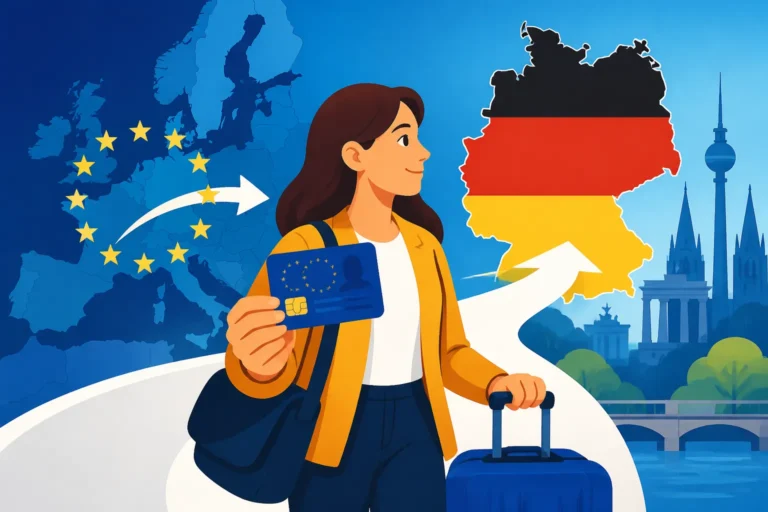
Thinking that an EU Blue Card from France or Spain lets you simply move to Berlin and start working immediately is a dangerous misconception. I nearly lost a lucrative Munich job offer because I assumed my existing European permit completely bypassed German bureaucracy. This guide explains how to legally transfer your EU Blue Card to Germany without accidentally invalidating your status.
Disclosure: This post may contain affiliate links. We may earn a commission at no extra cost to you if you make a purchase through these links. Read full disclosure.
The Myth of Seamless European Borders
Expats often confuse the ability to travel freely across the Schengen zone with the legal right to work and reside. The EU Blue Card is designed to facilitate intra-European mobility, but it is heavily regulated by strict timelines.
The 12-Month Mobility Rule Explained
The European Union overhauled the Blue Card directive to facilitate better mobility for highly skilled workers. If you hold an EU Blue Card issued by another member state (like Italy, Poland, or the Netherlands), you possess a massive administrative advantage over someone applying directly from a third country.
However, this advantage is locked behind a strict timeline. To qualify for long-term mobility to Germany, you must have legally held your first EU Blue Card for at least 12 continuous months in the issuing country. If you attempt to transfer your life to Germany in month eleven, your application will be treated as a standard, first-time application, and you lose all accelerated mobility perks.
Visa-Free Entry vs Work Authorization
If you pass the 12-month threshold, you are granted a phenomenal bureaucratic shortcut: you do not have to apply for an entry visa at the German embassy in your current host country. You can simply pack your bags, cross the border into Germany, and enter visa-free.
However, visa-free entry is not the same as work authorization. You cannot legally start your new German job the second you unpack. You have exactly one month from your date of entry to register your physical address and apply for your new German EU Blue Card directly at the local Ausländerbehörde (Foreigners’ Authority). Navigating this mandatory initial municipal registration is a rigid process deeply explored in German Bureaucracy 101: Understanding the Anmeldung, Schufa, and Tax ID.
Step by Step Blue Card Transfer Process
Transferring your status means proving to the German state that your new corporate role meets their specific, domestic labor standards.
Securing a Valid German Contract
Your current EU Blue Card is tied to your employer in your first host country. To transfer to Germany, you must secure a brand new employment contract from a German company. This new contract must meet the strict German statutory minimum salary thresholds for 2026.
For standard professions, your gross annual salary must be at least €50,700. If you work in a designated shortage occupation—such as IT, engineering, mathematics, or medicine—the threshold drops to €45,934.20. Your new job must also clearly match your academic or professional qualifications. If your new contract falls even one euro short of these thresholds, the local authorities will reject the transfer and force you to apply for a standard, heavily restricted work visa. Understanding how these salary tiers operate is a fundamental skill outlined in Understanding the Different Types of German Visas and Residence Permits.
Applying Locally at the Auslaenderbehoerde
Once your contract is signed and you arrive in Germany, you must submit your application directly to the Ausländerbehörde. Because you are applying under the EU mobility directive, the process is structurally streamlined, but municipal offices still operate on massive backlogs.
You must bring your passport, your current valid EU Blue Card from the first member state, your new German employment contract, and your university degrees. During the waiting period, the immigration office will usually issue you a bridging document so you can legally reside while your application is evaluated, a safety net decoded in Understanding German Residence Permit Labels 18 19c etc.
Overcoming Bureaucratic Application Hurdles
While the mobility directive removes the foreign embassy from the equation, you still have to satisfy notoriously pedantic domestic German clerks.
Translating Your European Documents
The German immigration officer processing your transfer will fiercely scrutinize your university degrees and your civil documents. If you are bringing your spouse, they will demand to see your marriage certificate. If these documents were originally issued in Spanish, French, or Polish for your first Blue Card application, the German bureaucrat will likely refuse to accept them.
Germany operates strictly in the German language. You must provide legally sworn, certified translations of your foreign civil and academic documents. Utilizing Lingoking is the absolute most efficient way to clear this hurdle. Because Lingoking uses court-sworn translators officially recognized by the German state, handing their certified documents to the caseworker instantly shuts down any questions regarding the authenticity of your background. If your company requires translated background checks, using Lingoking prevents costly administrative delays.
Bridging the Health Insurance Gap
When you deregister from your first EU host country to move to Germany, your local public health coverage in that country terminates. The German Ausländerbehörde absolutely refuses to issue your new residence permit if you cannot prove you have fully compliant German health insurance. You cannot rely on your old EU health card.
To seamlessly bridge this terrifying gap, transferring expats heavily rely on Feather Insurance. Because Feather Insurance caters specifically to the international community, their digital platform allows you to secure comprehensive statutory or private coverage before you even attend your immigration appointment. Handing the caseworker the German-language PDF confirmation generated by Feather Insurance proves you are fully covered from day one, preventing a devastating visa rejection. Deciphering which insurance tier mathematically fits your new German salary is mapped out in Public vs Private Health Insurance in Germany: Which is Right for You?.
Managing Funds and Family Transition
Under the updated EU mobility directives, if your family lived with you in the first EU country under your Blue Card, they can move to Germany with you without undergoing a new “means of subsistence” financial test. However, this protection only applies to legally recognized spouses.
If you have an unmarried partner who was living with you in the first country, they do not automatically inherit your mobility rights in Germany. They must secure their own independent visa, such as a student visa or a job seeker visa. To do this, the German government will demand they prove independent financial solvency by locking over 11,000 euros in a blocked account (Sperrkonto). Setting up this account using legacy banks while transitioning between two countries is agonizing. Using Expatrio bypasses this nightmare entirely. By setting up a legally mandated blocked account through Expatrio, your partner secures a fully digital, government-approved financial proof in days. Handing the official Expatrio certificate to the authorities guarantees your partner’s independent visa is approved quickly. Managing the logistics of moving your entire household is a massive undertaking outlined in Bringing Your Family to Germany: The Family Reunification Visa.
The Fast Track to Permanent Settlement
The most powerful, hidden benefit of transferring an EU Blue Card is the accumulation of permanent residency time across borders.
Combining Your European Residency Time
Usually, acquiring the Erlaubnis zum Daueraufenthalt-EU (EU Long-Term Residence Permit) requires a foreigner to live in Germany continuously for five years. However, as an EU Blue Card holder, the time you spent living in your first EU host country mathematically counts toward this five-year requirement.
If you lived in France on a Blue Card for three years and then transfer to Germany, you only need to work in Germany for two more years to reach the five-year threshold for permanent EU settlement. This ability to stitch together your European timeline completely frees you from the anxiety of temporary visas and grants you ultimate geographic freedom, a highly complex transition deeply detailed in Understanding the German Immigration Terminology: From Aufenthaltstitel to Niederlassungserlaubnis.
| Relocation Feature | Standard Third-Country Application | EU Blue Card Transfer (After 12 Months) |
| Entry Requirement | Must apply for an entry visa at the embassy | Visa-free entry allowed |
| Application Location | Home country consulate | Local German Ausländerbehörde |
| Family Subsistence Test | Fully required (proof of income/space) | Waived for previously cohabiting spouses |
| Time to Permanent EU Residency | Clock starts at 0 upon entering Germany | Time spent in previous EU country counts |
References
Primary sources (official)
- Federal Office for Migration and Refugees (BAMF): The official central authority guidelines detailing the exact 12-month requirement for visa-free entry and long-term mobility under the EU Blue Card directive. https://www.bamf.de/EN/Themen/MigrationAufenthalt/ZuwandererDrittstaaten/Arbeit/BlaueKarteEU/blauekarteeu-node.html
- Make it in Germany – EU Blue Card: The federal government’s official portal outlining the updated 2026 salary thresholds and the specific conditions for changing jobs across European borders. https://www.make-it-in-germany.com/en/visa-residence/types/eu-blue-card
Other helpful sources
- European Commission – EU Immigration Portal: A broad, overarching guide explaining the fundamental rights, intra-EU mobility privileges, and permanent residency accumulation rules for recognized long-term residents. https://immigration-portal.ec.europa.eu/index_en
Disclaimer
The information provided in this article is for general informational and educational purposes only and does not constitute professional legal, tax, or immigration advice. German immigration laws under the Aufenthaltsgesetz (AufenthG), specifically regarding the 12-month long-term mobility rule and the exact 2026 salary thresholds for the EU Blue Card (€50,700 standard / €45,934.20 shortage), are strictly enforced by local immigration authorities (Ausländerbehörden). You must apply for your German EU Blue Card within one month of entering the country, and you are not permitted to begin working until the authorities grant explicit authorization. Always consult a certified German immigration lawyer (Fachanwalt für Ausländerrecht) regarding cross-border visa transfers.