Work-Life Balance in Germany: How Germans Spend Their Free Time
I remember the distinct panic of my German manager telling me to immediately shut down my laptop after I casually responded to a Slack message on a Friday evening. Realizing that work-life balance is heavily enforced here is a massive, disorienting culture shock. This guide explains how to navigate German free time, unlearn corporate burnout, and build a fulfilling life.
Disclosure: This post may contain affiliate links. We may earn a commission at no extra cost to you if you make a purchase through these links. Read full disclosure.
The Sacred Boundary Between Office and Home
Leaving Work at Work The Feierabend Culture
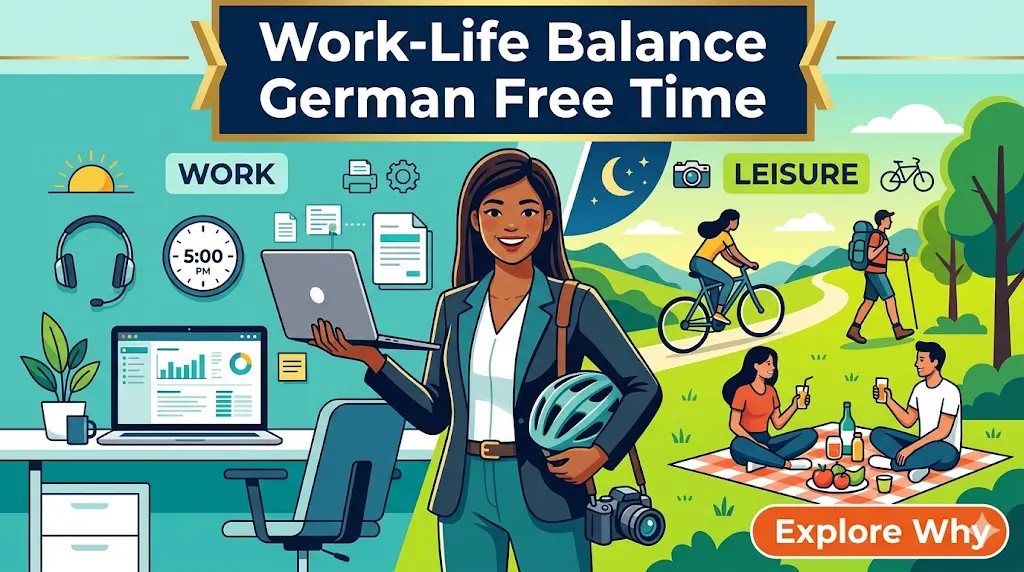
In many fast-paced corporate cultures across the Americas and Asia, staying late at the office is worn as a badge of honor, a performative display of your dedication to the company. In Germany, staying late consistently is often viewed entirely differently: it is seen as a sign of inefficiency or poor time management. When the clock strikes 5:00 PM, a rapid, almost synchronized exodus occurs. This daily transition is encapsulated by the beautiful, untranslatable German concept of Feierabend.
Feierabend literally translates to “celebration evening,” but it practically means the absolute end of the working day. It is not just a time on the clock; it is a mental boundary. When a German coworker wishes you a “Schönen Feierabend,” they are officially releasing you from your professional duties. You are not expected to think about quarterly reports, answer client emails, or brainstorm project ideas once you leave the building.
For newly arrived expats, adjusting to the Feierabend culture induces a strange sense of guilt. You might sit at your desk at 5:30 PM, terrified that leaving “early” will damage your career prospects. I spent my first few months sneaking out of the office, only to realize I was the last one there. Validating that you are allowed—and explicitly expected—to rest is the first major psychological hurdle of integrating into the German workforce. To understand how this fits into your broader adaptation, take a look at Coping with Culture Shock: Adjusting to Life in Germany.
The Legal Right to Disconnect
The German dedication to rest is not merely a cultural quirk; it is violently protected by federal law. The German Working Hours Act (Arbeitszeitgesetz) strictly regulates how much an employer can demand of you. The standard legal workday is eight hours. While it can be temporarily extended to ten hours in exceptional circumstances, your employer must ensure that your average working time does not exceed eight hours a day over a six-month period.
Furthermore, the law mandates an uninterrupted rest period of at least eleven hours between shifts. If you finish answering a late-night email at 11:00 PM, you legally cannot be forced to begin work the next day until 10:00 AM. In recent years, massive German corporations and trade unions have taken this even further, implementing servers that physically stop routing emails to employees’ smartphones during the weekend.
This strict legal framework means that checking your inbox on a Saturday is not just culturally frowned upon; it can be an active liability for your HR department. For expats accustomed to an “always-on” hustle culture, this legal right to disconnect requires a massive unlearning process. You have to realize that your promotion does not hinge on your weekend availability. Understanding your fundamental rights as an employee is just as important as decoding your taxes, which you can explore in Understanding Your German Payslip: Gross vs Net Salary Explained.
Dealing With Colleague Boundaries
Because Germans aggressively protect their private time, they also enforce a massive structural divide between their professional lives and their personal lives. In peach cultures (like the US or the UK), coworkers frequently become instant friends. You go to happy hours together, invite each other to weekend barbecues, and share deep personal details over the water cooler. Germany is a classic coconut culture: hard and formal on the outside, soft and loyal on the inside.
Your German colleagues are generally exactly that: colleagues. During your first year, you will likely not be invited to their home, and they will likely not want to spend their precious weekend grabbing a beer with you. They have spent years carefully curating a private circle of friends from university or their hometown, and breaking into that circle takes an immense amount of time.
This strict compartmentalization is incredibly isolating for expats who rely on the office as their primary vehicle for socialization. You will feel lonely at first. However, the flip side of this boundary is that workplace drama is significantly reduced. You do not have to pretend to be best friends with your manager. If you want to actually build a social circle, you must look outside the office walls, a strategy we deeply outline in Finding Your Community: Expat Groups, Clubs, and Meetups in Germany.
Surviving the German Sunday Rest
The Shock of Ruhetag
Perhaps the most jarring adjustment to daily life in Germany is the concept of the Ruhetag, or the day of rest. Rooted in both Christian tradition and strong labor union laws, federal regulations dictate that almost all retail stores, supermarkets, pharmacies, and shopping malls must remain strictly closed on Sundays.
Every single expat has a war story about their first weekend in Germany. You wake up lazily on a Sunday morning, decide to go grocery shopping for the week, and step out onto eerily empty streets. Realizing that you forgot to buy food and that every single Rewe or Edeka is locked tight until Monday morning induces a unique, isolating panic. I spent an entire Sunday eating dry pasta because I didn’t understand the severity of this shutdown.
The Ruhetag extends far beyond commercial closures; it governs municipal noise levels. It is socially unacceptable—and often illegal depending on your local municipality—to vacuum your apartment, mow your lawn, drill a hole in the wall, or even use the public glass recycling bins on a Sunday. If you decide to do loud household chores, you will likely receive a sharp knock on the door from a furious neighbor. It forces a complete, mandatory deceleration of your life.
How Locals Actually Spend Sundays
If you cannot shop, clean, or run errands, how do Germans actually spend their Sundays? The answer usually revolves around nature, family, and cake. The Sunday Spaziergang (walk) is a sacred national pastime. Rain, snow, or shine, Germans will don weather-appropriate gear and go for a long, deliberate walk through the local forest, park, or city streets. It is not an athletic hike; it is a slow, methodical way to get fresh air and converse with family.
This is immediately followed by the tradition of Kaffee und Kuchen (coffee and cake) around 3:00 PM. While retail stores are closed, bakeries and cafes are usually legally permitted to open for a few hours on Sunday afternoons. Locals gather to eat massive slices of Apfelstrudel or Schwarzwälder Kirschtorte.
Adapting to this rhythm requires having the right gear. Because the weather is notoriously unpredictable, having a high-quality, windproof jacket and comfortable walking shoes is absolutely essential. Ordering durable outdoor gear on Amazon Germany before your first winter sets in will save you from freezing during these mandatory Sunday walks. Likewise, if you decide to embrace the baking culture yourself instead of going to a cafe, sourcing specific baking tins and a good kitchen scale from Amazon Germany will make your Sunday afternoons infinitely cozier.
Preparing for the Weekend Shutdown
Surviving the Ruhetag requires treating Saturday like a strategic military operation. Saturday is errand day. The supermarkets on a Saturday afternoon are absolute chaos, filled with locals hoarding groceries to survive the 24-hour retail drought. You must plan your meals in advance and execute your shopping list before the stores close (which, in some conservative states like Bavaria, can be as early as 8:00 PM on a Saturday).
If you do fail to plan, there are a few emergency loopholes. Supermarkets located inside major central train stations (Hauptbahnhof) or airports possess special permits to remain open on Sundays to serve travelers. Additionally, in cities like Berlin or Leipzig, you can rely on the local Späti (late-night convenience store) to buy overpriced emergency milk and frozen pizza.
During your first few volatile months, managing these logistics is overwhelming. This is why securing a centrally located, furnished apartment through Wunderflats is a strategic lifesaver. Properties listed on Wunderflats are often situated in well-connected urban neighborhoods, meaning that if you do run out of groceries on a Sunday, you are only a short walk or a quick U-Bahn ride away from an exempt train station supermarket. A well-located Wunderflats apartment buys you a massive margin of error while you adapt to the uncompromising German calendar.
Finding Your Tribe Through Vereine
The Association Obsession
Because Germans do not easily make friends at the office or strike up random conversations on the bus, they rely on highly structured environments to socialize. The absolute backbone of German free time is the Verein (club or association). There are over 600,000 registered Vereine across the country. There is a legally registered club for literally everything: rabbit breeding, historical reenactment, choir singing, community gardening, and tabletop gaming.
This structured socialization feels deeply unnatural to expats who are used to spontaneous hangouts. However, joining a Verein is the ultimate cheat code for bypassing the hard exterior of the German coconut culture. When you join a club, you are instantly united by a common passion, which completely eliminates the need for awkward small talk.
You show up every Tuesday evening for practice or meetings. Over the course of several months, the formal barriers naturally erode. The shared activity provides a safe, predictable framework for interaction, and these club acquaintances frequently evolve into intensely loyal, lifelong friendships. To dive deeper into navigating these specific social dynamics, review Nightlife and Networking: Using Social Events to Advance Your Career.
Sports and Outdoor Clubs
The most popular entry point for expats is the local sports club (Sportverein or Turnverein). Germany has a massive, decentralized amateur sports culture. You do not need to be a professional athlete to join; there are leagues for every age and skill level. Whether you want to play football, learn bouldering, or join a massive rowing club on the river, there is an association waiting for you.
The membership fees for these clubs are usually shockingly cheap, often costing only a few euros a month, because they operate on a non-profit, volunteer basis. However, what they lack in financial cost, they demand in commitment. You are expected to show up consistently, volunteer for club events, and help organize the annual summer festival.
If you decide to join a specialized club, arriving with the proper equipment shows that you take the hobby seriously. Sourcing a high-quality tennis racket, indoor football shoes, or a specific type of climbing chalk on Amazon Germany ensures you are fully prepared for your first practice without having to navigate a confusing, German-only sporting goods store. Being prepared allows you to focus entirely on breaking the ice rather than worrying about your gear.
Navigating Expat vs Local Social Circles
When integrating, you will constantly fight the gravitational pull of the “expat bubble.” Finding other English-speaking foreigners on Meetup apps or Facebook groups is incredibly easy. You share the exact same struggles, from battling the immigration office to deciphering your internet contract, making instant bonding effortless.
While this expat bubble is crucial for your mental survival during the first year, relying on it permanently will stunt your integration. Expat circles are notoriously transient; people constantly move away, get new visas, or return home, leaving you to constantly rebuild your friend group from scratch.
You must use the expat community as a bridge, not a fortress. Joining a German Verein forces you out of your comfort zone. Yes, the club meetings will be entirely in German, and you will likely sit quietly for the first few weeks, exhausted by the mental effort of translation. But pushing through this discomfort is the only way to anchor yourself permanently in the society. For strategies on balancing these dual worlds, explore Language Exchange Meetups: Practicing German and Making Friends.
Vacation Days and Bridge Days
The 30 Day Vacation Norm
The concept of vacation in Germany is treated with absolute reverence. By federal law, an employee working a five-day week is entitled to a minimum of 20 days of paid vacation per year. However, this legal minimum is almost entirely ignored by the corporate sector. The cultural and standard industry norm in Germany is between 28 and 30 days of paid vacation annually.
This sheer volume of time off—nearly six full weeks—is mind-boggling for expats moving from countries where 10 or 14 days is the standard. More importantly, there is absolutely zero guilt attached to actually using them. Your manager expects you to take all 30 days. In fact, HR departments will actively chase you down in November and force you to schedule your remaining days off because German labor law makes it incredibly difficult for companies to roll unused vacation days over into the next fiscal year.
Another massive cultural shock is that if you fall ill during your approved vacation, those days do not count against your holiday balance. If you get the flu while sitting on a beach in Spain, you simply go to a local doctor, get a medical certificate, and your German HR department will legally refund those vacation days back into your account. The state aggressively protects your right to rest and recuperate. To master the administrative side of calling in sick, consult Bureaucracy Basics: Understanding Bescheinigung, Anträge, and Other Paperwork.
Maximizing the Brueckentage
To stretch their 30 days of vacation into months of actual time off, Germans utilize a highly strategic calendar hack known as Brückentage (bridge days). Germany has a generous amount of regional and federal public holidays, and unlike some countries where holidays are shifted to a Monday, German holidays fall on their exact calendar date.
If a public holiday, such as Ascension Day (Christi Himmelfahrt), lands on a Thursday, the Friday in between the holiday and the weekend is the “bridge.” By sacrificing just one single day of your annual vacation allowance to take that Friday off, you instantly create a luxurious four-day weekend.
Germans are ruthless and precise about planning these bridge days. In many corporate offices, the battle for approving bridge days begins in January. If you wait until April to ask for the Friday after Ascension Day off, your boss will likely deny it due to lack of staff coverage. You must learn to buy a physical calendar at the start of the year, mark every single regional public holiday, and submit your vacation requests months in advance.
Travel Culture and Domestic Escapes
With six weeks of vacation and high disposable incomes, Germans are the undisputed world champions of travel. The moment a long weekend hits, the Autobahn clogs with camper vans and the airports flood with people seeking the sun. The absolute favorite foreign destinations are Majorca (Spain), the northern coast of Italy, and the beaches of Croatia.
However, domestic travel is equally beloved. The Baltic Sea (Ostsee) in the north and the Alps in the deep south are incredibly popular domestic escapes. Since the rise of remote work, many expats have started utilizing their generous vacation time to engage in “workations.”
If you want to escape the gray Berlin winter without draining your vacation days, you can easily relocate your home office. Booking a temporary, fully furnished flat through Wunderflats in a sunnier southern city like Freiburg or Munich for a month allows you to drastically change your scenery. Wunderflats provides the fast, reliable Wi-Fi necessary to maintain your professional output during the week, while placing you right next to the Black Forest or the Alps for your weekend adventures.
| Work-Life Aspect | Expat Expectation (Americas/Asia) | German Reality |
| Working Hours | “Always on,” answering weekend emails shows dedication. | Strict 8-hour days. 11-hour rest periods legally enforced. |
| Vacation Days | 10-15 days. Taking them all looks bad to management. | 28-30 days. HR will force you to use them by December. |
| Weekends | Shopping, loud chores, catching up on life admin. | Ruhetag. Stores closed, quiet enforced, focus on nature. |
| Socializing | Spontaneous happy hours with coworkers. | Scheduled hobby clubs (Vereine) with private friends. |
Wellness and Disconnecting
The Sauna and Spa Culture
If you want to truly experience how Germans disconnect from the stress of daily life, you must visit a local Therme (thermal bath and spa). However, this requires overcoming one of the most terrifying cultural hurdles for conservative expats: Freikörperkultur (FKK), or free body culture.
In Germany, saunas are strictly, non-negotiably nude, and they are almost universally mixed-gender. You cannot wear a bathing suit into a German sauna; the staff will literally ask you to leave if you try, citing hygiene reasons. For many expats, the thought of sitting completely naked in a small wooden room with a dozen strangers of all genders is a nightmare.
However, if you can push past the initial panic, you will discover that the German sauna culture is incredibly respectful, desexualized, and profoundly relaxing. It is a space dedicated entirely to health and wellness. The ritual of the Aufguss—where a Saunameister pours essential oils over hot stones and dramatically waves a towel to circulate the searing heat—is an intense, meditative experience.
To survive your first trip, you need massive, high-quality sauna towels (one to sit on, one to wrap yourself in while walking). Ordering proper oversized spa towels and a comfortable bathrobe on Amazon Germany ensures you arrive at the Therme looking like a local who knows the etiquette, heavily reducing your anxiety. For a deeper dive into the medical benefits of this culture, read Healthy Living in Germany: Wellness, Fitness, and Mental Health Guide.
Kleingartenvereine The Allotment Gardens
For Germans living in dense, apartment-heavy cities, accessing private green space is vital for mental health. This desire birthed the Schrebergarten or Kleingartenverein (allotment garden). You will see these massive colonies of tiny, manicured gardens with small wooden sheds located along train tracks or on the edges of major cities.
These plots of land are rented out to city dwellers for nominal annual fees. They provide a private oasis where locals can escape the concrete, grow their own vegetables, and host weekend barbecues. However, in true German fashion, these gardens are governed by incredibly strict association rules. There are regulations dictating exactly how tall your hedges can be, what percentage of your plot must be used for growing fruit versus ornamental flowers, and strict bans on sleeping in your shed overnight.
Getting a plot requires joining long waiting lists, sometimes lasting years. But if you manage to secure one, or if you befriend a local who invites you to theirs, it offers a deeply peaceful, grounding escape from the fast-paced urban grind.
Recharging Mental Health
The German focus on free time is ultimately rooted in a deep societal understanding of mental health and burnout prevention. The state views an exhausted, burned-out worker as a liability to the economy and the healthcare system.
If you are diagnosed with severe burnout, German public health insurance fully covers extended stays at specialized rehabilitation clinics, known as a Kur. A doctor can prescribe you three weeks at a health resort in the mountains or by the sea, fully paid for by your insurance, purely to prevent you from experiencing a total mental collapse.
This systemic safety net proves that the German work-life balance is not just a collection of quirky cultural habits; it is a profound commitment to human sustainability. It takes time to stop feeling guilty for resting. But once you embrace the Feierabend, respect the quiet of a Sunday, and use all 30 of your vacation days, you will discover a quality of life in Germany that is incredibly difficult to leave behind.
References
Primary sources (official)
- Federal Ministry of Justice – Working Hours Act (Arbeitszeitgesetz): https://www.gesetze-im-internet.de/arbzg/
- Make it in Germany (Official Portal) – Working Hours and Holidays: https://www.make-it-in-germany.com/en/working-in-germany/working-environment/working-hours-holidays
- Federal Ministry of Labour and Social Affairs – Vacation Rights: https://www.bmas.de/EN/Labour/Labour-Law/labour-law.html
Other helpful sources
- Expatica – German Work Culture and Ethics: https://www.expatica.com/de/working/employment-law/german-work-culture-100900/
- Deutschland.de – The German Love of Clubs (Vereine): https://www.deutschland.de/en/topic/life/society-and-integration/clubs-and-societies-in-germany
Disclaimer
The information provided in this guide is for general informational purposes only and is based on the real-world experiences of expats adapting to the German work and cultural landscape. Labor laws regarding minimum rest periods, maximum weekly hours, and statutory vacation days are strictly governed by the German Working Hours Act (Arbeitszeitgesetz) and may vary based on your specific employment contract or collective bargaining agreement (Tarifvertrag). This article does not constitute legal, HR, or medical advice. Always consult your employer’s HR department, your public health insurance provider (Krankenkasse), or a certified labor lawyer for precise guidance regarding your employment rights and benefits.