How to Apply for a Niederlassungserlaubnis in Germany
Getting your mail and seeing that your temporary residence permit is expiring in three months is a rite of passage that never gets less stressful. I remember the cold sweat I broke into during my third year in Berlin, realizing I had to face the bureaucracy all over again. This guide is designed to end that cycle by helping you secure your Niederlassungserlaubnis, the permanent right to live and work in Germany.
Disclosure: This post may contain affiliate links. We may earn a commission at no extra cost to you if you make a purchase through these links. Read full disclosure.
The Security of the Niederlassungserlaubnis
The Niederlassungserlaubnis is more than just a piece of plastic; it is the ultimate "I’ve made it" badge for an expat in Germany. Unlike the temporary permits that tie you to a specific employer or purpose, this settlement permit allows you total freedom in the German labor market. You can quit your job, start a business, or even take a sabbatical without worrying that the Ausländerbehörde will ask you to leave the country in thirty days.
When you hold this permit, you are effectively a German citizen in every way except for the right to vote and hold a German passport. You no longer need to check the remaining months on your visa before booking a long-term holiday or applying for a mortgage. In fact, most banks are significantly more likely to offer you a home loan once you can show them this permanent status. It provides a level of psychological peace that is hard to quantify until you actually have it in your hand.
However, getting to this point requires navigating a labyrinth of requirements that can feel like they were designed to test your patience. The transition from a temporary permit to a permanent one is a significant step, and the case workers at the immigration office will scrutinize your history with a fine-toothed comb. They are looking for stability, integration, and a clear sign that you are a contributing member of society who won't rely on state benefits in the near future.
Understanding the General Requirements for Permanent Residency
To apply for the settlement permit, you generally need to have lived in Germany for five consecutive years. However, this is just the baseline. The real meat of the application lies in your financial and social contributions. You must prove that you have paid into the statutory pension scheme (Gesetzliche Rentenversicherung) for at least 60 months. This is often the point where freelancers or those who have had gaps in employment struggle.
Financial stability is the next pillar. The state wants to see that you can support yourself and your family without any "public funds." This means no Bürgergeld or similar subsidies. They will look at your net income, your warm rent, and any existing debt or child support obligations. For those who are just starting out or moving between permit types, services like Expatrio can be incredibly helpful for managing the financial documentation and insurance requirements that lead up to this point. They provide a streamlined way to handle the various financial proofs that the German authorities demand.
Social integration is measured through your language skills and your knowledge of the German legal and social system. You will typically need to prove German language proficiency at a B1 level. This is non-negotiable for the standard five-year path. Additionally, you will need to pass the "Life in Germany" test, which covers history, politics, and local customs. You can read more about the specifics of The German Citizenship Test (Einbürgerungstest) as the requirements for the settlement permit are very similar.
The Accelerated Paths for Specialists and Blue Card Holders
One of the most common questions I get is about the "shortcuts." If you are here on an EU Blue Card, you are in luck. Germany is desperate for skilled labor, and they reward Blue Card holders with a significantly faster track to permanent residency. If you can prove B1 German, you can apply for your settlement permit after only 21 months of employment. If your German is at a basic A1 level, the wait is 33 months.
Graduates of German universities also have it easier. If you finished your degree here and have held a residence permit for work or self-employment for two years, you can often apply for the settlement permit early. This is a massive advantage for international students who decide to build their lives in German cities. It cuts the standard five-year wait in half, provided you have been paying into the pension system during those two years of post-grad work.
Freelancers have perhaps the most difficult road. While there isn't necessarily an "accelerated" path for them unless they fall under specific economic interest categories, the scrutiny of their business's viability is intense. The immigration office will look at your tax assessments from the last few years and your projected earnings. If you are a freelancer, you should definitely check out the guide on Health Insurance for Freelancers and the Self-Employed: Navigating the System to ensure your coverage meets the strict requirements for permanent residency.
| Applicant Category | Residence Requirement | Language Requirement | Pension Contributions |
|---|---|---|---|
| Standard Employee | 5 Years | B1 | 60 Months |
| EU Blue Card | 33 Months | A1 | 33 Months |
| EU Blue Card (Fast Track) | 21 Months | B1 | 21 Months |
| German University Graduate | 2 Years | B1 | 24 Months |
| Skilled Worker (Fachkraft) | 3 Years | B1 | 36 Months |
The Document Checklist: Leaving No Room for Error
When you finally get that appointment at The Foreigners' Office (Ausländerbehörde): How to Deal With It, you need to walk in with a folder that would make a librarian proud. The German bureaucracy does not handle "I'll email that to you later" very well. If you are missing one document, they may cancel the appointment and tell you to re-book—which could take another six months.
You will need your current passport, your current residence permit, and a biometric photo that was taken in the last six months. Do not try to use the photo from your last permit; they will notice. You also need proof of your income, usually in the form of your last six months of salary slips (Gehaltsabrechnungen) and a statement from your employer confirming you are still in an active, non-terminated employment relationship.
For those who have documents from their home country—like marriage certificates or university degrees from abroad—these must be translated by a state-certified translator in Germany. Using a service like Lingoking is highly recommended here, as they provide the exact type of certified translations that the German authorities accept without question. This is not the time to use a generic translation app; the stakes are far too high. You can learn more about this in our guide on How to Get a Certified Translation for German Immigration.
Navigating the Language and Integration Requirements
The B1 language certificate is often the biggest hurdle for expats who work in English-speaking tech bubbles. It is very easy to live in Berlin or Munich for five years and never get past "Ein Döner, bitte." However, for the settlement permit, you must prove you can handle everyday situations, understand complex texts, and express yourself clearly. You will need to present a certificate from an accredited provider like the Goethe-Institut or Telc.
If you are worried about the language requirement, start preparing at least a year before you plan to apply. Many people find that taking an integration course (Integrationskurs) is the best way to hit two birds with one stone, as it usually ends with both the B1 exam and the "Life in Germany" test. If you are curious about how long the total journey takes, you can check out How Long Until You Can Get Permanent Residence in Germany? to map out your timeline.
The "Life in Germany" test (Leben in Deutschland) consists of 33 questions selected from a pool of 300. You need to get 15 correct to pass for the settlement permit. The questions cover everything from what the German flag looks like to what a "works council" does. It sounds daunting, but most of it is common sense if you have lived here for a few years. Still, doing a few practice rounds online is essential.
Dealing with the Pension and Social Security Trap
The rule about 60 months of pension contributions is the "gotcha" that catches many people off guard. If you were a student working a minijob, those months might not count unless you opted into the pension scheme. If you were a freelancer and didn't pay in voluntarily, you might have zero months on your record despite living here for a decade.
You can request a "Rentenversicherungsverlauf" (pension insurance record) from the Deutsche Rentenversicherung. This document is a mandatory part of your application. It lists every single month you or your employer paid into the system. If you find you are short a few months, you might have to wait a bit longer to apply. It is also worth looking into Pension Options in Germany: Riester, Rürup, and the State Pension to understand how your future security is being built while you wait for your permit.
For those on private health insurance, you must prove that your coverage is "equivalent" to public insurance. This means it must cover a wide range of treatments and not have a high deductible that would make you a burden on the state in an emergency. If you are unsure if your plan qualifies, revisit the comparison in Health Insurance in Germany: Understanding Public vs Private Coverage to make sure you aren't walking into a rejection.
The Interview and the Waiting Game
Once you have submitted your documents and paid the fee (usually between €113 and €147), the waiting begins. The case worker will take your fingerprints and tell you that your "Elektronischer Aufenthaltstitel" (eAT) will be ready in 4 to 8 weeks. However, the internal "check" of your background can take longer. They will verify your records with the police and the tax office to ensure you haven't been hiding any major issues.
During the interview, be polite, be punctual, and—this is key—try to speak as much German as possible. Even if your B1 is shaky, showing the effort goes a long way with the officials. If they see you are trying to integrate, they are often much more helpful. If you struggle with the language, have a look at our tips for How to Prove German Language Skills for Citizenship (B1) to boost your confidence before the big day.
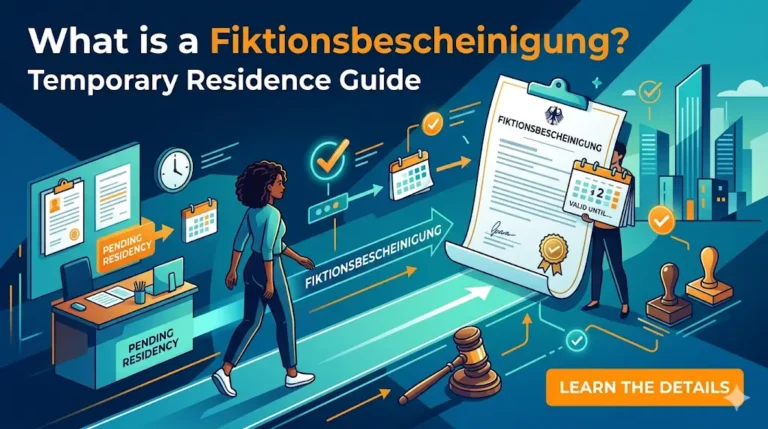
One thing to keep in mind is that your current permit must remain valid while the application is being processed. If it expires while you are waiting for your appointment, you must obtain a "Fiktionsbescheinigung." This is a temporary document that proves you are in the country legally while your permanent status is being decided. Never let your legal status lapse; it can reset your "years of residence" clock to zero.
Final Steps and Life After Approval
When you finally receive the letter saying your permit is ready for pickup, it feels like a weight has been lifted. You go back to the office, hand over your old permit, and receive your new card that says "Niederlassungserlaubnis" on the back. It usually has no expiry date, although the card itself will need to be replaced when your passport expires.
With this permit, you can now consider even bigger steps, like buying property or eventually applying for citizenship. If your income has increased or you’ve changed jobs during this process, make sure your documentation reflects that, as you'll need to know How to Prove Income for a German Residence Permit for any future administrative tasks. You might even want to consult with a professional to optimize your taxes now that you are a permanent resident; finding How to Find an English-Speaking Tax Advisor (Steuerberater) in Germany is a great next step for your financial health.
Ultimately, the Niederlassungserlaubnis is your ticket to a truly settled life in Germany. It represents your commitment to the country and the country’s commitment to you. The paperwork is a nightmare, the wait is agonizing, and the offices are intimidating—but I can tell you from personal experience, the moment you walk out with that card, every single form was worth it.
Disclaimer
This article is for informational purposes only and does not constitute legal advice. Immigration laws in Germany are subject to change, and individual cases may vary. Always consult the official website of your local Ausländerbehörde or a qualified immigration lawyer for the most current and personal guidance.