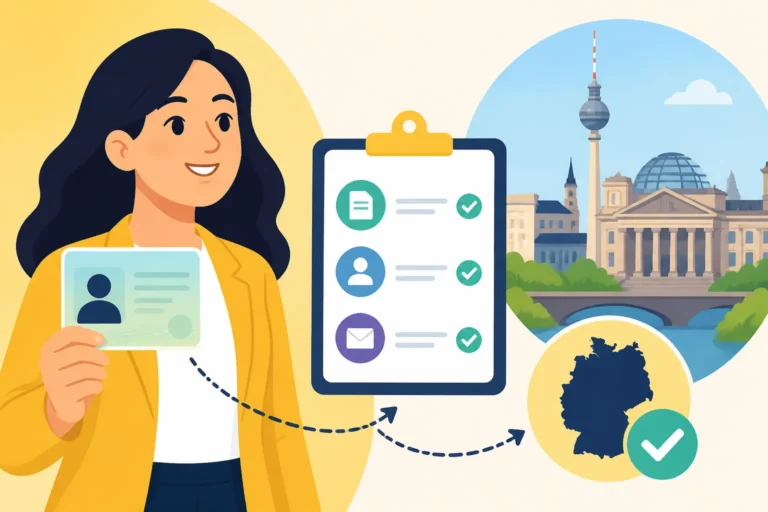
How to Keep Your Original Nationality When Naturalizing in Germany
Imagine finally qualifying for German citizenship, then hesitating because you do not want to lose the passport you were born with. That passport may connect you to your parents, your property, your right to retire back home, or simply who you are. This guide explains how to naturalize in Germany and keep your original nationality, step by step.
Disclosure: This post may contain affiliate links. We may earn a commission at no extra cost to you if you make a purchase through these links. Read full disclosure.
Germany Says Yes, but Your Home Country Decides
For many years, the biggest fear in every expat Stammtisch I attended was renunciation. Friends from Turkey, the United States, Russia and dozens of other countries sat at the same table with the same complaint. They wanted to become German, but the price was handing back their first passport. Some paid it. Many simply stayed on a settlement permit for decades because the emotional cost was too high.
That situation has changed. The question is no longer only “Will Germany let me?” It is now “Will my home country let me?” Most of the confusion I see comes from people treating those two questions as one.
What Changed in German Nationality Law
Germany’s modernised nationality law, the Staatsangehörigkeitsgesetz or StAG, now accepts multiple citizenship as the general rule. You no longer have to prove that you renounced your previous nationality before receiving your naturalization certificate, the Einbürgerungsurkunde. The old system of exceptions has largely become irrelevant. Under that system, some nationalities could keep their passport and others could not, and people spent months gathering evidence that renunciation was “unreasonable.”
In practice, your local naturalization authority, the Einbürgerungsbehörde, now concentrates on the usual criteria. These are lawful residence, language skills, self-sufficiency, a clean record and your commitment to the constitutional order. For the full list, see Dual Citizenship in Germany: What’s Now Allowed and Recent Changes to German Citizenship and Immigration Law.
Why Your Original Passport Can Still Disappear
Here is the trap. Germany has stopped asking you to give up your old nationality, but it has no power over what your country of origin does. Some countries automatically strip citizenship from anyone who voluntarily acquires a foreign one. This often happens on the day the foreign naturalization takes effect, with no letter or warning.
I once met an engineer in Stuttgart who celebrated his naturalization ceremony with champagne. Three months later, he tried to renew his home passport at his consulate. He was told politely that he had ceased to be a citizen on the day he accepted the German certificate. Germany had done nothing wrong. His own country’s law did the damage.
German officials will not research your home country’s rules for you. Keeping your original nationality is your responsibility.
How Different Countries Treat Dual Nationality
Every country writes its own rules, and those rules change. The table below shows the general position of several countries whose nationals often naturalize in Germany. Treat it as a starting point for your own research. It is not a final answer, so always confirm with your embassy or consulate before you apply.
| Country of origin | General stance on keeping citizenship | What to check before applying |
|---|---|---|
| United States | Generally permits dual nationality | US tax filing obligations continue regardless |
| United Kingdom | Generally permits dual nationality | Passport renewal process from abroad |
| Turkey | Generally permits, with notification duties | Whether to inform Turkish authorities, and reacquisition if you renounced earlier |
| Poland | Generally permits | Entry to Poland must be on the Polish passport |
| Italy | Generally permits | Registration with the consulate’s AIRE registry |
| India | Does not permit; voluntary foreign citizenship ends Indian citizenship | Surrendering the Indian passport and applying for OCI status |
| China | Does not recognise dual nationality; loss is generally automatic | Hukou, property and visa implications |
| Japan | Voluntary foreign naturalization generally causes loss | Consequences for family registration and residence in Japan |
| Austria | Loss unless a retention permit is granted beforehand | Applying for the Beibehaltungsbewilligung in time |
| Netherlands | Loss in most cases, with limited exceptions | Whether an exception such as marriage applies |
| Singapore | Does not permit | National service and renunciation formalities |
If your country is in the “does not permit” group, naturalizing in Germany means choosing between the two passports, not collecting both. In that case, compare the advantages honestly in Citizenship vs Permanent Residency in Germany: Which to Aim For? before committing. Readers from India in particular should see Immigration to Germany from India and Other High-Application Countries: Tips and Insights for context on the OCI route.
Step-by-Step: Naturalizing While Keeping Your Original Nationality
This is the process I recommend to everyone who asks me. It is cautious and a little slow, and it protects you from the horror story above.
- Research your home country’s nationality law. Use the official government website of your country, not forum posts. Look for terms like “voluntary acquisition of foreign nationality,” “loss of citizenship” and “retention.”
- Write to your embassy or consulate in Germany. Ask a direct question: “Will I lose my citizenship if I voluntarily acquire German citizenship?” Request the answer in writing.
- Find out whether your country requires a retention permit or prior approval. If it does, apply before your German naturalization is completed.
- Check any notification duties. Some countries allow dual nationality but expect you to report your new citizenship within a set period.
- Prepare your German application. See How to Apply for German Citizenship (Einbürgerung) and gather your paperwork using What Documents Do You Need for German Citizenship?.
- Arrange translations of any foreign-language documents your authority requests.
- Coordinate the timing of your certificate handover. If you are waiting on a retention permit, ask the Einbürgerungsbehörde whether the ceremony can wait until approval arrives.
- After naturalization, update both countries correctly. Keep your old passport valid, register as required, and store your naturalization certificate safely.
Get the Answer in Writing
Verbal answers at consulate counters are worth very little. Staff rotate, rules change, and a friendly “Don’t worry, it’s fine” will not help you if the ministry back home decides otherwise. An email or letter on official letterhead gives you something to rely on and to show if a dispute arises later.
If the consulate replies in its own language, keep the original. Some applicants need it translated for their German file or for their own records. A certified translation service such as Lingoking can handle official translations into German online. That spares you a hunt for a sworn translator in your town. For the formal requirements, see How to Get a Certified Translation for German Immigration.
Retention Permits and the Timing Trap
Countries like Austria use a retention permit system. The rule is strict: you must hold the permit before you acquire the foreign nationality. If you receive your German certificate first and apply afterwards, the permit is useless because the loss has already happened.
So timing is everything. In Germany, naturalization takes effect when you are handed the Einbürgerungsurkunde, not when your application is approved internally. This gives you a small window to manage. Tell your caseworker about your situation early. In my experience, most caseworkers would rather schedule the handover later than see an applicant lose a nationality by accident.
Documenting Your Residence and Background
Your naturalization file will usually ask for evidence of your residence history, income and identity. Many people find their early years in Germany hardest to document, especially those who arrived as students. Students who arrived with a blocked account through a provider such as Expatrio can often use those old statements. They help reconstruct when they arrived and how they supported themselves at the start. Keep every document from those first months. You may need it years later.
Birth certificates, marriage certificates and name-change records from abroad often need an apostille or legalisation as well as translation. Apostilles and Certified Translations for German Immigration covers which countries use which system. Lingoking is one option for ordering certified German translations of these civil records. Whichever service you use, check with your authority whether it wants the translation attached to the apostilled original.
Living With Two Passports in Practice
Getting both nationalities is only half the story. The other half is living with them sensibly, and this is where long-term expats pick up small habits that save headaches.
Travel, Borders and Passport Rules
Many countries insist that their own citizens enter and leave on their national passport. Poland, for example, expects Polish citizens to use Polish documents at its borders. Showing your new German passport at your home airport can cause confusion or worse.
A simple rule works well. Use your home passport for your home country, and your German passport for the Schengen area and most other travel. Book flights in the name and passport you will actually present. Keep both passports valid at all times, because renewing one in a hurry from abroad is miserable.
Remember the consular protection limit too. While you are physically in your other country of nationality, that country will usually treat you only as its own citizen. German consular help may then be limited.
Military Service, Property and Inheritance
Dual nationality can bring obligations along with rights. Some countries still have compulsory military service, and holding a second passport does not automatically exempt you. Check your status before you visit, especially if you are a young man from a country with active conscription.
Property and inheritance are the quieter benefits of keeping your original nationality. In some countries, foreigners face restrictions on owning land or inheriting certain assets. This is often the main reason families want to keep their first citizenship. If that applies to you, keeping the old passport may protect your family’s future rather than being a sentimental gesture.
If You Already Renounced in the Past
Many people who naturalized under the old German rules had to give up their original nationality. Some countries now allow former citizens to reacquire their nationality. Under the current German law, doing so generally no longer costs you your German citizenship.
The process depends entirely on your country of origin. It often involves a consulate application, proof of former citizenship and sometimes residence requirements. Former Turkish citizens who hold the Turkish Mavi Kart (blue card), are a common example of people now asking about reacquisition. If you hold German citizenship through family history rather than naturalization, see German Citizenship by Descent and Declaration (StAG), since different rules may apply.
Preparing Your Language and Integration Evidence
Do not let the dual nationality question distract you from the core requirements. Your language certificate and integration evidence still carry real weight in your file, and missing documents delay everything. If your German is close to the required level but not quite there, start now. See How to Prove German Language Skills for Citizenship (B1) for the accepted certificates. That way your application is ready the moment your consulate confirms you can keep your passport.
For a broader overview of every eligibility criterion, see German Citizenship by Naturalization: Eligibility and Application Steps. Taking it slowly, getting everything in writing and timing the handover carefully is the most reliable way to finish with two passports instead of one.
Disclaimer
This article is for general informational purposes only and does not constitute professional advice. Laws, prices and regulations vary by location and change over time. Consult a qualified professional for guidance on your specific situation.