Recognition Partnership Visa: Working While Validating Foreign Qualifications
I remember holding a lucrative German job offer that was slowly expiring because the authorities in my home country took eight months to officially recognize my university degree. The agony of waiting for foreign qualification validation used to destroy countless expat careers before they even began. This guide breaks down the revolutionary new Recognition Partnership Visa, explaining how you can finally move to Germany, start working immediately, and handle the bureaucratic recognition process while earning a salary.
Disclosure: This post may contain affiliate links. We may earn a commission at no extra cost to you if you make a purchase through these links. Read full disclosure.
The Bureaucratic Nightmare of the Old System
Before we look at the new visa, you have to understand the specific bureaucratic wall that the German government finally decided to tear down. For decades, the German immigration system operated on a rigid, inflexible principle that locked thousands of highly qualified professionals out of the European labor market.
Why Recognition is Mandatory in Germany
Germany is a country built on formalized qualifications. Unlike the US or the UK, where employers often care more about your portfolio and practical experience than your specific college major, Germany relies heavily on state-certified standards. This is especially true for “regulated professions” (reglementierte Berufe) such as nursing, medicine, engineering, and teaching. To legally work in these fields, the state must verify that your foreign training is exactly equivalent to the rigorous German standard.
Even for non-regulated professions, proving your qualifications was historically the only way to secure a standard work visa. The government wanted absolute assurance that an expat possessed the exact skills listed on their employment contract. This verification process is known as Anerkennung (Recognition). The authorities compare the curriculum of your foreign university degree or vocational training against the German equivalent. If there are massive gaps in your education—for example, if a foreign nursing degree lacks a specific number of clinical hours—you are issued a deficit notice (Defizitbescheid) and forced to take additional exams or training.
The sheer volume of these applications meant that the Central Office for Foreign Education (ZAB) and various regional chambers of commerce were catastrophically backlogged. Expats were left waiting in the dark, unable to move forward with their lives or their careers until a physical piece of paper was stamped in Germany and mailed across the globe.
The Old Catch-22 of Waiting Abroad
Under the old immigration laws, this recognition process created a brutal catch-22. You could not apply for a German work visa until your qualifications were fully recognized. But because the recognition process took six to twelve months, foreign employers would simply rescind their job offers. No hospital in Munich or tech firm in Berlin was willing to keep a position open for a year while you fought with the ZAB from India or Brazil.
If you received a partial recognition or a deficit notice, the situation was even worse. You were told you needed to complete a six-month training course in Germany to bridge the gap in your education, but you couldn’t easily get a visa just to take a bridging course without a guaranteed job waiting for you on the other side. You were trapped outside the country, fully qualified to do the work, but legally barred from crossing the border.
The government finally realized this system was actively destroying their ability to recruit international talent during a historic labor shortage. To understand how they systematically dismantled these barriers across the entire immigration spectrum, you should review Germany’s New Immigration Laws: Key Changes Explained.
Introducing the Anerkennungspartnerschaft
In March 2024, the German government launched a massive overhaul of the Skilled Immigration Act. One of the crown jewels of this reform was the creation of the Anerkennungspartnerschaft (Recognition Partnership), legally codified under Section 16d Paragraph 3 of the Residence Act (AufenthG).
What is the Recognition Partnership Visa?
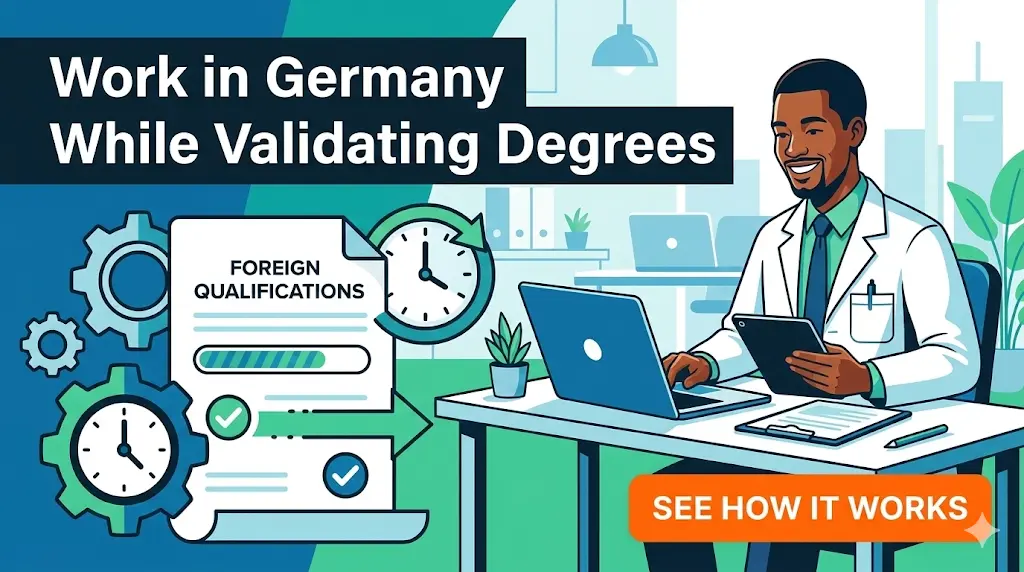
The Recognition Partnership Visa is a profound paradigm shift. It completely flips the old timeline on its head. Instead of forcing you to wait in your home country until your degree is 100% verified, this new visa allows you to fly to Germany and start working immediately, before the formal recognition process is complete.
You and your new German employer enter into a legally binding “partnership.” You commit to initiating the formal recognition procedure immediately upon arriving in Germany, and your employer commits to supporting you through that process. This means that if the authorities eventually determine you need to take a bridging course or pass a specific German knowledge test (Kenntnisprüfung) to achieve full equivalence, your employer will actively accommodate this.
The visa is initially issued for one year. If the recognition process takes longer than expected—which is incredibly common due to municipal backlogs—the residence permit can be extended for up to three years. This gives you a massive, comfortable runway to clear the bureaucratic hurdles without the terrifying threat of imminent deportation hanging over your head. It is a lifeline for professionals who were previously stuck in administrative purgatory.
How It Benefits Both You and Your Employer
For the expat, the benefits are life-changing. You get to move to Germany, start earning a euro-based salary, sign an apartment lease, and begin integrating into the culture immediately. You are no longer burning through your savings while waiting for an embassy email. You tackle the recognition bureaucracy from within the country, which is infinitely easier because you can physically walk into the local offices or call them during standard German business hours.
For the German employer, this visa is a massive competitive advantage. They no longer have to wait a year to onboard desperately needed staff. A hospital can hire a foreign nurse and put them to work on the ward the very next month. Even though the nurse might have to work under supervision initially, they are still contributing to the team while studying for their final equivalence exams.
Because the employer must actively support your training, this visa inherently filters out exploitative companies. Only employers who genuinely care about your long-term career development will sign a Recognition Partnership agreement. If you want to understand how standard employment protections work once you are inside the company, read Understanding German Work Contracts: Probation, Notice Periods, and More.
Core Eligibility Requirements for the Visa
While the Recognition Partnership lowers the barrier to entry, it does not remove it entirely. The German government does not hand out this visa to unskilled laborers. You must prove a baseline of professional competence and secure a highly specific type of corporate sponsorship before the embassy will approve your application.
Educational and Language Prerequisites
The absolute foundation of your application is your foreign education. To qualify for the Recognition Partnership, you must possess either a university degree or a vocational training qualification that required at least two years of full-time study. Crucially, this qualification must be officially recognized by the state in the country where you obtained it.
You do not need full German equivalence yet, but you must prove your degree is legitimate in your homeland. For university degrees, you can often prove this by finding your institution in the Anabin database. For vocational training, you must apply for a digital Statement on a Foreign Vocational Qualification (DAB) from the ZAB. When submitting these foreign diplomas to the German embassy, they must be flawlessly translated. Utilizing a certified service like Lingoking connects you directly with sworn translators recognized by German courts, ensuring your educational background is never rejected due to poor translation formatting.
Language is the second major hurdle. You cannot arrive in Germany with zero language skills and expect to navigate a complex professional recognition process. The government mandates that you prove a minimum of A2-level German proficiency (according to the CEFR framework) before the visa is issued. You must provide a certified test result from a recognized institution like the Goethe-Institut or TELC. For regulated professions like nursing, the required level is often bumped up to B2.
The Job Offer and the Employer Agreement
You cannot apply for a Recognition Partnership Visa as a freelancer or a job seeker. You must have a concrete, legally binding employment contract waiting for you in Germany. If you are still in the phase of applying for jobs from abroad and need to conduct interviews, you must utilize a different pathway, such as the Opportunity Card (Chancenkarte): Germany’s Points-Based Job-Seeker Visa Explained.
The job offer must be for “qualified employment,” meaning it generally requires an academic or vocational background. The salary offered must align with regional collective agreements or the local market average; you cannot be paid minimum wage for an engineering role simply because your degree isn’t fully recognized yet. The Federal Employment Agency (Bundesagentur für Arbeit) will review your contract to ensure the salary is fair.
In addition to the standard employment contract, you must submit the actual written Recognition Partnership Agreement (Anerkennungspartnerschaftsvereinbarung). This document explicitly states that the employer allows you to attend qualification measures, grants you the necessary time off to study for exams, and has the internal capacity to mentor you. The immigration authorities will verify that the company is “suitable”—meaning they have a track record of providing vocational training or post-qualification skills development.
Step-by-Step Application Process
Securing the visa is a cross-border administrative marathon. You have to coordinate the approval of local domestic agencies in Germany with the consular officers stationed at the embassy in your home country.
Preparing Your Documents and Translations
Your application portfolio must be utterly pristine. The German embassy and local immigration offices will not accept a chaotic folder of unverified, English-language documents. You will need your original passport, biometric photos, your signed employment contract, the signed partnership agreement, and the proof of your foreign degree’s state recognition.
Crucially, the German authorities demand absolute legal accountability for every word in your foreign documents. Every single university transcript, syllabus, and employer reference letter must be formally translated into German. You cannot translate these yourself, nor can you use an AI tool or a generic online agency. The authorities exclusively demand formal translations executed by a “Sworn Translator” (vereidigter Übersetzer).
Finding these specific, certified translators from thousands of miles away can cause massive delays to your timeline. Utilizing a dedicated platform like Lingoking is essential here. They connect you directly with German-certified sworn translators who turn around legally flawless, perfectly formatted documents that carry the exact stamps and seals the immigration office demands. Ensuring your portfolio is translated by a professional through Lingoking guarantees the embassy will not stall your application for administrative technicalities.
Navigating the Embassy and Financial Proofs
Once your documents are translated and your A2 German certificate is in hand, you must book an appointment at the German embassy or consulate in your home country. Because this visa requires pre-approval from the Federal Employment Agency regarding your working conditions, processing times can take several weeks. To understand the broader context of embassy wait times and entry procedures, study Visas and Residence Permits in Germany: Everything You Need to Know.
A critical component of the embassy interview is proving your financial stability. Even though you have an employment contract, the embassy wants to ensure your starting salary is high enough to cover your living expenses in Germany. Currently, you need to prove you have access to roughly €1,160 per month before taxes. If your initial trainee salary falls slightly below this threshold, you will be forced to make up the difference using a Blocked Account (Sperrkonto).
If the embassy demands a Blocked Account to cover a salary shortfall, utilizing a certified digital provider like Expatrio allows you to open a government-approved escrow account entirely online within days. Expatrio instantly generates the exact financial confirmation document the embassy demands. Furthermore, you must prove you have comprehensive health insurance. Because you are entering as a salaried employee, you will transition into the German public healthcare system. Using an English-first broker like Feather Insurance allows you to smoothly set up your public health insurance membership before you even land, ensuring you are fully compliant on day one.
Arriving in Germany and Completing the Process
Getting the visa glued into your passport and boarding the plane feels like the finish line, but the real administrative marathon begins the moment you land. You must balance your new corporate job with the intense bureaucracy of the local recognition offices.
Working Rights and Regulated Professions
The exact nature of your daily work depends heavily on whether your profession is regulated or non-regulated. If you are an IT specialist or a marketing manager (non-regulated), you can generally start working in your target role immediately, assuming your employer is satisfied with your current skill level. You simply perform your job while the paperwork for your formal equivalence assessment grinds through the background bureaucracy.
However, if you work in a highly regulated profession—most notably nursing, medicine, or specialized engineering—the rules are stricter. A foreign nurse entering on a Recognition Partnership Visa cannot immediately administer medication or operate independently on a German hospital ward. Until you pass your final knowledge test (Kenntnisprüfung) or complete your adaptation course (Anpassungslehrgang), you must work as an assistant or a nursing helper under the direct supervision of fully licensed German staff.
This supervised period is incredibly valuable. It allows you to learn the specific clinical vocabulary in German, understand the internal dynamics of a German hospital, and get paid a living wage while you prepare for your final exams. You are earning while learning, completely bypassing the old system that forced you to study in isolation abroad.
Transitioning to a Permanent Work Visa
The Recognition Partnership Visa is inherently temporary. Its entire legal purpose is to serve as a bridge. You are granted up to three years to finalize your recognition. You must proactively submit your application to the competent recognition authority (Anerkennungsstelle) immediately after arriving and registering your address in Germany.
Once the authority officially declares that your foreign qualification is fully equivalent to the German reference occupation, you receive your coveted Recognition Notice (Anerkennungsbescheid). The moment this physical document is in your hands, the partnership phase ends.
You do not have to leave Germany or fly back to your home country. You simply book a new appointment at your local immigration office (Ausländerbehörde). You present your full recognition certificate and your ongoing employment contract, and you apply to transition your status into a standard Skilled Worker Visa (Fachkräftevisum) or the premium EU Blue Card, depending on your salary level.
Navigating the local immigration office to make this switch is a notorious stressor for expats. Once you secure that final, permanent work permit, the agonizing journey of validating your foreign past is over, and your long-term German career officially begins.
References
Primary sources (official)
- Make it in Germany – Visa for recognition partnership: https://www.make-it-in-germany.com/en/visa-residence/types/visa-recognition-partnership
- Make it in Germany – Employment within the framework of a recognition partnership: https://www.make-it-in-germany.com/en/looking-for-foreign-professionals/entering/employment-recognition-partnership
Other helpful sources
- Federal Foreign Office – Employment – Recognition of Professional Qualifications: https://india.diplo.de/in-en/service/2539272-2539272
Disclaimer
This guide is provided for informational purposes only and does not constitute formal legal, financial, or immigration advice. German immigration laws, salary thresholds, language requirements, and municipal processing timelines change frequently and depend heavily on the discretion of local authorities and the Federal Employment Agency. Always consult the official websites of the German embassy in your home country, the Federal Office for Migration and Refugees (BAMF), or seek professional counsel from a certified German immigration lawyer before making binding relocation decisions or submitting formal visa applications.