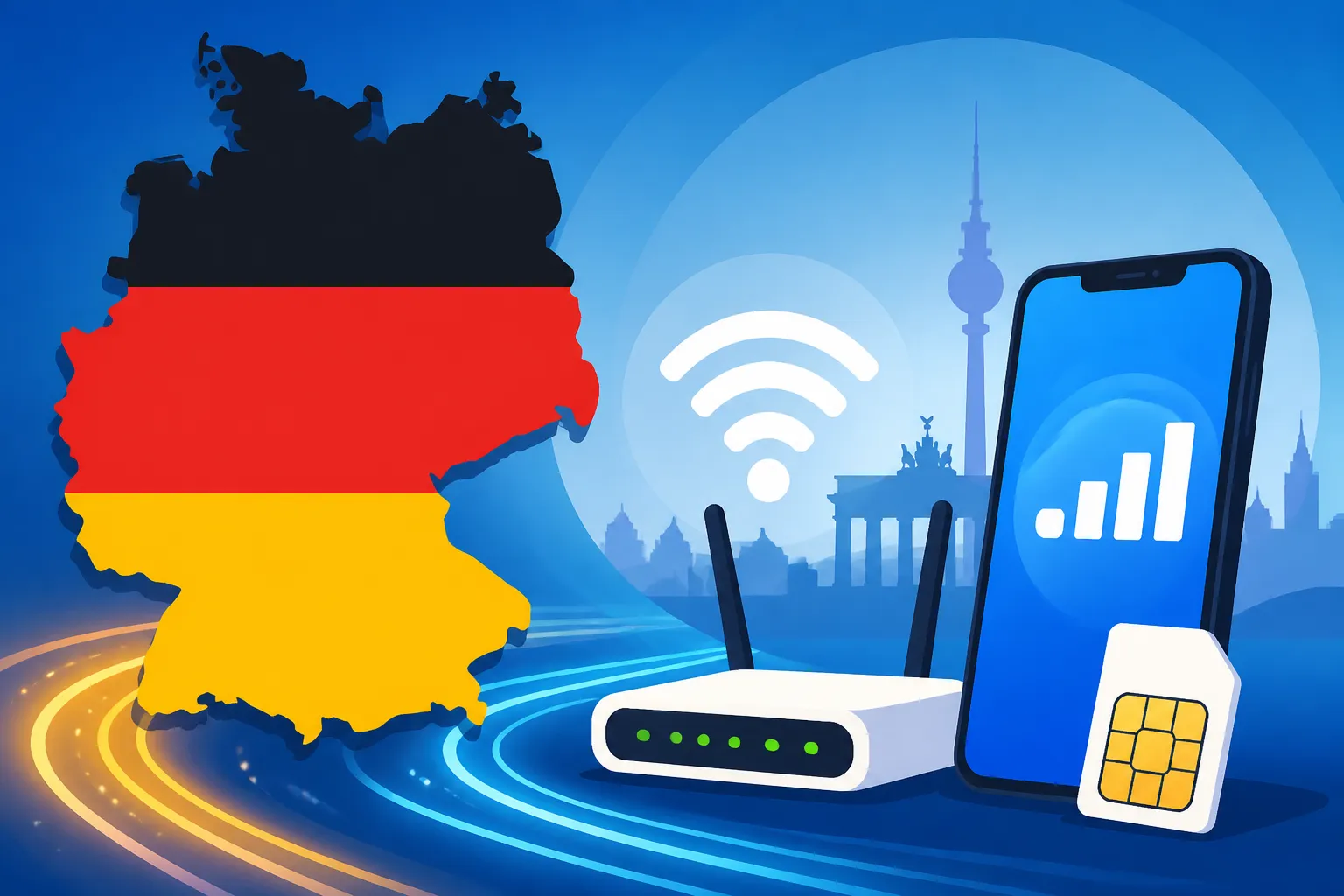
Internet and Mobile Providers in Germany
Arriving in Germany and realizing you cannot even load Google Maps to find your way out of the airport is a rite of passage for every newcomer. I remember sitting on my suitcase in a chilly Berlin S-Bahn station, desperately trying to connect to a spotty public Wi-Fi network just to find the address of my Wunderflats apartment. This guide solves the digital disconnect by meticulously breaking down how to navigate the complex world of German internet and mobile providers.
Disclosure: This post may contain affiliate links. We may earn a commission at no extra cost to you if you make a purchase through these links. Read full disclosure.
The Landscape of Home Internet in Germany
When you first move into a permanent apartment, you might expect that getting online is as simple as flipping a switch. Unfortunately, Germany’s digital infrastructure is often described by locals and expats alike as a "Digitalwüste" or digital desert. While the government is making strides to improve connectivity, the reality on the ground involves legacy copper wires and a fair amount of bureaucratic friction. Understanding the technology available at your specific address is the first step in avoiding a month-long wait for a technician.
Connection Types: DSL, Cable, and Fiber
DSL (Digital Subscriber Line) is the most common connection type in Germany. It runs through your telephone line and is available in almost every building. While it is generally reliable, speeds can vary wildly depending on how far you are from the local exchange. Most providers offer VDSL, which can reach speeds of up to 250 Mbps, but if you live in an older building in a rural area, you might find yourself capped at a frustrating 16 Mbps.
Cable internet is a powerhouse in the German market, often providing much higher speeds than DSL at a more competitive price point. This runs through your TV cable connection. If your apartment has a multimedia socket, you can often get speeds up to 1,000 Mbps (1 Gigabit). However, cable is a shared medium, meaning your internet might slow down during peak evening hours when everyone in your building is streaming Netflix at the same time.
Glasfaser (Fiber) is the gold standard but remains relatively rare in residential areas. If you are lucky enough to move into a new build, you may have fiber-to-the-home (FTTH). This offers symmetrical speeds and incredible reliability. If your landlord mentions fiber is available, grab it immediately, as it is far superior to any other option. For those still waiting for a permanent contract, using a temporary solution like Airalo for mobile data can bridge the gap while you wait for your home installation.
The Major Providers: Telekom, Vodafone, and O2
Deutsche Telekom is the former state monopoly and owns the majority of the physical infrastructure in the country. They are often the most expensive option, but they offer the most robust customer service and the highest reliability. If you are working from home and cannot afford a single hour of downtime, Telekom is usually the safest bet. They also offer "Magenta" bundles that combine your home internet with your mobile plan for a monthly discount.
Vodafone is the primary competitor to Telekom, largely because they bought Unitymedia and Kabel Deutschland, giving them massive control over the cable network. Their pricing is aggressive, and they often offer the best "speed-for-Euro" ratio. However, their customer support is famously hit-or-miss, and navigating their automated phone systems in German can be a nightmare for a newcomer.
O2 (Telefónica) is generally the budget-friendly choice among the big three. They offer DSL, Cable, and even 5G home routers (HomeSpot). O2 is particularly popular with expats because they often provide monthly-cancellable contracts, which is a rarity in a market that loves long-term commitments. If you are unsure how long you will be staying in a particular city, looking into Short-Term Accommodation in Germany: Options for Your First Weeks might give you the flexibility you need before signing a two-year O2 contract.
Navigating the Contract Maze
In Germany, the "Mindestlaufzeit" or minimum contract duration is typically 24 months. This is a significant hurdle for expats who might be on a limited-term work visa or are simply unsure about their long-term plans. Breaking these contracts early is notoriously difficult unless you are leaving the country entirely and can provide official proof of your Abmeldung: Deregistering When You Leave Germany and Why It Matters.
The 24-Month Trap and Flex Contracts
Most "promotional" prices you see on billboards—such as €19.99 per month—only apply for the first six or twelve months. After that, the price usually jumps significantly, often doubling. You must read the fine print to see what the "average" cost over 24 months will be. Always factor in the "Bereitstellungsgebühr" (activation fee), which can range from €40 to €70.
Fortunately, "Ohne Laufzeit" (without a fixed term) or "Flex" contracts are becoming more common. You will pay a slightly higher monthly fee and usually a higher upfront activation cost, but you gain the ability to cancel with just one month's notice. This is invaluable if you are living in a temporary flat via Wunderflats while searching for a long-term home. It prevents you from being stuck paying for internet in an apartment you no longer live in.
The Setup Process and the Infamous Technician
Once you sign a contract, the waiting game begins. It typically takes between 10 and 21 days for a connection to be activated. If the previous tenant had the same type of connection and the line is still "active," the provider might be able to do a remote activation. However, more often than not, a technician from Telekom (even if you signed with Vodafone or O2) must visit your home to flip a switch in the basement or at the local street box.
The "Techniker-Termin" is a common source of frustration. You will usually be given a window of four to six hours during a workday. If the technician doesn't show up—which happens more than it should—you have to call and reschedule, potentially waiting another two weeks. My advice? Make sure your name is clearly printed on your doorbell and mailbox, as technicians often use "could not find name" as an excuse to skip a difficult appointment. While you wait, you can buy a mobile router on Amazon Germany to stay productive.
Costs, Hardware, and Hidden Fees
When you sign up, you will be asked if you want to rent a router. This usually costs between €2 and €10 per month. Over a two-year contract, you could end up paying €240 for a device that isn't yours. Thanks to "Routerfreiheit" (router freedom) laws, you have the right to use your own hardware. Buying a high-quality Fritz!Box on Amazon Germany is often a better investment, as you can take it with you to your next apartment or sell it when you leave.
Be aware of "hidden" costs like the shipping fee for the router or extra charges for a physical paper bill. Most providers default to a "Digital-Rechnung," which is fine, but some still charge a few euros if you want a letter in the mail. Also, check if the contract includes a "Festnetz-Flat" (landline flat rate). Even if you don't own a physical home phone, these are often bundled in, and calling mobile numbers or international numbers from that line can be incredibly expensive.
Mobile Phone Plans and Providers
The mobile market in Germany is divided into three network operators (Telekom, Vodafone, and O2) and dozens of smaller discount providers known as MVNOs (Mobile Virtual Network Operators). Choosing between them depends on where you live and how much data you consume. For your first few days, an eSIM from Airalo is a lifesaver, but for the long term, you'll want a local number for things like Registering Your Address (Anmeldung): Step-by-Step Guide.
Prepaid vs. Postpaid Contracts
Prepaid SIM cards are the easiest way to get started. You can buy them at supermarkets like Aldi, Lidl, or REWE. You aren't tied to a contract, and you can change your "Tarif" every four weeks. However, German law requires identity verification for every SIM card. This usually happens via "VideoIdent" (a video call where you show your passport) or "PostIdent" (taking your passport to a post office). Be warned: many VideoIdent agents struggle with non-EU passports that lack specific holographic security features, so you might need to visit a physical shop.
Postpaid contracts (Laufzeitverträge) usually offer more data and subsidized smartphones. These require a German bank account and a SCHUFA and Documents Landlords Want in Germany check. If you have just arrived and have no credit history in Germany, you might be rejected for a high-end contract with a free iPhone. It is often better to start with a "SIM-only" contract or a prepaid plan for the first six months to build up your local financial footprint.
Network Quality: D-Netz vs. E-Netz
In Germany, you will often hear people talk about "D-Netz" quality. This refers to the networks of Telekom (D1) and Vodafone (D2). Historically, these have had much better coverage in rural areas and on trains. If you plan to travel through the countryside or use the Deutsche Bahn frequently, paying a premium for a provider that uses the D-Netz is worth every cent.
The "E-Netz" (O2/Telefónica) has improved significantly in recent years, especially in major cities. In places like Berlin, Munich, or Hamburg, the O2 network is often just as fast as Telekom and significantly cheaper. However, as soon as you step into a forest or a small village, you might find yourself stuck on "Edge" or with no signal at all.
Discount Providers and MVNOs
If you want the quality of the Telekom or Vodafone network without the high price tag, look at MVNOs.
- Congstar uses the Telekom network and is very popular for its "Fair Flat" options.
- Otelo uses the Vodafone network.
- WinSim and PremiumSim use the O2 network and offer some of the cheapest data packages in the country, often with monthly cancellation options.
These providers are almost exclusively digital. You won't find a physical shop to help you if something goes wrong, so you'll need to be comfortable managing your account through an app or website. For accessories like power banks or cases, Amazon Germany is usually the most convenient source.
Practical Tips for Newcomers
Getting connected is more than just picking a provider; it is about navigating the unique "quirks" of German bureaucracy and consumer culture. From the language barrier to the mysterious "Service-Hotline," being prepared will save you hours of frustration.
Getting Connected Before the Anmeldung
One of the biggest "Catch-22s" in Germany is that many providers require an Anmeldung (Address Registration) vs Visa: Why Both Are Needed in Germany to sign a contract, but you need the internet to find an apartment and book an appointment. If you are in this situation, stick to prepaid SIM cards or "Flex" plans that don't require long-term residency proof. Some digital-first banks also allow you to open an account without an Anmeldung, which helps with setting up the "Lastschrift" (direct debit) that internet companies love.
If you are staying in a Wunderflats apartment, the internet is usually pre-installed and included in the rent. This is a massive advantage because it allows you to hit the ground running without waiting for a technician. You can use that time to research long-term providers for when you move into your permanent unfurnished flat.
Managing Hardware and Technical Issues
German walls are often made of thick brick or reinforced concrete, which are natural enemies of Wi-Fi signals. If you have a larger apartment, don't rely on the basic router provided by your ISP. You may need a "Powerline" adapter or a Mesh Wi-Fi system. Again, check Amazon Germany for "WLAN-Repeater" to ensure you have a signal in every room.
If your internet goes down, be prepared for a challenge. Most customer service lines are predominantly in German. If your language skills aren't there yet, try using the provider's Twitter or Facebook support pages, as the agents there often have more time to use translation tools or might even respond in English. Alternatively, looking into Finding English-Speaking Services (Doctors, Plumbers, etc.) in Germany can sometimes lead you to community forums where expats share tips on reaching English-speaking tech support.
Cancellation and the "Kündigungsfrist"
The most important word to learn in German is "Kündigung" (cancellation). Historically, if you didn't cancel your contract three months before it ended, it would automatically renew for another full year. New laws have improved this: after the initial two-year period, you can now cancel monthly. However, you still need to be proactive.
I highly recommend using a service like "Aboalarm" or "Volders." For a small fee, they will send a legally binding cancellation letter on your behalf. This is much safer than calling a hotline where an agent might "forget" to process your request. Always get a "Kündigungsbestätigung" (confirmation of cancellation) and keep it in your files. If you are leaving Germany, you can often cancel early by showing your Abmeldung: Deregistering When You Leave Germany and Why It Matters papers, but you usually still have to pay for three months after the date you move.
Summary of Major Provider Options
| Provider | Network | Best For | Typical Contract |
|---|---|---|---|
| Deutsche Telekom | D1 | Reliability & Support | 24 Months (Flex available) |
| Vodafone | D2 / Cable | High-Speed Cable | 24 Months |
| O2 (Telefónica) | O2 | Budget / Monthly Flex | 24 Months or Monthly |
| Congstar | D1 | High-quality Prepaid | 4 Weeks / No contract |
| Aldi Talk | O2 | Easiest to start | 4 Weeks / Prepaid |
| WinSim / PremiumSim | O2 | Extreme value | Monthly or 24 Months |
Managing Your Mobile Connection During Travel
If you are a frequent traveler or just arrived in Germany and are waiting for your physical SIM card to arrive, eSIM technology is your best friend. A service like Airalo allows you to buy a data package for Germany (or the entire EU) in minutes. This is particularly useful if you are moving between cities or spending your first week exploring.
Remember that thanks to EU roaming regulations, your German SIM card will work in other EU countries (like France, Italy, or Spain) at no extra cost. However, be careful with "non-EU" countries like Switzerland or the UK, where roaming charges can still apply depending on your specific provider. Always check your "Roaming-Optionen" in your provider's app before crossing the border.
For those planning to settle in long-term, it's worth checking out How to Set Up Internet in Germany Without German Skills (English-Friendly Providers) to see which companies are most welcoming to the international community.
Disclaimer
The information provided in this guide is for educational and informational purposes only. While every effort has been made to ensure the accuracy of the details regarding providers, contracts, and legal requirements in Germany, service terms and conditions change frequently. We are not a legal or financial advisory service. Always read the specific terms and conditions of any contract before signing, and consider consulting with a professional if you have concerns about your residency status or consumer rights.