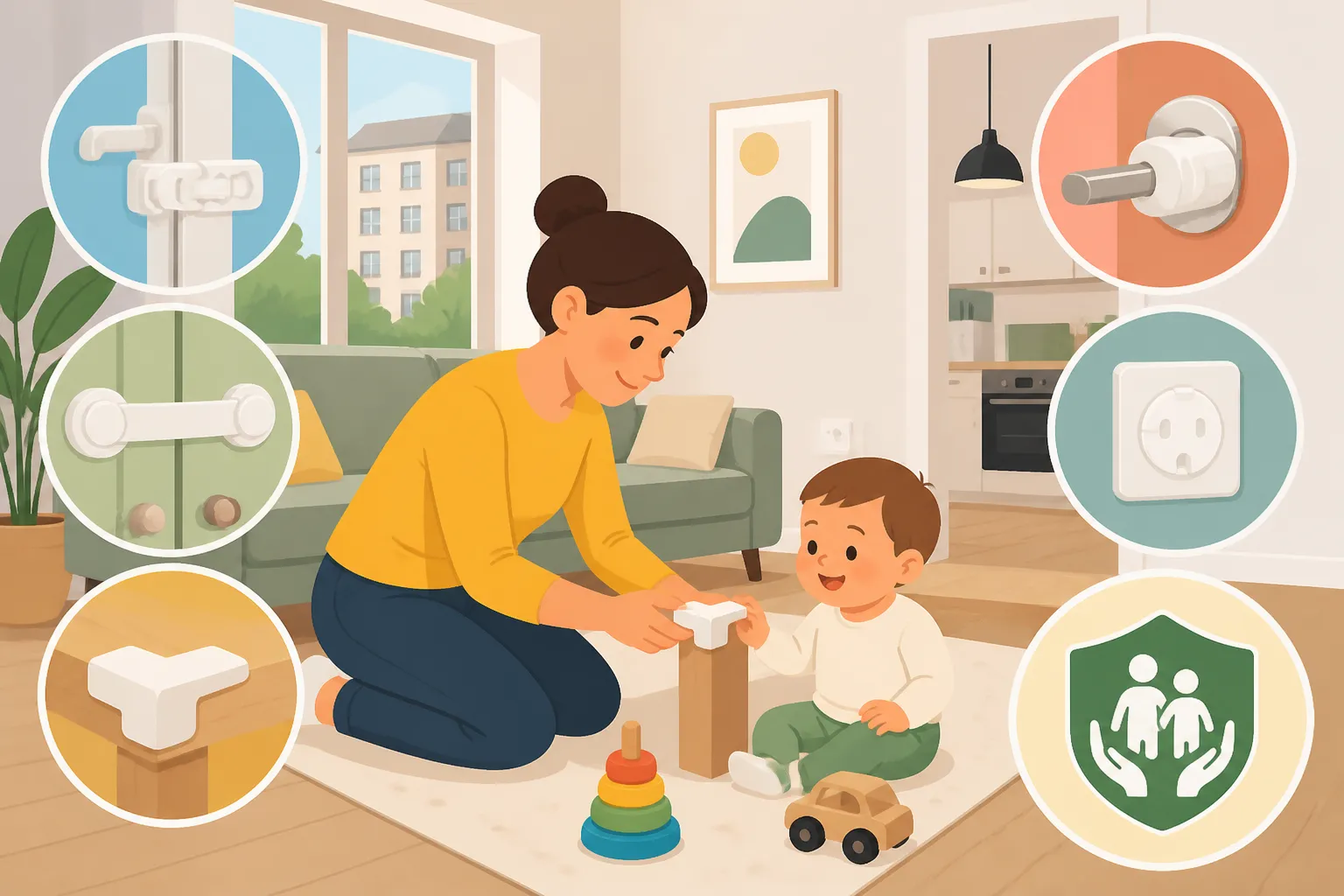
How to Childproof a Rented Apartment in Germany
Many expat parents in Germany face the same problem. The toddler is suddenly climbing toward a tilt-and-turn window, the bookcase wobbles, and the lease seems to forbid drilling into anything. You want a safe home, and you also want your Kaution back when you leave. This guide covers what you can do without asking, what needs the landlord’s approval, and how to put the request in writing.
Disclosure: This post may contain affiliate links. We may earn a commission at no extra cost to you if you make a purchase through these links. Read full disclosure.
Understanding What Your German Lease Actually Allows
The Myth That You Cannot Touch Anything
Many newcomers read their Mietvertrag, see a clause about not altering the property, and decide that a single screw hole could cost them their deposit. That is too pessimistic. German rental practice generally treats ordinary use of a home as part of what you pay rent for. A reasonable number of wall plugs (Dübel) for shelves, curtain rails or a safety bracket usually counts as normal use, not damage. The usual expectation is that you fill and tidy those holes when you move out.
The real limits are more specific. Avoid drilling through tiles, especially in bathrooms and kitchens. Do not cut into window frames or doors. Anything attached to the building’s exterior, such as a balcony net fixed to the facade, may need permission. For a detailed look at where those lines sit, see Installing Curtains & Fixtures: What You Can and Can’t Do in Rentals and Renovating and Decorating: Can You Paint Your Rental Walls in Germany?.
Why Documentation Matters Before You Start
A friend of mine in Leipzig childproofed her Altbau flat thoroughly. She anchored furniture, added cupboard locks and swapped the window handles. Two years later at the handover, the landlord’s agent counted every hole and questioned why the original window handles looked scratched. She had kept the handles in a labelled bag, but she had no photos showing that some marks were already there before she moved in.
Take dated photos of every wall, window and door frame before you install anything. If you are early in your tenancy, compare them against your move-in report. The process is explained in Apartment Handover Protocol: Documenting Condition When Moving In/Out. Good records are what protect your deposit, which is covered in more depth in Security Deposits (Kaution) in Germany: Getting It Back and Protecting Yourself.
Furnished and Short-Term Rentals Are a Different Case
If you are living in a furnished bridge apartment from a platform like Wunderflats while you hunt for something permanent, the rules get tighter. The furniture belongs to someone else. Drilling into a landlord’s wardrobe to fit a tip-over strap is not the same as drilling into a wall. In that situation, message the host through the platform before you change anything. Ask whether heavy furniture is already anchored and whether you may add adhesive-mounted locks. Many hosts agree quickly, and having the approval in writing on the platform is useful protection. Short-Term and Furnished Rentals in Germany explains how these contracts usually work.
The Room-by-Room Childproofing Checklist for German Apartments
Windows, Balconies and the Tilt-and-Turn Problem
Every expat parent worries about the German Dreh-Kipp-Fenster, the window that tilts open at the top or swings fully open from the side. A child who learns to turn the handle can open it fully in seconds. The simplest renter-friendly fix is a lockable window handle (abschließbarer Fenstergriff). The standard handle is usually held by two screws under a small cover plate, so you can swap it out without permanent changes. Put the original handles in a labelled bag with their screws and refit them before you move out.
Other options include adhesive window blockers that limit how far the sash opens, and restrictors that clamp onto the frame. Adhesive products are less invasive, but test a hidden spot first on older wooden frames, because the glue can pull off paint.
Balconies need separate thought. Check the gaps between railing bars, and look for anything a child could climb, such as planters, chairs or a stacked crate of Pfand bottles. A balcony safety net fastened with cable ties to the railing usually counts as removable. If it has to be screwed into the facade or the ceiling, ask the landlord first.
Furniture Anchoring and the Wall Problem
Tip-over accidents are a quiet danger, and they are especially relevant in Germany because most rentals come unfurnished and families fill them with flat-pack furniture. IKEA and most German furniture brands include a tip-over restraint (Kippschutz) in the box. Install it.
The difficult part is the wall. German apartments mostly have three types, and each needs a different plug.
- Solid masonry, typical in Altbau and many post-war buildings, takes standard plastic Dübel well. Old plaster can crumble, though, so drill slowly.
- Plasterboard (Rigips or Gipskarton), common in newer builds and in partition walls, needs cavity plugs (Hohlraumdübel). A standard plug will pull straight out.
- Concrete in modern Neubau needs a hammer drill. If you do not own one, you can often borrow one from a neighbour or a tool library.
Knock on the wall before you buy anything. A hollow sound means plasterboard. If you are unsure, the staff at OBI, Bauhaus or Hornbach will match the plug to your wall if you describe it or show them a photo. When the job feels beyond you, How to Find Reliable Tradespeople (Handwerker) in Germany helps you find someone trustworthy.
Electrical Sockets, Kitchens and Bathrooms
German Schuko sockets are round and recessed. Many newer installations have built-in shutters, called “erhöhter Berührungsschutz”, which block anything pushed into only one hole. Older flats often lack them. Plug-in socket covers (Steckdosensicherungen) are cheap, require no tools and leave no trace. Power strips (Mehrfachsteckdosen) on the floor are a common hazard. Choose models with built-in child protection, or mount them out of reach on the back of a desk using the keyhole slots.
In the kitchen, many German rentals have electric or induction hobs built into a fitted kitchen (Einbauküche), which may belong to the landlord or a previous tenant. A hob guard (Herdschutzgitter) usually clamps onto the worktop edge, so drilling is rarely needed. Cupboard and drawer locks come in adhesive and magnetic versions. Magnetic ones are invisible from outside and remove cleanly. If the fitted kitchen belongs to the landlord, avoid screw-in latches unless you have permission.
Bathrooms raise the tile question. Never drill tiles for a safety product without approval. Use suction or adhesive toilet locks, a non-slip bath mat, and a lockable cabinet that stands on the floor instead of hanging on the wall. Many apartments have a Durchlauferhitzer, an instant water heater, with a temperature dial. Lowering it reduces the risk of scalding. If the system is central and you cannot reach the setting, ask the landlord or the Hausverwaltung.
Doors, Hallways and the Shared Stairwell
Pressure-mounted stair gates (Treppenschutzgitter zum Klemmen) are the renter’s best option for internal doorways and staircases inside a maisonette. They brace between the walls without screws. Rubber pads protect the paint, and you should check the tension regularly. Screw-mounted gates are safer at the top of a staircase, so get permission if you need one there.
The shared stairwell (Treppenhaus) is not yours to alter. You cannot install a gate there, and fire-safety rules generally require escape routes to be kept clear. Your building’s house rules may also cover prams and items in the hallway. Read them before you leave anything there, using What is Hausordnung? Navigating Apartment Rules and Regulations as a guide. For the front door of your flat, a high-mounted door chain or an additional lever lock at adult height stops toddlers from wandering into the stairwell.
Smoke Detectors Are Not Optional
Smoke detectors (Rauchmelder) are legally required throughout Germany in bedrooms, children’s rooms and hallways that serve as escape routes. The duty to install them generally falls on the property owner. Whether the tenant or the landlord must test and maintain them depends on the federal state and your contract. If the nursery has no detector, report it to your landlord in writing straight away. This is not a favour you are asking for. It is a legal requirement.
Quick Reference Table
| Hazard | Renter-Friendly Solution | Leaves a Trace? | Ask Landlord First? |
|---|---|---|---|
| Tilt-and-turn windows | Lockable handle swap, keep originals | No, if refitted | Usually not |
| Balcony climbing | Removable net with cable ties, clear furniture | No | Yes, if screwed to facade |
| Furniture tip-over | Kippschutz with correct Dübel | Small holes, filled at move-out | Usually not for walls |
| Sockets | Plug-in covers, child-safe power strips | No | No |
| Hob | Clamp-on Herdschutzgitter | No | No |
| Cupboards | Magnetic or adhesive locks | Rarely | Yes, if landlord’s kitchen |
| Bathroom storage | Freestanding lockable cabinet | No | No, avoid tiles |
| Internal stairs | Pressure-fit gate, screw-fit at top | Screw-fit leaves holes | Yes, for screw-fit |
| Missing smoke detector | Report formally | Not applicable | Required by law |
Asking Your Landlord for Permission the German Way
Why Writing Beats Calling
Germans do business in writing. A friendly phone call with your Hausverwaltung may feel productive, but if the person who promised “no problem” leaves the company, that promise goes with them. Send an email, or a letter for anything significant, and keep the written reply with your lease. This is the single most useful habit for any expat tenant, and it matters even more when you are making changes to the property.
What a Good Safety Request Contains
A short, specific and polite request is the most likely to get a yes. Include the following.
- Your name, address and flat position, for example “3. OG links”, meaning the third floor on the left.
- The reason, stated simply, such as a toddler in the household and the need to secure windows and balcony.
- Exactly what you want to install, ideally with the product name.
- How it will be fixed and how many holes, if any.
- A clear promise to remove everything and restore the original condition when you move out (Rückbau bei Auszug).
- A request for written confirmation.
A workable German subject line is “Bitte um Zustimmung: Kindersicherung in der Wohnung”. In the body, a sentence such as “Wir möchten zur Sicherheit unseres Kleinkindes ein Balkonschutznetz anbringen und verpflichten uns zum vollständigen Rückbau bei Auszug” covers the essentials. Send photos showing where the item would go. If your German is not yet good enough to follow up by phone, Dealing With a German Landlord: Lesson Prep for Nebenkosten and Repairs is a practical way to rehearse that conversation.
When the Landlord Says No or Does Not Answer
Most landlords agree to child safety measures because nobody wants an accident on their property. If you receive a refusal, ask what the reason is and suggest a less invasive alternative, such as a clamp mount instead of screws or an adhesive product instead of drilling. If you receive silence, send a polite reminder after a reasonable period. If the request concerns a genuine defect, such as a missing smoke detector or a loose balcony railing, it is a repair obligation, not a request for permission. Your position is much stronger in that case. German Tenant Rights and Laws: What Expats Need to Know explains where those obligations lie.
Buying Supplies and Protecting Yourself Financially
Where to Shop for Childproofing Gear
For speed, Amazon Germany is hard to beat. Searching “Kindersicherung Fenster” or “Kippschutz Möbel” turns up hundreds of options, and delivery is often next day. Read reviews carefully, since quality varies a lot among unbranded sellers. For hands-on advice, try BabyOne for baby-specific products. The drugstores dm and Rossmann carry basics such as socket covers and corner guards. Hardware chains are the best choice for plugs and tools. Second-hand stair gates and playpens often turn up on Kleinanzeigen and at Flohmärkte, and parents tend to sell them in good condition once their children outgrow them. How to Find Furniture for a German Apartment on a Budget lists further sources.
If you have just landed and are still in temporary housing without a German mobile contract, an eSIM from a provider like Airalo means you can order products, compare reviews and run German product labels through a translation app from the first day. Many essentials are worth buying before your container arrives.
Liability Insurance and Children
Childproofing protects your child. Liability insurance protects you from what your child does to other people’s property. Private Haftpflichtversicherung is almost universal in Germany. It covers you if your toddler floods the downstairs flat by leaving the bath tap running or scratches a neighbour’s car with a scooter.
There is a detail that many expats miss. Under German law, very young children often cannot be held legally responsible for damage they cause. Some policies will therefore refuse to pay unless they explicitly include damage caused by children who are not legally liable. Look for the phrase “Schäden durch deliktsunfähige Kinder” in the policy terms. How to Get Haftpflichtversicherung in Germany walks you through choosing a policy, and Home and Liability Insurance in Germany (Haftpflicht and Hausrat) explains how it works together with contents cover.
Thinking Ahead to Your Next Apartment
Once you have childproofed one flat, you will look at the next one differently. At viewings, check the window handles, the depth of the balcony, the type of walls, whether the kitchen is fitted and whether smoke detectors are already installed. Ground-floor flats with a small garden appeal to many families, and buildings with a lift save you from carrying a pram up five flights. How to Find Family-Friendly Neighborhoods in German Cities helps you match the neighbourhood to the flat.
Childproofing a German rental takes some planning, a few polite emails and a bag of labelled original handles. It is far from impossible. Do the reversible things first, put the rest in writing, and you will have a safer home and your deposit at the end.
Disclaimer
This article is for general informational purposes only and does not constitute professional advice. Laws, prices and regulations vary by location and change over time. Consult a qualified professional for guidance on your specific situation.