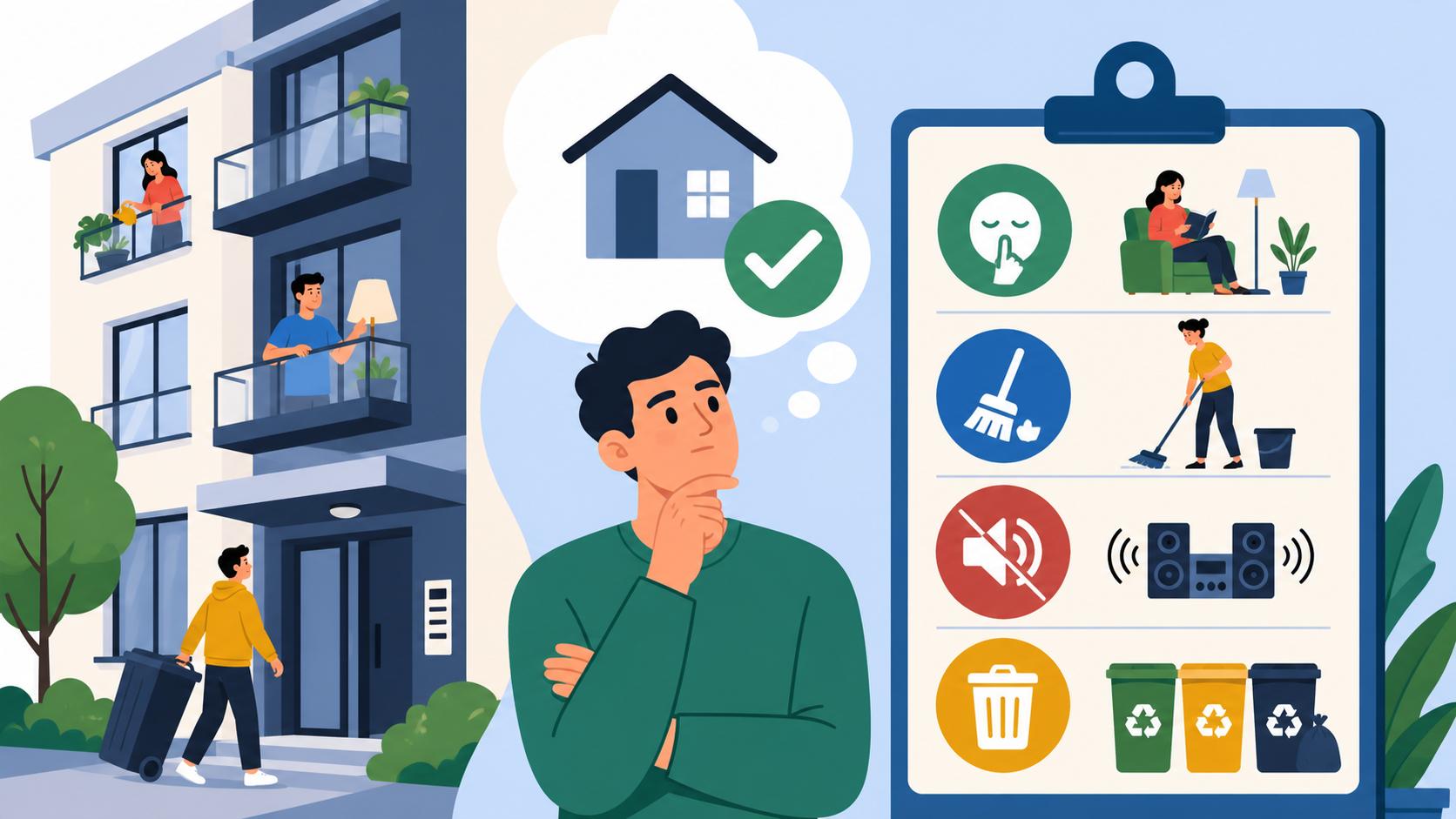
What is Hausordnung? Navigating Apartment Rules and Regulations
You have just spent three months hunting for a flat, survived the grueling viewing process, and finally secured your keys. But then, you notice a laminated sheet of paper in the hallway or a dense appendix in your contract filled with rules about when you can vacuum or how to mop the floor. I remember my first week in Berlin; I thought I was being a "good neighbor" by cleaning my balcony on a Sunday, only to have my neighbor practically teleport to my door to explain that I was violating the peace. This guide will help you understand and navigate the mysterious world of the Hausordnung so you can avoid the dreaded "neighbor note" on your door.
Disclosure: This post may contain affiliate links. We may earn a commission at no extra cost to you if you make a purchase through these links. Read full disclosure.
Understanding the Legal Weight of the Hausordnung
When you first move into a German apartment, you aren't just signing a lease for four walls and a ceiling; you are entering into a social contract with every other person in that building. The Hausordnung, or house rules, is the legal backbone of this social contract. While it might seem like a mere list of suggestions, it is often a legally binding part of your rental agreement. If you found your home through a professional platform like Wunderflats, you might find these rules translated or clearly outlined, but in many traditional German "Altbau" buildings, they remain a dense wall of German text.
There are two main types of Hausordnung. The first is part of your actual rental contract. Because you signed it, these rules are binding as long as they don't violate federal laws. The second type is a general house rule set by the landlord or the building management (Hausverwaltung) and posted in a common area. These are usually more general but still govern daily life. It is crucial to understand that while a Hausordnung can tell you how to behave, it cannot strip you of your basic rights. For example, a rule saying "no visitors after 10 PM" is generally illegal and unenforceable, as you have a right to host guests.
However, the Hausordnung is highly effective at regulating "external" effects—things like noise, smells, and the usage of shared spaces. If you repeatedly and flagrantly ignore these rules, you can receive an "Abmahnung" (a formal warning). Accumulate enough of these, and your landlord may have grounds to terminate your lease. This is why Understanding German Rental Contracts: Key Terms and Conditions is so vital for any newcomer. You need to know which parts of that thick stack of papers are legally enforceable and which are just cultural expectations.
The Sacred Quiet Hours and the Concept of Ruhezeit
In Germany, silence is not just a preference; it is a regulated commodity. The Hausordnung will almost always dedicate its longest section to "Ruhezeiten" or quiet hours. If you come from a culture where Saturday afternoon is the prime time for DIY projects or loud music, you are in for a significant culture shock. German law and house rules generally divide these quiet periods into three specific categories: night rest, midday rest, and the total peace of Sundays and public holidays.
Night Rest (Nachtruhe)
Generally, Nachtruhe begins at 10:00 PM and ends at 6:00 AM or 7:00 AM. During these hours, "Zimmerlautstärke" (room volume) is the golden rule. This means your music, television, or conversation should not be audible outside your apartment. I learned the hard way that even running a dishwasher or a washing machine late at night can be a point of contention in older buildings with thin floors. If your Hausordnung specifically forbids late-night laundry, you must follow it.
Midday Rest (Mittagsruhe)
Though becoming less common in big cities, many buildings still observe a "Mittagsruhe" between 1:00 PM and 3:00 PM. This is a time for children to nap and for the elderly to rest. If you are planning to hang pictures or use a power drill, check your rules first. Breaking the peace during Mittagsruhe is a quick way to alienate your neighbors. For those moving from abroad, these nuances are a big part of German Culture & Etiquette: A Guide to Social Life and Customs.
Sundays and Public Holidays
Sundays are essentially "closed" in Germany. No shops are open, and no loud work is allowed. This includes vacuuming, glass recycling (don't even think about throwing bottles into the bin on a Sunday), and definitely any construction work. This is the day for rest. If you need to catch up on chores, make sure they are the silent kind. If you need to buy thick rugs or noise-canceling headphones to keep the peace, you can find a wide selection on Amazon Germany to help dampen the sound of your daily life.
Maintenance and the Treppenhausreinigung Duty
One of the most surprising elements of a Hausordnung is the delegation of cleaning duties. In many modern buildings, the landlord hires a cleaning service, and you pay for this via your "Nebenkosten" (additional costs). However, in many older or smaller buildings, the "Kehrwoche" (sweep week) or "Treppenhausreinigung" (staircase cleaning) is the responsibility of the tenants.
This means that on a rotating basis, it is your job to mop the hallway, clean the stairs, and sometimes even wipe down the front door or the basement stairs. The Hausordnung will specify the frequency and the scope. If there is a small sign hanging on your door handle or a chart in the hallway, that is your signal that it is your turn. Neglecting this duty is considered a major offense in German neighborly relations. It isn't just about cleanliness; it's about showing that you are a responsible member of the community.
Beyond cleaning, the Hausordnung often dictates "Winterdienst" (winter service). If it snows, someone needs to clear the sidewalk in front of the building to prevent pedestrians from slipping. While landlords often outsource this, some contracts still place the burden on tenants. If you are unsure how these costs are calculated when a service is hired, take a look at Household Bills in Germany: Understanding Nebenkosten and Monthly Costs.
| Feature | Common Rule | Tip for Expats |
|---|---|---|
| Noise | No loud noise 10 PM – 7 AM | Use "Zimmerlautstärke" (room volume) only. |
| Sundays | No drilling, vacuuming, or glass recycling | Plan all loud chores for Saturday instead. |
| Hallways | No shoes, bikes, or strollers allowed | Keep escape routes clear for fire safety. |
| Laundry | No washing machines after 10 PM | Check for a dedicated "Waschkeller" (laundry cellar). |
| Ventilation | Must vent apartment (Stoßlüften) daily | Open windows fully for 5-10 mins twice a day. |
| Recycling | Strict sorting of paper, plastic, bio, and rest | Mis-sorting can lead to building-wide fines. |
The Shared Spaces: Cellars, Courtyards, and Balconies
The Hausordnung also governs how you use the spaces that aren't technically "yours" but are part of the building. This includes the "Keller" (basement), the "Hinterhof" (courtyard), and the "Fahrradraum" (bike room). These areas are often sources of friction because people tend to treat them as overflow storage for things that don't fit in their flats.
Balcony Etiquette
Your balcony is your private oasis, but the Hausordnung has a say here too. For instance, grilling with charcoal is often strictly forbidden due to the smoke and fire hazard. Electric grills are usually allowed, but you should still be mindful of the smell. Additionally, hanging laundry so it is visible above the balcony railing is sometimes prohibited to maintain the "aesthetic" of the building. If you are looking for a space that is a bit more flexible, you might want to look into Finding an Apartment in Germany: Best Websites and Tips for Expats to find modern buildings with more relaxed rules.
The Hallway (Treppenhaus)
Fire safety is a massive deal in Germany. The Hausordnung will almost certainly state that the hallway must remain clear. This means no shoe racks, no decorative umbrellas, and often no strollers or bicycles. Even if your hallway looks wide enough, the fire department views these items as tripping hazards during an evacuation. If your neighbor complains about your shoes in the hall, they are usually backed by the law.
Trash and Recycling
I cannot stress this enough: recycling is a religion in Germany. The Hausordnung will outline exactly how trash is to be sorted. If you put a pizza box (paper) in the "Restmüll" (general waste) or leave a bulky sofa by the bins without calling for a "Sperrmüll" (bulky waste) pickup, you will likely hear about it. To avoid these awkward confrontations, read up on the German Recycling System Explained: How to Sort Trash and Recycle Properly.
Ventilation and the Culture of Stoßlüften
If there is one thing that confuses expats more than the noise rules, it is the German obsession with "Lüften" (ventilating). Many house rules specifically state that tenants are responsible for preventing mold by properly ventilating their apartments. In Germany, this is done via "Stoßlüften"—opening your windows completely (not just tilted) for 5 to 10 minutes several times a day.
If you fail to do this and mold develops, the landlord might try to hold you financially responsible for the repairs, claiming you didn't follow the Hausordnung. This is a common point of dispute during the move-out process, which is why having a solid Apartment Handover Protocol: Documenting Condition When Moving In/Out is so important. You want to prove the state of the walls when you arrived. If the air in your new place feels a bit dry after all that venting, you can find humidifiers or weather stations to monitor the humidity on Amazon Germany.
Handling Conflicts and the Blockwart Mentality
Despite your best efforts, you might eventually run into a neighbor who seems to live for the Hausordnung. In German culture, there is a historical (and sometimes satirical) figure known as the "Blockwart"—the self-appointed guardian of the rules who watches the hallway and the trash bins with a hawk-like intensity.
If you receive a complaint, the best approach is to remain calm and empathetic. Most Germans value directness. If you were playing music too loud, apologize and adjust. If the complaint feels unfair, refer back to your contract and German Tenant Rights and Laws: What Expats Need to Know. You have rights, including the right to "normal" living noises like the occasional sound of a crying baby or a late-night shower (within reason).
If a neighbor is consistently breaking the rules and it affects your quality of life—perhaps they are drilling at midnight or leaving trash in the hallway—you should first try to talk to them. If that fails, you can contact the Hausverwaltung. Keep a "Lärmprotokoll" (noise log) documenting the dates and times of the infractions. This is often required if you ever want to argue for a rent reduction due to a loss of "Wohnqualität" (living quality). For more on how rent and quality of life are linked, check out Rent Increases in Germany: Understanding Mietspiegel and Rent Control.
Why the Hausordnung Ultimately Helps
It’s easy to feel like the Hausordnung is a list of ways to stop you from having fun. However, after living here for a few years, I’ve realized that these rules are the reason why German apartment buildings are, for the most part, incredibly peaceful and well-maintained. When everyone follows the same set of expectations, there is less ambiguity and fewer "hidden" conflicts.
The Hausordnung ensures that you can sleep at night, that the hallway doesn't smell like rotting garbage, and that the staircase is safe to walk down in an emergency. By respecting Neighborhood Noise Rules: Understanding Ruhezeit (Quiet Hours) in Germany, you are contributing to a community where everyone’s right to a peaceful home is protected. It takes some getting used to, but once you find your rhythm, you’ll find that "life by the rules" in Germany can be quite comfortable.
Disclaimer
The information provided in this guide is for educational and informational purposes only and does not constitute legal advice. While every effort has been made to ensure the accuracy of the information, laws and local regulations regarding housing in Germany can change. Always consult with a qualified legal professional or a tenant association (Mieterverein) regarding specific legal issues or disputes with your landlord or neighbors.