Cycling in German Cities: Bikes and Bike-Sharing
Navigating urban transport in a new country can be intimidating, especially when you are trying to figure out local traffic customs, bike-sharing apps, and strict municipal regulations. Cycling is one of the fastest and most satisfying ways to explore German cities, but stepping onto a bike path without knowing the unwritten rules can lead to loud bell-ringing from angry locals or hefty fines from the police. This guide breaks down everything you need to know about urban cycling in Germany, from picking the right bike-sharing service to mastering local traffic laws and combining your ride with public transit.
Disclosure: This post may contain affiliate links. We may earn a commission at no extra cost to you if you make a purchase through these links. Read full disclosure.
Navigating the Urban Cycling Infrastructure in Germany
When I first arrived in Germany, I assumed that riding a bicycle would be identical to cycling back home: jump on a saddle, stay to the right, and watch out for cars. I quickly learned that German urban infrastructure is a complex ecosystem with dedicated lanes, specialized traffic signals, and strict spatial boundaries. Understanding how roads are partitioned is the first step toward a stress-free commute, whether you are pedaling through Berlin or cruising past the Marienplatz in Munich.
Bike Lanes, Shared Paths, and Priority Routes
In most German towns and cities, you will encounter a wide variety of cycling paths. The classic Radweg (bike path) is often paved with red bricks or marked with a dedicated painted lane running parallel to the sidewalk. It is crucial to remember that bike paths are strictly segregated from pedestrian walkways. Walking in a red-brick bike lane is one of the classic newcomer blunders, and you will quickly hear a sharp ring of a bell or a frustrated shout if you accidentally step into the path of a daily commuter.
Beyond standard bike lanes, you will frequently see Fahrradstraßen (bicycle streets). On these designated roads, cyclists have full priority over motor vehicles. Cars are permitted only if an additional sign indicates it, and even then, drivers must adapt their speed to the pace of the cyclists, never exceeding 30 km/h. Furthermore, you will come across shared pedestrian and cycle paths marked with blue circular signs depicting a pedestrian and a bicycle. If the sign shows a horizontal line separating the two, cyclists and pedestrians must stay on their respective sides. If the line is vertical or the symbols are combined without a divider, cyclists are legally required to yield to pedestrians and adjust their speed accordingly.
Reading German Bike Signs and Signals
Traffic light control for cyclists in Germany is remarkably thorough. At major intersections, you will notice miniature traffic signals specifically designed for bicycles, positioned at eye level below the main car signals. You must follow these dedicated bike signals rather than the general traffic lights for motorists. If no specific bike signal is present, you follow the standard traffic lights for road traffic, not the pedestrian signals, unless the bike path clearly routes you through a pedestrian crossing with dual symbols.
Directional signage is equally detailed. Green-and-white signs indicate major cycling routes, showing destination names alongside distances in kilometers. Pay close attention to supplementary signs beneath standard traffic symbols. For instance, a white rectangular sign displaying a bike symbol with the word frei (e.g., Einbahnstraße, Fahrrad frei) means that cyclists are legally permitted to ride against the flow of traffic on that specific one-way street. Assuming a one-way street allows counter-flow cycling without that specific sign can result in an immediate police warning.
The Golden Rules of Cycling Etiquette and Safety
German cycling culture values predictability and adherence to the rules above all else. Sudden weaves, unexpected stops, or riding on the wrong side of the road will alienate fellow cyclists. You should always ride on the right-hand side of the road or the designated right-hand bike path. Riding against the prescribed direction on a one-way bike path is known locally as Geisterradeln (ghost cycling) and is a frequent cause of accidents and police fines.
Hand signals are non-negotiable. Before making a turn or pulling out to pass a slower rider, extend your arm clearly in the direction you intend to move. When passing another cyclist, pass on the left and leave ample space. If you need to stop to check your phone or consult a map, pull off the bike path completely onto the pedestrian pavement, ensuring you are not blocking foot traffic. Observing these basic norms makes integrating into the local flow effortless, demonstrating respect for the shared public space and keeping everyone safe.
| Infrastructure Type | Right of Way Rules | Key Signage / Markings |
|---|---|---|
| Dedicated Radweg | Cyclists only; Yield to cross-cars | Red brick paving or solid lines |
| Fahrradstraße | Cyclists have absolute priority | Blue sign with white bike symbol |
| Shared Path (Combined) | Pedestrians have priority | Circular blue sign (dual symbols) |
| One-Way (Fahrrad frei) | Counter-flow allowed for bikes | One-way sign + “Fahrrad frei” |
How Bike-Sharing Systems Work in Major German Cities
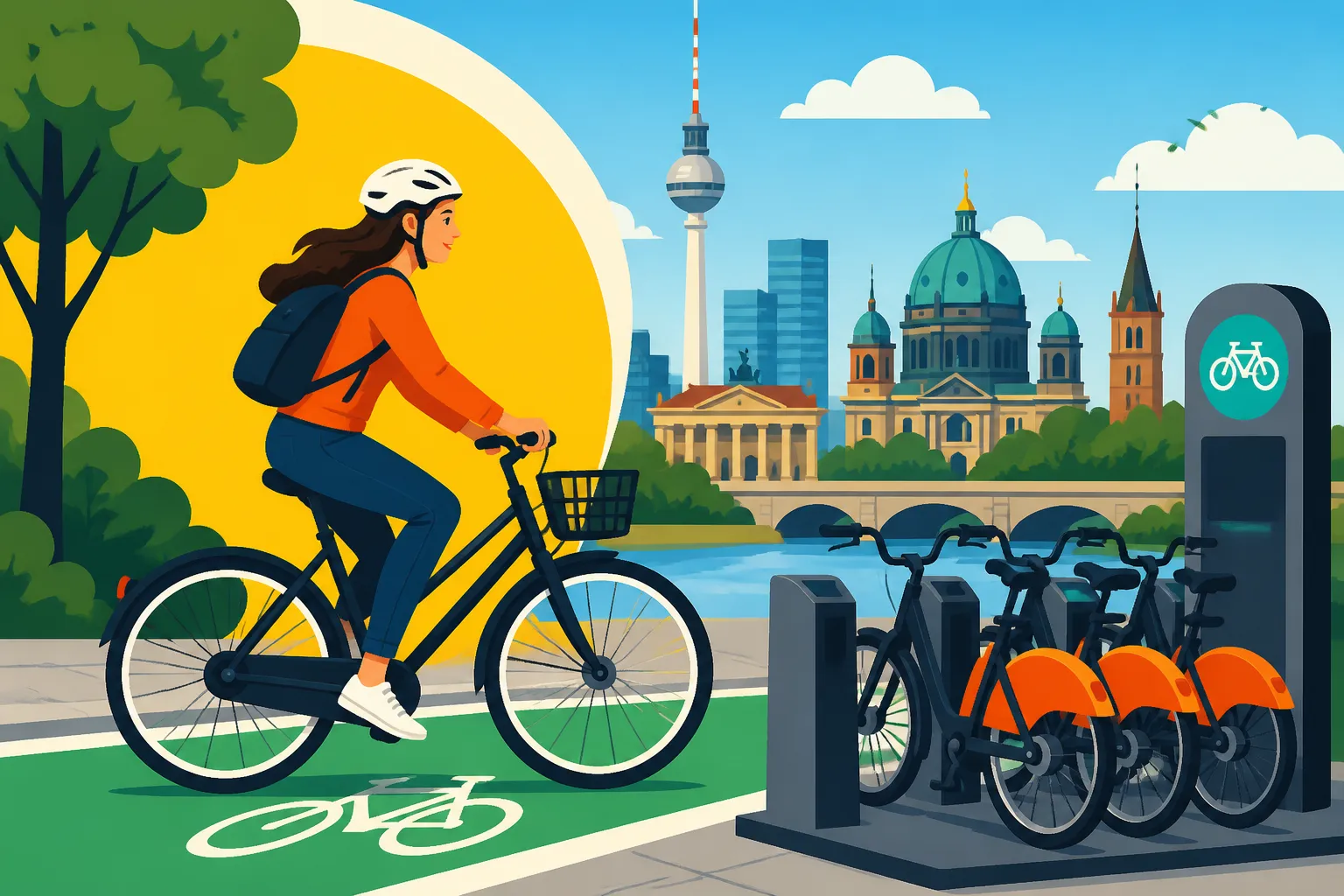
For tourists and short-term visitors, buying a bicycle rarely makes financial or practical sense. Thankfully, Germany boasts an extensive network of short-term rental networks and bike-sharing schemes. Whether you need a quick ten-minute ride to the train station or a sturdy cruiser to explore local sight-seeing spots, modern bike-share platforms offer unprecedented flexibility across nearly every major urban center.
Station-Based vs. Dockless Bike-Sharing Apps
When exploring city transit options, you will encounter two primary styles of bike-sharing: station-based systems and dockless (free-floating) systems. Station-based systems require you to pick up and drop off the bicycle at fixed physical hubs spread throughout the urban area. The major advantage of station-based fleets is reliability; you generally know exactly where to find a working bike and where you can return it without incurring penalties.
Dockless systems allow you to unlock a bicycle anywhere within a defined operational zone using a smartphone app. Once your trip is finished, you park the bike neatly on a public street corner within the designated boundary, lock it manually or via the app, and walk away. While dockless options offer ultimate point-to-point convenience, they require you to be vigilant about local parking zones. Municipalities across Germany have introduced strict rules regarding where rental bikes can be parked, prohibiting drop-offs near parks, monuments, riverbanks, or busy pedestrian intersections.
Overview of Popular City Networks and Services
Several major players dominate the German bike-share landscape. Nextbike is one of the most widespread systems in the country, operating in dozens of cities including Berlin, Leipzig, Cologne, and Frankfurt. They often partner with local public transit agencies, offering discounted rates if you hold a local transit pass or a monthly commuter ticket. Nextbike operates a hybrid system, combining fixed stations with flexible drop-off zones.
In addition to municipal options, commercial platforms offer dockless bicycles and e-bikes in larger metros. Services like Lime and Bolt provide motorized or pedal-assist bikes, making hills and longer distances far less daunting. Deutsche Bahn also runs its own network called Call a Bike, which features recognizable red-and-white bicycles parked near major train stations and central intersections across many German metropolitan areas. If you are planning an itinerary across multiple cities, downloading these apps beforehand saves considerable time. You can arrange regional transit tickets on platforms like Omio and then jump straight onto a shared bike the moment you arrive at the central station.
Registration, Unlocking, and Parking Rules
Getting started with a bike-sharing app in Germany is straightforward, but it requires a few preliminary setup steps. You will need a smartphone with active cellular data, a valid credit card or digital wallet payment method, and a verified phone number. It is wise to complete the account creation and identity check before heading out, especially if you plan to rely on a bike immediately after stepping off a train or flight.
To unlock a bike, open the app, scan the QR code located on the handlebars or the frame lock, and wait for the lock mechanism to pop open. Before riding away, perform a quick safety inspection: check that the brakes grip properly, verify that both tires have sufficient air pressure, and ensure the seat height is comfortably adjusted.
When you complete your trip, carefully review the app’s parking map. Leaving a bike outside the permitted service zone will trigger automatic fine penalties from the service operator. Always lock the bike in a visible, upright position along a street side, ensuring it does not block wheelchair ramps, tactical paving for visually impaired pedestrians, or doorway entrances.
Rules of the Road, Legal Requirements, and Fines
Germany takes traffic regulations seriously, and cyclists are subject to the same strict legal framework as motorists under the Straßenverkehrs-Ordnung (StVO). Ignorance of the law is not accepted as an excuse by the local Polizei. To protect yourself from unexpected fines and keep your journey smooth, you must understand the legal hardware requirements and traffic rules governing non-motorized vehicles.
Mandatory Equipment for German Bikes (StVZO Rules)
If you own a bicycle or lease one long-term, it must strictly comply with the Straßenverkehrs-Zulassungs-Ordnung (StVZO). This law lays out the mandatory equipment required for any bike ridden on public roads:
- Braking Systems: Two independently operating brakes (one for the front wheel, one for the rear).
- Front Lighting: A white headlight powered by a dynamo or rechargeable battery pack.
- Rear Lighting: A red tail light that remains lit even when stopped.
- Reflectors: A white front reflector, a red rear reflector, yellow reflectors on both sides of each pedal, and either reflective white stripes on the tire sidewalls or two yellow spoke reflectors per wheel.
- Audible Warning: A clear-sounding bell. Simple horn devices or loud shouts are not legal substitutes.
Rental and bike-share vehicles from major providers are built to comply with these rules automatically. However, if you purchase a second-hand bicycle from a local market, you are personally responsible for retrofitting any missing reflectors, lights, or bells before riding on public streets.
Traffic Laws, Alcohol Limits, and Right-of-Way Rules
In Germany, the default rule at uncontrolled intersections (intersections without traffic lights or priority signs) is Rechts vor Links (right before left). This means you must yield to any traffic coming from your right side, regardless of whether that traffic is a car, truck, or another bicycle. Failing to yield under the Rechts vor Links rule is a major cause of urban collisions.
Another vital issue that catches tourists off guard is cycling under the influence of alcohol. The legal alcohol limit for cyclists in Germany is far stricter than many imagine. While a blood alcohol concentration (BAC) of 0.16% is considered absolute legal unfitness to ride (absolut fahruntüchtig) and results in heavy fines, court appearances, and potential loss of your driver’s license, you can be prosecuted at a BAC as low as 0.03% if you exhibit erratic driving or are involved in an accident. Treating a bicycle as a safe way home after a long night at a beer garden is a dangerous misconception. If you have been drinking, it is always safer to rely on Getting Around German Cities: U-Bahn, S-Bahn, Trams, and Buses or hail a local taxi.
Helmets, Phone Usage, and Common Fines to Avoid
Unlike some countries, Germany does not have a mandatory helmet law for adult cyclists. Wearing a helmet is strongly encouraged for personal safety, but you will not be fined for riding bareheaded. However, insurance companies may consider the lack of a helmet when assessing liability claims in the event of a serious accident.
On the other hand, phone usage and headphone rules are strictly enforced:
- Mobile Phones: Holding a mobile phone while cycling—even if you are just looking at a map—is illegal and subject to an immediate fine. If you need navigation instructions, invest in a secure handlebar mount or listen to audio directions through a single earpiece.
- Headphones/Earphones: Wearing headphones is legally allowed only if the volume is low enough that you can still clearly hear ambient noise, emergency sirens, and pedestrian warning calls.
- Pedestrian Zones: Riding through designated pedestrian-only streets (Fußgängerzone) during restricted hours will result in an immediate stop and fine by police officers patrolling on foot or on mountain bikes.
To keep your journey safe, review basic safety standards through resources on Staying Safe in Germany: Common-Sense Tips for Travelers to avoid basic infractions that could dampen your stay.
| Infraction | Potential Legal Consequence | Practical Impact |
|---|---|---|
| Riding without working lights | Immediate monetary fine | Increased risk at night |
| Using phone while riding | On-the-spot police fine | Loss of vehicle control |
| Riding wrong way on bike lane | On-the-spot police fine | High risk of head-on collisions |
| Cycling under influence (high BAC) | Court summons, heavy fine, points | Loss of driving privileges |
Integrating Cycling with Public Transport and Regional Trips
One of the highlights of living in or visiting Germany is how seamlessly different transit modes connect with one another. Bicycles are not viewed as isolated tools; they are part of an integrated transit chain. By combining your bike with regional rail lines and municipal subway systems, you can plan expansive day trips, explore countryside trails, and simplify your daily routine.
Taking Bikes on U-Bahn, S-Bahn, and Regional Trains
You can take bicycles on most German public transit vehicles, including the U-Bahn (underground), S-Bahn (suburban rail), and regional trains (RB/RE). However, you cannot simply roll your bike onto a train with a standard passenger ticket. In almost all transit networks, you must purchase a supplementary bicycle ticket (Fahrradkarte). These can be bought as single-trip add-ons, day passes for bicycles, or monthly bike upgrades.
When waiting on the train platform, look for large bicycle symbols painted on the platform floor or posted on the side windows of train cars. These indicate multi-purpose compartments (Mehrzweckabteil) designed specifically to accommodate bikes, strollers, and wheelchairs. Always enter through these marked doors.
During peak rush hours (typically 06:00 to 09:00 and 16:00 to 18:00 on weekdays), some city transit networks ban bicycles entirely to preserve standing space for commuters. Furthermore, rush-hour restrictions can vary wildly between federal states. If a train compartment is overcrowded, wheelchair users and families with strollers always take priority over cyclists. If the conductor determines there is no room, you must wait for the next train.
Multi-Modal Commuting and Long-Distance Travel Solutions
For long-distance journeys across Germany using high-speed Intercity-Express (ICE) or Intercity (IC) trains, taking a bike requires advanced planning. Unlike regional trains, ICE trains require a mandatory bicycle space reservation (Fahrrad-Reservierung) alongside your specialized bike ticket. Because high-speed trains have limited bicycle racks per train set, these spaces fill up weeks in advance during summer months and holiday weekends.
If you prefer to avoid the hassle of transporting a physical bike on long-distance trains, a convenient alternative is booking your travel itinerary via Omio to find express train connections, then arranging a local rental or guided bike tour at your destination through GetYourGuide. This multi-modal approach saves you from maneuvering a heavy bicycle up steep train steps, transferring between tight connections, or securing rare bike spots on long-distance rail cars.
Securing Your Bike and Preventing Theft in Urban Areas
Bicycle theft is a reality in major German cities, particularly around high-density transit hubs like central train stations (Hauptbahnhof) and university campuses. To protect your investment or avoid heavy loss fees on long-term rental bikes, following robust locking procedures is essential.
Never rely on cheap cable locks, which can be snipped in seconds with handheld wire cutters. Invest in a heavy-duty U-lock (Bügelschloss) or a high-grade folding lock (Faltschloss). Always lock the frame of the bicycle—not just the quick-release front wheel—to a immovable, permanently anchored metal object such as a dedicated bike rack (Fahrradständer) or heavy street post. Avoid locking your bike to temporary construction fences or wooden railings.
Many larger cities now feature guarded bicycle parking garages (Fahrradparkhaus) located right at major rail stations. These facilities offer secure access, video surveillance, and protected shelter for a small daily fee. If you plan to leave your bike at a station overnight, paying for a guarded parking spot provides peace of mind.
City-by-City Cycling Guide: Berlin, Munich, Hamburg, and Beyond
Every major region in Germany has a distinct character, and its cycling infrastructure reflects local topography, urban history, and civic priorities. Understanding the specific riding environment of individual cities will help you choose the best routes, bike-sharing services, and neighborhood bases for your stay.
Berlin and Leipzig: Flat Terrains and Creative Pathways
Berlin is vast, flat, and remarkably cycle-friendly, making bikes one of the fastest modes of transport across the capital. Neighborhoods like Prenzlauer Berg, Friedrichshain, and Kreuzberg feature extensive networks of dedicated bike lanes and quiet side streets. You can cross the historical center, pedal along remnants of the Berlin Wall, or ride straight through the expansive green acres of Tempelhofer Feld, a former airport transformed into a massive public park. If you want to dive deeper into the unique vibe of the capital, check out our guide on Living in Berlin: Expat Guide to Neighborhoods and Lifestyle.
Leipzig, located just a short train ride south of Berlin, is another flat paradise for cyclists. Thanks to its compact scale and large student population, cycling is deeply ingrained in daily life. The city features smooth green belts, car-free park corridors, and seamless routes leading directly from the city center out to the surrounding Neuseenland lake district. Both cities offer dense coverage from dockless bike-share operators, allowing you to pick up wheels on almost any corner.
Munich and Münster: Traditional Bike Capitals and Scenic Routes
Munich combines pristine urban planning with breathtaking Bavarian scenery. The city takes great pride in its expansive bike pathways that run alongside the Isar River, allowing you to ride from the northern suburbs clean through the city center into the English Garden without ever interacting with heavy car traffic. Munich is an ideal base for active travelers; you can secure long-term lodging options via Booking.com, rent a sturdy touring bike, and embark on day trips out to nearby Alpine lakes.
No discussion of German cycling culture is complete without mentioning Münster in North Rhine-Westphalia. Münster is widely considered the bicycle capital of Germany, where bikes outnumber human residents. The focal point of Münster’s cycling infrastructure is the Promenade, a green, tree-lined ring road built along the former medieval city ramparts that is reserved exclusively for cyclists and pedestrians. Motor vehicles are completely prohibited on the Promenade, creating a peaceful highway around the old town center.
Frankfurt and Cologne: Navigating Financial Hubs and River Promenades
Frankfurt am Main presents an interesting contrast: a modern financial district of skyscrapers surrounded by charming historic corridors. While downtown traffic can feel intense, Frankfurt features beautiful, wide cycle paths running along both banks of the Main River. Cyclists can pedal uninterrupted along the riverfront, taking in views of the skyline or stopping at traditional apple wine taverns in Sachsenhausen. When moving through financial sectors, be mindful of commercial delivery vans and taxi traffic, remaining vigilant at high-volume intersections.
Cologne (Köln) relies heavily on cycling to relieve congestion across its dense urban core. The highlight of cycling in Cologne is following the Rhine Promenade, which offers flat, paved riding paths spanning both sides of the river connected by major bridges like the Hohenzollern Bridge.
Riding across the bridges provides panoramic views of the Cologne Cathedral (Kölner Dom). However, narrow historical streets in Cologne’s Altstadt can be crowded with foot traffic during peak travel seasons. When sightseeing on foot in crowded old towns, remember basic customs laid out in What Should You Not Do in Germany as a Visitor? to avoid clashing with busy locals go about their day.
| City | Terrain & Vibe | Signature Route / Highlight |
|---|---|---|
| Berlin | Flat, wide, urban | Tempelhofer Feld & Wall Trail |
| Munich | Flat to rolling, scenic | Isar River Trails & English Garden |
| Münster | Exceptionally flat, cycle-first | The car-free Promenade ring road |
| Frankfurt | Urban core, riverside paths | Main River Promenade Loop |
Key Practical Considerations for Urban Cycling
Before you set off on two wheels, keeping a few practical, real-world factors in mind will ensure your experience remains enjoyable from start to finish:
- Weather Readiness: German weather can change rapidly, particularly in spring and autumn. Always carry a lightweight, waterproof jacket in your backpack. Fenders (Schutzbleche) on your bike are essential if you want to avoid rain spray from wet pavement.
- Cobblestone Streets: Historical inner cities often feature cobblestone streets (Kopfsteinpflaster). These surfaces can be extremely slick when wet and jarring to ride over. Lower your speed, grip the handlebars firmly, and avoid sudden sharp turns on wet cobblestones.
- Tram Tracks: In cities with extensive tram networks (such as Leipzig, Berlin, or Munich), streetcar tracks set into the asphalt present a hazard for cyclists. Always cross tram tracks at a sharp angle (as close to 90 degrees as possible). If your wheel slips into a parallel track groove, you will almost certainly crash.
- Winter Riding: While cities clear snow from major bike lanes promptly, black ice (Glatteis) is a real danger during cold winter mornings. Ride cautiously, test your brakes early, and consider lowering your seat slightly so you can quickly place both feet flat on the ground if you slip.
By honoring local traffic laws, respecting pedestrian boundaries, and leveraging the country’s bike-sharing platforms, pedaling through Germany will quickly become your favorite way to travel. Enjoy the fresh air, embrace the freedom of two wheels, and experience German city life like a local.
Disclaimer
This article is for general informational purposes only and does not constitute professional advice. Laws, prices and regulations vary by location and change over time. Consult a qualified professional for guidance on your specific situation.