Health Insurance for Freelancers: Budgeting for Public vs Private
As a freelancer in Germany, navigating the compulsory healthcare system is a massive financial decision. This comprehensive guide compares public and private health insurance options, explaining premium calculations, coverage benefits, and long-term budgeting strategies for self-employed expats.
Disclosure: This post may contain affiliate links. We may earn a commission at no extra cost to you if you make a purchase through these links. Read full disclosure.
The Freelancer Health Insurance Dilemma in Germany
Mandatory Coverage and the Dual System
Germany operates under a strict, universal mandate for healthcare coverage known as the Krankenversicherungspflicht. From the absolute moment you register your residency (Anmeldung) in the country, you are legally required to be enrolled in a compliant health insurance scheme. There are absolutely no exceptions for expats, digital nomads, or temporary freelancers. Failing to secure insurance will result in massive, accumulating back-payments that the government will aggressively collect once you finally register.
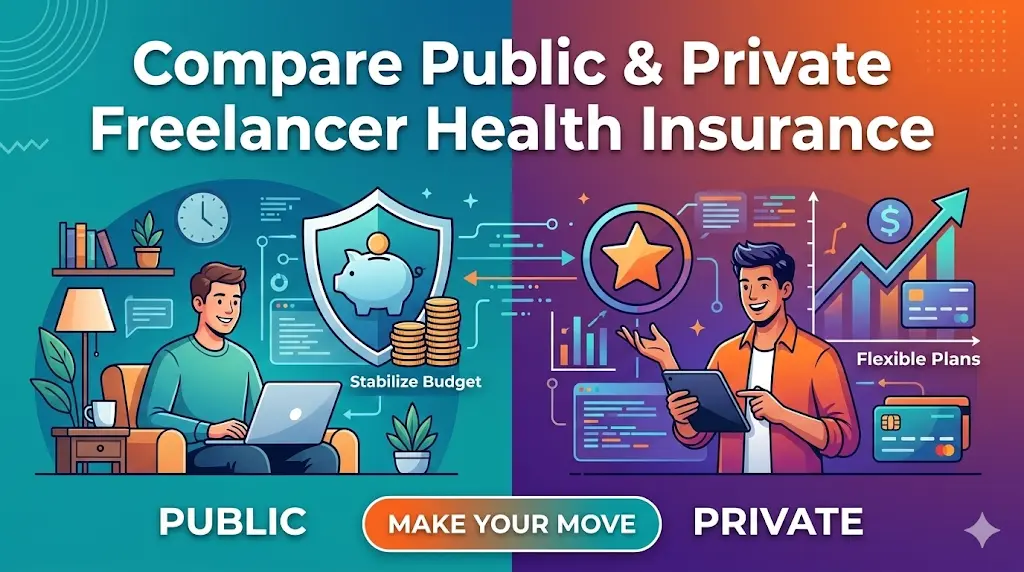
The German healthcare landscape is divided into two distinct, parallel systems: the Statutory Public Health Insurance (Gesetzliche Krankenversicherung or GKV) and the Private Health Insurance (Private Krankenversicherung or PKV). For a standard, salaried employee earning below a certain income threshold, the choice is made for them; they are mandatorily placed into the public system. However, freelancers (Freiberufler and Gewerbetreibende) enjoy a unique structural privilege: they are immediately exempt from the compulsory public insurance requirement from day one, regardless of how much or how little they earn.
This immediate freedom of choice is both a blessing and a terrifying financial trap for newly arrived expats. Choosing between the solidarity-based public system and the risk-based private system permanently alters your monthly cash flow, your tax deductions, and your long-term retirement planning. Because returning to the public system after switching to the private system is legally incredibly difficult (and often impossible after age 55), making an informed decision before signing a contract is paramount. To understand the foundational mechanics of these competing systems, review our core guide on Healthcare in Germany: A Comprehensive Guide for Expats.
Why Freelancers Face the Full Financial Burden
The most profound financial shock for expats transitioning from employment to self-employment is the sudden realization of the total cost of social security. In a traditional German employment contract, the heavy burden of health insurance—which hovers around 18% to 19% of your gross salary when factoring in long-term care—is split perfectly down the middle. The employee pays roughly 9%, and the employer legally matches that with another 9% out of their own corporate budget. This employer match is a massive, invisible subsidy.
When you become a freelancer, that invisible employer disappears. You are legally classified as both the employer and the employee. Therefore, you are forced to shoulder 100% of the health insurance premiums entirely on your own. If you choose the public system, you will be paying the full ~18% to 19% of your total business profit directly to the insurance provider. This devastating reality frequently catches expat founders off guard, leading to severe liquidity crises during their first year of operation.
To survive this massive overhead cost, meticulous cash-flow management is non-negotiable. Expat freelancers must treat a significant portion of every incoming invoice as money that belongs to the state and the health insurance fund. By utilizing modern digital banking platforms like N26, you can create dedicated “Spaces” or sub-accounts. Whenever a client pays you, you instantly drag the necessary percentage for health insurance and taxes into these hidden spaces, ensuring you never accidentally spend capital that you owe.
The KSK Künstlersozialkasse Exception
While standard freelancers face the brutal reality of paying 100% of their health insurance costs, the German government provides an extraordinary lifeline for a specific subset of the self-employed: artists, writers, musicians, and publicists. This lifeline is the Künstlersozialkasse (KSK), or the Artists’ Social Security Fund. The KSK is not an insurance provider itself; rather, it is a federal agency that subsidizes the social security contributions of recognized creative professionals.
If you qualify for admission into the KSK, the agency effectively acts as your “employer.” You pay 50% of your public health, long-term care, and statutory pension insurance premiums to the KSK, and the KSK contributes the other 50% using funds collected from a federal tax on corporate media and art consumers. For an expat graphic designer, freelance journalist, or independent musician, gaining entry into the KSK is a monumental financial victory that cuts their overhead costs completely in half.
However, the application process for the KSK is notoriously bureaucratic, slow, and demands extensive proof that your work is genuinely “artistic” or “publicistic” in nature, and that you derive your primary income from these activities in Germany. The review process can easily take six months. During this waiting period, you must secure your own insurance. If you operate a hybrid business model—such as a photographer who also earns significant revenue from non-artistic commercial e-commerce—the KSK may reject your application.
Public Health Insurance Gesetzliche Krankenversicherung for Freelancers
How Public Premiums are Calculated
If you opt to enter or remain in the Statutory Public Health Insurance (GKV) system as a freelancer, your monthly premium is calculated entirely based on your financial capacity, not your medical history. The public system operates on the principle of solidarity. For 2026, the baseline contribution rate is fixed at 14.6% of your gross profit. On top of this, every specific public provider (like TK, AOK, or Barmer) charges an additional supplemental rate (Zusatzbeitrag), which typically averages around 1.7% to 2.5%. Finally, you must add the mandatory long-term care insurance (Pflegeversicherung), which sits around 3.4% (or 4.0% for childless individuals over 23).
When combined, a freelancer in the public system will pay roughly 19.5% to 21% of their total business profit directly to health insurance. Because a freelancer’s income fluctuates wildly from month to month, the GKV cannot calculate a fixed monthly rate dynamically. Instead, they use the official income tax assessment (Steuerbescheid) from your previous fiscal year to estimate your current year’s premium. If you are a brand-new freelancer, they will base your initial premium on the profit estimate you submitted in your initial tax registration questionnaire.
This system creates a highly dangerous administrative trap: retroactive assessments. If you estimate your profit at €30,000 for the year, the GKV will charge you a modest monthly premium. However, if your business explodes and you actually earn €60,000, you will eventually file your tax return proving this higher income. The GKV will then legally demand a massive, retroactive back-payment for the premiums you “underpaid” throughout the year, while simultaneously doubling your current monthly premium. To navigate the broader implications of these official tax documents, see Understanding Taxes in Germany: An Expat’s Guide to the German Tax System.
Minimum and Maximum Income Thresholds
To protect the system and its participants, the German government establishes strict mathematical boundaries for public insurance premiums. These are the minimum assessment base (Mindestbemessungsgrundlage) and the income assessment ceiling (Beitragsbemessungsgrenze). For expats just launching their businesses with very little initial revenue, the minimum assessment base is a critical figure. The state assumes a minimum hypothetical income for all freelancers (roughly €1,178 per month in recent fiscal years), even if you actually earned zero euros that month. This means the absolute cheapest public insurance premium a standard freelancer can secure is generally around €220 to €250 per month.
On the opposite end of the spectrum is the income assessment ceiling. The public system does not penalize massive financial success infinitely. For 2026, the Beitragsbemessungsgrenze hovers around €62,100 to €66,000 annually (adjusted yearly). Once your freelance profit exceeds this hard ceiling, your public health insurance premium maxes out. Even if your business generates €200,000 in pure profit, you will only pay the percentage calculated up to the ceiling limit, which typically caps the maximum public premium at roughly €1,000 to €1,050 per month.
For highly successful expat freelancers, hitting this maximum cap often triggers the desire to explore private health insurance, as private premiums for young, healthy individuals are frequently significantly cheaper than the €1,000 maximum public rate. However, before jumping ship, one must deeply evaluate the broader systemic benefits of the public system, which we detail comprehensively in Public Health Insurance gesetzliche Krankenkasse: What It Covers and Costs.
Family Co-Insurance Benefits Familienversicherung
The single most powerful financial argument for a freelancer to remain in the public health insurance system is the concept of Familienversicherung (family co-insurance). In the German public system, health insurance covers the entire family unit based on a single premium. If you are a freelancer paying into the GKV, your non-working spouse and your dependent children are legally covered by your exact same policy at absolutely zero additional cost.
This solidarity principle is a massive financial shield for expat families settling in Germany. If you have a partner who is currently learning the language or staying home to raise three children, the entire family of five is fully medically insured for the price of your single, income-based premium. Furthermore, the public system does not charge you extra if you have pre-existing conditions, nor do they exclude coverage for chronic illnesses you developed prior to moving to Germany.
If you were to move that exact same family of five into the private insurance sector, the financial math changes violently. Private insurance operates on individual risk. You would be forced to purchase five completely separate, individual policies—one for you, one for your spouse, and one for each child. This would instantly obliterate any potential savings you might have secured by leaving the public system.
Private Health Insurance Private Krankenversicherung for Freelancers
Risk Based Premium Calculations
Private Health Insurance (Private Krankenversicherung or PKV) abandons the solidarity principle entirely in favor of a risk-based capitalist model. If you are a freelancer, you have the legal right to apply for PKV immediately. When you apply, the private insurance company does not care if your business profit is €30,000 or €300,000; your income is largely irrelevant to the premium calculation. Instead, the insurance underwriter evaluates your specific demographic and medical profile: your entry age, your biological sex, and your current health status.
Because the premium is based purely on risk, a healthy, 28-year-old expat freelancer with no pre-existing conditions can often secure comprehensive private coverage for €300 to €400 per month. If that same 28-year-old is a highly successful software developer earning €80,000 a year, the public system would charge them the maximum cap of over €1,000 a month. In this specific scenario, transitioning to the private system saves the young freelancer roughly €600 every single month in overhead costs.
However, this massive immediate discount requires passing rigorous medical underwriting. The private provider will demand a complete, highly detailed medical history spanning the last three to five years. If you have a chronic condition, a history of severe mental health treatment, or impending expensive surgeries, the PKV provider will either reject your application entirely, mandate massive risk surcharges (Risikozuschläge), or explicitly exclude those specific conditions from your coverage.
Customizing Your Coverage and Deductibles
Unlike the public system, which offers a standardized, legally mandated catalog of benefits to everyone, private health insurance allows you to meticulously customize your policy to fit your budget and lifestyle. You are essentially building an a la carte insurance contract. You can opt for VIP perks, such as the right to be treated exclusively by the chief physician (Chefarztbehandlung) in a hospital, guaranteed single-bed rooms, and comprehensive coverage for high-end dental implants and alternative medicine (Heilpraktiker).
To manipulate your monthly premium cost, private insurance relies heavily on deductibles (Selbstbeteiligung). You can agree to pay the first €500, €1,000, or even €2,000 of your medical bills out-of-pocket every year before the insurance company pays a single cent. By accepting a high deductible, your fixed monthly premium drops significantly. For healthy expats who rarely visit the doctor beyond annual checkups, taking a high deductible is a highly lucrative calculated risk.
Crucially, as a freelancer without an employer, you do not receive six weeks of paid sick leave. If you get injured and cannot work, your income drops to zero instantly. When building a private policy, you must actively purchase a sick pay rider (Krankentagegeldversicherung). This rider guarantees you a fixed daily payout (e.g., €100 per day) if you are medically incapacitated for an extended period, preventing total financial collapse.
The Aging Risk and Long Term Costs
The catastrophic danger of private health insurance for expats is the “aging trap.” While PKV is incredibly cheap when you are 30, medical inflation and your deteriorating biological health guarantee that your premiums will rise significantly as you age. By law, private insurers must set aside a portion of your early premiums into an aging reserve (Altersrückstellungen) to artificially suppress your premiums later in life. However, this buffer is rarely enough to offset the massive price hikes that occur in your 60s and 70s.
It is entirely common for a private premium that cost €400 a month at age 30 to skyrocket past €1,200 a month by age 65. If you are a retired freelancer living on a fixed, independent pension, a €1,200 mandatory monthly health insurance bill can push you into deep poverty. The German government is acutely aware of this trap, which is why they established incredibly strict laws preventing older citizens from fleeing back into the public system once they realize they can no longer afford private care.
Generally, once you turn 55, returning to the statutory public health insurance system is legally impossible, even if your freelance business goes bankrupt. You are permanently locked into the private sector. Therefore, choosing PKV is not a short-term hack to save cash in your 20s; it is a lifelong financial commitment. You must guarantee that your business will be successful enough to absorb these massive premium increases in the future.
| Feature | Public Insurance (GKV) | Private Insurance (PKV) |
| Premium Calculation | Based on total business profit (~19.5%). | Based on age, health status, and chosen perks. |
| Family Coverage | Spouses and kids included for free. | Each family member requires a separate paid policy. |
| Cost at High Income | Capped at the maximum assessment ceiling. | Unaffected by high income; remains fixed by risk. |
| Cost in Old Age | Drops significantly if your retirement income is low. | Increases heavily due to medical inflation and age. |
| Switching Back | Easy to switch to PKV at any time. | Nearly impossible to return to GKV after age 55. |
Budgeting Strategies and Administrative Management
Navigating Cash Flow and Premium Deductions
Managing the crushing weight of health insurance premiums requires strategic tax planning. Fortunately, the German government recognizes health insurance as a fundamental necessity. Whether you are paying €300 a month for a private policy or €900 a month for the maximum public rate, the vast majority of your health and long-term care insurance premiums are fully tax-deductible as “precautionary expenses” (Vorsorgeaufwendungen).
When you file your annual income tax return, these massive premium payments are deducted directly from your taxable business profit, significantly lowering your final income tax burden. This tax shield softens the blow of the high monthly costs. However, to benefit from this, your cash flow must be highly organized. Expats frequently manage their administration from coworking spaces or while traveling. Accessing your sensitive cloud-based accounting software and transmitting your tax data over unsecured public Wi-Fi networks exposes your business to catastrophic data breaches.
Securing your digital footprint is absolutely mandatory. By running a premium Virtual Private Network like NordVPN on your devices, you ensure that every connection to your business bank or the government tax portals is wrapped in military-grade encryption. This renders your highly sensitive financial data completely invisible to network snoops, ensuring your business operations remain secure and legally compliant.
Handling International Clients and Cross Border Fees
Freelancers who opt for expensive private health insurance must aggressively protect their profit margins to afford the rising premiums. Expats frequently leverage their global networks to secure high-paying clients in the United States, the UK, or their home countries. However, if an international client pays a massive invoice via a traditional SWIFT wire transfer into your standard German bank account, legacy banks will crush your revenue.
Traditional banks apply terrible hidden exchange rate markups and extract arbitrary correspondent fees, quietly shaving hundreds of euros off your profit before the money clears. To protect your global revenue and ensure you can afford your healthcare, utilizing agile, borderless financial infrastructure is paramount. By invoicing your international clients using a Wise business account, you provide them with local bank details in their native currency.
They pay via a cheap local transfer, and Wise converts the funds to Euros at the exact, real mid-market exchange rate with a tiny, transparent upfront fee. This infrastructure bypasses legacy banking extortion, guaranteeing that your international revenue remains intact.
Integrating Health Costs into Long Term Wealth
The ultimate rule of choosing Private Health Insurance as a freelancer in Germany is that you must rigorously invest the savings. If switching from public to private insurance saves you €500 a month in your 30s, you absolutely cannot use that €500 to lease a luxury car or upgrade your apartment. That surplus cash is an illusion; it is capital you are temporarily borrowing from your future self, as your private premiums will inevitably skyrocket in old age.
You must divert that €500 savings directly into the global capital markets to build a war chest that will fund your expensive healthcare during retirement. Because expats are highly mobile and may not remain in Germany forever, locking capital into rigid, localized German private pension products is often a strategic mistake due to a lack of cross-border portability.
Instead, international professionals overwhelmingly pivot toward utilizing sophisticated, low-cost global brokerages. By opening a dedicated investment account with Interactive Brokers, freelancers gain unparalleled, frictionless access to global stock exchanges. You can systematically deploy your monthly health insurance savings into diversified ETFs and global equities. Interactive Brokers offers extremely low execution fees and complete geographic portability, ensuring your wealth travels with you seamlessly.
Conclusion
Deciding between Public and Private Health Insurance as an expat freelancer in Germany is an irreversible choice that dictates your financial trajectory for decades. The public system (GKV) offers profound peace of mind, family co-insurance, and income-scaled premiums that protect you during lean years, but it imposes a brutal financial ceiling on highly successful founders. Conversely, the private system (PKV) provides immediate, massive cash-flow relief for young, healthy professionals and VIP medical perks, but it hides a devastating “aging trap” that requires fierce long-term financial discipline.
By meticulously segregating your taxes and premiums using digital banks like N26, protecting your cross-border profit margins with Wise, securing your administrative data with NordVPN, and aggressively investing your private insurance savings through Interactive Brokers, you can build a sustainable, highly lucrative freelance career in Germany without sacrificing your medical security or your future retirement.
References
Primary sources (official)
- Federal Ministry of Health (BMG): The supreme federal authority providing comprehensive English-language documentation on the structure of the dual healthcare system, mandatory insurance laws (Krankenversicherungspflicht), and statutory contribution ceilings. https://www.bundesgesundheitsministerium.de/en/en/health-system
- Künstlersozialkasse (KSK): The official federal agency portal detailing the application process, artistic eligibility requirements, and subsidized contribution structures for creative freelance professionals. https://www.kuenstlersozialkasse.de/
Other helpful sources
- GKV-Spitzenverband: The central association of statutory health insurance funds, providing updated, granular data on minimum assessment bases, maximum income ceilings (Beitragsbemessungsgrenze), and supplemental rates. https://www.gkv-spitzenverband.de/english/english.jsp
- Verband der Privaten Krankenversicherung (PKV): The official association of German private healthcare providers, offering industry-standard definitions on aging reserves (Altersrückstellungen), sick pay riders, and risk assessments. https://www.pkv.de/
Disclaimer
The information provided in this article is for general informational and educational purposes only and does not constitute professional financial, medical, or legal advice. German health insurance laws, the strict regulatory inability to switch from PKV back to GKV after age 55, and the specific eligibility requirements for the Künstlersozialkasse are highly complex and subject to continuous legislative updates. Attempting to navigate medical underwriting or retroactive public premium assessments without localized expertise carries severe lifelong financial risks. Always consult directly with a certified independent insurance broker (Versicherungsmakler), a tax advisor (Steuerberater), or the specific health insurance funds regarding your unique medical history, freelance business model, and long-term residency plans in Germany.